If you’re deciding between self-storage and RV storage as an investment, here’s the key takeaway: both options can deliver solid returns, but they cater to different strategies and risk profiles.
- Self-Storage: A mature, $44.33 billion industry with steady demand driven by life events like moving or downsizing. It offers consistent returns, averaging 16.85% annually over 25 years, and benefits from additional revenue streams like tenant insurance and late fees. However, urban markets face oversupply risks, and construction costs for climate-controlled units can be high.
- RV Storage: A smaller but growing $2.6 billion market expected to reach $6 billion by 2032. It requires larger land parcels but has lower construction and operating costs. With fewer than 2,000 dedicated facilities nationwide, demand far exceeds supply, offering opportunities in underserved areas. Tenants are highly reliable, with delinquency rates under 1%.
Quick Comparison
| Factor | Self-Storage | RV Storage |
|---|---|---|
| Market Size | $44.33 billion | $2.6 billion, growing to $6 billion by 2032 |
| Annual Return | 16.85% 25-year average | Strong potential, benchmarks maturing |
| Tenant Behavior | 13 to 15 month stays, 30% over 2 years | Long-term, low turnover, low delinquency |
| Construction Costs | $50 to $250+/sq. ft. | $30 to $150+/sq. ft., depending on open parking vs. Class A covered/enclosed |
| Land Requirements | 2 to 10+ acres | 7 to 10+ acres |
| Revenue Streams | Late fees, insurance, retail | Dump stations, wash bays, solar income |
| Occupancy | 85% to 92% | High; demand exceeds supply in many markets |
| Zoning Challenges | Moderate | Higher due to land and size needs |
Both asset classes offer flexibility with month-to-month leases and appeal to different investor goals. Self-storage is ideal for those seeking proven stability and scalability, while RV storage suits those targeting underserved markets with reliable tenants. Choose based on your financial goals, market conditions, and risk tolerance.
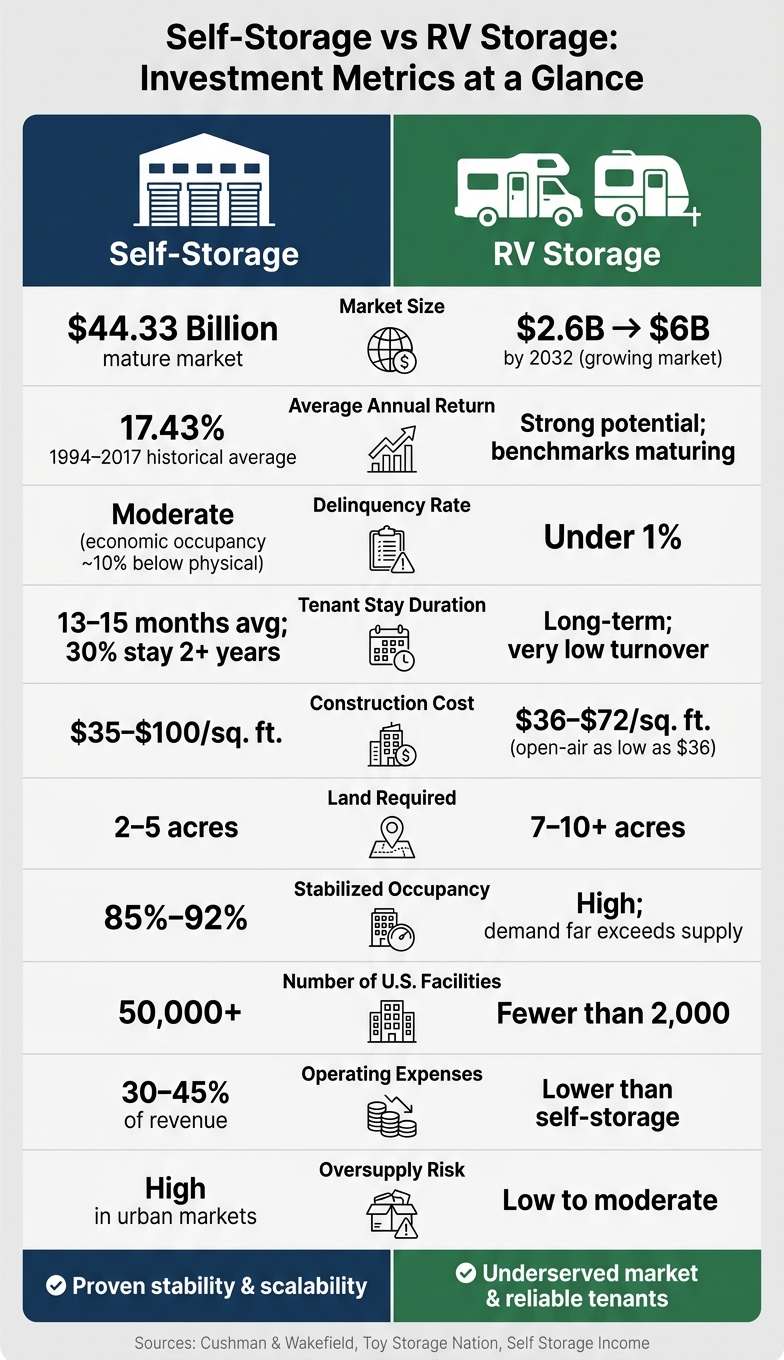
Self-Storage vs RV Storage: Key Investment Metrics Compared
Boat & RV Storage MARKET vs. Self-Storage #realestateinvesting
sbb-itb-09b4138
Market Demand and Tenant Behavior
Self-storage demand often stems from major life changes. :
"Self-storage demand is generally driven by life events that disrupt household living situations, often referred to as the ‘Four Ds – death, divorce, downsizing, and displacement.’"
This connection to life events helps the self-storage market remain steady, even during tough economic times. For instance, during the 2008 financial crisis, self-storage REITs delivered a 5% positive return, while many other real estate sectors saw heavy losses. A key reason for this resilience? Storage costs make up only a small portion of most tenants’ monthly expenses.
RV storage, on the other hand, is shaped by lifestyle preferences and regulatory restrictions. With fewer than 14% of HOAs allowing RV or boat parking on residential properties, many owners need off-site storage solutions. There’s also a shift in the demographic of RV owners: the median age has dropped to 49, and 22% of owners are now between 18 and 34. This younger generation’s enthusiasm for RVs points to a growing demand for storage options.
Tenant behavior highlights further differences between these two markets. Self-storage tenants typically rent units for 13–15 months, with roughly 30% staying beyond two years . In contrast, RV and boat storage tenants tend to hold onto their spaces much longer. Since they’re protecting high-value assets – ranging from $50,000 to over $500,000 – defaults or cancellations are rare . Additionally, RV owners are generally willing to travel farther for quality storage, often driving 20–50 miles, compared to the 3–5 mile radius most self-storage customers prefer. These patterns contribute to steady, long-term returns in RV storage.
The supply landscape also sets these markets apart. The U.S. has over 50,000 self-storage facilities , but some fast-growing cities like Atlanta and Orlando are already grappling with oversupply. In contrast, there are fewer than 2,000 dedicated RV storage facilities nationwide, despite nearly 25 million U.S. households owning a boat or RV. Current supply meets only about 20% of the estimated demand :
"When you look at the number of RVs and boats being shipped and the number of storage spaces being developed, we are far underserved."
Recognizing these supply challenges is crucial for evaluating potential investment opportunities.
Cost Structure and Development Economics
When you shift the lens from tenant habits to the economics of development, the cost challenges for self-storage and RV storage become quite distinct. A big factor is land cost, which varies widely between the two. Self-storage typically needs 2–5 acres in urban areas where demand is high, while RV storage requires much larger plots – 7–10+ acres – but can save on expenses by situating on the outskirts of metro areas. Land acquisition for RV storage often stays below $200,000–$300,000 per acre.
Construction costs also set these two storage types apart. For RV storage, costs depend on the type of structure: open canopies start at about $36/sq. ft., fully enclosed units begin at $56/sq. ft., and premium facilities can exceed $72/sq. ft:
"Boat/RV facilities require much less [steel], meaning they cost roughly half as much to build."
This lower construction cost often makes RV storage attractive to developers, even though it requires more land. A common approach is to mix unit types – 50% open-air, 30–40% canopy-covered, and 10–20% enclosed – balancing cost efficiency with market demand .
Operating costs also highlight differences. For self-storage, expenses generally consume 30–45% of revenue, driven by payroll, utilities, and maintenance for enclosed building. RV storage, on the other hand, benefits from lower upkeep costs. Open-air facilities don’t need HVAC systems and require minimal cleaning between tenants. Both types of storage are increasingly adopting automation technologies like smart locks, kiosks, and cloud-based management tools to cut payroll expenses even further. These cost differences directly shape profitability and investment outcomes.
Here’s a side-by-side comparison of key metrics:
| Metric | Self-Storage | RV/Boat Storage |
|---|---|---|
| Typical Land Size | 2 to 10+ acres | 7 to 10+ acres |
| Drive Lane Width | 20 to 30 ft | 45 to 60 ft |
| Construction Cost | $50 to $250+/sq. ft. | $30 to $150+/sq. ft. |
| Operating Expenses | 30% to 45% of revenue | Generally lower, depending on format and amenities |
| Stabilization Timeline | 18 to 36 months | 18 to 36 months |
| Zoning | Commercial/Suburban | Industrial-park zones or other approved uses |
Zoning, however, is a recurring hurdle for RV storage development. Many municipalities see large open parking lots as eyesores, often requiring developers to add screening or enclosed structures to gain approval. To navigate these challenges, experienced developers typically allocate 8–12% of hard costs for contingencies and account for potential delays in the zoning process. These risks are crucial to consider when projecting returns.
Ultimately, these cost dynamics play a major role in shaping revenue potential and overall investment performance, which will be explored in the next section.
Revenue, Cash Flow, and Return Profiles
Revenue generation is a key area where self-storage and RV storage facilities diverge, each offering unique income opportunities. While both rely on rental income, their additional revenue streams and rent structures set them apart.
Self-storage facilities bring in extra income through various channels. Beyond the basic unit rents, they collect late fees (typically $20–$50 per incident), tenant insurance fees ($10–$15/month), retail sales, and commissions from truck rentals, which together contribute an additional 2%–4% to gross revenue. On the other hand, RV storage facilities capitalize on high-value services like dump stations, wash bays, electrical hookups, propane sales, and even solar energy generation. A standout example is Oakley Executive Boat & RV Storage in Oakley, CA, where solar-integrated canopies generate over $695,000 annually in income besides rental fees.
The rent structures also differ significantly. Self-storage rents range from $40–$80/month for a small 5×5 unit to $180–$350/month for a larger 10×30 unit, with climate-controlled units commanding a 25%–50% premium. RV storage rents vary based on the type of space, from $27–$120/month for uncovered outdoor spots to $150–$433+/month for fully enclosed indoor units. Both asset types operate on month-to-month leases, allowing operators to adjust rents quickly in response to market trends.
When it comes to returns, self-storage has a proven track record, delivering an average annual return of 17.43% between 1994 and 2017, outperforming most other real estate asset classes. For instance, one investor purchased a 50,000-square-foot "mom-and-pop" facility for $2.5 million, invested $800,000 in upgrades, and – after adjusting rents that were 50% below market – achieved over $50,000 in monthly gross revenue and approximately $250,000 in annual net income. This translated to a 10% cash-on-cash return. As Self Storage Income highlights:
"When gross revenue doubles, net operating income can triple or quadruple, thanks to fixed operating expenses."
RV storage, while newer and lacking extensive historical benchmarks, presents strong fundamentals. Delinquency rates are impressively low – under 1% – as tenants aim to protect their high-value assets. Turnover costs are minimal, often limited to sweeping and pest control. Additionally, institutional capital is increasingly flowing into this sector, compressing cap rates and signaling growing investor confidence.
Here’s a quick comparison of key metrics:
| Metric | Self-Storage | RV & Boat Storage |
|---|---|---|
| Typical Monthly Rent Range | $25 to $350/unit | $27 to $433+/space |
| Stabilized Occupancy | 85% to 92% | High; supply often lags demand |
| Expense Ratio | 30% to 45% of revenue | Lower than self-storage in many open-air formats |
| Delinquency Rate | Varies; economic occupancy often around 5% below physical occupancy | Often low due to high-value assets |
| Cap Rates | 5.0% to 10.0% depending on class | Compressing due to institutional interest |
| Avg. Annual Historical Return | 16.85% 25-year average | Growing; benchmarks still maturing |
Self-storage stands out for its established return history and multiple revenue streams. Meanwhile, RV storage shines with its low delinquency rates, minimal turnover costs, and potential for high ancillary income, especially in premium Class A facilities with top-tier amenities.
Pros and Cons
This section breaks down the main benefits and challenges of investing in self-storage and RV storage. The comparison below highlights how these factors shape investment decisions and outcomes.
Self-storage has been around for a long time and is considered a stable asset class. One of its biggest strengths is its ability to weather economic downturns, thanks to demand drivers often referred to as the "4 Ds": death, divorce, dislocation, and downsizing. It’s also operationally efficient – cloud-based software allows a single part-time manager (or no on-site staff at all) to oversee 200–400 units. On the downside, the market is highly competitive, dominated by large real estate investment trusts (REITs). This creates challenges like oversupply risks in big cities and steep construction costs for climate-controlled units.
On the other hand, RV storage is still in the early stages of growth. According to Troy Bix, Founder of Toy Storage Nation:
"All data indicates that RV and boat storage is where self-storage was 25 to 30 years ago."
Construction costs for standard canopy structures start at about $36 per square foot, but viable developments often require 7–10 acres of land with 45-foot-wide drive lanes. These land and zoning requirements can make development more complex.
Here’s a side-by-side comparison of key factors:
| Factor | Self-Storage | RV & Boat Storage |
|---|---|---|
| Market Maturity | Established; intense competition from REITs | Growing; mostly smaller operators |
| Recession Resistance | Very high, driven by the "4 Ds" | High, as owners protect valuable assets |
| Oversupply Risk | High, especially in some urban areas | Low to moderate due to zoning and land constraints |
| Construction Cost | $50 to $250+/sq. ft. depending on product type | $30 to $150+/sq. ft. depending on open parking vs. Class A covered/enclosed |
| Land Requirements | 2 to 10+ acres | 7 to 10+ acres with wide drive lanes |
| Delinquency Risk | Moderate; occasional unit turnover | Very low in many markets |
| Scalability | High; operations can be highly automated | Moderate; expansion depends on land availability |
| Maintenance | Includes doors, roofs, and HVAC systems | Focuses on pavement, dump stations, and wash bays |
These comparisons emphasize the importance of matching your investment strategy to your financial goals and risk tolerance. Both asset classes offer distinct opportunities and challenges, requiring careful consideration before diving in.
Conclusion
Both self-storage and RV storage offer promising returns, but they cater to different types of investors. Self-storage boasts a proven track record, with average annual returns of 17.43% between 1994 and 2017. It also offers scalability and steady demand, even during economic downturns. On the other hand, RV storage is still gaining momentum, with the global market expected to grow from $2.6 billion in 2024 to nearly $6 billion by 2032. It also benefits from low delinquency rates and limited competition.
Choosing the right investment depends on your goals. If you have the capital and want a business with a history of success and potential for automation, self-storage is a strong choice. Acquiring undervalued facilities can lead to significant equity gains. However, if you prefer a lower-risk option with tenants who are highly reliable, RV storage is worth considering – especially in locations near travel hubs, national parks, or areas with strict HOA rules against oversized vehicle parking.
"Delinquency rates are among the lowest in the storage sector – often under 1% – as tenants are typically storing high-value vehicles and prioritize keeping payments current." – Oakside
This reliability highlights the long-term income potential of RV storage. As discussed earlier, both asset types have unique strengths. Self-storage has shown an ability to outpace inflation, with NOI exceeding inflation by 190 basis points since 2008. Meanwhile, RV storage benefits from minimal competition and a growing market. Both options allow for operational flexibility, such as month-to-month leases and locking in long-term fixed-rate financing to stabilize properties over time.
Neither asset class is inherently better than the other. Self-storage excels in historical performance and scalability, while RV storage shines in tenant reliability and market timing. The key is to align your choice with your financial objectives, local market conditions, and risk tolerance. Each path has distinct advantages – choose the one that best fits your strategy.
FAQs
How do I choose the best market for RV storage?
Selecting the right location for RV storage can make or break your business. Focus on areas near popular recreational spots, busy RV travel routes, or regions with a high concentration of RV owners – these tend to have strong demand.
Equally important is scoping out the competition. Look for places where existing storage options are limited, as this creates an opportunity to fill a gap in the market. Accessibility matters too – customers are more likely to choose a facility that’s easy to reach.
Don’t skip the research phase. Dive into local market data to understand demand trends, the competitive landscape, and what potential customers are looking for. A location with plenty of demand but minimal competition gives you a solid foundation for success.
What are the biggest zoning risks for RV storage projects?
When it comes to RV storage projects, one of the biggest hurdles is navigating land use restrictions and zoning regulations. Many areas have rules that either limit or outright prohibit RV storage facilities, making it tricky to get the green light for your project.
To avoid running into expensive setbacks, it’s crucial to dive into local zoning laws early in the planning process. Understanding these regulations upfront can save you time, money, and frustration down the road.
How can I increase cash flow in a self-storage facility?
To improve cash flow in a self-storage facility, focus on three main areas: increasing occupancy, adjusting rental rates strategically, and keeping expenses under control. Higher occupancy not only provides a steady income stream but also helps distribute fixed costs more effectively. Meanwhile, using dynamic pricing strategies or offering upgraded units can bring in more revenue per tenant.
On the expense side, look for ways to manage costs like utilities, staffing, and maintenance without compromising service quality. You might also explore targeted marketing campaigns or special promotions to attract new tenants and fill vacant units. Regularly reviewing your operational expenses ensures you’re running efficiently and keeping your net income as high as possible.