If you time promotions by unit type and occupancy level, you can fill more spaces without cutting rates across the board by using proven pricing strategies.
I’d boil the article down to this:
- Turn promos on by unit class, not just total site occupancy
- Use 85% occupancy as a starting trigger, get more aggressive below 80%, and pull promos back around 90%–95%
- Match the offer to the season:
- Fall/winter: longer stays and prepaid deals
- Spring/summer: refill move-outs and hold returning tenants
- Slow months like January, February, and late August: short entry offers
- Watch physical occupancy and economic occupancy together so filled spaces do not lead to weak rent collection
- Protect pricing with minimum stays, no stacking, new-customer-only terms, and clear dates like 11/01/2026 to 12/31/2026
This piece shows that boat and RV storage has a sharp seasonal pattern. A vacant 40-foot RV space can hit revenue harder than a small self-storage unit, so promo timing matters. I also see a clear theme throughout: do not run blanket discounts. Short, targeted offers tend to work better, especially when they fit the space type, the season, and the local demand window.
A few takeaways stand out:
- Open storage often responds to small move-in offers
- Covered spaces may need moderate incentives
- Enclosed units can support stronger deals, but only with a clear return to full rent
- A space-hold fee of 25% to 40% of monthly rent can help keep summer revenue from dropping to $0 when tenants take vehicles out
- In many cases, bundled services can protect base rent better than a plain discount
Quick comparison
| Period | Main problem | Best promo focus | Common offer style |
|---|---|---|---|
| Fall/Winter | Need longer occupancy | Prepay and retention | 4- to 7-month deal, final month free, rate lock |
| Spring | Move-outs | Space retention and upgrades | Hold fee, upgrade promo |
| Summer | Slower leasing in some markets | Refill vacancies | Event-tied limited offer |
| January/February/Late August | Soft demand | Low-friction move-ins | First month for $1, second month free, fee waiver |
For me, the core idea is simple: use promotions like a pricing tool, not a default discount. That means setting rules in advance, tracking results by unit type, and ending offers once occupancy recovers.
sbb-itb-09b4138
Using seasonal promotions as a revenue-management tool
A seasonal promotion works when it solves a clear, measurable gap: a dip in occupancy, a slow-moving unit class, and a set end date. That matters even more in boat and RV storage, where demand shifts by season and by unit type. So the job isn’t just to run an offer. It’s to control what starts it, which units it applies to, and when it stops.
When to trigger promotions based on occupancy and unit mix
The simplest way to handle this is to set trigger bands by unit class, not by total property occupancy. A good starting point is to turn on a promotion when a unit category drops below 85% physical occupancy, make the offer stronger below 80%, and stop discounting once that class returns to a steady 90%–95% range.
That threshold is only part of the story. Unit type matters just as much.
- Open outdoor spaces tend to be the most price-sensitive and the fastest to lease, so short intro offers or a small first-month discount often do the job.
- Covered storage usually responds best to moderate incentives, since renters are weighing weather protection, convenience, and price.
- Enclosed units carry the highest rent and often lease more slowly, so they can support stronger incentives when the goal is to move premium inventory. Even then, the offer should show a clear path back to standard pricing.
This is where operators can get tripped up. A property may look healthy on paper, but one unit class can still lag behind. Overall occupancy can hide weak spots. That’s why managing by unit mix, not just total occupancy, matters so much.
Which promotion types fit which occupancy goals
The table below shows the four promotion structures that fit boat and RV storage best, along with where each one makes the most sense.
| Promotion Type | Primary Goal | Best Season | Typical Structure | Revenue Impact |
|---|---|---|---|---|
| Introductory offer (e.g., first month discounted) | Generate quick move-ins during slow leasing periods | Off-peak or shoulder season | First-month discount or fixed-dollar move-in credit | Short-term dip, with potential recovery as full rent begins |
| Prepaid multi-month discount | Lock in longer tenure and reduce turnover | Fall and winter | One free month on a longer prepay or a modest annual-commitment discount | Neutral to positive if retention holds |
| Referral incentive | Generate low-cost lead flow through owner communities | Spring and year-round | Credit for a qualified referral | Minimal impact; can improve lease velocity |
| Seasonal package | Align demand with predictable storage cycles | Spring and fall | Bundled offer tied to a defined storage window | Positive if it fills otherwise vacant months |
Across all four, the point is the same: improve net revenue per occupied unit, not just physical occupancy. A heavily discounted unit may look full, but after concessions and holding costs, it can bring in less money than an empty space. Once the trigger and offer type are clear, the next move is to line that promotion up with the season.
How Oakside Co supports promotion strategy with asset-level analysis
For portfolio owners, promotion choices should reflect asset value and local demand. Oakside Co supports promotion strategy through data-driven underwriting, monthly occupancy modeling, and investment-banking-level analysis tailored to self-storage and boat and RV assets. That asset-level view helps owners match each promotion to the right property, unit mix, and demand cycle. In plain terms, it turns promotion planning into a repeatable operating rule.
As Nolen Masserman of Oakside puts it:
"Seasonal promotions are most effective when they are treated as a revenue-management lever, not a blanket discount; the right offer, for the right unit type, at the right time can protect rate integrity while improving occupancy."
- Nolen Masserman – Managing Director at Oakside
From here, the seasonal playbooks show how to apply those rules in fall, winter, spring, and summer.
Seasonal promotion playbooks for peak, shoulder, and off-peak periods
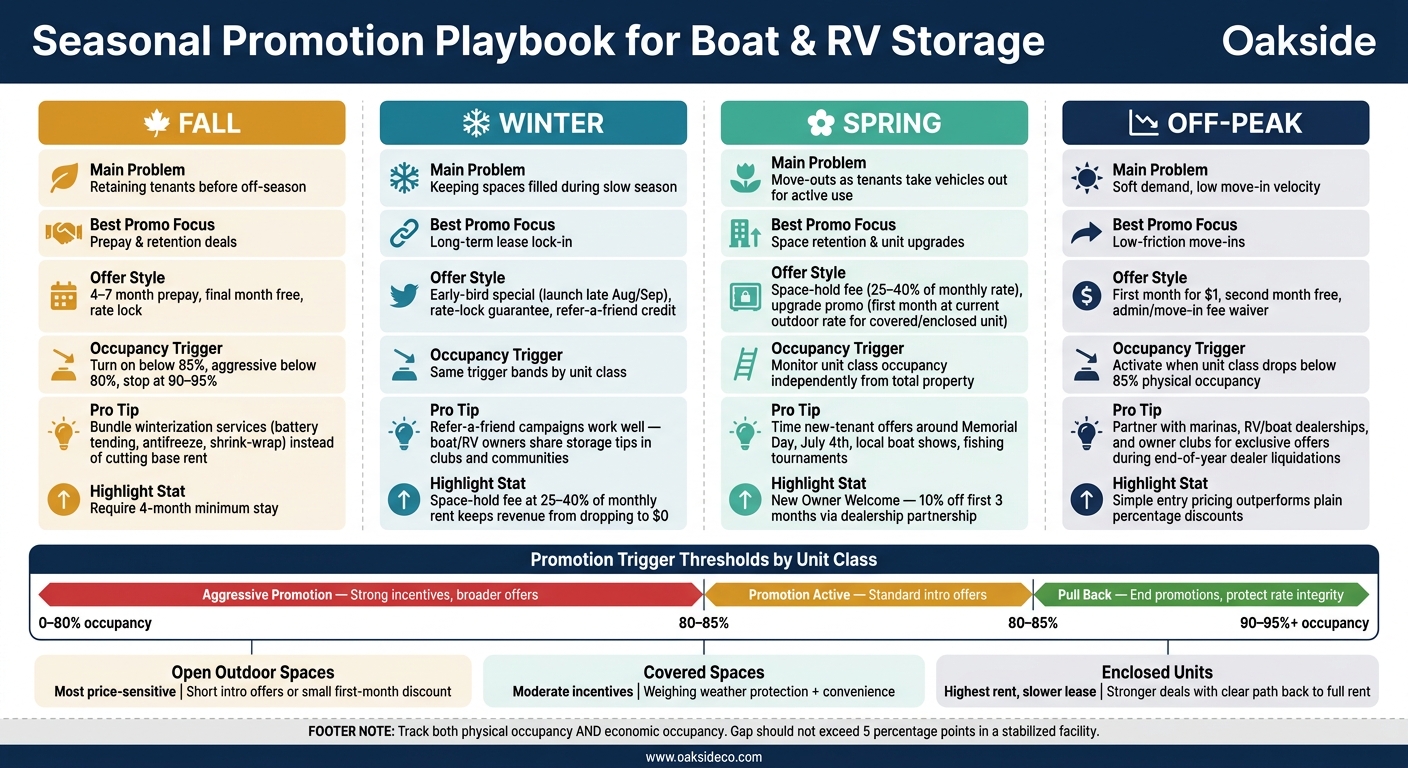
Seasonal Promotion Playbook for Boat & RV Storage Facilities
Each season brings a different vacancy issue, so the offer should match the gap in leasing demand. In fall and winter, the goal is keeping tenants longer. In spring, the focus shifts to moving current tenants into better unit types. During slower months, short-term offers can help fill lagging space.
Fall and winter promotions that lock in longer occupancy
Fall and winter promotions should focus on retention. A winter prepay offer, usually for 5 to 7 months, does that well. Operators can set it up as a fixed seasonal price or offer the final month free. Either way, the pitch is simple: commit now, save money, and avoid going month-to-month.
One smart way to protect street rates is to bundle services instead of cutting rent. For example, a local mobile mechanic could provide winterization services like battery tending, antifreeze treatment, or shrink-wrapping. That keeps the base rate where it is while still making the lease feel like a better buy. The tenant gets something useful, and the operator avoids training the market to expect lower rent.
An early-bird winter special launched in late August or September can pull in planners before they sign elsewhere. Add a rate-lock guarantee – no increases during the winter stay – and a common objection disappears. To keep the deal tied to longer occupancy, require a 4-month minimum.
| Metric | Month-to-Month (Winter) | 4- to 7-Month Seasonal Contract |
|---|---|---|
| Revenue Certainty | Higher per month, but high risk of mid-winter vacancy | Slightly lower effective rate, but guaranteed for the full period |
| Predictability | Low; tenants may leave as soon as the weather breaks | High; revenue is locked in for the duration of the off-season |
| Spring Re-rent Potential | Moderate; requires active re-selling in spring | High; the tenant is already on-site for the start of the spring season |
| Operational Effort | High (frequent move-ins/move-outs, monthly billing) | Low (single contract or one-time prepayment) |
Fall is also a strong time for refer-a-friend campaigns. Boat and RV owners often talk about winter storage with friends, clubs, and other owners, so word-of-mouth tends to travel fast. A small one-time rent credit for a qualified referral can bring in low-cost leads without changing the base rate.
Spring calls for a different playbook because the main issue is not new demand. It’s move-outs.
Spring and summer promotions that reduce move-out-driven vacancy
Spring and summer promotions should help refill move-outs fast. Customers take their boats and RVs out for active use, and a property that looked full in February can have empty spaces by May.
A space-hold fee is a practical tool for this. Instead of losing the tenant fully when they take the vehicle out for the season, offer a hold option at 25% to 40% of the standard monthly rate. That fee keeps their spot reserved for return, keeps some revenue coming in, and cuts down on re-leasing work in the fall.
For new tenants, time promotions around local boating events and holiday demand. A limited-time offer tied to Memorial Day weekend, July 4th, a local boat show, or regional fishing tournaments can catch buyers right after they purchase a vehicle and need storage on the spot. A "New Owner Welcome" discount, such as 10% off the first three months through a local dealership, puts the facility in front of that buyer at exactly the right moment.
Spring is also a good time to upgrade existing outdoor tenants into covered or enclosed units that became available over winter. A "first month at your current outdoor rate" offer gives tenants an easy reason to move up. That can improve revenue per occupied unit without having to lease the space from zero.
Outside the main seasonal rush, keep offers short, narrow, and tied to the unit class that’s falling behind.
Holiday and off-peak offers for slower leasing periods
January, February, and late August are often the slowest leasing windows for boat and RV storage facilities. Offers during these periods should drive move-ins without creating rate issues that stick around too long.
For the offer itself, simple entry pricing usually works better than a plain percentage discount. A "second month free" or "first month for $1" special lowers the barrier to get started while keeping the long-term monthly rate at the standard market level. Waiving the move-in or administrative fee during holiday periods is another low-cost option that feels like a win for the customer without cutting recurring revenue.
Partner channels can also help during slow weeks. Marinas, RV and boat dealerships, and owner clubs can distribute exclusive move-in offers when demand is soft. This works especially well during end-of-year dealer liquidations, when buyers are already motivated and often need storage right away.
Operational guardrails: data, terms, and performance tracking
Without tracking results, an occupancy bump can turn into a revenue hit. A promo only does its job when operators measure what happens and set the rules before launch. Start with the numbers that show whether the offer is filling units without cutting too deeply into rent.
The metrics that show whether a promotion is working
Track two core metrics: physical occupancy and economic occupancy. Physical occupancy shows how many units are rented. Economic occupancy shows how much of your potential rent you’re actually collecting.
In a stabilized facility, economic occupancy should usually trail physical occupancy by no more than 5 points. If that gap starts to widen, the promotion may be filling space while eating into income.
Don’t stop at the property level. Track results by unit class too. A site can look fine on the surface while one unit type is quietly underperforming.
A few other numbers matter here:
- Move-ins by campaign, using promo codes or lead-source fields
- Average length of stay
- Renewal rate
- Net revenue by unit type
These metrics help show whether a promo is bringing in steady tenants or short-term discount shoppers. Review them monthly, then roll them up quarterly so you can spot seasonal changes early.
Once the data shows a real problem, the next move is tightening the offer terms.
Promotion terms that protect rate integrity and reduce disputes
Treat every promotion as a time-bound offer, not a permanent rate cut. That sounds simple, but it saves a lot of headaches later.
Four terms do most of the heavy lifting:
- New-customer-only terms help stop current tenants from asking for retroactive discounts.
- Minimum stay requirements – often 2–3 months or longer – give the facility time to recover acquisition and admin costs.
- A no-stacking rule, stated plainly as "Promotions may not be combined with other offers", stops people from piling discounts on top of each other.
- Clear start and end dates in mm/dd/yyyy format – for example, 11/01/2026 to 12/31/2026 – cut down on confusion and disputes.
Fee disclosures matter just as much as the headline deal. If a promo comes with admin fees, lock fees, required insurance premiums, or refundable deposits, those amounts should appear in U.S. dollars in the lease addendum, reservation confirmation, and website offer page.
If the advertised offer says one thing and the move-in process says another, complaints tend to show up fast. So do bad reviews.
That setup also makes it much easier to use the same playbook across more than one property.
How portfolio owners can standardize promotion playbooks across multiple assets
A portfolio playbook works best when it separates fixed rules from local triggers.
The fixed layer should cover discount caps, eligible promotion types, the no-stacking rule, minimum stay requirements, and the promo-code naming convention used across all property management systems. The local layer gives each site room to adjust for its own peak and off-peak calendar, unit mix, and occupancy thresholds.
Use the same occupancy thresholds described above to trigger offers across assets. That keeps the system consistent instead of leaving each site to improvise.
Centralized monthly reporting is what makes the whole thing hold together. Track physical occupancy, economic occupancy, promo-driven move-ins, and net revenue by unit type across all assets. That gives portfolio owners a clean way to compare promo performance from site to site and retire offers that aren’t moving the right metrics.
Centralized reporting also keeps promotion decisions aligned across the portfolio.
Conclusion: Turning seasonal demand swings into steadier occupancy
Seasonal promotions work because they help smooth out predictable occupancy swings. In boat and RV storage, seasonality is normal. The bigger issue is volatility that isn’t managed.
In practical terms, operators should line up fall, winter, spring, and summer offers with the exact vacancy problem each season creates. That means targeted offers, not blanket discounts, with a clear seasonal purpose.
That approach only pays off if you measure the right results. Use unit-level occupancy triggers, and track both physical occupancy and economic occupancy to make sure the promotion lifted revenue, not just fill rate.
Over time, the payoff shows up in more than occupancy alone. Steadier occupancy and higher effective rates can cut churn and strengthen NOI. Steadier occupancy and stronger effective rates can also help with refinancing and sale readiness.
"Our team blends investment-banking-level analysis with real operator expertise, delivering strategies that are deeply informed, data-driven, and aligned with each client’s unique objectives." – Nolen Masserman, Managing Director at Oakside
Oakside Co provides the data and analysis owners need to fine-tune promotion timing and pricing. It also helps owners use that data to price promotions with more precision.
FAQs
How do I choose the right promo by unit type?
Use a data-driven approach built around occupancy by unit type, like covered RV spaces, uncovered lots, and enclosed warehouses.
If a unit type is above 90% occupancy, think about raising rates instead of offering discounts. If it drops below 85%, run short-term, targeted promotions. Nolen Masserman, Managing Director at Oakside, recommends looking at historical rent data, local trade area analysis, and unit-specific performance.
What if physical occupancy rises but revenue drops?
This often points to static pricing, heavy discounting, or too many delinquent accounts. Your facility may look full, but you may not be getting the full market value from your space.
Focus on economic occupancy – the rent you actually collect – not just physical occupancy. Cut back on deep concessions, use structured rate increases for long-term tenants, and tighten collections so income lines up more closely with capacity.
How long should a seasonal promotion run?
A seasonal promotion should follow your facility’s occupancy thresholds and demand cycles, not a fixed calendar. Put promos in play when occupancy drops below 85%, then adjust them based on what the numbers show in real time.
As Nolen Masserman, Managing Director at Oakside, notes, operators should pull back promotions as occupancy gets close to 90% or higher. That helps protect street rates and long-term net operating income.