If I had to boil this study down to one point, it’s this: climate control still supports the clearest rent premium, while security, lighting, and digital access now mostly help protect occupancy. For owners, the better question is not “Does this amenity look good?” but “Does it lift rent, support lease-up, hold tenants, or add fee income?”
Here’s the short version:
- Climate-controlled units still stand out because renters often pay more for them.
- Cameras, gated access, lighting, and online tools still matter, but many renters now expect them.
- Tenant insurance and simple add-ons can add high-margin fee income.
- Service-heavy extras can bring in revenue, but they also bring more staff work.
- RV and boat storage still lacks enough recent data for a clear amenity ranking.
Quick Comparison
| Area | What stands out | Main effect |
|---|---|---|
| Self-storage pricing | Climate control | Higher rents and strong demand |
| Self-storage leasing | Security, lighting, digital access | Better occupancy and retention |
| Fee income | Tenant insurance, smart bundles, premium unit types | Added NOI with lower friction |
| RV/boat storage | Compare investment returns | No firm ranking yet |
I see the study as a simple filter for capex and pricing decisions: pay for features that move rent or fee income, and be careful with upgrades that mostly add cost.
sbb-itb-09b4138
Core Amenity Trends in Self-Storage
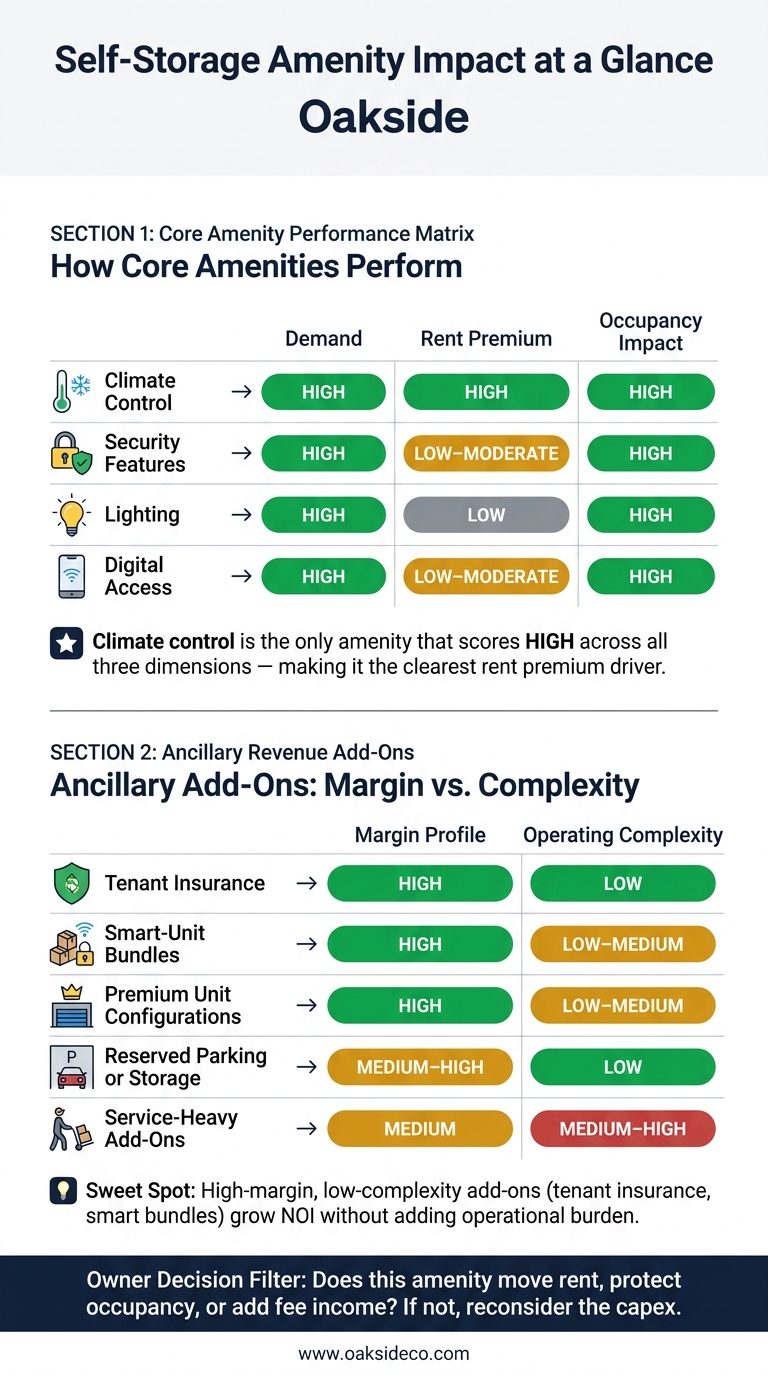
Self-Storage Amenity Impact: Rent Premium vs. Occupancy vs. Ancillary Revenue
In self-storage, climate control is still the clearest premium driver. It’s the feature most likely to support higher rents in a direct way.
By contrast, security, lighting, and digital access now work more like baseline expectations. They still matter a lot. They help operators win move-ins, keep tenants longer, and avoid losing renters to nearby sites. But they tend to support occupancy and retention more than rent growth.
The sections below separate the amenities that still earn a clear premium from the ones that mostly protect day-to-day performance.
Climate-Controlled Units and Rent Premiums
Climate-controlled units continue to stand out because customers are often willing to pay more for them. That’s especially true when they’re storing items that can be damaged by heat, cold, or humidity.
Think about what people put in storage: furniture, electronics, documents, photos, and business inventory. If a renter worries about warping, mold, or moisture damage, climate control stops feeling like an extra. It starts feeling like the safer choice.
That shift matters for pricing. While not every amenity leads to a rent bump, climate control often does because the value is easy for renters to understand. It solves a clear problem, and people will often pay for peace of mind.
Security, Lighting, and Digital Access as Decision Drivers
Security, lighting, and digital access still shape leasing decisions in a big way. They help renters feel safe, make the property easier to use, and remove friction from the move-in process.
But here’s the key point: these features are now closer to table stakes than premium add-ons.
A site with poor lighting or weak security can lose customers fast. A site with gate access, decent lighting, cameras, and online account tools is more likely to meet what renters already expect. In other words, these features often protect occupancy rather than push rents much higher.
Digital access fits the same pattern. Online reservations, contactless entry, and app-based account management can make a site more appealing, especially for busy renters. Still, many customers now see that convenience as part of a normal storage experience, not something worth a big extra charge on its own.
Self-Storage Amenities Compared by Demand, Rent Premium, and Occupancy Impact
Here’s a simple way to think about the current amenity picture:
| Amenity | Demand | Rent Premium | Occupancy Impact |
|---|---|---|---|
| Climate control | High | High | High |
| Security features | High | Low to moderate | High |
| Lighting | High | Low | High |
| Digital access | High | Low to moderate | High |
Climate control sits in its own lane because it can support both higher rents and strong demand. Security, lighting, and digital access still matter just as much in the leasing decision, but they’re more likely to help a property stay competitive than to justify a major pricing jump.
Ancillary Revenue and High-Margin Amenity Additions
Beyond rent premiums, some amenities bring in money through paid add-ons and bundled services. The best bets are the ones that increase NOI through self-storage pricing strategies that don’t turn day-to-day operations into a headache.
Tenant Insurance, Smart-Unit Bundles, and Premium Unit Configurations
Some add-ons are appealing because they’re simple to roll out and easy for residents to understand.
Tenant insurance is a good example. In many cases, it can add steady fee income with little admin work, especially when enrollment and billing are built into the leasing flow.
Smart-unit bundles can work the same way. A package that includes smart locks, thermostats, leak sensors, or app-based controls can feel like a small upgrade to the resident, while creating another line of income for the property. The appeal here is pretty clear: one bundle, one monthly charge, and limited extra work once the setup is done.
Premium unit configurations also fit this model. Think upgraded layouts, furnished units, home-office setups, or units with better in-unit features. These can support higher pricing and, in some cases, add-on fees, without the staffing load that comes with service-heavy perks.
Service-Based Add-Ons With Measurable Revenue
Service-based add-ons can also bring in income, but they usually need tighter execution.
That might include things like:
- Reserved parking
- Storage units
- Pet services
- Package handling upgrades
- Cleaning or laundry-related services
The upside is simple: these offers can produce direct monthly revenue that’s easy to track. You can usually see what’s selling, what’s underused, and what needs a pricing change.
The tradeoff is that service-based offers often come with more moving parts. More vendors. More resident questions. More follow-up. So while the income can be strong, the cleanest wins tend to come from services that are easy to bill, easy to manage, and easy to explain.
Ancillary Amenity Revenue Compared by Margin and Complexity
Not all ancillary revenue is equal. Some options have strong margins because they need very little labor after launch. Others can bring in decent top-line dollars but chip away at profit once staff time and vendor oversight enter the picture.
A simple way to think about it:
| Amenity Add-On | Margin Profile | Operating Complexity |
|---|---|---|
| Tenant insurance | High | Low |
| Smart-unit bundles | High | Low to medium |
| Premium unit configurations | High | Low to medium |
| Reserved parking or storage | Medium to high | Low |
| Service-heavy add-ons | Medium | Medium to high |
If the goal is to grow NOI without piling on extra work, the sweet spot is usually high-margin, low-friction add-ons. That’s where ancillary revenue starts to look less like a side perk and more like a smart part of the property’s income mix.
Amenity Demand and Profitability in RV and Boat Storage
The source material does not provide enough RV and boat storage data to rank amenity returns.
What Amenity Data Means for Owners and Institutional Sellers
Put all the studies together, and the takeaway is pretty simple: pay for amenities that move rent or ancillary income. Be careful with features that mostly add operating cost and little else.
Which Amenities Now Function as Baseline Expectations
Security, lighting, and digital access are now table stakes. They matter, but mostly because tenants expect them. Climate control still shows the clearest rent premium.
Using Amenity Data to Guide Repositioning and Disposition Strategy
For owners, this is where the math gets practical. Prioritize ways to increase property value that can lift rent or add ancillary revenue. Be wary of upgrades that increase capex but don’t show a measurable payoff.
Conclusion: Amenities With the Clearest Impact on Rent or NOI
Climate control and low-friction ancillary add-ons show the clearest impact on rent or NOI. Security, lighting, and access tend to protect occupancy more than they change pricing power, and RV/boat amenity benchmarks are still too limited for a firm ranking.
For owners and institutional sellers, the real test is straightforward: does the amenity change pricing power, occupancy, or exit value?
FAQs
Which amenities justify higher rents?
Amenities that directly improve security, convenience, and vehicle protection are the ones most likely to support higher rents. Climate-controlled units often command premiums of 13% to 50% compared with standard drive-up units.
For RV and boat storage, covered or enclosed units can help push pricing up. The same goes for electrical hookups, dump stations, wash bays, and security features such as smart locks, unit alarms, and perimeter surveillance. If an amenity helps protect a vehicle or makes storage less of a hassle, tenants are often willing to pay more for it.
When do amenities mainly protect occupancy instead of pricing?
Amenities matter most when the market gets tougher. If it’s harder to push rates, the job changes: keep units full and protect net operating income.
That’s where the right features can make a big difference. Drive-up access, 24/7 entry, and better lighting make the property easier and safer to use. In turn, they help hold on to tenants, keep the site competitive, and support steadier occupancy and revenue.
How should owners prioritize amenity upgrades for NOI?
Start with high-margin, low-effort upgrades that either bring in more revenue or cut costs.
Good options include:
- tenant insurance
- smart-unit technology
- LED lighting
- smart locks
- access controls
For RV and boat storage, features like electric trickle-charge outlets, wash bays, and dump stations can help lift income.
The key is simple: put money into projects with a clear ROI, based on local demand and solid property maintenance.