Want to boost your self-storage facility’s profits? Ancillary income – revenue from services beyond basic rentals – can significantly increase your property’s value and financial stability. Here’s a quick guide to help you get started:
- Understand Your Current Income: Audit non-rent revenue streams like tenant insurance, retail sales, and administrative fees. Even small increases can add substantial value.
- Tailor to Your Market: Align offerings like vehicle storage, package lockers, or retail products with local demand and your facility’s profile.
- Introduce Core Strategies: Optimize fees, improve tenant insurance adoption, and expand retail options to generate more revenue.
- Leverage Property Assets: Use underutilized spaces for vehicle storage, cell towers, or solar panels to create additional income.
- Track and Improve: Monitor performance quarterly, adjust pricing or services, and focus on high-impact opportunities.
Key takeaway: Every dollar of ancillary income boosts your net operating income (NOI), directly increasing your property’s market value. For example, $15,960 in insurance revenue can add $228,000 in value at a 7% cap rate. Start small, measure results, and scale strategically.
Step 1: Assess Your Current Ancillary Income
Before diving into new services, it’s essential to understand where your current income stands and identify areas where revenue might be slipping through the cracks.
Document Existing Non-Rent Revenue
Take a close look at your financials and pull out all sources of non-rent revenue. Organize these into clear categories like administrative fees, late and lien fees, retail sales (think locks, boxes, packing tape), tenant insurance commissions, and service fees such as truck rentals or package handling. Breaking it down this way helps you see which streams are performing well and which might need attention.
Even small amounts of fee income can make a big difference when it comes to your facility’s value. For instance, one example showed that administrative, late, and lock-cut fees made up just 2% of total income but added $482,997 to the facility’s sale price. That’s because every extra $1 in monthly ancillary income can boost market value by over $200.
Once you’ve documented everything, think about how your property and its market can support and grow these income streams.
Analyze Facility Profile and Market Demand
Understanding your property’s profile is the next step. For example, a multi-story urban facility with limited space might not be ideal for boat or RV storage but could thrive with package lockers or retail displays. On the other hand, a rural, ground-level property near a lake or highway might be perfect for vehicle storage.
It’s also important to align your offerings with local tenant needs. Dive into trade area demographics like household income, the mix of renters versus homeowners, and proximity to amenities. For example, a high-income suburban market might support smart-unit upgrades at $15 per month per tenant. Meanwhile, a rural location near a marina could see vehicle storage rates topping $400 per month. Don’t forget to ask tenants directly – sometimes the best insights come straight from the people using your facility.
Finally, make sure your plans align with both operational realities and local regulations.
Check Regulatory and Operational Constraints
Certain revenue streams come with rules and restrictions. For example, state laws often regulate late fees, lien fees, and tenant insurance commissions. Boat and RV storage might require zoning approval, while cell-tower leases can involve navigating local ordinances with legal guidance.
Your operational model also plays a big role. Facilities that are remotely managed or automated may face challenges offering services like truck rentals or retail sales, which usually need on-site staff to run smoothly. Before adding a new revenue stream, weigh the potential operational headaches – like delays, parking issues, or staffing needs – against the benefits to ensure they’re worth it.
sbb-itb-09b4138
Step 2: Put Core Income Strategies in Place
Now that you’ve assessed your income, it’s time to implement strategies that can boost your additional revenue streams. Based on your earlier review of your property profile and market demand, here are some practical steps that most facilities can adopt quickly – without needing major upgrades or extra staff.
Optimize Fees and Charges
Fees like administrative, late, and lien charges are often overlooked as revenue opportunities. Regularly reviewing these fees and comparing them to local market rates ensures you’re staying competitive and compliant with state regulations at the same time.
How you present these fees can make all the difference. Instead of positioning them as penalties, frame them as solutions. For example, explaining that a late fee is designed to encourage timely payments – helping tenants avoid the lien process – can build trust and minimize resistance.
Another key area to focus on is tenant insurance.
Improve Tenant Insurance Offerings
Tenant insurance is a high-margin revenue source that requires minimal effort to maintain. The best approach? Make coverage mandatory. Tenants can either enroll in your facility’s insurance plan or provide proof of their own policy. To ensure success, train your team to confidently explain the benefits of insurance. Clear and consistent messaging can help tenants see it as a valuable safeguard, leading to higher adoption rates.
Expand Retail Offerings
Adding a small retail section near your front desk or rental kiosk can be a straightforward way to increase revenue while enhancing tenant convenience. Stock essential items like boxes (in various sizes), packing tape, bubble wrap, high-quality locks, mattress covers, and dish-packing kits. Bundled moving kits are also a great option – they simplify decisions for tenants and boost your average sale.
Make retail an integral part of the tenant experience. For instance, if a tenant mentions they’re moving during a rainy week, you can suggest a mattress cover right then and there. Keep your pricing in line with local retail rates to protect your margins, and include retail product recommendations in your onboarding process. This ensures every tenant encounter becomes an opportunity to increase sales, rather than leaving it as an afterthought.
Step 3: Use Property Assets to Generate More Revenue
Once you’ve nailed down your core strategies, it’s time to think bigger. Your property itself – beyond fees, insurance, and retail – can become a powerful source of additional income. Open land, parking lots, rooftops, and other underutilized spaces may hold untapped potential, often requiring just a small upfront investment. These ideas work hand-in-hand with earlier optimization efforts by drawing value directly from your physical assets.
Add Vehicle and RV Services
Start by assessing your property profile to identify areas that could be monetized. For example, with an investment of around $10,000, you could create 10–15 parking spaces for vehicles or RVs. Adding premium features like electrical hookups, dump stations, or wash bays could raise monthly rates to over $400 per space. However, before diving in, check local zoning regulations and ensure your infrastructure can handle the upgrades.
A great example comes from 4 Seasons Storage in Interlochen, Michigan. They teamed up with a third-party provider to offer vehicle detailing and wrapping services for their boat and RV storage customers. Not only did this create a convenient one-stop-shop experience, but they also earned referral fees for every service completed. If you go this route, make sure to vet third-party vendors carefully since their service quality will reflect on your brand.
And don’t stop at vehicle storage – there are plenty of other leasing opportunities to explore.
Consider Site-Based Leases
Unused areas like rooftops or the edges of your property can be leased out for things like cell towers, billboards, or solar panels. These types of agreements often provide steady, long-term income with little involvement on your part. Plus, the extra monthly revenue can boost your facility’s overall market value. When negotiating these leases, it’s smart to have an attorney review the terms to ensure things like rent increases and maintenance responsibilities are spelled out clearly.
Offer Package Lockers and Mailbox Services
With the rise of e-commerce, package lockers and mailbox rentals are a win-win opportunity. By installing parcel lockers, you can serve not only your tenants but also the surrounding community, turning your facility into a convenient pickup hub. This added convenience could also attract non-tenants who might eventually decide to rent storage units. Before launching, make sure you’ve secured partnerships with carriers and set pricing that reflects the value and accessibility you’re offering.
Step 4: Track, Refine, and Scale Ancillary Income
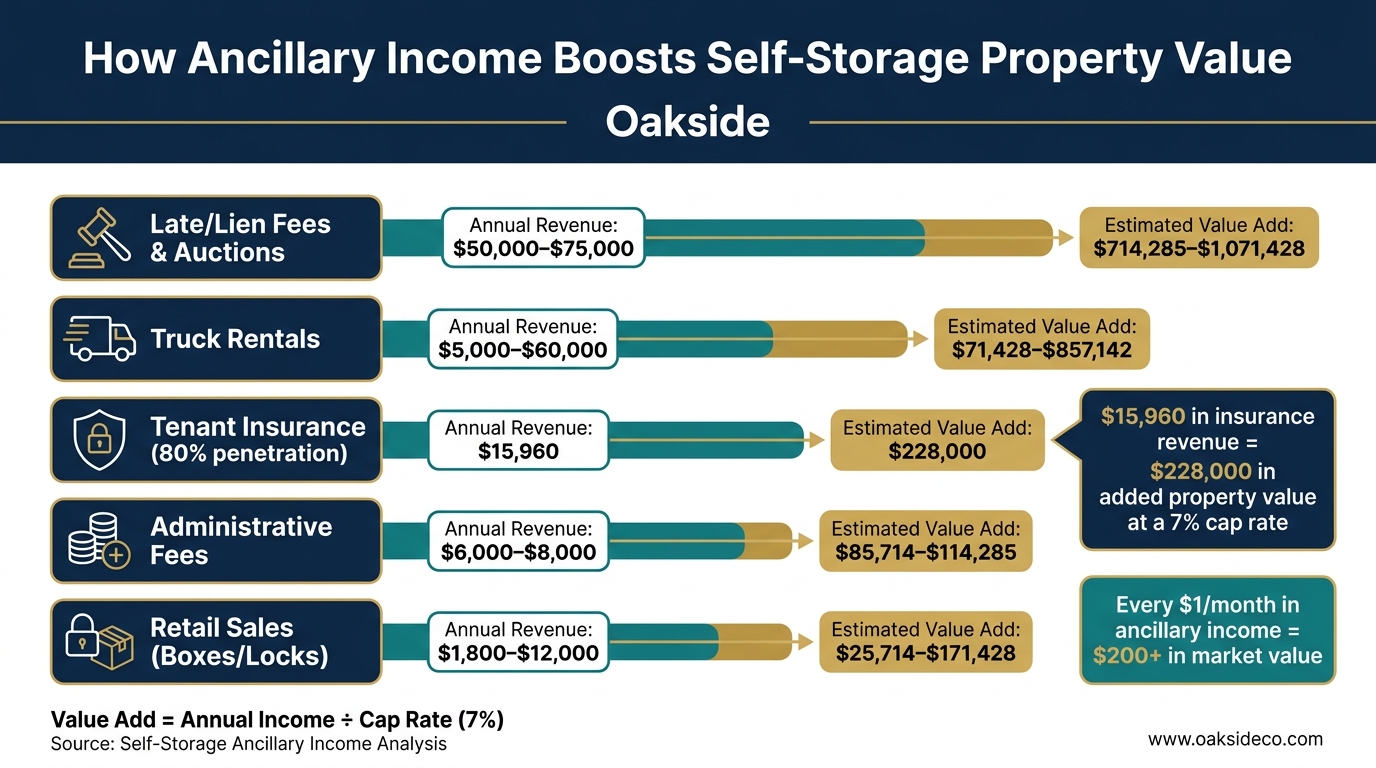
Ancillary Income Value Add: Self-Storage Revenue Streams at a 7% Cap Rate
Once you’ve set up your ancillary income strategies, the key to maintaining and growing their impact lies in consistent monitoring and refinement. Simply putting these income streams in place isn’t enough – you need to ensure they’re performing as expected and find ways to improve them over time.
Track and Analyze Revenue Streams
To get a clear picture of how each income stream is performing, create a detailed chart of accounts for every category (e.g., insurance commissions, retail sales, late fees, truck rentals). Avoid lumping all ancillary income into one general category, as this makes it difficult to identify which streams are thriving and which need attention.
Focus on tracking key metrics. For instance, the penetration rate (or take rate) reveals the percentage of tenants using a particular service. A low penetration rate for tenant insurance might indicate that staff need better training on presenting the option or that pricing needs adjustment. Additionally, keep an eye on commission percentages and compare the revenue from each stream to its operational costs.
If your ancillary income is noticeably lower than the typical range for your facility type, you may not need to introduce new services just yet. Instead, optimize the ones you already have.
Review and Adjust Each Quarter
At the end of each quarter, review your data and compare it to the previous quarter. Ask yourself: is this income stream growing, staying flat, or declining? Flat or declining streams deserve closer scrutiny – sometimes a small pricing adjustment or a quick training session for staff can turn things around. Also, assess whether any service consistently costs more to operate than it generates in revenue.
Seasonal services, such as propane sales, are a great example of streams that require careful evaluation. While they might perform well in winter, they could hurt your margins during other times of the year. Additionally, gathering tenant feedback twice a year can provide valuable insights. Tenants often highlight areas where new services could be introduced. A practical goal is to aim for two new ancillary add-ons each year.
Refining your approach not only enhances revenue but also directly impacts your property’s valuation metrics.
Factor Ancillary Income into Valuation
This is where diligent tracking pays off. Every dollar of ancillary income contributes to your property’s market value. For example, at a 7% cap rate, an additional $15,960 in annual ancillary income could boost your asset value by approximately $228,000. The table below highlights the potential impact of different income streams:
| Ancillary Stream | Potential Annual Revenue | Estimated Value Add (7% Cap Rate) |
|---|---|---|
| Tenant Insurance (80% penetration) | $15,960 | $228,000 |
| Administrative Fees | $6,000–$8,000 | $85,714–$114,285 |
| Truck Rentals | $5,000–$60,000 | $71,428–$857,142 |
| Retail Sales (Boxes/Locks) | $1,800–$12,000 | $25,714–$171,428 |
| Late/Lien Fees & Auctions | $50,000–$75,000 | $714,285–$1,071,428 |
Sources:
When preparing your pro forma, break down ancillary income by category with detailed revenue and cost projections. Institutional buyers will closely examine these figures, and a well-documented income history demonstrates professional management. If you’re planning to sell, working with an advisory team that knows how to present this data effectively during underwriting can significantly influence your sale price. Companies like Oakside Co specialize in helping clients transform operational income data into valuation narratives that stand up to due diligence.
Conclusion: Building Asset Value Through Ancillary Income
A well-planned ancillary income strategy can directly increase your property’s value. By starting with a clear assessment of your current income streams and implementing a disciplined quarterly review process, every additional dollar of net operating income (NOI) can significantly enhance your property’s market valuation. For instance, at a 7% cap rate, even modest fee income can translate into a noticeable boost in value – an aspect buyers often highlight in underwriting.
This growth comes from taking a proactive, unified approach. By integrating various ancillary income streams into a cohesive strategy, you can ensure consistent value-building efforts. Tailor your services to fit the needs of your local market, train your team to present these services effectively, and maintain detailed records for each revenue category. These steps not only streamline quarterly reviews but also demonstrate professional management and operations – a key factor for institutional buyers who closely examine income histories during their evaluations.
If you’re preparing to sell or simply want a clearer picture of your property’s current market value, Oakside Co offers tools to help. They specialize in modeling income streams against your cap rate and identifying potential gaps before you take your property to market. Their expertise helps convert operational income data into a compelling valuation narrative that stands up to due diligence and enhances your property’s appeal.
FAQs
What ancillary income stream should I add first?
Start with the basics that are widely accepted in the industry. Offering tenant insurance is a smart move – it’s straightforward to manage and comes with attractive profit margins. You can also boost revenue by selling retail items like boxes, locks, and packing supplies, which are easy to stock and always in demand.
Once you’ve established these essentials, think about expanding your offerings. Depending on your facility’s available space, staff capabilities, and local market needs, services like truck rentals or vehicle storage can be excellent additions. These options can help you cater to a broader audience while maximizing your facility’s potential.
How do I calculate value add from ancillary income at my cap rate?
To figure out how much ancillary income contributes to your facility’s value, you can use a simple formula: divide the extra annual profit by your facility’s capitalization rate. For instance, if your facility generates an additional $7,500 in yearly profit and has a cap rate of 7%, that boosts your asset value by $107,143.
As Nolen Masserman, Managing Director at Oakside, puts it: “Even small revenue changes can significantly impact asset value.” Cameron Vale, President at Oakside, echoes this, emphasizing, “Every dollar of monthly income creates substantial market value.”
Which add-ons work with remote or automated management?
Remote and automated facilities can tap into additional income streams by leveraging technology to handle tasks traditionally done by hand. Common offerings include selling retail moving supplies through online platforms or kiosks and managing truck rentals via self-service systems. Tech upgrades like smart locks and app-based entry systems can also be introduced. According to Nolen Masserman, Managing Director at Oakside, these features should integrate seamlessly into the automated experience to ensure they add value without causing disruption.