Planning capital expenditures (CapEx) for storage facilities ensures long-term asset value, stable cash flow, and lender confidence. Unlike operating expenses (OpEx), which cover daily costs like utilities and minor repairs, CapEx involves larger investments such as roof replacements, parking upgrades, or security system installations. A structured plan helps avoid costly surprises and aligns spending with business goals.
Here’s a quick breakdown of the process:
- Step 1: Build a CapEx framework to guide decisions and classify expenses.
- Step 2: Assess your facility’s current condition with a property condition assessment (PCA).
- Step 3: Create a multi-year spending plan, balancing short-term needs with future projects.
- Step 4: Prioritize maintenance by risk and return to protect income and tenant satisfaction.
- Step 5: Track and adjust your CapEx plan regularly to stay aligned with financial goals.
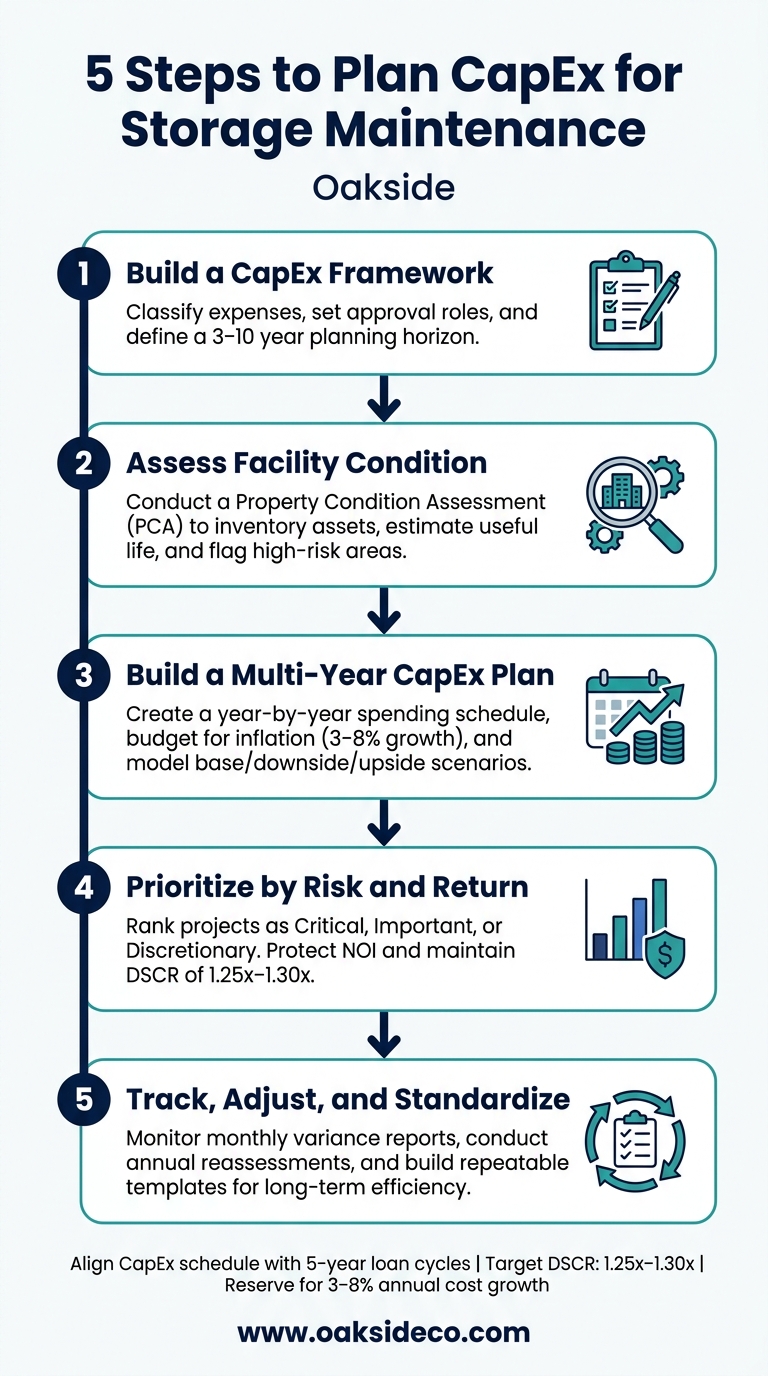
5-Step CapEx Planning Process for Storage Facilities
Step 1: Build a CapEx Framework
Creating a clear framework is the first step toward making consistent and well-informed capital expenditure (CapEx) decisions.
A CapEx framework acts as a guide for identifying, approving, and funding large-scale expenses. Without it, decisions can become inconsistent and reactive, which often leads to higher costs.
What Counts as CapEx in Storage Maintenance?
In general, expenses that extend the life or significantly enhance the value of an asset are classified as CapEx. This distinction is important for budgeting, taxes, and lender reporting. On the other hand, routine expenses that simply maintain day-to-day operations are classified as operating expenses (OpEx).
Here’s a breakdown of common CapEx examples across different storage types:
| Storage Type | Common CapEx Examples |
|---|---|
| Standard Self-Storage | Roof replacement, exterior painting, unit mix reconfiguration, security system upgrades |
| Boat & RV Storage | Paving, gravel resurfacing, steel canopy installation, lot drainage improvements |
| Climate-Controlled / Wine Storage | HVAC system overhauls, backup generators, humidity control equipment |
| Portable Container Facilities | Site preparation, foundation work, prefabricated unit replacement |
For example, patching a roof leak is considered OpEx, but replacing the entire roof qualifies as CapEx. Making this distinction helps keep financial records accurate and ensures smooth communication with lenders.
Setting a Long-Term Planning Horizon
An effective CapEx plan should include both short- and long-term perspectives. A 3- to 5-year active plan, paired with a 5- to 10-year reserve schedule, offers a balanced approach. The shorter-term plan focuses on immediate needs, while the longer-term reserve ensures preparedness for major future projects.
Aligning your CapEx schedule with your financing cycle is a practical move. In the self-storage sector, five-year loan terms are common, with interest rates starting in the high 6% range as of 2026. Planning around this cycle ensures you meet lender expectations, particularly when it comes to maintaining a debt service coverage ratio between 1.25x and 1.30x.
To stay on track, conduct regular financial reviews each month and hold formal quarterly planning sessions. Factors like changes in occupancy, unexpected repairs, and inflation can quickly affect projections, so frequent updates are crucial.
Defining Roles and Approval Processes
Establishing clear roles and approval procedures is essential for a smooth CapEx process. Key roles include:
- The Property Owner or Sponsor: Ultimately responsible for funding and ensuring liquidity to cover capital needs as they arise.
- The Asset Manager or Third-Party Management Company: Handles daily operations and identifies potential maintenance issues before they escalate.
- An Owner’s Representative: For large projects like expansions or system overhauls, this role manages bidding, permits, and construction oversight.
For institutional owners or those managing multiple properties, a formal approval process is critical. Significant CapEx requests should include thorough documentation to withstand scrutiny from lenders and investment partners. Setting clear approval thresholds ensures accountability and avoids confusion.
Step 2: Assess Your Facility’s Current Condition
Taking a close look at your facility’s current state is key to building an effective CapEx plan. Once you’ve established your CapEx framework, the next step is conducting a detailed evaluation of your property. A property condition assessment (PCA) provides a clear snapshot of your facility’s condition today and outlines what it will require in the coming years.
How to Conduct a Property Condition Assessment
A PCA involves a systematic inspection of all major physical components of your property. For standard self-storage facilities, this means evaluating roofs, unit doors, and drainage systems. For boat and RV storage, the checklist grows to include lot paving, gravel surfaces, steel canopies, wash bays, and perimeter security. If your facility is climate-controlled, you’ll need to account for HVAC systems, humidity sensors, and backup generators as well.
The purpose of this process is to create a comprehensive inventory of all capital assets on the property, noting their condition and age. This inventory becomes the foundation for assessing costs and potential risks. By thoroughly documenting these details, you’ll be better equipped to estimate the lifespan of each asset and the costs associated with replacing them.
Estimating Useful Life and Replacement Costs
The next step is to estimate how much life each asset has left and what it will cost to replace. For example, a roof installed in 2010 with a 25-year lifespan carries a different financial outlook than one installed in 2018. Lenders are increasingly requiring such detailed analyses to meet financing requirements, so precision here is critical – vague numbers won’t pass muster.
To ensure your replacement cost estimates are accurate, compare them against financial data from similar properties in your area. Tools like TractIQ can help by benchmarking expenses against CMBS disclosures, minimizing guesswork when projecting future costs. Once you’ve nailed down replacement costs, shift your focus to the assets that pose the greatest risks to your operations.
Identifying High-Risk Maintenance Areas
Not all maintenance issues are created equal. While some problems may be purely cosmetic, others can directly impact occupancy rates, tenant safety, or lender confidence. Security systems, roofing, and drainage infrastructure often rank as the most critical components for most storage types because their failure can disrupt operations immediately.
For specialized facilities, the stakes can be even higher. Take wine storage, for instance – humidity controls and backup generators are mission-critical. A power outage without a generator could lead to significant inventory losses for tenants. Similarly, in boat and RV facilities, the state of paved surfaces and canopy structures directly affects tenant satisfaction and your ability to charge premium rates. If your property includes portable container units, keep in mind that units not permanently affixed to foundations can complicate valuations during federally regulated loan applications.
Step 3: Build a Multi-Year CapEx Plan
Once you’ve completed your property condition assessment and pinpointed high-risk areas, it’s time to transform that information into a phased spending plan. This step prioritizes projects based on urgency and financial implications, helping you align maintenance schedules with operational goals. A well-structured plan not only protects your asset’s value and net operating income (NOI) but also provides a clear financial roadmap while safeguarding cash flow.
Creating a Year-by-Year CapEx Schedule
A year-by-year schedule helps distribute projects over time in a way that balances financial and operational priorities. Start by grouping similar projects – for instance, combining roof repairs with gutter replacements – to minimize costs and avoid contractor delays.
Timing matters as much as budgeting. Use real occupancy data to avoid scheduling disruptive projects during peak periods. For example, in high-demand markets like Arizona or Florida, major projects such as lot repaving or canopy repairs should be planned during off-season months when seasonal "snowbird" demand drops. Lenders typically expect stabilized occupancy to range between 82% and 92%, so any project that could displace tenants or limit access should be carefully timed to stay within this range and maintain your debt service coverage ratio. Once your timeline is finalized, adjust your financial plan to reflect these considerations.
Budgeting for Reserves and Inflation
Your multi-year plan must account for rising costs over time. A practical guideline: lenders currently project self-storage rental rate increases within the 3% to 8% range. Applying a similar rate of growth to your maintenance budget ensures it remains realistic and aligns with your NOI projections.
Additionally, include a dedicated capital reserve contribution in your annual budget. By 2026, lenders are placing more emphasis on reserve levels, requiring operators to hold additional capital upfront to ensure properties can stabilize without needing mid-cycle financing. Insufficient reserves can hinder refinancing opportunities and reduce buyer confidence.
Planning for Cost Variances with Risk Scenarios
To prepare for uncertainties, incorporate flexibility into your CapEx plan by modeling base, downside, and upside scenarios. This approach accounts for potential delays, price fluctuations, or early project completions, ensuring you maintain enough liquidity to handle unexpected expenses. Scenario planning not only adds credibility with lenders and investors but also helps determine how much cash you should keep accessible at any time.
sbb-itb-09b4138
Step 4: Prioritize Maintenance Projects by Risk and Return
Once your multi-year schedule is set, it’s time to focus on directing funds where they’ll have the greatest impact. Prioritize projects based on risk and return – not all maintenance needs are equally urgent, and a clear prioritization framework ensures your capital goes to the areas that matter most.
How to Rank Projects by Risk and Revenue Impact
Organize your projects into three tiers: critical, important, and discretionary.
- Critical projects are non-negotiable. These are repairs that ensure safety and meet regulatory requirements. For example, maintaining backup generators for climate-controlled units (like those used for wine storage) is essential. A generator failure could lead to inventory loss and liability issues, making these projects a top funding priority.
- Important projects protect your bottom line and lender relationships. Think of roof repairs, drainage fixes, or security system upgrades. Delaying these could lead to occupancy issues or even loan covenant violations.
- Discretionary projects are value-add investments. These include enhancements like adding RV canopies or upgrading standard units to climate-controlled ones. These should only be tackled after critical and important needs are addressed.
This tiered system helps you balance immediate operational needs with opportunities for long-term growth.
Balancing Maintenance with Value-Add Projects
When deciding how to allocate your CapEx budget, start by comparing essential maintenance to discretionary upgrades. Use tools like GIS analysis to assess market demand before committing funds to expansion projects. Protecting your existing NOI should always come first – lenders typically require a DSCR (Debt Service Coverage Ratio) between 1.25× and 1.30×. A deferred repair that causes tenant turnover will hurt your NOI far more quickly than missing an expansion opportunity. Once critical and important projects are fully funded, allocate remaining capital toward upgrades that improve your asset’s competitive edge.
Aligning CapEx with Financing and Exit Plans
Your financing and exit strategy should guide which projects to prioritize and when to execute them. If you’re planning to sell or refinance soon, focus on upgrades that improve your asset’s yield-on-cost and cap rate. For example, converting units to climate-controlled status or integrating new technology can significantly boost asset value. Timing is key – these types of projects are most effective when completed 12 to 24 months before a sale, giving them time to stabilize and positively impact your NOI.
Coordinate your upgrades with your loan’s exit timeline, ensuring they enhance yield-on-cost without overextending your liquidity or DSCR (targeting a range of 1.25× to 1.30×). Additionally, consider conducting a cost segregation study for major investments like fencing, surveillance systems, or lot improvements. This can accelerate depreciation, freeing up cash for other projects.
Step 5: Track, Adjust, and Standardize Your CapEx Process
A well-maintained CapEx plan isn’t static – it evolves through constant tracking, reassessment, and standardization to safeguard your assets. Once projects are in motion, your attention should shift to keeping spending on track, revisiting initial assumptions, and creating systems that simplify future planning.
Tracking Actual Spending Against Your Plan
Don’t wait until the end of the year to evaluate your CapEx spending. Instead, monitor actual spending against your plan on a monthly basis. Monthly variance reports can quickly flag cost overruns, helping you meet lender-required DSCR (Debt Service Coverage Ratio) standards.
Using software that integrates real-time, facility-level financial data can make this process much more efficient. Some operators have cut the time spent on market research and financial reporting from 20 hours to just 2 minutes by leveraging tools that auto-populate quarterly narratives and investment memos. Verified data eliminates guesswork, allowing you to fine-tune future estimates. This kind of ongoing tracking also lays the groundwork for meaningful annual reviews and process improvements.
Annual Reassessments and Climate Factors
Once you’ve established regular monitoring, it’s important to formally review your CapEx plan every 12 months. These reviews should do more than just confirm spending figures – they should adjust for environmental and operational changes. For example, revisit flood zone maps, utility costs, and the condition of critical infrastructure like climate-control systems. If your facility provides specialized storage, ensure that backup generators and humidity sensors are fully functional to avoid tenant dissatisfaction or liability.
Location-specific factors also deserve attention. Properties in fast-growing Sun Belt states like Florida, Texas, and Arizona often face higher wear and tear due to seasonal demand spikes and increased tenant turnover. Make sure your annual reassessments account for these regional dynamics rather than relying on rigid schedules.
Building Repeatable Processes for Long-Term Efficiency
Standardizing your CapEx processes can significantly improve efficiency and readiness. Create templates for key tasks like property condition assessments, budget variance reports, and capital reserve calculations, and use them consistently. These documented processes not only streamline operations but also strengthen your position when lenders or buyers scrutinize your records. For instance, as of 2026, lenders have started requiring more detailed trade area analyses and higher reserve levels before approving permanent financing.
Assigning a single point of contact to oversee CapEx tracking year after year can also make a big difference. An analyst or advisor familiar with your asset’s history will spot performance trends and gaps far more effectively than someone new to the property. Over time, this consistency transforms your CapEx management into a proactive strategy that protects and enhances the value of your assets.
FAQs
How do I decide if a repair is CapEx or OpEx?
The key difference between Capital Expenditures (CapEx) and Operating Expenses (OpEx) lies in their purpose and the timeframe of their impact.
CapEx refers to costs tied to long-term investments, such as significant upgrades, new equipment, or structural improvements. These expenses are typically capitalized, meaning their cost is spread out over time through depreciation.
On the other hand, OpEx encompasses the everyday expenses required to keep operations running smoothly. This includes things like utility bills, rent, and routine maintenance.
As Nolen Masserman, Managing Director at Oakside, explains, correctly distinguishing between the two is essential for accurate financial reporting. Proper categorization also helps preserve the value of long-term assets and ensures financial stability.
How much cash should I keep in capital reserves?
Determining how much cash to keep in reserves is a crucial factor for the long-term stability of self-storage and boat/RV facilities. Lenders generally expect higher reserves to ensure that properties remain stable over time. Cameron Vale, President at Oakside, points out that while self-storage properties often demand less capital compared to other types of assets, having enough liquidity is still essential for managing risks. A solid reserve allows owners to handle unexpected costs and tackle operational hurdles with greater ease.
Which CapEx projects should I fund first to protect occupancy?
To keep occupancy rates steady, it’s crucial to focus on CapEx projects that boost your facility’s appeal and reliability. According to Nolen Masserman, Managing Director at Oakside, strategic reinvestment plays a vital role in preserving long-term value.
Key areas to prioritize include:
- Property visibility: Enhancements like improved signage or landscaping can make your facility more noticeable and inviting to potential renters.
- Security: Upgrades such as advanced surveillance systems or gated access provide peace of mind for tenants.
- Climate-controlled spaces: Modern renters often expect features like temperature-regulated storage, especially in areas with extreme weather conditions.
By maintaining essential infrastructure and addressing these high-impact areas, you can meet renter expectations, reduce risks, and support consistent occupancy levels.