Construction costs in storage development are rising steadily in 2026, with increases projected between 3% and 6%. Factors like material price hikes, labor shortages, and stricter energy codes are driving budgets higher, while regional differences and zoning delays add complexity. Developers must manage costs carefully to ensure projects remain financially viable.
Key takeaways:
- Material costs: Steel prices are up 4–7% due to tariffs; insulation costs rose 19% year-over-year.
- Labor shortages: 439,000 unfilled positions in Q1 2026, with wages up 5.8%.
- Facility costs: Single-story storage ranges from $55–$85/GSF; multi-story climate-controlled facilities cost $105–$170/GSF.
- Regional impact: Coastal areas face higher costs and longer permitting timelines (up to 18+ months).
- Strategies to control costs: Early procurement, modular construction, and phased development can mitigate risks and delays.
Developers should prioritize accurate budgeting, early planning, and cost-saving measures to navigate these challenges effectively.
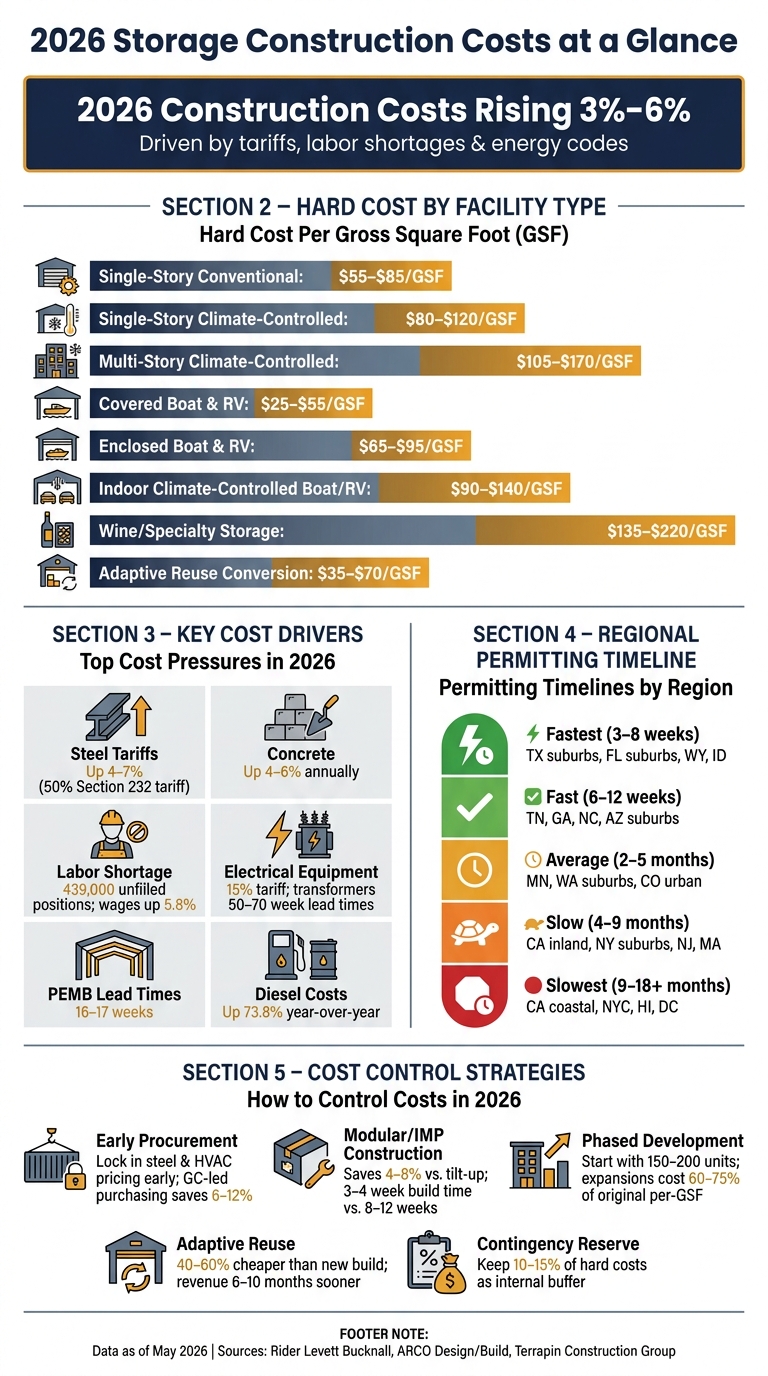
2026 Storage Construction Costs by Facility Type & Region
2026 Cost Outlook for Storage Facilities
Will Costs Rise, Stabilize, or Fluctuate in 2026?
Construction costs are expected to climb steadily in 2026, with increases projected between 3% and 6% – a far cry from the sharp double-digit jumps seen in previous years. Terence Tracey, Vice President and Head of Growth & Strategy at Rider Levett Bucknall, highlighted this shift:
"The consistency suggests that the industry may be settling into a more predictable environment, one where owners and developers can recalibrate expectations and plan investments with greater confidence."
However, predictability doesn’t mean costs are completely stable. For example, steel and aluminum tariffs caused national construction averages to rise by 3% to 5% in just one month (April to May 2026). Meanwhile, non-metal materials like insulation saw a 19% year-over-year increase in Q1 2026. This means relying on outdated cost data could lead to underestimating budgets.
On a brighter note, lead times for roll-up doors have returned to a manageable 4–6 weeks, which helps with project scheduling.
Next, let’s break down how these cost trends vary for self-storage facilities versus boat/RV storage projects.
How Cost Drivers Differ Between Self-Storage and Boat/RV Facilities
While industry-wide trends provide a baseline, specific facility types come with their own unique cost drivers. Here’s how the numbers stack up for self-storage and boat/RV facilities.
Self-storage facilities tend to have more complex interiors. Climate-controlled units require HVAC systems, dehumidification, interior partitions, and roll-up doors throughout. Multi-story buildings add even more complexity with elevators, structural load adjustments, and fire suppression systems. On top of that, new energy codes are tacking on an extra $0.40 to $0.90 per gross square foot (GSF) for PV-ready electrical upgrades in multi-story projects. As a result, hard costs for self-storage can range from $55–$85/GSF for single-story conventional facilities to $105–$170/GSF for multi-story climate-controlled ones.
Boat/RV storage, on the other hand, has a different set of priorities. These projects often require high-clearance steel frames (typically 14–16 feet) and large-format automated doors that can cost between $3,500 and $7,500 each. While interior partitioning is minimal, these facilities need 2 to 3 times more land than traditional self-storage to accommodate larger vehicles and turning space. Here’s a quick comparison of hard costs across facility types:
| Facility Type | Hard Cost Range (per GSF) |
|---|---|
| Single-Story Conventional | $55–$85 |
| Single-Story Climate-Controlled | $80–$120 |
| Multi-Story Climate-Controlled | $105–$170 |
| Boat/RV – Covered (Roof only) | $25–$55 |
| Boat/RV – Enclosed (Walled) | $65–$95 |
| Indoor Climate-Controlled Boat/RV | $90–$140 |
One key consideration for boat/RV storage projects is vertical clearance. Increasing clearance from 14 feet to 16 feet adds $2–$4 per square foot to construction costs. However, this upgrade often pays off, as it allows for 20%–30% higher rental rates. For many developers, the added expense is well worth the return.
sbb-itb-09b4138
Key Factors Driving 2026 Construction Costs
Material Prices: Steel, Concrete, and Storage Doors
Steel remains the biggest expense for storage developers, and current tariffs are making it even pricier. The 50% tariff on steel and aluminum (with an additional 25% on derivatives) has caused imported steel framing components to rise by 4% to 7% in May 2026 alone. For steel-heavy projects, this tariff adds $15 to $25 per square foot, which can turn a seemingly profitable project into a financial headache.
Concrete isn’t much of a relief either. Its prices are expected to increase by 4% to 6% throughout 2026, driven by rising energy costs and stricter environmental regulations. Urban markets, in particular, are unlikely to see any price breaks.
On a positive note, roll-up door prices have stabilized, and lead times are now back to a manageable 4–6 weeks. However, compromising on door quality could lead to losses exceeding $200,000 during early operations.
Labor Availability: Shortages and Wage Pressures
While material costs often grab attention, labor shortages are quietly driving project budgets higher. By Q1 2026, the U.S. commercial construction sector reported 439,000 unfilled positions, with wages for construction labor increasing 5.8% year-over-year. In high-demand cities like Phoenix, Dallas, and Austin, skilled trade wages have surged by 7% to 11%.
The root of the issue lies in workforce demographics. A significant 41% of the construction workforce is 55 or older, and retirements are outpacing new apprenticeships by a ratio of 2 to 1. Adding to the strain, large-scale projects such as semiconductor facilities and data centers are absorbing the most skilled crews, leaving storage developers scrambling for labor. As a result, mid-size project timelines have stretched by 6 to 14 weeks longer compared to 2019. In some regions, steel erector rates have jumped from $18 per square foot to $26 per square foot, as developers are forced to bring in crews from other states.
"Most 2026 bid overruns that get blamed on ‘inflation’ are really labor – the scarcity premium, the overtime padding, the bench-depth insurance every honest GC has to carry just to hold schedule." – Terrapin Construction Group
These labor shortages are also creating ripple effects, further complicating equipment procurement and project timelines.
Equipment and Long-Lead Items: Delays and Cost Impact
Equipment procurement has become another major hurdle, adding to schedule risks. Pre-Engineered Metal Buildings (PEMB), a key structural component for storage facilities, now require 16 to 17 weeks of lead time. To stay on schedule, some developers are opting for built-up steel systems, which can be sourced in 8 to 11 weeks.
Electrical equipment is another bottleneck. Key components like transformers, panel boards, and conduit systems face a 15% tariff as of April 2026, with distribution transformers carrying lead times of 50 to 70 weeks due to shortages of copper and steel. Multi-story facilities now frequently require 800A to 1,200A electrical service to support modern features like security systems and EV-ready parking, adding to both cost and procurement challenges.
Adding to the complexity, construction machinery prices have risen 4.0% year-over-year, while diesel costs have skyrocketed by 73.8% in the past 12 months. Even transporting equipment to job sites has become significantly more expensive.
"Firms bidding work over the next 60 to 90 days should treat energy-related costs as a live variable, not a fixed assumption." – Eric Gaus, Chief Economist, Dodge Construction Network
To summarize, here’s where the biggest material and equipment cost pressures stand in 2026:
| Material / System | 2026 Cost Trend | Key Driver |
|---|---|---|
| Steel Framing | Up 4–7% (May 2026) | 50% Section 232 tariffs |
| Concrete / Cement | Up 4–6% (annual) | Energy costs, environmental regulations |
| Roll-up Doors | Pricing stable | Lead times normalized to 4–6 weeks |
| Copper / Electrical | Peak pricing in Q2 | 20% spike in late 2025 from supply disruptions |
| Construction Machinery | Up 4.0% year-over-year | Diesel costs, tariff pass-through |
Regional and Regulatory Cost Differences
Zoning and Permitting Costs by Region
Where you build matters – a lot. Construction costs for single-story, climate-controlled storage facilities can differ by as much as 40% across the U.S.. For example, in the Midwest, costs range from $76–$105 per gross square foot (GSF), while along Coastal California, they jump to $125–$165/GSF. A big part of this difference comes down to zoning hurdles and permitting delays.
Permitting timelines can make or break a project’s finances. In places like suburban Texas and Florida, permits are often approved in just 3 to 8 weeks. But in areas like Coastal California or New York City, it can take a staggering 9 to 18+ months. These delays increase financing costs, push back revenue, and shrink potential returns.
| Permitting Tier | Timeline | Typical Regions |
|---|---|---|
| Fastest | 3–8 weeks | TX suburbs, FL suburbs, WY, ID, ND, SD |
| Fast | 6–12 weeks | TN, GA suburbs, NC suburbs, AZ suburbs, CO suburbs |
| Average | 2–5 months | MN, WA suburbs, OR suburbs, CO urban, IL suburbs |
| Slow | 4–9 months | CA inland, NY suburbs, NJ, MD, MA urban, WA urban |
| Slowest | 9–18+ months | CA coastal, NYC, HI, DC |
Beyond the delays, zoning regulations add another layer of complexity. Roughly 80% of self-storage projects require conditional use permits (CUPs), which involve public hearings and political scrutiny, often stretching project timelines by months. Some states have even imposed moratoriums or outright bans on new storage facilities. As of 2026, at least 15 states have active restrictions. For instance, in Rockford, Illinois, self-storage is now limited to industrial zones, and New York City requires facilities over 50,000 square feet to dedicate 25% of their space for industrial use.
"Zoning has become the most formidable barrier to entry." – Loan Analytics
Soft costs, including permits, plan reviews, and impact fees, typically account for 2% to 5% of hard construction costs. For a 100-unit project, these costs can range from $50,000 to $150,000+, with permit fees alone running $10,000 to over $40,000 depending on the location. Zoning complications can tack on an additional $50,000–$150,000 in fees and delay projects by 6–18 months.
A smart strategy? Schedule a pre-application meeting with the local building department before submitting formal plans. This step can help identify potential issues early, shaving off 6 weeks of resubmittal time.
These regional differences highlight the critical need to align your project’s location with your investment goals.
Regional Labor and Supply Chain Differences
Labor and supply chain dynamics also play a big role in shaping costs. Labor expenses vary widely across regions, influenced by local construction demand. In cities like Phoenix, Dallas-Fort Worth, and Columbus, Ohio, large-scale construction projects are pulling skilled tradespeople – such as mechanical, electrical, and plumbing (MEP) workers – away from smaller projects. For example, sprinkler labor costs in the Sun Belt have risen 6% due to this competition.
"The people who swing hammers, set panels, and pull wire are scarcer than any material on the project." – William Goodin, Terrapin Construction Group
In high-cost areas like California and the Northeast, union labor rules, strict energy codes, and seismic standards push costs to $38–$62+ per square foot, compared to $23–$38 per square foot in Sun Belt markets. Adopting updated energy codes, such as IECC/ASHRAE standards, further increases costs. For instance, multi-story projects now require PV-ready electrical service upgrades, adding $0.40 to $0.90 per square foot.
Supply chain issues also vary by region. Transformer lead times, for example, already range from 16 to 52 weeks nationally but can stretch even longer in regions with strained utility infrastructure. To avoid costly delays, it’s crucial to verify local electrical grid capacity before finalizing site plans.
Ultimately, choosing a location means balancing lower construction costs with potential labor shortages and regulatory delays. While Sun Belt markets offer lower expenses, they face labor challenges. Meanwhile, coastal markets are pricier but may provide stronger demand in areas with limited supply.
Ways to Control Construction Costs
Phased Development and Standardized Design
Phased development is a smart way to manage construction expenses. Start with 150–200 units to use early rental income and gather real market data before committing to larger expansions. When it’s time to grow, metal buildings can be extended by adding frames and removing end-walls at about 60–75% of the original per-square-foot cost.
Standardized design can amplify these savings. Using standard unit sizes like 10×10 and 10×20 simplifies construction, reduces material waste, and lowers architectural and engineering (A&E) fees, which typically make up 5–8% of hard costs for self-storage projects. Avoid custom finishes or unique structural elements. Sticking to standard manufacturer specifications keeps procurement efficient and minimizes long-term maintenance issues. In a climate of fluctuating material prices and labor shortages, these design strategies help minimize the risk of cost overruns.
"The compounding cost savings come from compressed schedule, reduced change orders, and earlier rent commencement – not from beating up a single line item." – Terrapin Construction Group
Off-Site Fabrication and Modular Construction
Alternative construction methods also offer cost control benefits. Pre-engineered metal buildings (PEMBs) are a popular choice for single-story drive-up facilities, with shell costs ranging from $14–$30 per square foot. For climate-controlled or multi-story projects, Insulated Metal Panels (IMP) on a structural steel frame are becoming a favored option. IMP envelopes combine air barrier, vapor retarder, and insulation into one product, reducing trade coordination and the size of HVAC systems. Compared to tilt-up concrete, IMP can lower total project costs by 4–8% while speeding up the dry-in phase.
Factory-built systems provide predictable costs and more reliable early budgeting, which is especially valuable given ongoing labor shortages and supply chain uncertainties. Matt Ives, Director of Revenue and Marketing at Lynx Contractor Storage, explains:
"The financial advantage often lies in predictability rather than raw savings. Self-storage developers gain tighter cost control, fewer surprises and clearer budgeting early in the process."
Modular construction also significantly shortens timelines. For instance, a professional crew can complete a 50×100 metal storage building in 3–4 weeks, compared to the 8–12 weeks required for conventional builds. A faster timeline means earlier rent collection, which directly boosts the financial performance of your project.
Early Procurement for Long-Lead Items
Pairing modular construction with early procurement strategies is another effective way to safeguard both your budget and timeline. Securing materials like HVAC systems, switchgear, and roll-up doors early helps avoid delays and locks in pricing – an essential move in the face of fluctuating steel prices caused by tariff uncertainties.
One practical procurement tip: let your general contractor (GC) handle the purchase of doors, hardware, and security electronics. Thanks to their volume relationships, GC-led procurement can save 6–12% compared to traditional purchasing methods. Engaging your GC during the schematic design phase – not after plans are finalized – ensures these savings are realized early. It also allows for adjustments that can significantly reduce costs, as AJ Wertzberger, Design-Build Manager at ARCO Design/Build, points out:
"If a retaining wall can be redesigned to save six figures, or a building shift reduces utility costs, those decisions need to happen early. That’s how you maximize the value of the site."
Budgeting and Planning for 2026 Storage Projects
When it comes to storage development, getting the budget and plan right is the foundation for success. Let’s dive into the key numbers and strategies that will keep your project on track.
Cost Benchmarks for Storage Facility Developers
Before construction begins, it’s crucial to set a realistic cost baseline. As of May 2026, hard costs typically make up 60% to 70% of the total budget, while soft costs add another 15% to 25%. To get a full project estimate, you’ll need to add 25% to 40% to your hard-cost baseline.
Here’s a quick breakdown of hard cost benchmarks for different facility types, along with planning notes to guide your decisions:
| Facility Type | Hard Cost per GSF | Key Planning Note |
|---|---|---|
| Single-Story Conventional | $55–$85 | Simplest design; permits are quicker to secure. |
| Single-Story Climate-Controlled | $80–$120 | Proper HVAC sizing is critical for long-term costs. |
| Multi-Story Climate-Controlled | $105–$170 | Requires 800A–1,200A electrical service. |
| Adaptive Reuse Conversion | $35–$70 | Upfront structural assessments are a must. |
| Covered Boat & RV | $25–$55 | Needs 2–3 times the land of conventional storage. |
| Enclosed Boat & RV | $65–$95 | Large-format doors cost $3,500–$7,500 each. |
| Wine/Specialty Storage | $135–$220 | Requires advanced mechanical systems and finishes. |
Land costs are another major factor. In less populated areas, they can account for 12% to 18% of your budget. In dense urban areas, this jumps to 30% to 45%. On top of that, site work – like grading, utilities, and drainage – can add $4.25 to $8.00 per square foot before construction even starts. To avoid surprises, invest in geotechnical and environmental Phase I assessments, which cost $2,000 to $4,000 upfront. Skipping this step could lead to soil issues that tack on $100,000 to $400,000 to your budget.
Contingency planning is another area where developers often fall short. A 3% to 5% contingency reserve just doesn’t cut it anymore. Charlie Kao, Principal at Twin Oaks Capital, stresses the importance of proper reserves:
"Contingency isn’t a luxury, it’s protection. Avoid the temptation to reduce contingency funds to improve underwriting."
Experts recommend negotiating a 10% contingency with lenders while keeping 10% to 15% of hard costs as an internal buffer. With stabilization timelines stretching to 3–4 years in many markets, this extra cushion can make a big difference.
Cost Drivers and Mitigation Methods: Comparison Table
Once you’ve set your benchmarks, the next step is understanding what drives costs and how to manage them. As William Goodin puts it: "The cost story is no longer ‘is it cheap to build?’ It is now ‘can the deal pencil at stabilized cap rates?’"
Here’s a comparison of common cost drivers and ways to mitigate them:
| Cost Driver | Expected Impact | Mitigation Method |
|---|---|---|
| Steel Tariffs | 4%–7% increase in framing costs | Pre-purchase materials; lock in supplier pricing early. |
| Soft Costs | 15%–25% of hard costs | Use repeatable design prototypes to lower architectural fees. |
| Climate Control | Adds $20–$40 per GSF | Opt for Insulated Metal Panels (IMP) to reduce HVAC size. |
| Permit Delays | 4–9 month timeline; ongoing carrying costs | Work with city officials early and hire local engineers. |
| Site Work | $4.25–$8.00 per GSF | Conduct geotechnical/soil testing before site control. |
| Electrical Service | $50,000–$150,000 for upgrades | Plan for 800A–1,200A service upfront for climate-controlled sites. |
| Stormwater/Drainage | $25,000–$100,000 additional cost | Determine municipal runoff requirements before committing to a site. |
Electrical service sizing is an area where mistakes can be costly. Multi-story climate-controlled facilities need 800A to 1,200A service to power security systems, kiosks, and HVAC. Underestimating this can lead to correction costs of $50,000 to $150,000 down the line. Adam Winters from ARCO Design/Build highlights why early planning is essential:
"Cost overruns don’t just impact margins. They can delay financing, disrupt lease-up timing, and ultimately change the viability of a project."
Conclusion: Making Sound Financial Decisions in Storage Construction
In 2026, achieving success in storage construction revolves around securing cost certainty at stabilized cap rates. It’s no longer just about finding inexpensive land – early pricing strategies and careful budgeting are taking center stage.
Key Takeaways for Storage Investors in 2026
Here’s a breakdown of the most important insights for investors moving forward:
- Cost certainty is now a competitive edge. Developers who lock in steel prices early, bring general contractors on board during the schematic design phase, and adopt design-build delivery methods are cutting project timelines by 15% to 25% and minimizing change orders.
- Adaptive reuse saves time and money. Repurposing vacant big-box retail spaces costs 40%–60% less than new construction and can accelerate revenue generation by 6–10 months.
- Efficient construction methods matter. For new builds, insulated metal panel (IMP) envelopes combined with structural steel frames provide faster construction, better energy efficiency, and long-term cost savings. However, multi-story facilities often fall short of the expected 85% net rentable efficiency, typically landing between 65% and 75%, which can reduce revenue by 12% to 18%.
- Target the right metrics. Aiming for a yield-on-cost of 7.5%–9.0% and achieving lease-up stabilization within 18–24 months is essential to managing development risks.
As Adam Winters from ARCO Design/Build puts it:
"Cost certainty has become a strategic advantage, not a nice-to-have."
FAQs
How do I estimate total project cost from $/GSF hard costs?
To calculate the total project cost, begin with the hard cost per gross square foot (GSF):
- $55–$85 for a conventional single-story facility
- $80–$120 for a climate-controlled single-story facility
- $105–$170 for multi-story facilities
Then, add 25–40% to account for land, soft costs, and equipment. Soft costs – such as permits, engineering, and legal fees – typically make up an additional 15–35%, depending on the complexity of the project and its location.
What’s the best way to avoid permit and zoning delays in my market?
To steer clear of permit and zoning delays, it’s crucial to do your homework during the site selection phase. Make sure the property aligns with zoning requirements before committing to a purchase. It’s also a smart move to connect with city officials early on. They can guide you toward engineers and contractors who already have good relationships in the area.
When it comes to submitting plans, accuracy is everything. Provide detailed, code-compliant drawings from the start to avoid multiple resubmissions, which can stretch the timeline by weeks. Don’t overlook specialty agency approvals either – whether it’s the fire marshal or environmental reviews, identifying these requirements early can help you sidestep potential bottlenecks.
Which long-lead items should I buy early to protect my schedule and budget?
To keep your 2026 construction schedule and budget on track, it’s essential to secure critical long-lead items early – ideally during the schematic or design development phase. Prioritize items like structural steel, insulated metal panels (IMP), and specialized electrical equipment such as switchgear and transformers.
Reduce potential risks by identifying and approving 2–3 alternate options for materials like IMPs and roofing membranes. Additionally, consider using owner direct purchase (ODP) for key items. This approach helps you lock in pricing and secure manufacturing capacity well in advance.