When selling a self-storage property, the goal is to maximize its value and attract serious buyers. Here’s how you can prepare your property for a successful sale:
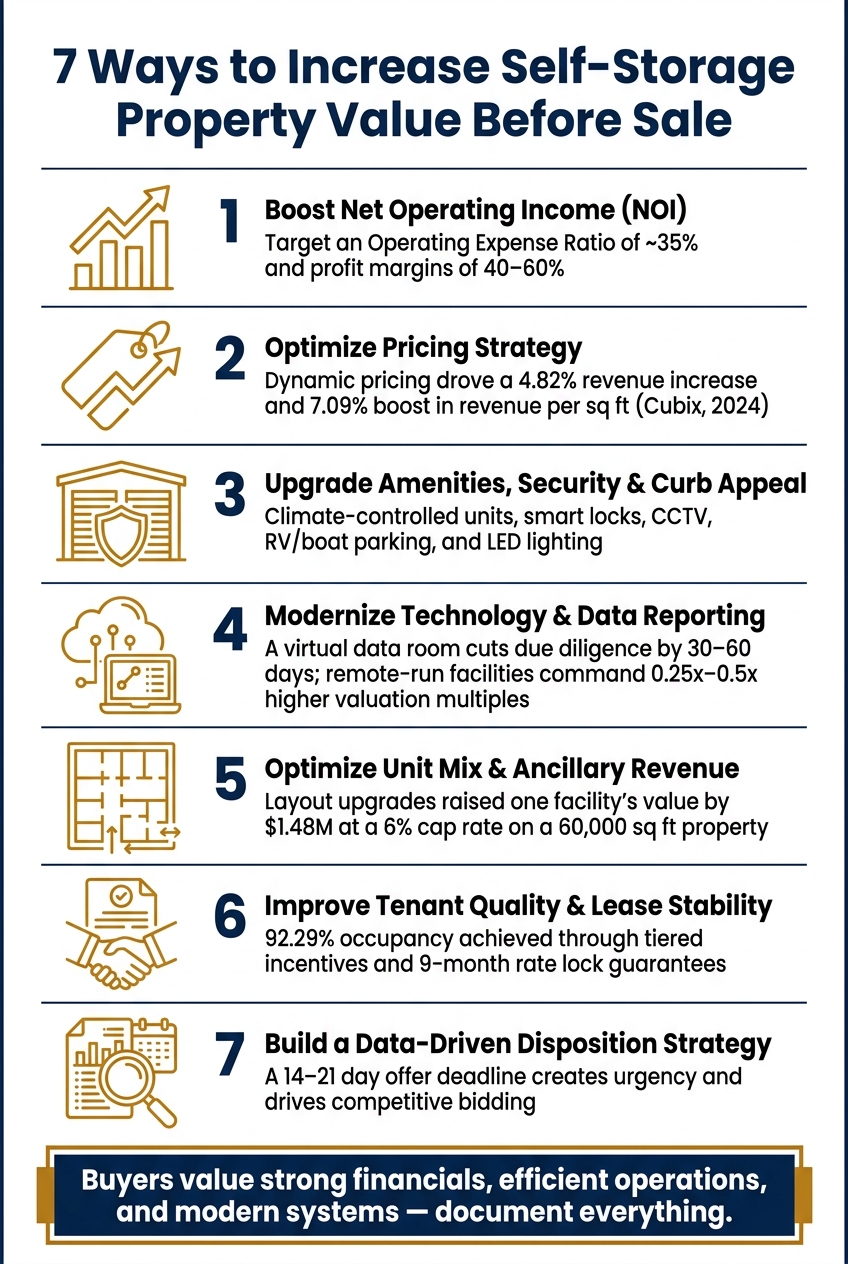
- Boost Net Operating Income (NOI): Cut expenses like labor and utilities while improving efficiency with automation and inspections.
- Optimize Pricing: Use dynamic and tiered pricing to adjust rates based on demand, occupancy, and market trends.
- Upgrade Appearance & Features: Improve security, curb appeal, and amenities like climate-controlled units and parking for RVs or boats.
- Leverage Modern Technology: Adopt cloud-based systems for better data reporting and create a virtual data room for streamlined due diligence.
- Refine Layout & Revenue Streams: Adjust unit sizes, enhance site flow, and add ancillary income sources like retail sales or tenant insurance.
- Focus on Tenant Quality: Avoid artificial occupancy boosts, standardize leases, and offer incentives that promote long-term retention.
- Create a Data-Driven Sales Strategy: Document your improvements, financials, and market data to back up your asking price.
Key takeaway: Buyers value a property with strong financials, efficient operations, and modern systems. By addressing these areas, you can increase your sale price and ensure a smoother process.
7 Ways to Increase Self-Storage Property Value Before Sale
How Do I Come Up With The Value For My Storage Facility
sbb-itb-09b4138
1. Boost Net Operating Income Through Operational Efficiency
Net operating income (NOI) is a critical metric for buyers, directly influencing cap rates and sale prices. By focusing on operational efficiency, self-storage facilities can improve NOI while maintaining service quality.
Focus on Labor Costs
Labor often represents the largest expense. Implementing tools like smart locks, automated gate access, and online payment systems can significantly reduce the need for full-time staff. Many automated facilities operate effectively with minimal part-time help, which cuts payroll expenses – a major component of any operating budget. A well-run facility typically aims for an Operating Expense Ratio (OER) of around 35%, with profit margins ranging between 40% and 60% when overhead is kept in check.
Manage Utility Expenses
Utility costs, especially in climate-controlled facilities, are another area to optimize. For a 40,000-square-foot facility, annual maintenance and utility costs can range from $2 to $4 per square foot. Reducing these expenses can make a noticeable impact on NOI. Regular inspections of high-wear items like unit doors, roofs, and pavement can help catch small issues early, avoiding costly capital repairs right before a sale.
"Cutting excess utility use, automating processes, and optimizing staffing helps protect NOI."
Audit Marketing Spend
Marketing often eats up a significant chunk of the budget, with small operators spending $500 to $2,000 per month on ads. However, many fail to track which channels actually drive move-ins. Transitioning to data-driven digital marketing and focusing on local SEO can help ensure every dollar counts. Since most self-storage properties take 18–36 months to stabilize, optimizing operations well before a planned sale can improve the financial record presented to buyers.
Improving NOI through operational efficiency not only enhances current profitability but also sets the stage for additional strategies to increase property value.
2. Use Revenue Management and Rent Optimization
Once you’ve trimmed costs, it’s time to focus on pricing strategies. Flat-rate pricing can leave money on the table by failing to account for factors like unit location, market conditions, or demand. When paired with efficient operations, smarter pricing approaches can directly improve NOI (Net Operating Income) – a critical metric for attracting buyers.
Dynamic pricing is all about adjusting rates in real time based on factors like occupancy, seasonal trends, and local market activity. For example, if units are filling quickly, rates can be increased. Conversely, during slower periods, targeted promotions can help maintain occupancy. Facilities using dynamic pricing often outperform those sticking to static rates. CBRE‘s analysis, highlights the effectiveness of this approach:
"These models adjust rent based on seasonality, competitor pricing, and occupancy levels, allowing operators to optimize revenue and maintain profitability even during off-peak periods."
A great example comes from Cubix Asset Management‘s 2024 pricing strategy. Under the leadership of Francesca Venezia, the company implemented dynamic, tiered, and differentiated pricing models. This resulted in 12,848 rate adjustments, leading to a 4.82% revenue increase and a 7.09% boost in revenue per square foot, all while maintaining a strong 92.29% occupancy rate.
"Pricing isn’t just about filling up units – it’s about maximizing revenue without compromising occupancy."
Tiered pricing offers another effective method. Instead of charging a flat rate for all 10×10 units, you can categorize them into tiers such as Economy (upper floor, interior), Standard (first floor), and Premium (drive-up, climate-controlled). By segmenting units this way, facilities can increase average rates. For a 400-unit facility, even a modest 5% lift in average rates can add approximately $28,500 to annual revenue.
To make these strategies even more precise, pricing software can be a game changer. Smaller operators with one to five facilities can use PMS-native tools that automate rate adjustments based on occupancy thresholds, such as raising rates when a unit type reaches 85% capacity. Larger portfolios may benefit from advanced platforms like Veritec or Prorize, which offer features like market benchmarking and churn sensitivity analysis. These data-driven systems not only improve revenue but also make properties more appealing to potential buyers.
3. Upgrade Amenities, Security, and Curb Appeal
Once you’ve fine-tuned operations and pricing, the next step is upgrading your facility to boost its appeal. Buyers don’t just look at numbers – they also judge a property by its appearance and features. If your facility looks neglected, even stellar financials won’t save the deal. Upgrades to physical features and amenities not only justify premium pricing but also make a strong first impression.
Security and curb appeal go hand in hand when it comes to building buyer confidence. Adding smart locks, modern CCTV systems, and improved access controls shows professionalism and can even reduce operating costs by cutting down on staffing needs. Simple improvements like better lighting can also make a big difference in perceived value. On the curb appeal side, fresh landscaping, clean signage, and well-maintained pavement signal that the property is move-in ready. Preventive maintenance – like fixing unit doors or patching up fencing – not only keeps the property looking good but also protects you during buyer inspections, where deferred maintenance might otherwise hurt your negotiating power.
Amenities are another key piece of the puzzle. Features like climate-controlled units for sensitive items, RV and boat parking, and drive-up access appeal to a broader range of tenants and justify higher rates. Here’s a quick breakdown of common upgrade categories and their potential impact:
| Upgrade Category | Example Improvements | Value Impact |
|---|---|---|
| Security | Smart locks, CCTV, gate access control | Justifies higher rates and reduces insurance costs |
| Curb Appeal | Landscaping, pavement, LED lighting, updated signage | Creates a positive first impression for buyers |
| Units | Climate-controlled storage, RV/boat parking | Attracts long-term, higher-paying tenants |
| Convenience | Drive-up units, 24/7 access, ground-floor storage | Supports tiered pricing and improves tenant retention |
| Ancillary Services | Retail sales (locks, boxes), package acceptance | Adds additional income streams |
4. Modernize Technology, Data, and Reporting
Streamlining operations and refining pricing strategies can boost revenue, but upgrading your technology takes it a step further – it builds trust with buyers by providing transparent and dependable data. While a facility’s appearance plays a role, modern systems and precise data are what truly seal high-value deals. Buyers and lenders scrutinize your records during due diligence, and what they uncover can either reinforce their confidence or lead to price negotiations. This technological focus complements earlier strategies aimed at revenue growth and operational improvements.
Perceived risk is the key concern here. Nolen Masserman, Managing Director at Oakside Companies, explains:
"The facilities using modern systems with minimal deferred maintenance are often seen as lower risk, which can lead to more favorable loan terms, higher loan-to-value ratios, lower interest rates and faster approvals."
Disorganized or incomplete records can signal inefficiencies. Even a small discrepancy – like $20,000 in income – could result in a $120,000 drop in property value when buyers apply a 6x NOI multiple. This makes accurate, well-organized data critical to securing the best sale price. Implementing a cloud-based property management system, such as Storable or Sitelink, ensures your records are consistent, easy to audit, and showcase your facility’s technological advantages.
Creating a virtual data room (VDR) is another essential step. This secure digital repository should include at least three years of profit and loss statements, tax returns, rent rolls, and 24 months of monthly occupancy history broken down by unit type. These are the exact documents SBA 7(a) lenders require and serious buyers expect. A VDR can significantly speed up the due diligence process, cutting it down by 30 to 60 days. This reduces deal fatigue and minimizes the risk of the transaction falling apart.
Additionally, a strong remote management setup demonstrates scalability. Facilities that run autonomously – using automated systems for access and billing – can command valuation multiples that are 0.25x to 0.5x higher than those requiring constant owner involvement. When paired with documented Standard Operating Procedures for tasks like collections and lien sales, you’re essentially showing buyers that the business can operate smoothly without hands-on oversight. These technological advancements also pave the way for improvements in property layout and tenant quality.
| Documentation Item | Why Buyers Care | Priority |
|---|---|---|
| 3 Years of P&Ls / Tax Returns | Required for SBA 7(a) financing and NOI verification | High |
| 24-Month Occupancy History | Shows stability trends rather than a single snapshot | High |
| Exportable Rent Roll | Confirms effective rent per square foot, driving valuation | High |
| Virtual Data Room | Shortens due diligence by 30–60 days | High |
| Online Rental / Autopay Logs | Demonstrates revenue stability independent of owner | Medium |
5. Optimize Unit Mix, Site Layout, and Ancillary Revenue
The way your facility is designed – both in terms of unit configuration and additional revenue opportunities – has a direct impact on your Net Operating Income (NOI) and, ultimately, the sale price. Since buyers focus on income potential, every square foot that isn’t generating revenue is a missed opportunity.
Reevaluate your unit mix. Not all unit sizes perform equally. If your 10×30 units are sitting empty while there’s a waitlist for 5×5 units, it’s time to consider a change. Converting underperforming large units into smaller, high-demand options – or even specialty spaces like climate-controlled units or RV/boat parking – can significantly boost revenue per square foot:
"Adding new unit types or converting underused spaces can help optimize your revenue per square foot."
Site layout plays a bigger role than many realize. Units with drive-up access, ground-floor locations, or spots close to the main entrance often command higher rents compared to interior or upper-floor units. If your layout doesn’t emphasize these premium features, you’re likely missing out on additional income. Enhancements like better pavement, clear signage, and optimized traffic flow can also improve occupancy rates. For example, a facility with upgraded asphalt and signage reached 92% occupancy at $15 per square foot, while a neighboring property with deferred maintenance only achieved 88% occupancy at $14 per square foot. At a 6% cap rate, increasing cash flow by $88,800 through these improvements raised the value of a 60,000-square-foot facility by $1.48 million.
In addition to layout adjustments, ancillary revenue streams offer a quick way to boost NOI without expanding your footprint. Programs like tenant insurance referrals, selling locks and moving supplies, truck rentals, and administrative fees generate extra income with minimal effort. These additional streams not only increase revenue but also show potential buyers that the business isn’t solely reliant on unit occupancy. When a well-thought-out layout leads tenants toward premium units and convenient services, ancillary offerings naturally enhance income diversity and overall property value.
6. Improve Tenant Quality, Occupancy Stability, and Lease Terms
Having high occupancy rates may look good on paper, but what really matters is whether those numbers are sustainable. Serious buyers aren’t just interested in your current occupancy – they want to know if it’s built to last. RK Kliebenstein, Founder of Self Storage LLC, explains it well:
"A common seller mistake is to offer deep discounts and concessions to rapidly drive occupancy just before a sale… a sophisticated buyer will immediately re-underwrite your rent roll to reflect achievable, long-term market rates."
If you artificially boost occupancy with heavy discounts right before selling, it can backfire. Savvy buyers will adjust the rent roll to reflect realistic market rates, recalculating your Net Operating Income (NOI) accordingly. This often leads to a lower valuation than if you had avoided those discounts in the first place. The key takeaway? Focus on genuine, steady occupancy that aligns with market conditions to maintain credibility and protect your NOI.
Build Long-Term Occupancy
To attract tenants who are likely to stay longer, consider offering incentives that promote stability. For example, instead of "first month free" deals, try promotions like "25% off for the first 4 months." This approach reduces tenant turnover without giving away too much revenue upfront. Another effective strategy is implementing a 9-month rate lock guarantee, which provides tenants with price certainty, improving retention rates.
A great example of this in action comes from Cubix Asset Management. In 2024, under Francesca Venezia’s leadership, the company adopted a data-driven strategy that combined dynamic pricing, tiered incentives, and rate lock guarantees. The results speak for themselves: they achieved a steady occupancy rate of 92.29%, increased average rent per square foot by 3.5%, and boosted total revenue by 4.82% through 12,848 strategic rate adjustments.
Standardize Lease Terms
Inconsistent lease agreements can raise red flags for buyers, signaling potential operational risks. By standardizing lease terms, you demonstrate a reliable and repeatable system, which is particularly appealing to institutional buyers like REITs. Offering modest discounts for 6- or 12-month contracts can encourage longer commitments, helping to stabilize your rent roll. This not only improves tenant quality but also ensures more predictable income, which directly enhances your NOI and reduces perceived buyer risk.
Clean Up Your Financials
One or two years before listing your property, take the time to tidy up your financial records. Remove any personal or non-business expenses – like personal car payments – from your profit-and-loss statement. Buyers and their underwriters will strip these out anyway, and a cluttered P&L can create unnecessary doubts. A clean financial record, paired with a stable and well-documented tenant base, signals lower risk to buyers. And when perceived risk is reduced, valuations tend to rise.
7. Build a Data-Driven Disposition Strategy
Once you’ve fine-tuned your operations and stabilized tenant occupancy, it’s time to showcase the enhanced value of your property. Leveraging your improved NOI (Net Operating Income) and tenant stability, a well-structured, data-backed disposition strategy becomes critical.
Operational upgrades only translate into higher sale prices when they’re thoroughly documented. Your sales package should include detailed financial and occupancy records, as well as a clear property history highlighting the capital improvements made during your ownership. Margo Masserman, VP at Oakside Companies, emphasizes this point:
"Valuing a self-storage facility requires reviewing key reports and assessing physical condition. Buyers generally evaluate assets based on current, in-place rents and market-adjusted expenses."
Local market data also plays a big role. Including verified details like competitor rates, absorption trends, and demographic insights reassures buyers that your asking price reflects the market’s realities. Cameron Vale at Oakside Companies underscores the importance of this:
"Having real historic occupancy and financial data allows us to tell a credible market story and dramatically improves the quality of our offering materials."
To maximize interest, market your sales package with a 14- to 21-day offer deadline. This creates a sense of urgency among buyers, encouraging competitive bids and potentially driving up the final sale price. As Margo Masserman puts it:
"Multiple offers are key to driving up the price!"
Combining well-documented improvements with a strategic sales process ensures your property gets the attention – and price – it deserves. Partnering with a specialized advisor can take your disposition strategy even further. For example, Oakside Co, a national commercial real estate advisory firm specializing in self-storage and boat & RV assets, helps sellers organize financial records, benchmark operational metrics, craft targeted marketing plans, and manage competitive bidding. Their investment-banking-level analysis equips sellers with the tools to secure the best possible outcome.
Conclusion
Selling a self-storage property for the highest price requires thorough preparation and a clear strategy. Each step is designed to address the concerns of potential buyers while showcasing the property’s value. By focusing on operational improvements, revenue management, and strategic upgrades, you can build buyer confidence and maximize the sale price.
For instance, improving NOI (Net Operating Income) through better operations, smart pricing strategies, and targeted upgrades not only increases income but also attracts serious buyers. Features like enhanced amenities and improved curb appeal leave a lasting impression during property tours. Meanwhile, modern technology and transparent data reporting simplify the underwriting process, making the deal more appealing. A well-thought-out disposition strategy, supported by detailed financials and market insights, ensures a smooth and successful transaction.
As Margo Masserman of Oakside Companies explains:
"Selling a self-storage facility is an undertaking. To ensure you extract the most value at closing, the process requires careful consideration and strategic planning."
Ultimately, buyers are drawn to verified improvements, not just promises. By demonstrating clear, documented upgrades and reliable tenant metrics, you position your property as a solid investment.
FAQs
How far ahead should I start preparing my facility to sell?
Preparing your self-storage facility for sale should ideally begin 3 to 6 months in advance. This timeline allows you to make necessary upgrades, enhance its curb appeal, and ensure the property aligns with market expectations. Thoughtful improvements during this period can boost the facility’s value and draw in buyers who are ready to pay top dollar.
Which upgrades raise value the most without over-improving?
Upgrades such as better security systems, improved lighting, and more efficient access control can be smart, budget-friendly ways to increase property value. These updates not only make a property more appealing but also come with depreciation benefits, making them a balanced investment. They’re seen as practical improvements that catch the attention of potential buyers without requiring excessive spending.
What documents do buyers expect in due diligence?
During the due diligence process, buyers generally look for documents that outline the property’s financial and operational performance. These documents often include financial statements, occupancy rates, maintenance records, and property appraisals. Supplying well-organized and accurate records allows buyers to evaluate both the property’s value and its overall condition effectively.