Selling a self-storage facility involves careful planning, accurate valuation, and understanding market trends. Key factors include timing the sale, maximizing income, and preparing the property for buyer scrutiny. Here’s what you need to know:
- Why Sell? Common reasons include retirement, burnout, health issues, financial opportunities, or competition.
- Timing Matters: Sellers often list in spring to reflect peak summer occupancy in financials. Strong Net Operating Income (NOI) years and stable market conditions (2026 cap rates: 5.0%-8.5%) are ideal.
- Valuation Formula: Property Value = NOI ÷ Cap Rate. Every $1 of income can add $10 to the sale price.
- Preparation Steps: Organize financial records, address maintenance issues, and ensure compliance with local regulations.
- Sales Process: Typically takes 6-12 months, including valuation, marketing (6-10 weeks), and due diligence.
- Sales Approach: On-market listings attract more offers and higher prices but take longer. Off-market sales are faster but may yield less.
Avoid common mistakes like unrealistic pricing, poor preparation, and neglecting tax planning. Partnering with experienced brokers can simplify the process and help secure the best outcome.
Exit Strategies and Valuation: Preparing for a Successful Sale of Your Self Storage Facility – 380
sbb-itb-09b4138
How to Value Your Self-Storage Facility
To determine the value of your self-storage facility, start by calculating its Net Operating Income (NOI). This involves subtracting operating expenses (excluding mortgage payments) from total income [3]. Once you have the NOI, you can estimate the property value using this formula:
Property Value = NOI ÷ Cap Rate
Scott Schoettlin, Managing Director at SkyView Advisors, highlights the financial impact of cap rate changes:
"A swing of just half a percentage point [in cap rate] can add or subtract millions of dollars" [2].
For example, a facility generating $60,000 in NOI with a cap rate of 7% would be valued at roughly $857,142. If the cap rate drops to 5%, the value jumps to about $1.2 million. Even small improvements to your NOI can have a big impact on your facility’s valuation [2]. Let’s dive into the factors that influence these numbers.
Factors That Affect Your Facility’s Value
Several key factors determine how much your facility is worth to potential buyers:
- Location and demographics: The characteristics of the area around your facility, typically within a three- to five-mile radius, are crucial. Population density, average household income, and the amount of storage space already available per capita all influence demand. Areas with a high concentration of apartment renters often see stronger storage demand since renters tend to move more frequently and have less space than homeowners [2].
- Property condition: The physical state of your facility matters. Features like curb appeal, maintenance history, security measures, and lighting not only affect current performance but also shape buyer perceptions. Deferred maintenance can hurt your valuation since buyers account for future repair costs, which increases perceived risk [2].
- Occupancy and revenue trends: Facilities with occupancy rates above 90% often have room to increase rental rates, boosting NOI and value. However, buyers will look closely at the difference between physical occupancy (how full the facility is) and economic occupancy (how much revenue it generates). Heavy discounting can leave a facility 95% full but with weak revenue, which lowers its NOI [3].
- Operational efficiency: Buyers value facilities with modern systems, such as revenue-management tools, automation, and a strong digital marketing presence. These features help maintain high occupancy and control costs [2].
- Macroeconomic factors: Broader economic conditions, like changes in Federal interest rates, also play a role. When borrowing costs rise, asset values often decline [2].
Once you’ve assessed these internal factors, it’s time to broaden your perspective with a detailed market analysis.
Conducting a Market Analysis
To understand your facility’s competitive position, analyze 5 to 10 recent sales of comparable properties (known as comps). These facilities should be similar in size, type, and occupancy to yours. By dividing each property’s NOI by its sale price, you can calculate market-derived cap rates [3].
Look beyond just the numbers. Consider local factors like planned developments and zoning changes. Markets with high barriers to entry, such as strict zoning laws or limited land availability, often maintain stronger long-term values [3]. As Gavin Shields, CEO of Stora, explains:
"Replacement cost often sets a ceiling for valuations. If market values rise above cost, developers will build new facilities" [3].
For context, single-story facilities typically cost $50–$65 per square foot to build, while multi-story projects range from $90–$130 per square foot. If your facility’s value approaches these construction costs, new developments could enter the market and impact demand.
Don’t forget to account for seasonal revenue fluctuations by analyzing 12 months of income data. If you’re using projected income for valuation, make sure your assumptions about rent growth and lease-up speeds are realistic. Finally, consult an experienced broker or appraiser to validate your findings and avoid relying on just one metric [2][3].
Understanding Cap Rates in Self-Storage Valuation
Cap rates are a key tool for translating NOI into property value. They represent the expected return on investment in a specific market. Generally, a lower cap rate means a higher property value, as investors accept lower returns for lower-risk assets. On the flip side, higher cap rates indicate greater perceived risk or weaker demand, which reduces property value [3].
Cap rates vary widely depending on the market and the quality of the facility. For instance, a Class-A facility in a bustling urban area might trade at a 5% cap rate, while an older property in a less desirable location could see cap rates of 8% or higher [2]. Gavin Shields emphasizes this variability:
"Cap rates are market-specific. A facility in a major city will usually trade at a different cap rate than one in a smaller or higher-risk market" [3].
When applying cap rates, distinguish between trailing (historical) and pro forma (projected) NOI. Buyers tend to favor proven performance. For example, a facility with $500,000 in NOI would be valued at $10 million with a 5% cap rate. However, if the cap rate rises to 5.5%, the value drops to about $9.09 million [2].
Getting Your Facility Ready for Sale
When preparing to sell your self-storage facility, addressing potential buyer concerns upfront is critical. RK Kliebenstein, Founder of Self Storage LLC, emphasizes the importance of first impressions:
"A buyer’s first impression is your self-storage facility’s curb appeal. Signs of deferred maintenance are an immediate red flag" [5].
Buyers usually pay between 4.5x to 7x NOI for well-maintained properties. However, neglect can significantly lower this valuation. For example, $30,000–$80,000 in deferred maintenance could lead to price reductions of $150,000–$300,000 during due diligence [6].
Improving Property Appearance and Maintenance
Begin with the basics: pavement, landscaping, fencing, and lighting. These are the first things buyers notice. Poor pavement, for instance, not only diminishes curb appeal but can also raise concerns about ADA compliance, which might alarm lenders [6]. Roofing and drainage issues are particularly costly, often resulting in post-LOI price cuts ranging from $50,000 to $200,000 [6].
To address these concerns, consider hiring an engineer to evaluate major components like roofs, paving, and HVAC systems. Getting contractor bids allows you to either fix the problems or disclose them accurately to potential buyers [5][6].
Focus on high-impact improvements. Ensure unit doors are clean and functional [4][5]. Modernize your facility by upgrading to cloud-based video surveillance and gate access systems. These features not only enhance security but also support remote management, potentially increasing your sale multiple by 0.25x to 0.5x NOI [6]. On average, facilities spend $2 to $4 per square foot annually on maintenance and utilities [4].
Once you’ve optimized the physical aspects, shift your attention to organizing your financial and operational records.
Organizing Financial and Operational Documents
A polished exterior is just the start. Buyers will dive deep into your financial and operational data during due diligence. To streamline the process, prepare 12 months’ worth of financial, operational, and contractual records in a secure digital folder. This level of preparation can cut 30 to 60 days off the due diligence timeline [6].
Verifying Permits and Regulatory Compliance
After tackling documentation, ensure your facility complies with all regulatory requirements. Double-check that your current operations, including any expansions, align with local zoning ordinances. Verify that occupancy certificates are valid for all buildings. Conduct Phase I Environmental Site Assessments early to identify potential contamination risks and avoid closing delays. Review ADA compliance for parking and office access, and audit lien sale documentation to confirm legal adherence [6][7][8].
Additionally, examine tenant leases to ensure they prohibit hazardous materials and unauthorized business activities. Local regulations often forbid operations like vehicle repair or retail businesses within storage units [7][8].
Selecting Your Sales Approach
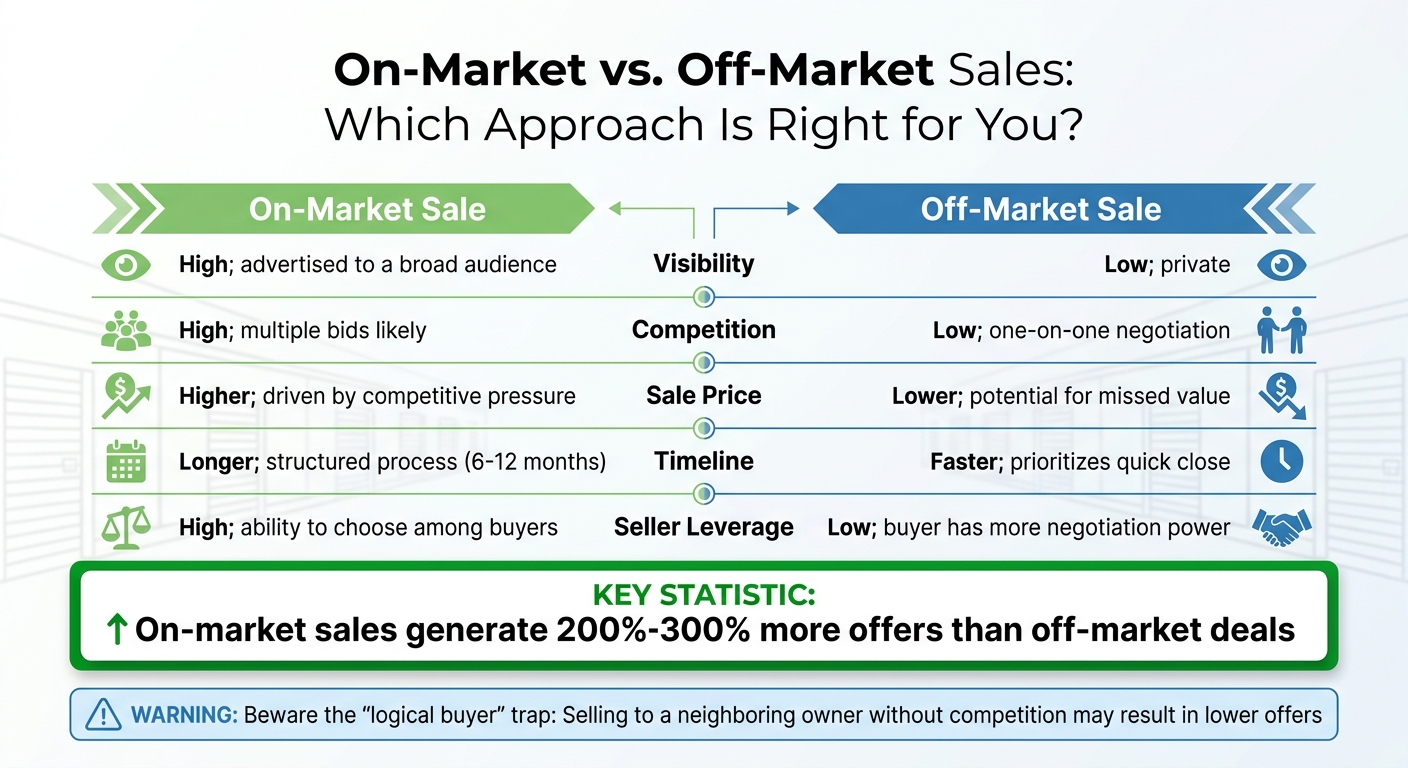
On-Market vs Off-Market Self-Storage Facility Sales Comparison
The sales strategy you choose will directly impact both the price you secure and how quickly you close the deal. By combining a well-prepared facility with strong market positioning, you can ensure that the work you’ve put into increasing its value translates into buyer confidence. Most sellers face a key decision: opt for an on-market sale to maximize exposure or go with an off-market offer from a buyer who approaches you directly.
Working with a Self-Storage Broker
A broker specializing in self-storage can connect you with a network of qualified buyers almost immediately. Some firms, for example, maintain databases with over 17,000 investors [10]. These buyers range from institutional investors like REITs and private equity funds to local operators eager to grow their portfolios.
But brokers do more than just connect you with buyers – they create what’s known as a "controlled, competitive process." Austin McLeod, Senior Vice President at Matthews Real Estate Investment Services, explains:
"If a facility can attract four or five unsolicited offers, it’ll likely generate two or three times that number if it’s fully marketed, driving higher offers through increased competition" [9].
Brokers also tidy up your financials by excluding one-time expenses, which helps present a higher, stabilized NOI [5]. This financial cleanup can significantly enhance your valuation. Additionally, experienced brokers guide you through the due diligence process, ensuring buyers receive the necessary documentation quickly, reducing delays, and minimizing the risk of price renegotiations.
It’s worth seeking brokers with hands-on experience managing or owning self-storage facilities. As Jason "Jay" Allen, Co-founder of Performance Self Storage Group Inc., puts it:
"When you’re selling a self storage facility you’re not only selling real estate, you’re selling a business. That makes things a little more complex" [10].
Ultimately, you’ll need to decide whether to pursue a widely marketed sale or a more discreet approach.
Off-Market vs. On-Market Sales: A Comparison
Your decision between on-market and off-market sales should align with your goals. On-market sales involve actively advertising your property, ensuring broad exposure and encouraging competitive bidding. Off-market sales, on the other hand, focus on privacy and speed, often at the expense of achieving the highest price [9].
Statistics highlight the benefits of on-market sales: they typically generate 200%-300% more offers than off-market deals [9]. However, the trade-off is time – on-market sales often take 6 to 12 months to complete [1].
| Feature | On-Market Sale | Off-Market Sale |
|---|---|---|
| Visibility | High; advertised to a broad audience | Low; private |
| Competition | High; multiple bids likely | Low; one-on-one negotiation |
| Sale Price | Higher; driven by competitive pressure | Lower; potential for missed value |
| Timeline | Longer; structured process | Faster; prioritizes quick close |
| Seller Leverage | High; ability to choose among buyers | Low; buyer has more negotiation power |
One common pitfall is what McLeod calls the "logical buyer" trap – selling to a neighboring owner or familiar contact without realizing they may not offer their best price unless pushed by competition [9]. He cautions:
"The misconception that private deals are ‘quick and easy’ or guarantee better terms can be costly" [9].
Using Digital Marketing to Reach Buyers
Whether you go on-market or off-market, digital marketing plays a key role in reaching buyers. Most property searches today start online, where institutional investors – such as REITs, private equity firms, and family offices – browse listings before contacting brokers or scheduling site visits [1].
High-quality online listings with professional photography and virtual tours can make a powerful first impression. These tools are especially effective in attracting institutional capital, which remains active in 2026 as firms seek opportunities to scale [1].
Timing also matters. Aim to list your facility between April and June. This timing allows your trailing 12-month financials to reflect peak summer occupancy, potentially boosting your valuation by as much as $400,000 for a 300-unit facility compared to winter listings [1].
Common Mistakes to Avoid When Selling
Even the most prepared sellers can make errors during the sales process. Three common pitfalls are setting an unrealistic price, being unprepared for due diligence, and neglecting tax planning.
Setting an Unrealistic Asking Price
Accurate financials are essential, and pricing missteps can derail a sale. Overpricing not only slows the process but can also reduce your final proceeds. Buyers are savvy and will quickly spot inflated numbers, especially when it comes to occupancy rates.
One common mistake is offering steep discounts just before listing a property to artificially boost occupancy. According to RK Kliebenstein, Founder of Self Storage LLC:
"This ‘marking to market’ can reveal that your actual stabilized NOI is much lower than what’s stated, which directly and negatively impacts the valuation" [5].
This means buyers will adjust numbers to reflect sustainable, market-rate rental income [5].
To present a clear and accurate picture, remove personal expenses – like vehicle payments – from your profit-and-loss statement. Additionally, separate one-time capital expenditures, such as a new roof or paving, from regular operating expenses. This allows buyers to see your true, stabilized NOI [5]. Deferred maintenance can also harm your valuation. If major systems like HVAC or roofing are near the end of their lifespan, buyers will likely deduct replacement costs from their offer – often dollar-for-dollar [5].
Failing to Prepare for Due Diligence
Pricing aside, preparation is crucial. Buyers will meticulously review every detail, and unexplained cost spikes or revenue gaps can lead to concessions or even kill the deal. Structural problems uncovered during physical inspections – like water damage or foundation issues – can completely derail negotiations if not addressed beforehand.
Start early by organizing your documentation. Compile a package that includes current rental agreements, customer payment histories, and a detailed accounting of all security deposits. Double-check that your property’s zoning supports its current use and any potential expansion plans, as buyers often consider future growth in their calculations. For older properties, it may be worth conducting an environmental assessment in advance to avoid surprises that could jeopardize the sale.
Overlooking Tax Consequences
Selling a property can have major tax implications. A lump-sum sale could push you into a higher tax bracket. Federal long-term capital gains rates typically range from 15% to 20%, and with the 3.8% Net Investment Income Tax, your total federal rate could hit 23.8% [12]. State taxes and real estate transfer taxes, which vary by location, add to this burden.
Depreciation recapture is another factor to consider, as the IRS taxes it even if you opt for an installment sale [12] [13]. To defer taxes, you could explore a 1031 exchange, which allows you to reinvest proceeds into a like-kind property. Keep in mind, you have 45 days to identify a replacement property and 180 days to complete the exchange [12]. Other options include installment sales, which spread tax liability over time, or Deferred Sales Trusts (DST), where the trust reinvests the principal while paying you in installments [11] [12].
Proper tax planning can protect your proceeds and help you achieve a favorable outcome. Always consult a CPA or tax attorney to navigate these complexities and ensure compliance with state-specific rules.
Conclusion
Selling a self-storage facility involves more than just listing the property – it requires detailed planning, an accurate valuation, and well-thought-out marketing and tax strategies. A smooth transaction hinges on precise assessments and thorough due diligence.
Partnering with seasoned professionals can make all the difference. As Gavin Shields, CEO at Stora, points out:
"Sanity-checking your numbers with a broker, appraiser, or experienced operator can help avoid costly mistakes" [3].
These professionals rely on various valuation techniques and proprietary data to deliver accurate assessments of your facility’s worth.
Beyond pricing, successful self-storage transactions often involve strategic asset improvements. Experts can uncover ways to boost your property’s value, such as adding climate control features or adjusting the unit mix to meet market demand, instead of selling the property as-is [14]. They also help avoid common mistakes, like over-relying on gross revenue instead of NOI or using broad national averages instead of localized cap rates [3].
This kind of expertise ensures a seamless transition from the planning stage to a successful sale. For instance, Oakside Co specializes in self-storage transactions, leveraging data-driven strategies and investment-grade analysis to help sellers achieve maximum value. With years of industry experience, comprehensive transaction management, and a robust investor network, Oakside Co supports both independent operators and institutional clients, offering tailored services that even include tax deferral strategies.