
When selling an RV storage facility, preparation is critical to achieve a high sale price and attract serious buyers. Here’s a quick breakdown of what you need to focus on:
- Start Early (12–24 Months Before Listing):
- Stabilize cash flow.
- Clean up financial records.
- Address physical property issues.
- Physical Property Condition:
- Fix deferred maintenance (e.g., paving, lighting, security).
- Ensure drive aisles meet RV standards (50–60 feet wide).
- Complete upgrades that add value (e.g., LED lighting, resurfaced asphalt).
- Financial Performance:
- Optimize rental rates based on occupancy trends.
- Reduce delinquencies and stabilize cash flow.
- Use property management software for accurate records.
- Legal and Regulatory Compliance:
- Conduct a Phase I Environmental Site Assessment.
- Ensure zoning compliance and valid permits.
- Organize all legal documents (e.g., deeds, surveys).
- Market Positioning:
- Highlight competitive advantages (e.g., location near recreational areas).
- Present growth opportunities (e.g., expansion, premium amenities).
- Organized Documentation:
- Provide 3 years of financial statements.
- Prepare a detailed rent roll and occupancy history.
- Use a secure digital data room for easy access.
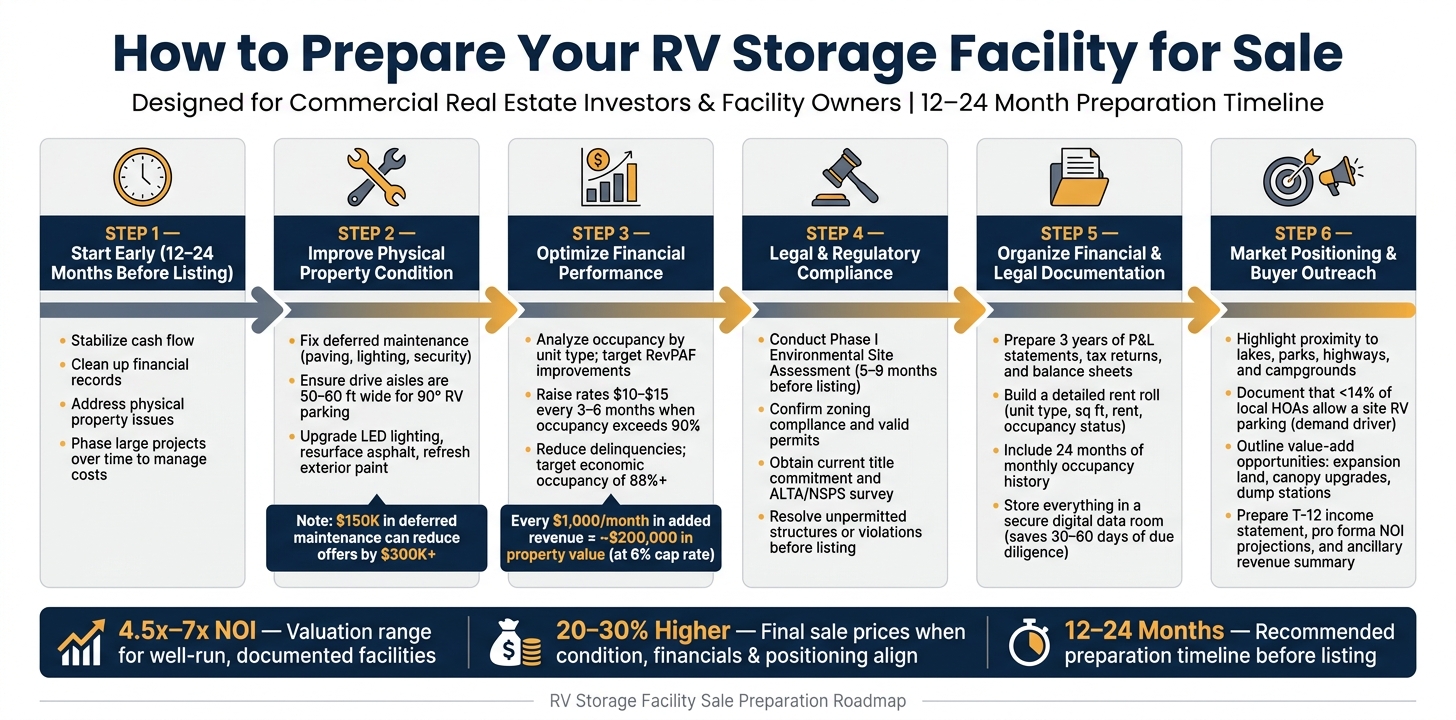
How to Prepare Your RV Storage Facility for Sale: 12–24 Month Roadmap
Assessing and Improving the Physical Condition of Your Facility
The condition of your property is one of the first things potential buyers notice. A well-maintained facility not only reflects operational efficiency but also reduces the perceived risks buyers associate with their offers. On the flip side, neglecting maintenance can cost you more than just repair expenses. As Matt Wess, Senior Vice President of Real Estate at MyPlace Self Storage, explains:
"The state of your facility can quietly add or subtract hundreds of thousands – sometimes millions – of dollars to or from your bottom line."
This makes physical upgrades a key part of preparing your property for sale.
Walk the Property and Document What Needs Fixing
Begin with a detailed walkthrough of your property, evaluating it as critically as a potential buyer would. Check everything: drive aisles, parking areas, fencing, gates, security systems, lighting, unit doors, and drainage. Keep a detailed list of every issue you find, no matter how small, and include rough cost estimates for each.
For RV storage facilities, drive aisle width is a major factor. Industry standards suggest 50–60 feet for 90-degree parking layouts to accommodate large vehicles and trailers. If your aisles are too narrow or your pavement shows significant wear, these will stand out as red flags to buyers. Take photos of all issues before and after repairs to showcase the improvements you’ve made. Once the assessment is complete, focus on upgrades that bring the most value.
Prioritize Upgrades That Deliver the Best Return
Not all repairs are created equal. Prioritize upgrades that directly influence buyer perception and reduce lender concerns.
Here’s why it matters: a facility needing $150,000 in repairs may see buyer offers drop by $300,000 or more because of the risks buyers perceive. This means every dollar of visible deferred maintenance can cost you about two dollars during negotiations.
For RV storage facilities, the most impactful upgrades often include LED lighting with motion sensors, resurfaced asphalt, fresh exterior paint, and enhanced perimeter security. For example, a comparison of two 60,000-square-foot properties found that the facility investing in new doors, updated lighting, a refreshed facade, and smooth asphalt was able to charge $1 more per square foot and reach 92% occupancy vs. 88% for the unimproved property. This translated to $1.48 million more in asset value at a 6% cap rate.
For larger projects like roof replacements or asphalt resurfacing, consider phasing the work over 12 to 24 months. This approach helps manage cash flow while ensuring the property is market-ready when the time comes. Once you’ve tackled these upgrades, ensure the property complies with local regulations and address any environmental concerns.
Confirm Code Compliance and Clear Environmental Issues
Code compliance and environmental issues can quickly derail a deal during buyer due diligence, often leading to price renegotiations. Addressing these problems early is far less costly than dealing with them mid-transaction.
Start with a Phase I Environmental Site Assessment (ESA), ideally 5 to 9 months before listing. This report identifies potential environmental concerns, such as underground storage tanks or nearby contamination, and is typically required for buyers using institutional or SBA financing. Unresolved environmental issues can even halt a sale entirely.
Beyond the ESA, confirm that your zoning permits your current operations, that all structures have valid permits, and that your Certificate of Occupancy is up to date. Additionally, ensure your stormwater drainage and septic systems meet local health standards. Unpermitted structures or zoning violations are major issues that buyers – and their attorneys – will uncover and use to negotiate a lower price. Resolving these problems before listing your property and organizing all documentation digitally will streamline the buyer’s review process and help keep the deal on track.
sbb-itb-09b4138
Improving Financial and Operational Performance Before Listing
Once physical upgrades are complete, it’s time to fine-tune your facility’s financial and operational performance. Buyers and lenders will scrutinize your income, occupancy trends, and daily operations just as closely as they examine the physical condition of the property. A facility that runs efficiently while generating consistent, growing revenue is not only easier to finance but also far more appealing to serious buyers.
Analyze Occupancy and Adjust Rental Rates
Don’t stop at looking at your overall occupancy percentage – it’s critical to dig deeper. For instance, a facility with 90% occupancy might have certain unit types, like covered RV spaces, operating at 98% capacity. This signals an opportunity to adjust rates for those high-demand units. Break down your occupancy data by unit type and compare your pricing to competitors within a 3–5 mile radius.
A key metric to focus on is RevPAF (Revenue Per Available Square Foot). To calculate this, divide your annual rental revenue by the total rentable square footage. For example, if a 50,000-square-foot facility generates $480,000 annually, the RevPAF is $9.60 per square foot per year.
- If a unit type has an occupancy rate above 90%, consider increasing rates to improve margins.
- If occupancy drops below 85%, use short-term promotions to attract new tenants.
To avoid disrupting your tenant base, implement rate increases gradually – $10–$15 increments every 3–6 months work well. Once your rental rates are optimized, shift your attention to ensuring operations can function without heavy owner involvement.
Formalize and Document How the Facility Operates
A facility that runs smoothly without relying on the owner is far more attractive to buyers. If your operations depend on personal knowledge, informal relationships, or manual processes, buyers may view this as a risk and adjust their offers accordingly. The solution? Document everything.
Start by creating standardized lease agreements that include clear rent escalation clauses. Ensure you have a written lien sale process, vendor contracts, and maintenance logs complete with invoices and warranties. Replace spreadsheets with property management software that can generate accurate rent rolls to withstand even the most rigorous due diligence.
Additionally, document your technology systems. Features like cloud-based gate access, online rental portals, and autopay enrollment demonstrate that your facility can generate demand and manage operations efficiently without requiring hands-on involvement. Facilities with operational efficiency can command valuations of 4.5x–7x NOI.
Reduce Delinquencies and Stabilize Cash Flow
When evaluating a facility, buyers prioritize economic occupancy – the rent actually collected – over physical occupancy. For example, a facility with 90% physical occupancy might still struggle if 10% of tenants are behind on payments. Most lenders require an economic occupancy rate of 88% or higher for favorable underwriting.
To close the gap, automate your collections process and enforce your lien procedures consistently. Encourage tenants to switch to autopay and reduce reliance on cash payments. Lease agreements should clearly outline the lien timeline to avoid confusion. Inconsistent collections practices are a red flag for lenders.
Consider implementing strategies to generate additional high-margin revenue. For instance, charging late fees ($20–$50 per incident) and offering tenant insurance ($10–$15 per month) can offset minor delinquencies. At a 6% cap rate, every $1,000 in added monthly revenue increases your property’s value by approximately $200,000. For a 300-unit facility, tenant insurance alone could produce $3,000 to $4,500 in monthly profit.
Organizing the Financial and Legal Documents Buyers Expect
When selling a property, it’s not just the asset itself that buyers evaluate – it’s also the confidence they gain from well-organized financial and legal records. A clear and structured data room can shave 30–60 days off due diligence, keeping deals on schedule. Here’s what you need to have ready to boost buyer confidence and streamline the sale process.
Prepare Three Years of Financial Statements
Buyers and SBA lenders typically require three years of financial records, including profit and loss (P&L) statements, tax returns, balance sheets, and a trailing twelve-month (TTM) summary to confirm the property’s net operating income (NOI). It’s crucial that your P&L statements align with your tax returns and bank records. Any discrepancies can raise concerns for lenders and give buyers room to negotiate a lower price.
To provide an accurate picture of earnings, prepare an owner’s add-back schedule. This adjusts for personal expenses that might skew the numbers. For example, a $20,000 gap in documented income could result in a $120,000 drop in property value if the valuation uses a 6x multiple.
Build a Detailed Rent Roll and Space Inventory
"This single document [rent roll] drives more of your valuation conversation than anything else." – DealFlow OS
A well-prepared rent roll is critical. It should list every unit with details such as unit number, type (e.g., covered RV, uncovered, drive-up), exact square footage, current rent, move-in date, and occupancy status. Pair this with a site map or space plan to help buyers visualize the property layout without needing extra clarification.
Additionally, include at least 24 months of monthly occupancy history. Buyers focus on trends over time rather than a single point in time. Inconsistent occupancy data can suggest operational risks, which might lower your valuation multiple and lead to price reductions.
Gather Deeds, Surveys, and Key Legal Documents
Legal documentation is another area where deals can stall if not handled early. Start by ordering a current title commitment to uncover any recorded liens, easements, or shared access agreements that may need resolution before closing. For surveys, an ALTA/NSPS survey is preferred by commercial lenders because it verifies property boundaries and flags potential encroachments.
Here’s a quick breakdown of key legal documents buyers will expect:
| Document | Purpose |
|---|---|
| Deed & Title Report | Confirms ownership and identifies liens or encumbrances |
| ALTA/NSPS Survey | Verifies boundaries and highlights encroachments |
| Phase I ESA | Essential for institutional and SBA financing |
| Zoning Letter | Confirms legal use and potential for expansion |
| Vendor/Service Contracts | Details obligations the buyer will inherit |
If you’ve done any construction or additions, make sure to have an updated certificate of occupancy and ensure all structures comply with zoning laws. For any known issues, such as a recorded easement, disclose them upfront. Being transparent builds trust and avoids last-minute renegotiations that could derail the deal.
Organize Everything in a Secure Digital Data Room
To make the process smooth, store all these documents in a secure digital data room. Use a clear folder structure (e.g., Financial, Legal, Operational, Environmental) and consistent file naming conventions like 2024-06-15_Phase-I-ESA. This ensures that buyers and their advisors can quickly locate what they need without repeated requests.
Positioning Your Facility to Attract the Right Buyers
Once you’ve strengthened your facility through physical upgrades and financial adjustments, the next step is to focus on showcasing its advantages. This isn’t just about advertising – it’s about understanding your potential buyers and addressing the factors that matter most to them.
Review Your Market Position and Property Advantages
With your operations and documents in order, take a closer look at your facility’s position in the local market. Start by identifying nearby competitors and comparing key elements like unit types, pricing, and occupancy rates. From there, document what makes your property stand out.
Certain features can carry significant weight with buyers. For instance, being located near recreational hotspots – like lakes, national parks, or highways leading to campgrounds – can drive consistent tenant demand. If fewer than 14% of HOAs in your area permit on-site RV parking, this creates a clear demand for off-site storage. Supporting this with county-level RV registration data can further highlight unmet demand, reinforcing your property’s strengths.
On the physical side, emphasize the condition of major infrastructure. Features like wide drive aisles and pull-through access are especially attractive for RV-specific facilities. These details can help position your property as a standout option in the market.
Outline a Value-Add Plan for Prospective Buyers
Buyers, particularly institutional ones, are not just interested in what the facility is today – they’re also looking at its future potential. Laying out a clear value-add plan can significantly increase your property’s appeal.
Highlight opportunities for growth, such as unused land that could accommodate more units or the potential to upgrade open-air spaces into canopy-covered or fully enclosed units. Adding premium amenities like electric trickle-charge outlets, dump stations, or wash bays can also be enticing. If your facility is nearing full occupancy, present this as a pricing opportunity – high occupancy suggests room for gradual rent increases, signaling future revenue growth rather than market saturation. A well-run facility often delivers an annual ROI of 7% to 12%, and showing a credible path to the upper end of this range can strengthen your negotiating position.
Including these potential upgrades in your marketing materials can make your property even more attractive to prospective buyers.
Prepare Professional Marketing Materials for Institutional Buyers
Institutional buyers prioritize stabilized NOI, transparent financials, and clear value-add opportunities. To appeal to this audience, your marketing materials must align with their expectations.
Use your detailed financial records and property highlights to create materials that resonate with institutional buyers. At a minimum, include a property overview featuring a trailing 12-month (T-12) income and expense statement, a pro forma with realistic NOI projections, and a summary of value-add opportunities. If your property has an assumable loan with a favorable interest rate, emphasize this as a financial advantage in a high-rate environment. Additionally, outline ancillary revenue streams like tenant insurance commissions, late fees, or retail sales to showcase a diversified income model that reduces perceived risk.
"Your target buyer and sale timing must be well-defined before you ever purchase a self-storage facility or start a development project. For example, if your goal is to sell to a real estate investment trust (REIT), you must build something that meets institutional criteria." – RK Kliebenstein, Founder, Self Storage LLC
Keep your materials straightforward and well-organized. Institutional buyers often review dozens of deals, so presenting accurate numbers, clear formatting, and a logical narrative will make your property stand out more than flashy presentations with thin data.
Conclusion: Steps to a Successful Sale
Selling an RV storage facility takes careful planning and attention to detail. One of the first steps is addressing any deferred maintenance before potential buyers step in. Unresolved physical issues can lead to steep price reductions during due diligence, so tackling them early is key to protecting your valuation. Similarly, having accurate and well-organized financial records is a must. Even small discrepancies in your financials can hurt your sale price, but clean, normalized records – especially when paired with an occupancy rate above 85% – can help your facility attract valuations ranging from 4.5x to 7x NOI. This foundation not only strengthens your position but also sets the stage for better financial and legal readiness.
A consistent, data-driven approach can also make a big difference. When your facility’s physical condition, financials, and market positioning are aligned, buyers tend to ask fewer questions and feel more confident. This confidence often translates into stronger competition among buyers, which can push final sale prices 20% to 30% higher than what owners initially expect.
Timing is another critical factor. In the lower middle market, the typical exit timeline ranges from 12 to 24 months. Starting your preparations early gives you the chance to resolve maintenance issues, let NOI improvements show in your financials, and explore tax-saving strategies like 1031 exchanges – all before entering into a contract.
Partnering with a specialized advisor can provide a significant advantage. Oakside Co, for example, focuses solely on self-storage and boat & RV assets, bringing over 33 years of combined expertise and more than 55 completed transactions to the table. Advisors with this level of specialization use their experience and proven strategies to help you secure the best possible value. When your property’s condition, financials, and market positioning come together seamlessly, a skilled advisor can guide you toward achieving top-dollar results.
FAQs
What repairs should I fix first to boost my sale price?
Focus on tackling urgent maintenance problems that could impact how buyers view your property or slow down the sale process. Start with fixing roofing, drainage, and security systems, as these are often non-negotiable for buyers. It’s a good idea to schedule a walkthrough with a contractor to spot other critical issues, such as pavement damage or HVAC system concerns. Taking care of these ahead of time can help you avoid price negotiations and make your property stand out to potential buyers.
How do I calculate and improve RevPAF before listing?
RevPAF is a simple yet powerful metric to measure how efficiently your facility generates revenue. To calculate it, divide your total rental income by the number of available units or spaces. This gives you a clear picture of how well your space is performing financially.
Tips to Improve RevPAF
Boosting your RevPAF requires a combination of smart pricing strategies and operational improvements. Here are a few ways to make it happen:
- Adjust pricing strategically: Use market research to set competitive rates that reflect demand.
- Upgrade amenities: Adding features like enhanced security or climate-controlled units can attract higher-paying tenants.
- Streamline operations: Implement tools like automated billing to reduce inefficiencies and improve customer experience.
- Monitor occupancy regularly: Keep an eye on your occupancy rates and tweak your strategies to maximize income before listing new units.
By focusing on these areas, you can optimize your facility’s revenue potential and stay ahead in a competitive market.
What documents do buyers and lenders require at closing?
Buyers and lenders usually need several important documents at closing to keep the transaction on track. These typically cover three main areas:
- Financial records: Items like profit and loss statements and tax returns.
- Legal documents: This includes the deed, title report, and any necessary permits.
- Operational records: Examples are tenant leases and maintenance logs.
In some cases, lenders might also require environmental assessments to evaluate potential risks. Having all these documents well-organized ahead of time can save you from unexpected delays and make the process much smoother.