


Buying an entity that owns real estate can trigger transfer tax - even when no deed changes hands. Before closing, check the ownership threshold, earlier transfers, property value, and filing deadlines. A purchase below 50% may still trigger tax when combined with other transfers.
Connecticut, New Jersey, New York, Maine, and Washington use different rules. Here’s a quick comparison:
| State | Ownership or property test | Transfers reviewed together | Filing deadline |
|---|---|---|---|
| Connecticut | More than 50% control | Related transfers; a six-month acting-in-concert presumption applies | Last day of the month after transfer |
| New Jersey | Control transfer involving Class 4A commercial property; applicable value above $1 million | Confirm current aggregation rules | Generally, last day of the month after completion |
| New York | 50% or more control | Three years | 15 days after transfer |
| Maine | More than 50% ownership | 12 months | 30 days after closing |
| Washington | 50% or more control | 36 months | Five days after closing |
The equity purchase price is not always the taxable amount. State rules may instead use real estate value or assessed value, and local taxes may also apply.
For staged purchases and property portfolios, review each ownership chain and parcel separately. Confirm current rates, exemptions, who owes the tax, and payment dates before signing - then assign each filing and payment task in the closing agreement.
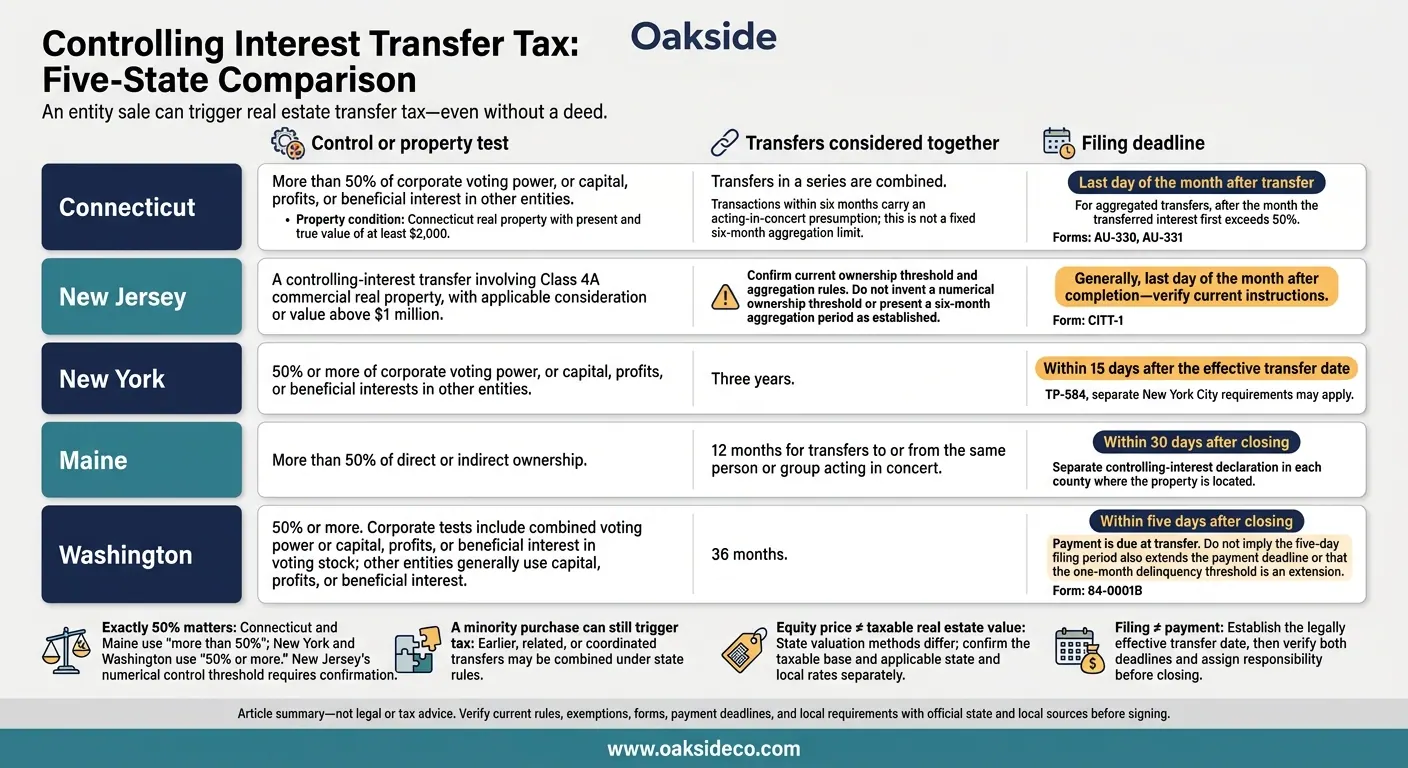
Controlling Interest Transfer Tax: Five-State Comparison
Voting control and economic ownership are different tests. Connecticut, for example, measures corporate voting power separately from capital, profits, or beneficial interest in other entities. The table separates explicit control tests from issues that still need state-level or transaction-specific confirmation.
| State | Controlling-interest threshold | Aggregation period | Attribution or acting-in-concert rules | Staged-closing effects |
|---|---|---|---|---|
| Connecticut | More than 50% of a corporation’s total combined voting power, or more than 50% of a partnership, LLC, trust, or other entity’s capital, profits, or beneficial interest. | Transfers in a series are combined; the supplied materials identify no fixed lookback period. | Related transferees may be presumed to act in concert. Closely timed transactions, common contract terms, and coordinated agreements can matter. | Combined transfers are tested together when the total transferred interest first exceeds 50%. |
| New Jersey | Not established in the supplied materials. | Confirm whether a six-month aggregation rule applies. | Not established in the supplied materials. | Review earlier closings before relying on an installment sale. |
| New York | Not established in the supplied materials. | Not established in the supplied materials. | Not established in the supplied materials. | Don’t treat installments as separate transfers until the aggregation rules are confirmed. |
| Maine | Not established in the supplied materials. | Not established in the supplied materials. | Not established in the supplied materials. | Confirm how successive transfers are combined before scheduling closings. |
| Washington | Not established in the supplied materials. | Washington guidance recognizes a lookback period, but its duration is not supplied here. | Not established in the supplied materials. | Multiple transfers can be combined within the applicable lookback period. |
A purchase below the threshold can still be taxable if prior transfers, affiliated buyers, or coordinated agreements push the combined interest above the control threshold. Review ownership schedules, voting agreements, operating agreements, side letters, and the full ownership chain.
Connecticut also recognizes certain controlled-group reorganizations that leave ultimate control unchanged.
After a transfer crosses the control threshold, the next issue is taxable value and rate.
Ownership Triggers and Aggregation
Connecticut’s controlling-interest transfer tax applies to entities that directly or indirectly own Connecticut real property with a present and true value of at least $2,000.
Transactions within six months of one another are presumed to involve parties acting in concert. The taxpayer must establish otherwise to the satisfaction of the Department of Revenue Services. Before staged closings, review prior and planned equity transfers, options, and side agreements.
Taxable Value and Rates
The tax is based on the value of the Connecticut real property interest, not just the equity purchase price. For portfolio transactions, identify Connecticut land, buildings, and other real property improvements separately. Use valuation records to support any separate treatment of business assets, equipment, or goodwill.
Apply the current statutory rate to the Connecticut real property value. Qualifying farm, forest, or open-space land may carry an additional tax of 1% to 10%, depending on how long the land has been owned or classified.
Filing, Payment, and Liability
The transferor generally must file Form AU-330 and pay the tax by the last day of the month after the transfer month. For aggregated transfers, the deadline falls after the month in which the transferred interest first exceeds 50%.
File any required AU-331, submit through myconneCT, and keep proof of filing and payment. The purchase agreement should assign duties for preparation, funding, and indemnity separately from statutory liability. Failure to make a required electronic payment can trigger a 10% penalty.
New Jersey requires a property-classification check before you assess control and taxable value.
Ownership Triggers and Aggregation
For self-storage or boat/RV parcels, confirm Class 4A status in municipal assessment records first. Business use alone doesn’t establish that classification. New Jersey’s Controlling Interest Transfer Tax (CITT) applies when a controlling interest transfers in an entity that directly or indirectly owns Class 4A commercial real property and the consideration or value exceeds $1 million.
Review the cap table, operating agreement, upper-tier ownership, related buyers, and prior transfers together. Separate closings don’t avoid aggregation. After testing control, determine which value the state uses as the tax base.
Taxable Value and Rates
If the entity holds only Class 4A property, total consideration usually controls. For mixed-asset deals, the Class 4A property’s equalized assessed value (EAV), allocated to the transferred ownership percentage, may control instead. Get the assessment records and document the asset allocation. Don’t assume enterprise value is the tax base.
| Applicable consideration or EAV | Rate |
|---|---|
| More than $1 million through $2 million | 1% |
| More than $2 million through $2.5 million | 2% |
| More than $2.5 million through $3 million | 2.5% |
| More than $3 million through $3.5 million | 3% |
| More than $3.5 million | 3.5% |
The effective date also determines whether these graduated rates apply.
Filing, Payment, and Liability
Under P.L. 2025, c. 69, the graduated rates and seller/grantor liability apply to transfers under binding agreements fully executed on or after July 10, 2025. Earlier qualifying agreements generally remain under the former 1% framework. Keep the signed agreement and all amendments, and check whether later changes affect how the July 10, 2025 effective-date rule applies.
File Form CITT-1 separately from the deed-based Realty Transfer Fee. Prior instructions required filing and payment by the last day of the month following completion. Before closing, verify the current deadline, submission instructions, and required attachments.
New York combines a 50% control test with a three-year aggregation rule. Property in New York City may also require separate city filings.
Ownership Triggers and Aggregation
New York defines control as 50% or more of voting power for corporations, or 50% or more of capital, profits, or beneficial interests for partnerships, LLCs, trusts, and other entities. Apply these tests at every ownership tier, including indirect interests in self-storage or boat/RV real estate.
Transfers within three years can be combined when applying the control test. Before treating a minority-interest sale as below the threshold, review prior and planned transfers, equity issuances, redemptions, and other related transactions.
If a transfer triggers control, the allocation of property value determines the tax base.
Taxable Value and Rates
Taxable consideration generally means the fair market value of the New York real property allocated to the transferred interest - not the equity purchase price. Document property-level allocations, debt treatment, and any assets outside New York. A $500 consideration threshold applies. Confirm the current state rate and any applicable New York City rate before calculating the tax.
Filing, Payment, and Liability
The grantor and grantee generally must jointly file Form TP-584. Any tax due is generally payable within 15 days after the effective transfer date. Later transfers in the same entity within the three-year period can require additional filings.
For an entity transfer without a recorded deed, file and pay directly with the New York State Tax Department. Keep ownership charts, agreements, and valuation materials.
Property in New York City may also be subject to separate city transfer-tax requirements in addition to state filing requirements. Use Form TP-584-NYC where required. The purchase agreement should assign responsibility for preparation, signatures, payment, and liability for additional tax, interest, and penalties.
Ownership Triggers and Aggregation
Maine’s rule matters in staged equity deals because related transfers can be combined over 12 months. The state generally taxes non-exempt transfers of more than 50% of direct or indirect ownership in an entity that holds Maine real estate. Exactly 50% does not, by itself, meet the threshold.
Transfers to or from the same person or group acting in concert are combined within that window. Review affiliated buyers and prior transfers, and confirm any claimed exemption - including one for an internal restructuring.
Taxable Value and Rates
Once the threshold is crossed, Maine bases the tax on Maine real property value multiplied by the ownership percentage transferred, not the equity purchase price.
The statutory rate is $2.20 per $500, or fraction thereof, plus an additional $3.80 per $500, or fraction thereof, on value above $1,000,000. Before closing, check the valuation and percentage adjustment against current Maine Revenue Services instructions.
Filing, Payment, and Liability
File a separate controlling-interest declaration in each county where the Maine property is located. The register of deeds calculates and collects the tax based on the reported value. Report and pay within 30 days after closing. A later transfer within the same 12-month window may require an amended return within 30 days.
The transferor and transferee normally owe one-half each. But if the transfer is not reported and the tax is not paid within 30 days, both parties may become jointly and severally liable for the full tax. The purchase agreement should assign responsibility for preparation, county filing, funding, and proof of payment. Those contract terms do not replace statutory compliance.
Washington has the tightest timing requirements of the five states: a 36-month lookback and a five-day filing deadline.
Ownership Triggers and Aggregation
Washington treats a controlling-interest transfer as a sale of the underlying real property. For corporations, the threshold is generally 50% or more of combined voting power, or 50% or more of capital, profits, or beneficial interest in voting stock. For other entities, it is generally 50% or more of capital, profits, or beneficial interest.
Washington aggregates transfers over 36 months. Trace direct and indirect ownership, related-party transfers, voting arrangements, and staged acquisitions.
Taxable Value and Rates
Once control transfers, Washington taxes the property value - not the equity price. The taxable base is the true and fair value of the entity’s Washington real property, including leaseholds and improvements. For self-storage and boat/RV portfolios, identify every Washington parcel and leasehold interest before closing.
Washington’s state REET applies in tiers:
- 1.10% up to $525,000
- 1.28% from $525,000.01 to $1,525,000
- 2.75% from $1,525,000.01 to $3,025,000
- 3.00% above $3,025,000
Applicable local REET is added to the state tax.
Filing, Payment, and Liability
File Form 84-0001B within five days after closing. Both parties or their authorized agents must sign. Payment is due at transfer. If the tax remains unpaid after one month, interest and penalties apply. Penalties are 5% after one month, 10% after two months, and 20% after three months.
When staged transfers trigger REET, interests transferred during the lookback period may bear a proportionate share of the tax. Use a tax covenant, seller representations about prior transfers, indemnity for pre-closing omissions, and an escrow or holdback sized to the estimated state and local REET.
Once control is triggered, the next question is what the state taxes: the purchase price, the allocated real estate value, or a value based on assessments.
The purchase price isn’t automatically the taxable base. Separate real property from other assets. Contract allocations help support the valuation, but they don’t determine it for tax purposes.
The table below highlights the main valuation rule for each state.
| State | Taxable-base comparison |
|---|---|
| Connecticut | Present true and actual value of the Connecticut real-property interest held directly or indirectly by the entity. |
| New Jersey | Applicable consideration or, in specified cases, equalized assessed value of Class 4A commercial property. Graduated rates range from 1% to 3.5%, depending on consideration or equalized assessed value. |
| New York | Apportion fair-market value to the New York real property attributable to the transferred interest. |
| Maine | Use Maine’s statutory valuation method - not enterprise value by default. |
| Washington | Use Washington’s statutory real-property value method. Don’t assume a proportional discount for the interest acquired. |
These differences affect closing estimates, escrow amounts, and whether the deal price matches the taxable base.
Before closing, have counsel reconcile ownership charts, assessor records, appraisals, allocations, and current guidance. In New Jersey, separating equipment and goodwill doesn’t, by itself, determine whether consideration or equalized assessed value applies. Use the taxable base, rate, and effective date to build the filing and payment calendar in the next section.
Filing and payment deadlines start on the legally effective transfer date, not the signing or recording date. Review assignments, approvals, escrow releases, and closing conditions to establish that date. For aggregated transfers, identify when ownership crossed the threshold.
These deadlines affect escrow, indemnity, and who signs each return. The table below sets out the forms, deadlines, and liability rules that affect closing risk.
| State | Required return and responsible party | Filing destination | Filing deadline | Payment deadline | Late-compliance exposure |
|---|---|---|---|---|---|
| Connecticut | AU-330; transferor files AU-330, and the entity generally files AU-331 | Connecticut DRS via myconneCT | Last day of the month after transfer; for aggregated transfers, use the month the interest first exceeds 50% | Same as AU-330 | Late-payment penalty: 10% of tax due or $50, whichever is greater. Interest: 1% per month or fraction thereof. |
| New Jersey | CITT-1; seller/grantor under current transition rules | NJ Division of Taxation | Last day of the month after transfer completion | With CITT-1 | Penalties and interest apply separately. Unpaid year-end tax, penalties, and interest become part of the balance used to calculate additional interest. |
| New York | TP-584; confirm the taxpayer in current instructions | State Tax Department; confirm filing method | Within 15 days after transfer | Confirm in current TP-584 instructions | Check late-filing, late-payment, and interest rules separately |
| Maine | Controlling-interest report; confirm statutory taxpayer | County office; confirm multi-county requirements | Within 30 days after transfer | Confirm whether payment accompanies the report | Check county-reporting consequences separately from penalties and interest |
| Washington | Controlling-interest return; confirm statutory taxpayer | State; confirm submission and payment methods | Within five days after transfer | Confirm current deadline; one month delinquent is not a filing extension | Distinguish the five-day filing deadline from delinquency; confirm penalties and interest |
Two filing traps deserve close attention: deedless transfers and separate city filings. An entity transfer without a deed can still require a filing. New York City filings are separate from state filings, and Connecticut requires AU-330 even for exempt transfers.
Plan around the shortest deadline. Before closing, confirm the current taxpayer, submission, and payment instructions. Keep proof of acceptance and payment for every return.
Compare tax exposure before signing. A direct asset purchase usually triggers deed-based transfer tax because title changes hands. Buying the property-owning entity may avoid recording a deed, but it can still trigger controlling-interest tax. The deal structure also shapes how the parties divide that risk.
Once you understand the state rules, build the closing around them.
| Deal structure | Trigger exposure | Key diligence | Contractual protections |
|---|---|---|---|
| Direct asset acquisition | Deed-based transfer tax on the real estate conveyance | Review each parcel’s location, classification, value, liens, exemptions, and recording requirements | Allocate deed tax and recording costs; require correct deeds and returns; provide closing escrow and address post-closing corrections |
| Entity acquisition | Controlling-interest tax, including indirect ownership rules where applicable | Trace voting, economic, and beneficial interests through every ownership tier | Include ownership-history representations, filing covenants, specific indemnities, and escrow or holdback where needed |
| Incremental equity purchases | Earlier or coordinated transfers may combine to cross the threshold | Reconstruct transfers over each state’s aggregation period; review affiliates and rollover holders | Restrict unapproved transfers; require review before each installment; fund any tax triggered later |
| Multi-property portfolio | Different taxes and taxable bases may apply across properties and entities | Map every property to its legal owner, jurisdiction, classification, value, and transfer history | Attach property-specific tax schedules; maintain separate reserves and filing responsibilities |
When a state aggregates related transfers, analyze staged closings together to determine control. Review rollover equity at both the property-owner and acquisition-vehicle levels, including continuing voting and beneficial rights. Trace indirect interests through parents, subsidiaries, trusts, and nominees. The buyer’s name alone doesn’t tell the whole story.
After choosing the structure, check the ownership chain and property records that determine tax exposure.
Ownership and Property Records to Review
Before signing, require organizational charts, capitalization tables, operating agreements, side letters, options, prior transfer agreements, and related-party schedules. These records should cover each state’s applicable aggregation period.
Match them against deeds, leases, title reports, property-tax classifications, locations, and valuations. Include upstream and downstream entities that may count under state attribution rules.
Keep eligibility, attribution, and taxable value separate in the closing analysis. Eligibility tests whether the entity, property, and transaction qualify. Attribution determines which interests and transfers count together. Valuation establishes the taxable base. Require a property-by-property, entity-by-entity matrix - not one blanket conclusion.
Then give each tax task a named owner and a deadline.
Contract Duties and Closing Deadlines
Specify who supplies ownership history, calculates tax, prepares and reviews returns, signs filings, delivers filings and notices to taxing authorities, funds payments, and handles amendments or audits. Require written tax review before equity changes hands.
If exposure is uncertain, spell out escrow funding and release conditions. Include indemnities for underpaid tax, interest, penalties, and professional fees, with survival tied to the applicable assessment period.
Tie the closing calendar to each legally effective transfer date, and update it after every staged closing.
The deal outcome depends on three separate checks: control, value, and filing timing. A controlling-interest transfer can trigger real estate tax even when title does not change.
Use these checks to guide the closing process:
- Control: Check final ownership and property records against the applicable control test, aggregation rules, and exemptions.
- Value: Confirm the taxable base and rate under the applicable state and local tax rules.
- Taxpayer: Confirm who owes the tax and whether funds are available to pay it.
- Deadline: Confirm the effective transfer date, required forms, where to file, and filing and payment deadlines. Keep proof of acceptance and payment.
For transaction support, Oakside Co can help coordinate the closing process. Qualified tax and legal advisers should confirm tax treatment and compliance.
This article is informational only and is not legal or tax advice. Verify the current rules against official state and local sources before signing.
How does seller rollover equity affect the control test?
Seller rollover equity affects the control test only indirectly: it helps show who controls the entity after closing. When the seller keeps equity in the buyer’s acquisition vehicle, that stake may point to continued control rather than a full cash-out. The size of the stake and the terms for decision-making, voting, and management determine whether the seller is merely investing alongside the buyer or still holds control.
Could one portfolio acquisition trigger tax in multiple states?
Yes. A single portfolio acquisition can trigger taxes in multiple states. This can happen when taxable events involve properties across state lines, or when investors’ tax residency and state rules for following federal tax law differ.
Even if a 1031 exchange or Opportunity Zone strategy defers federal tax, some states may still tax that deferred gain. It depends on whether each state follows the federal rules.
What if I discover unreported transfers after closing?
If you find unreported controlling interest transfers after closing, contact a qualified tax advisor or legal counsel right away. Choose someone who knows the state’s filing requirements. Reporting rules differ by state, and failing to disclose transfers can result in penalties or interest.
Nolen Masserman, Managing Director at Oakside, stresses that involving a professional early helps you address state-specific tax requirements and avoid costly exit planning mistakes.