
I start with the deal - not the tax savings. Before putting money into a self-storage Opportunity Zone fund, I check eligible gains, investment deadlines, the property’s census tract, and whether projected rents cover costs and debt.
Timing matters: legacy deferred gains generally become taxable by December 31, 2026, even without a cash payout. Qualifying investments made on or after January 1, 2027, generally follow a five-year deferral framework.
Here’s my checklist:
- Set up the fund: Document ownership, fees, investor rights, and who handles tax filings.
- Check the property and sponsor: Confirm zone status, construction deadlines, budgets, and past project results.
- Test the numbers: Model lease-up, financing, and 10%–20% construction overruns.
- Track compliance: Plan for the fund’s 90% asset test, spending deadlines, and investor reporting.
- Plan the exit: Review refinancing, sales, distributions, and each investor’s tax position.
My rule: <u>make sure the investment works before counting tax savings</u>. Then have tax counsel confirm which rules apply to your contribution date.
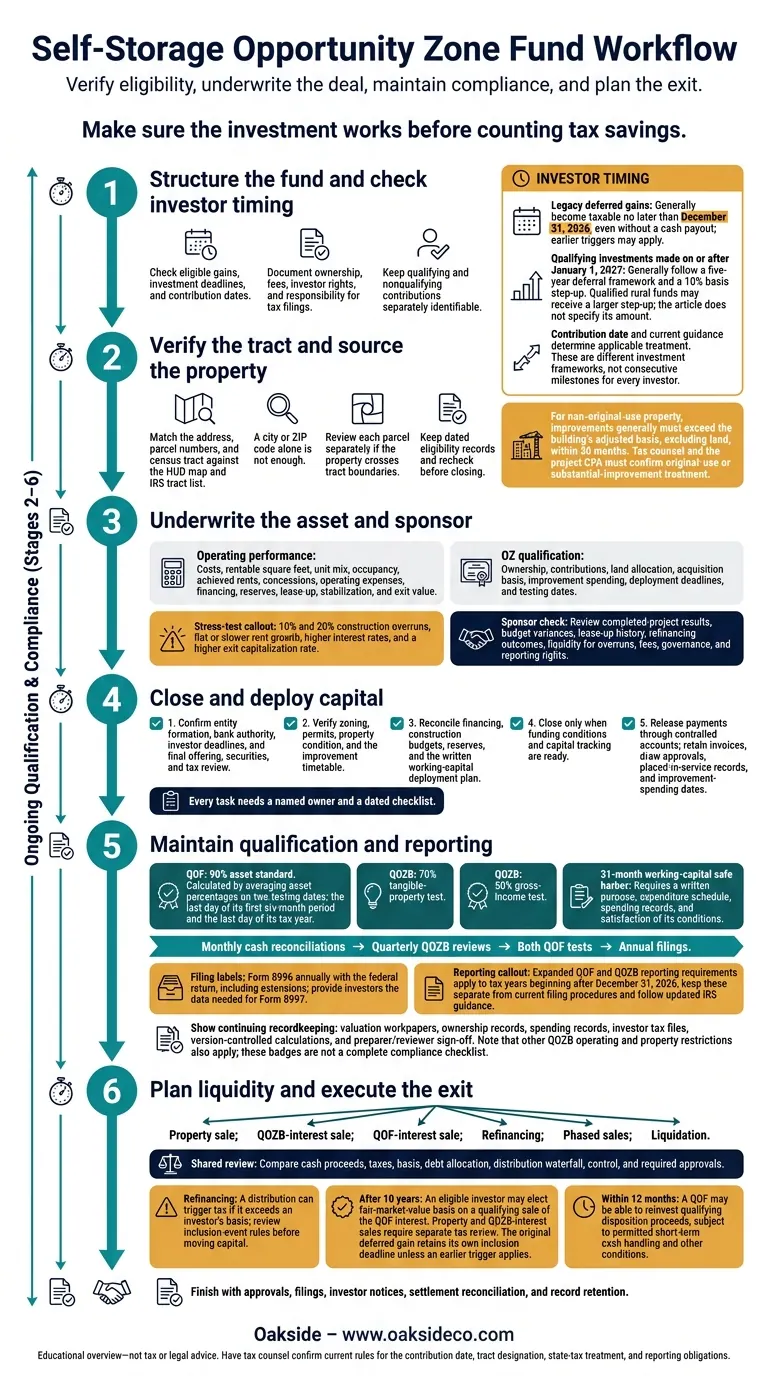
Self-Storage Opportunity Zone Fund Workflow
Verify Zone Status and Find Properties
With the fund structure and investor timing set, start sourcing properties and checking eligibility at the census-tract level.
Verify the census tract before underwriting. Match the address, parcel numbers, and census tract against the HUD map and IRS tract list. A city or ZIP code alone isn’t enough. Keep a dated map, tract identifier, assessor record, and written confirmation. Recheck eligibility before closing.
If a property crosses tract boundaries, review each parcel separately. Don’t assume the whole project qualifies. For rehab or development, tax counsel and the project CPA must confirm original-use or substantial-improvement treatment. For non-original-use property, improvements generally must exceed the building’s adjusted basis, excluding land, within 30 months.
Find properties through owner outreach, developer and lender relationships, municipal planning records, and investor, operator, and joint-venture networks. Screen each lead for its tract, parcel configuration, current and proposed use, acquisition basis, entitlement status, capital needs, seller motivation, and closing timetable.
Underwrite the Property and Assess the Sponsor
Once the tract qualifies, assess the asset, sponsor, and capital stack together.
Build two models: operating performance and OZ qualification. The property model should track costs in U.S. dollars and rentable square feet, with a breakdown by unit type. Include physical and economic occupancy, achieved rents, concessions, operating expenses, construction contingencies, financing, reserves, lease-up assumptions, stabilization dates, and exit value.
Then stress-test the numbers: flat or slower rent growth, 10% and 20% construction overruns, higher interest rates, and a higher exit capitalization rate.
The qualification model should track entity ownership, investor contributions, land allocation, acquisition basis, improvement spending, deployment deadlines, and testing dates. Use it to check whether the asset can meet the improvement timetable and qualification tests.
A QOF generally must hold at least 90% of its assets in qualified Opportunity Zone property on the applicable testing dates. A QOZB generally must also meet the applicable 70% business-property test.
Ask the sponsor for completed-project results, budget variances, lease-up history, refinancing outcomes, and proof of liquidity to cover overruns. Check whether the sponsor has delivered projects without missing OZ deadlines.
Review affiliate fees, reporting and audit rights, major-decision approvals, removal rights, and capital-call dilution. Compare leverage structures based on how they affect control, distribution priority, dilution risk, refinance pressure, and tax reporting.
Close the Deal and Deploy Capital
After diligence clears, lock in the capital plan and document the closing sequence.
Close with a dated checklist and a named owner for each task. Keep qualifying and nonqualifying contributions separately identifiable. Preserve acquisition, basis-allocation, and improvement records. Closing does not replace Form 8996 filing or later qualification tests.
- Before funding, confirm entity formation, bank authority, investor deadlines, and final offering, securities, and tax review.
- Confirm that zoning, permits, and property condition support the qualifying use and improvement timetable.
- Reconcile financing terms, construction budgets, reserves, and the written working-capital deployment plan.
- Close only when funding conditions and capital tracking are ready.
- Release acquisition and construction payments through controlled accounts. Keep invoices, draw approvals, placed-in-service records, and improvement-spending dates.
After closing, the focus shifts from executing the deal to keeping the fund qualified.
Meet QOF and QOZB Qualification Tests
Acquisition eligibility alone does not keep the fund compliant. Calculate the QOF’s 90% asset standard by averaging its asset percentages on two testing dates: the last day of its first six-month period and the last day of its tax year. Reconcile valuations to the balance sheet. A shortfall may trigger a monthly penalty based on that shortfall.
For a QOZB, track the 70% tangible-property and 50% gross-income tests, active business operations, and restrictions on nonqualified financial property, intangible property, and prohibited businesses. Record rent, fees, and other revenue separately in the ledger. Have tax counsel review whether the business and property continue to qualify.
Support the 31-month working-capital safe harbor with a written purpose, an expenditure schedule, and spending records. The safe harbor applies only when its conditions are met. These tests apply throughout the fund’s operating period.
Assign Filing and Compliance Duties
Give each compliance task a clear owner. Assign responsibility across the administrator, controller, property team, and tax adviser for the calendar, test schedules, records, filings, and corrective actions. Schedule monthly cash reconciliations, quarterly QOZB reviews, and both QOF tests. For each task, specify the deadline, supporting records, reviewer, and escalation threshold.
File Form 8996 annually with the federal return, including extensions. Give investors the data they need for Form 8997.
Expanded QOF and QOZB reporting requirements apply to tax years beginning after December 31, 2026. Keep those requirements separate from current filing procedures, and follow updated IRS guidance.
Keep Property and Investor Records
Keep enough documentation to recreate every test. Retain valuation workpapers, operating and capital-spending records, ownership records, working-capital plans and reconciliations, and investor tax files documenting eligible gains, contributions, distributions, and transfers.
Use version control for each test calculation, identify the preparer and reviewer, and link material balances and capital movements to supporting records.
Once the fund is running and compliant, focus on exit mechanics, tax timing, and investor liquidity.
Set exit rights at acquisition. Align investor liquidity needs with transfer restrictions, financing terms, and sale timing. Model refinancing, a property sale, an entity-interest sale, and liquidation. For each option, compare projected cash proceeds, taxes, remaining basis, debt allocation, preferred returns, promote or carried interest, and the effects of any proposed transfer or redemption.
Use the tax review to help choose between refinancing, an asset sale, an entity sale, or liquidation.
Review Taxes Before Moving Capital
Review taxes before every refinance, distribution, transfer, redemption, sale, or liquidation. Check each investor’s outside basis, liability allocation, holding period, and potential inclusion events. Also check whether the transaction changes the fund’s status or an investor’s tax treatment.
A refinance can trigger tax if distributions exceed basis. Before any distribution, review the amount and source of debt, lender terms, appraised value, debt-service coverage, reserve requirements, and each investor’s basis at that point. Calling a payment a “return of capital” does not determine its tax treatment.
After 10 years, an eligible investor may elect fair-market-value basis on a qualifying sale of the QOF interest. A property or QOZB-interest sale needs a separate review of gain, depreciation recapture, debt relief, and available elections. The original deferred gain still follows its own inclusion deadline unless an earlier trigger applies.
A QOF may be able to reinvest qualifying disposition proceeds within 12 months, subject to permitted short-term cash handling and other conditions. Document the sale date, proceeds, custody, deadline, and replacement investment.
Compare Exit Options and Complete the Sale
Compare the options below to match the exit with control, tax treatment, and liquidity needs.
| Option | Taxes | Liquidity and control | Distinguishing execution issue |
|---|---|---|---|
| Property sale | Analyze property-level gain and available elections. | Releases equity and ends facility ownership. | Coordinate property transfer and debt payoff. |
| QOZB-interest sale | Analyze entity-interest basis and liabilities. | Transfers the subsidiary; the QOF may retain other investments. | Address assumed liabilities and buyer tax treatment. |
| QOF-interest sale | Eligible investors may use the 10-year basis election. | Provides individual liquidity, subject to buyer demand and transfer restrictions. | Verify holding periods, election eligibility, and transfer consents. |
| Refinancing | Test distributions against basis and inclusion-event rules. | Retains ownership but increases leverage. | Confirm appraisal, debt-service coverage, and lender reserve terms. |
| Phased sales | May create taxable events across multiple years. | Releases capital gradually while retaining some assets. | Coordinate separate agreements and allocation schedules. |
| Liquidation | Determine final investor-level tax consequences. | Ends the fund and its control rights. | Settle creditors and the final waterfall before dissolution. |
After choosing an exit, address approvals, filings, and record retention.
Before closing, confirm how sale proceeds, closing reserves, and reinvestment cash will be treated. Obtain required manager, investor, and lender approvals, resolve conflicts, and complete buyer diligence. Coordinate transaction-related filings, investor notices, and required Opportunity Zone elections.
Match the settlement statement to debt payoffs, reserves, and the distribution waterfall. Keep digital records with access controls and an audit trail, following a written retention schedule from counsel and the tax adviser. Document valuation support, transaction management, buyer diligence, and disposition records.
After sourcing, underwriting, closing, and compliance planning, check whether the investment still works on both tax and deal terms. Use one documented workflow to verify gain eligibility and deadlines, confirm tract status, underwrite the deal, document funding, assign compliance duties, and plan the exit.
The deal must work on fundamentals. Before accepting capital, confirm that the self-storage asset warrants the Opportunity Zone structure. Assign responsibility for tax testing, investor reporting, valuation, and filings.
The contribution date matters. Separate legacy investments from new contributions after December 31, 2026. Legacy deferred gains generally become taxable no later than December 31, 2026, even without a sale. Get an investor-level tax projection and set aside cash for that tax bill.
For qualifying investments made on or after January 1, 2027, the framework generally provides a five-year deferral and a 10% basis step-up. Qualified rural funds may receive a larger step-up. Have each investor’s tax adviser and attorney use current guidance to confirm the rules for the contribution date, tract designation, state-tax treatment, and reporting obligations.
Can I invest both capital gains and cash in the same fund?
Yes, but it depends on your tax strategy’s structure and rules. In a 1031 exchange, exchange funds must go toward replacement property. Taking cash out may create taxable “boot.”
If you want tax deferral and access to cash, a Deferred Sales Trust can provide payments over time. The trust reinvests the remaining proceeds, allowing you to diversify.
What happens if my fund misses an OZ compliance deadline?
Missing an Opportunity Zone compliance deadline can lead to costly tax consequences. If an investment fails to meet IRS requirements, it may lose its intended tax benefits. That could make deferred capital gains taxable immediately.
Investors should work with tax professionals to meet all reporting deadlines and reinvestment windows.
How can I cover deferred-gain taxes without a fund payout?
Tax-deferral strategies include:
- A 1031 exchange: Reinvest sale proceeds in qualifying replacement real estate to defer capital gains and depreciation recapture taxes. Use a Qualified Intermediary, identify replacement property within 45 days, and close within 180 days.
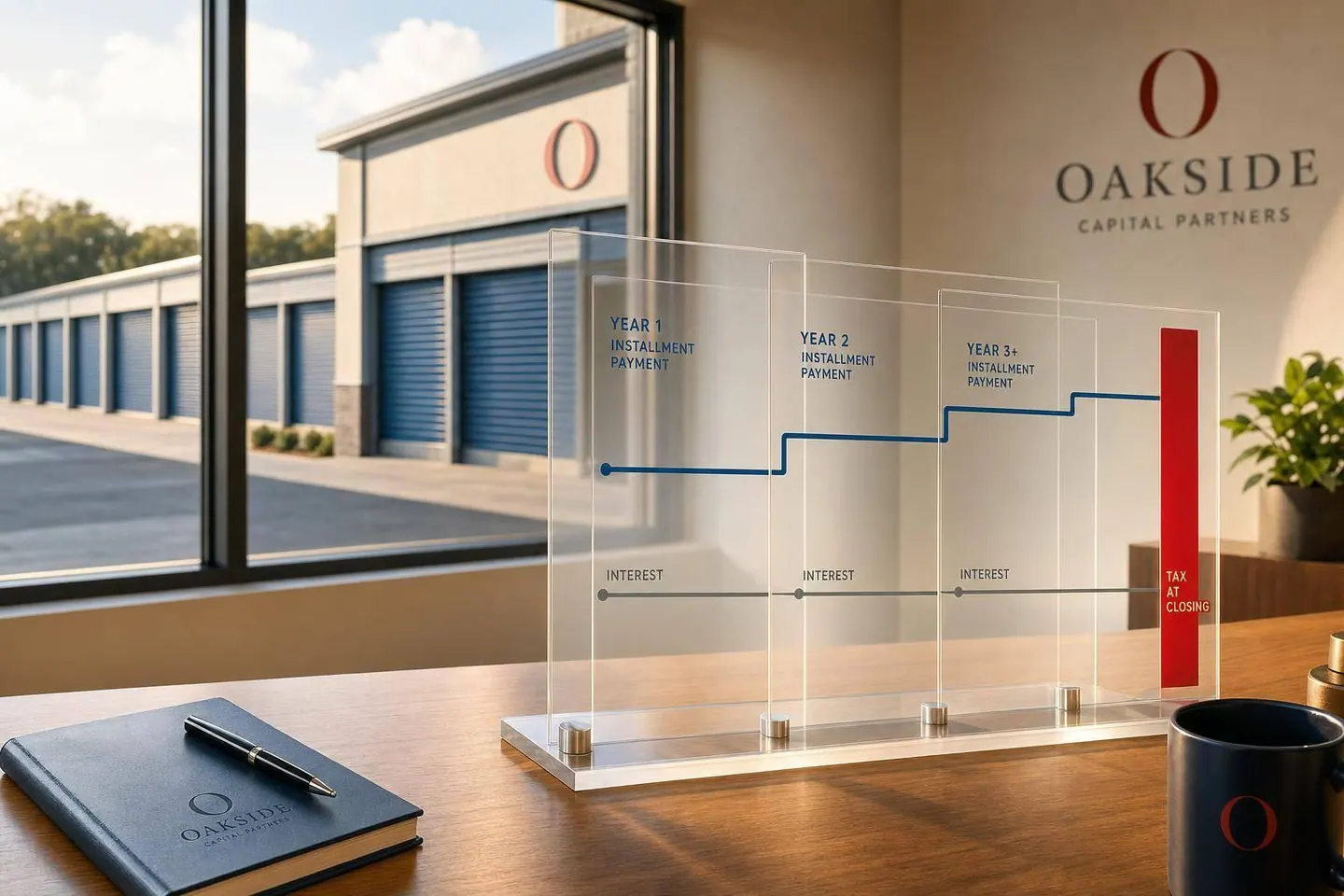
- An installment sale under IRC Section 453: Spread taxes over 3–7 years as you receive principal payments.
- A Deferred Sales Trust: Transfer property to an irrevocable trust, which pays you through a promissory note over 10–20 years.