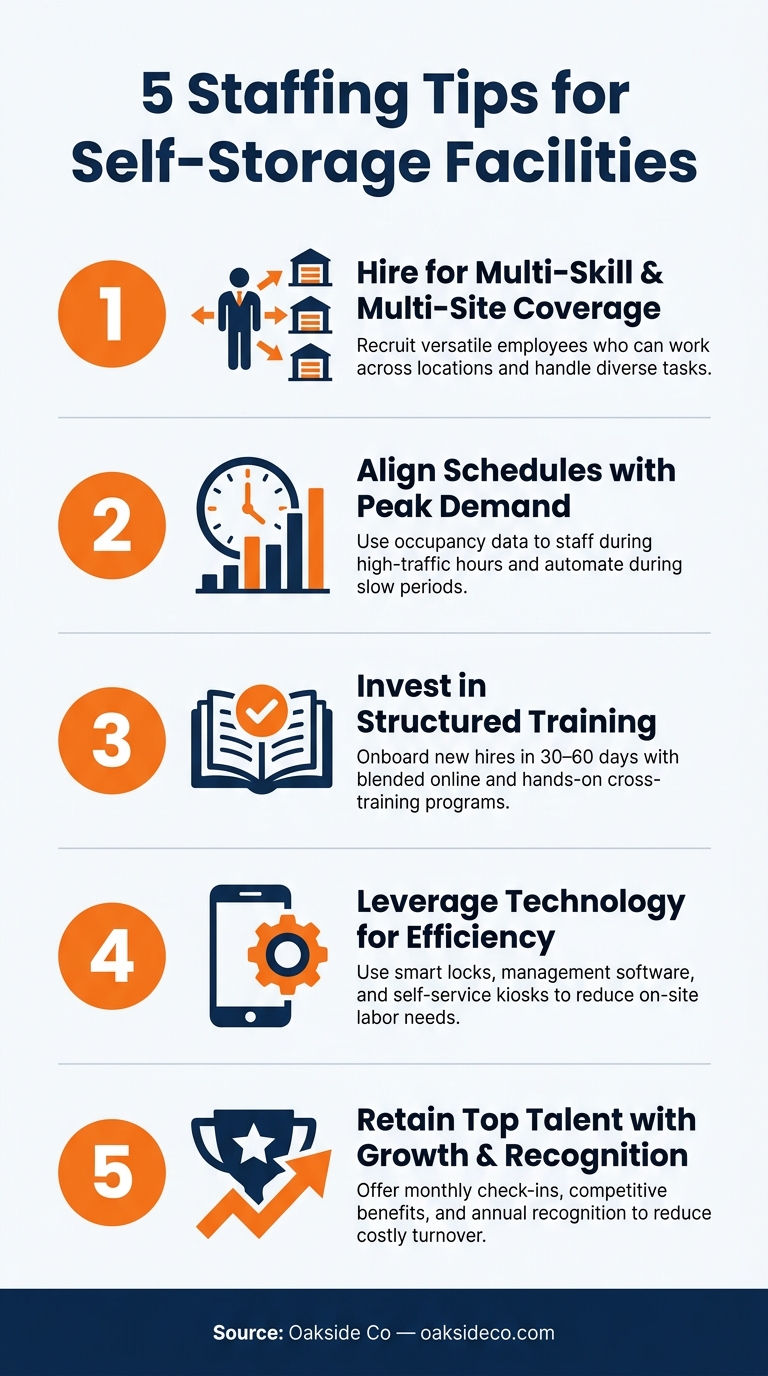
Running a self-storage facility requires more than just renting out units and collecting payments. Staffing plays a critical role in ensuring smooth operations, tenant satisfaction, and financial success. Here’s a quick rundown of five key tips to optimize staffing for your facility:
- Hire for flexibility: Look for employees who can handle multiple roles and work across multiple sites to reduce staffing needs without sacrificing service.
- Align schedules with demand: Use data to staff during peak hours and rely on technology for quieter times to manage labor costs effectively.
- Invest in training: Structured training programs, including cross-training, prepare staff to handle various tasks and minimize disruptions during absences.
- Leverage technology: Tools like automated access systems, management software, and self-service kiosks improve efficiency and reduce the need for constant on-site supervision.
- Retain top talent: Regular feedback, growth opportunities, and competitive benefits help keep your best employees and avoid turnover costs.
Focusing on these strategies can help self-storage operators balance costs, improve tenant experiences, and boost long-term performance.
5 Staffing Tips for Self-Storage Facilities
1. Hire for Multi-Site and Multi-Skill Coverage
In self-storage, having a lean team that can seamlessly work across multiple locations and handle various tasks is far more effective than maintaining a large team with rigid roles. When employees are capable of managing duties like leasing inquiries and basic maintenance across properties, you can reduce the number of staff needed without compromising service quality. This approach emphasizes hiring candidates with versatile skill sets right from the start.
The best employees are those who can juggle front-office responsibilities, such as tenant calls and rental agreements, while also managing back-end tasks like monitoring security systems or handling retail sales. Workers familiar with property management platforms like Storable Edge or smart-lock systems such as Noké bring added value. These tools support remote operations and streamline processes, reducing the need for constant on-site staffing while improving efficiency.
Here’s an example: Packer Storage, a self-storage business with two locations and 158 units in Ashland, WI, uses Storable Edge software to manage both properties through a single system. This setup ensures consistent operations across sites without requiring separate management teams at each location.
For smaller facilities, a hub-and-spoke model can be an effective solution. In this setup, a manager based at a larger, busier site remotely handles leasing and inquiries for a smaller nearby property. This approach eliminates the need for dedicated on-site staff at the smaller location. For instance, Smartlock Self Storage in Bridgeport, TX, which has 221 units, operates remotely from the Dallas/Fort Worth area using the Noké smart lock platform for fully contactless rentals.
Cross-training employees ensures operational continuity across locations. If one site experiences a staffing shortage, team members from another property can step in seamlessly. By hiring for versatility from the outset, businesses can manage rising personnel costs while maintaining operational stability over the long term.
sbb-itb-09b4138
2. Build Schedules Around Peak Hours and Labor Costs
Facilities often experience predictable surges in customer activity, which can be identified by analyzing rent-roll data and monthly occupancy trends. Aligning staffing levels with these demand patterns not only improves service quality but also helps keep costs in check.
For example, in Q1 2026, CubeSmart reported a 7.2% year-over-year increase in same-store personnel expenses, rising from $13.9 million to $14.9 million. This contributed to a 5.8% increase in total same-store operating expenses. Even minor overstaffing during slower periods can significantly impact profit margins.
| Same-Store Expense (Q1 2026) | Q1 2026 | Q1 2025 | Change |
|---|---|---|---|
| Personnel Expense | $14,902,000 | $13,899,000 | +7.2% |
| Total Operating Expenses | $72,197,000 | $68,211,000 | +5.8% |
Source: CubeSmart Q1 2026 Earnings Release
To strike the right balance, consider implementing a hybrid staffing model. Schedule on-site staff during peak hours to handle higher customer traffic effectively, while relying on remote management tools or automated systems – like online rental platforms, kiosks, and automated gate access – during quieter times. Automating tasks such as rent collection and gate access allows on-site staff to focus on more meaningful customer interactions.
Proper scheduling requires flexibility. Ensure your team is prepared for seasonal shifts in demand and avoid the inefficiency of sticking to routine schedules without considering actual customer activity.
3. Set Up a Structured Training and Cross-Training Program
Creating a well-organized training program helps new hires get up to speed quickly – often within 30 to 60 days – while also reducing service disruptions during staff turnover.
The best training programs mix flexible online modules with in-person coaching and annual hands-on events. While online tools provide convenience, hands-on coaching builds practical skills that digital training can’t fully replicate. This combination also makes cross-training more effective, preparing employees to handle multiple roles.
Cross-training is key to maintaining smooth operations. Train your team to take on tasks like gate access management, security monitoring, tenant insurance sales, and retail sales. This ensures your staff can step into different roles seamlessly, whether during employee absences or busy periods. Standardized training across locations further eliminates knowledge gaps, making transitions and coverage shifts much easier.
Additionally, focus on teaching revenue-driving skills like rate management, upselling tenant insurance, and retail sales. This not only enhances operational efficiency but also contributes to greater profitability.
4. Use Technology to Help Staff Work More Efficiently
Using integrated technology solutions can help your team stay productive and focused on what matters most. With the right tools, even a small team can manage operations effectively. For instance, automated access control systems – like smart locks and surveillance cameras – take care of routine security tasks. These systems eliminate the need for constant on-site supervision, allowing staff to focus on more important responsibilities instead of handling keys or monitoring entry points manually.
Management software plays a key role in streamlining operations as well. Tools like Storable Edge simplify processes by centralizing accounting, tenant communication, and occupancy reporting. This eliminates the chaos of juggling spreadsheets and gives teams a clear view of operational performance. On top of that, dynamic rate management tools adjust unit prices automatically, based on real-time occupancy and market trends. Facilities using these systems often see a 25–30% boost in revenue within the first year. By centralizing these functions, management software also paves the way for additional automation.
Self-service kiosks are another great example of efficiency-boosting tech. They handle everyday tenant tasks – like processing payments, renting units, and updating accounts – without requiring staff involvement. Take Cactus Storage in Yuma, AZ, for instance. This 354-unit facility uses on-site kiosks to provide 24/7 automated support, freeing up staff to focus on more complex tasks.
Remote monitoring takes things even further by consolidating oversight. Integrated surveillance cameras and access logs allow a single manager to oversee multiple properties from a central location. This is especially valuable for operators managing several sites, as it helps cut down on travel time and labor costs while keeping operations running smoothly.
5. Keep Top Performers with Feedback and Growth Opportunities
Retaining your best employees is just as important as hiring the right ones. High turnover can disrupt operations, increase costs, and impact the continuity tenants rely on. To avoid this, focus on providing constructive feedback and clear paths for professional growth.
Instead of sticking to annual reviews, try scheduling monthly check-ins between staff and area managers. These quick meetings are a great way to monitor progress, address concerns early, and discuss employees’ career aspirations. Regular touchpoints like these help employees feel supported and aligned with the company’s goals. To complement these check-ins, offer access to an online training platform year-round. This allows staff to continually develop their skills beyond the initial onboarding process.
Recognition is another key factor in keeping top talent. Hosting an annual awards event to celebrate outstanding employees can create a sense of appreciation and belonging. Public acknowledgment of achievements not only boosts morale but also motivates employees to stay committed.
Don’t overlook the importance of competitive benefits. Offering health insurance, a 401(k) with employer matching, and disability coverage shows employees you’re invested in their long-term well-being. These perks make it harder for competitors to lure your top performers away.
Conclusion
Staffing a self-storage facility effectively requires thoughtful and well-planned decisions. Hiring employees who can work across multiple sites and handle diverse tasks keeps operations efficient. Carefully planned schedules help control labor costs while ensuring tenants receive support when they need it most. A structured training program, along with cross-training, equips your team to handle unexpected situations – whether it’s a software issue or an unplanned absence. Leveraging technology to automate routine tasks allows your staff to focus on more impactful responsibilities. By investing in employee feedback, recognition, and clear opportunities for growth, you can retain top talent, reducing turnover costs and enhancing tenant satisfaction, which ultimately stabilizes revenue.
These strategies collectively form the foundation of a resilient and high-performing operation. Facilities that operate efficiently, retain skilled staff, and consistently deliver a dependable tenant experience are better positioned to achieve higher occupancy rates, stronger financial outcomes, and improved market standing – whether the goal is long-term ownership or preparing for a sale.
For operators, improving staffing efficiency has a direct impact on net operating income (NOI). At Oakside Co, we combine operational expertise with financial acumen to help owners identify areas where operational changes – like optimizing staffing structures – can enhance asset value.
"We partner with owners to uncover and unlock value at every stage of the investment lifecycle." – Nolen Masserman, Managing Director at Oakside
No matter the size of your portfolio, implementing the right staffing strategy strengthens your asset’s long-term value.
FAQs
How many employees does a self-storage facility really need?
The number of employees a self-storage facility needs depends on factors like its size, how it operates, and the goals of its management. There’s no universal formula for staffing. According to Nolen Masserman, Managing Director at Oakside, finding the right balance between staffing levels and cost efficiency is key to keeping productivity high and boosting the facility’s overall value. Using data-driven insights can help owners craft a workforce strategy that ensures smooth and efficient operations.
What tasks should I automate first to cut staffing costs?
To cut staffing costs and streamline operations, consider automating repetitive, high-volume tasks. Key areas to target include revenue management, tenant communication, and lead follow-up. By automating these processes, staff can focus on more impactful activities that drive occupancy and overall performance.
Nolen Masserman, Managing Director at Oakside, emphasizes that using scalable, data-focused technology can simplify operations and enhance value. Meanwhile, Cameron Vale, President at Oakside, points out that such technology plays a crucial role in maintaining long-term profitability.
What should a 30–60 day training plan include for new hires?
A well-structured 30–60 day training plan for self-storage staff should center around mastering operational tasks and delivering top-notch customer service. In the initial 30 days, the focus should be on building a solid foundation by covering key areas like facility management software, gate operations, safety procedures, and everyday responsibilities such as handling rentals, processing collections, and performing maintenance tasks.
As staff progress to the 60-day mark, the training should evolve to include revenue growth strategies, identifying sales opportunities, and honing advanced customer service skills. According to Nolen Masserman, Managing Director at Oakside, providing employees with data-driven approaches is essential for maximizing the value of a property.