A weak self-storage lease can turn a missed payment into a failed auction, a lawsuit, or a lower sale price. I’d focus on five risk areas first: lien language, default timing, liability and insurance terms, fee and access rules, and boat/RV addenda.
Here’s the short version:
- If the lease does not match current state law, lien sales can break down.
- Default terms need clear dates for late rent, notice, cure, lockout, and sale.
- Broad waivers and fuzzy insurance wording can lead to bigger claims.
- Undisclosed fees and loose access rules create billing fights and site-level problems.
- Boat and RV storage often needs a separate process because titled property may fall under DMV or vessel rules, not the usual storage lien path.
A few numbers show the risk fast:
- A California wrongful-sale case led to a verdict of more than $379,000
- One Arizona matter settled for $80,000
- Some audits show about 30% of lien-sale files miss compliance standards
If I were reviewing a lease, I’d ask one simple question: Can staff follow this form step by step without guessing – and does each step match the law in that state? If the answer is no, the lease needs work.
| Risk area | What to check | Why it matters |
|---|---|---|
| Lien terms | Notice method, deadlines, surplus proceeds | A sale can be challenged or voided |
| Default clauses | Late date, cure period, partial payments | Staff errors and tenant disputes |
| Liability terms | Negligence carve-outs, value cap, insurance notice | Bigger loss claims |
| Fees and access | Fee disclosure, rent-change notice, entry rights | Billing fights and rule issues |
| Boat/RV storage | VIN/HIN, title, insurance, towing consent | Extra legal steps for default or removal |
I’ve boiled this article down to the lease terms most likely to create legal cost, delay, or pricing pressure.
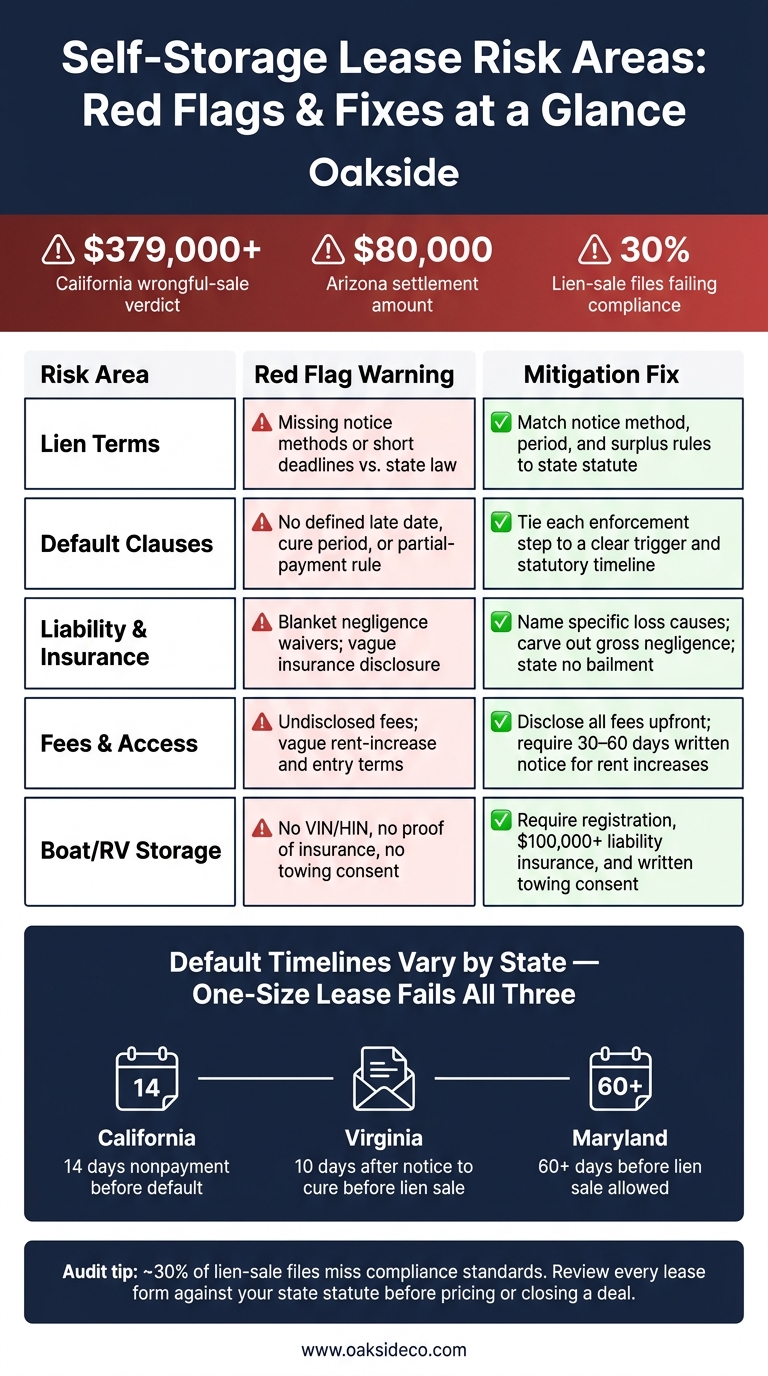
Self-Storage Lease Risk Areas: Red Flags & Fixes at a Glance
Red Flags in Lien, Default, and Termination Clauses
Missing or Noncompliant Lien Language
Even if a lease lines up with state law on the surface, the next thing to check is the lien language itself. That clause shapes what happens after a default. If it’s weak or out of step with the statute, collections can bog down fast. In many states, the lease may need to spell out the rules for liens, notice, sale, and surplus proceeds.
The same trouble spots show up again and again. Some leases leave out electronic delivery or verified mail as accepted notice methods, even when state law allows them. Others set notice periods that are shorter than the statute requires. That may sound like a small drafting issue, but it can become a big problem. If the operator follows the lease instead of the statute, the tenant may challenge the sale and, in some cases, get it voided.
Surplus proceeds are often missed too. The lease should make clear who gets unclaimed sale proceeds and when those funds are treated as abandoned under state law.
Vague Default Remedies and Incomplete Cure Periods
Vague default language creates a mess from both sides. Staff don’t have a clear playbook, and tenants have room to fight nearly every step. If a lease says default means only "nonpayment" but doesn’t explain when rent becomes late, when lien rights start, or what notice must go out, the whole collections process turns into a gray area.
State timelines are all over the map. In California, a tenant is in default after 14 consecutive days of nonpayment. In Virginia, the owner may move to a lien sale if the default is not cured within 10 days after notice. Maryland takes a very different approach and requires more than 60 days before a lien sale may happen. So a one-size-fits-all lease is almost guaranteed to miss the mark somewhere.
The safest approach is simple: tie each enforcement step to a clear trigger in the lease.
| Red-Flag Default Clause Pattern | Key Risk Created | Preferred Fix |
|---|---|---|
| "Late payment" with no timing defined | Disputes over when lien rights attach; inconsistent collections | Define due date, delinquency threshold, and default date |
| Immediate lockout upon any late payment | Conflicts with state self-storage acts; consumer protection complaints | Tie lockout to a defined delinquency period and written notice, not the first missed payment |
| No cure period between lien notice and auction | Wrongful sale claims; courts may void the sale | Include a cure period meeting or exceeding the statutory minimum |
| Sale timelines shorter than state statute | Lien sales can be voided; exposure to statutory damages and attorney’s fees | Track the state statute exactly for notice methods, minimum days, and advertising steps |
| No guidance on partial payments after default | Staff may inadvertently waive lien rights by accepting partial payment | State that partial payments don’t cure default unless the full balance is paid |
| No reinstatement terms once sale is scheduled | Disputes over whether the tenant can reclaim the unit before auction | Clarify when and how a tenant can reinstate and what must be paid |
Non-Monetary Default Gaps
Not every lease issue starts with unpaid rent. Problems like unauthorized occupancy, storing hazardous materials, illegal activity, and nuisance behavior can also justify termination. But that only works if the lease says so in plain terms. A lot of leases lean on broad wording like "no illegal use" and stop there. That’s often not enough.
The issue is enforcement power. If the lease does not clearly give the operator the right to terminate for rule or conduct violations, limit access, or call law enforcement when needed, staff may hesitate to act. And that hesitation can make a contained problem spiral into a safety concern or a drawn-out dispute.
Strong conduct-default language should do a few things well:
- List specific banned conduct
- Explain the notice and cure process for minor violations
- Reserve the operator’s right to act at once, with no cure period, when there is a safety or legal emergency
The lease and posted rules should say the same thing on banned conduct, notice, and immediate-removal rights in safety or legal emergencies. After that, the next step is to check whether liability waivers, insurance terms, and value caps do what they’re supposed to do.
sbb-itb-09b4138
Liability, Insurance, and Value Limitation Risks
Once lien and default language is in good shape, the next thing to check is loss exposure: what the lease says happens if a tenant’s property is damaged or stolen. These clauses often create the biggest uninsured gap. If the language is weak, claim exposure goes up and investor confidence can drop. After loss-allocation terms, the next place risk tends to hide is in the lease’s rules around revenue and access.
Overbroad Liability Waivers
A liability waiver should protect the facility. But many older leases push too far by trying to waive liability for any loss or damage from any cause, even the owner’s own negligence. Courts often won’t enforce language that tries to waive gross negligence, reckless conduct, or intentional acts. New York’s General Obligations Law § 5-321 goes even further and expressly voids lease terms that exempt a landlord from liability for its own negligence.
A tighter approach works better. Instead of using a blanket any-cause disclaimer, the lease should name the main causes of loss, such as fire, theft, burglary, vandalism, water intrusion, mold, vermin, and natural disasters. Then it should carve out only gross negligence and willful misconduct as exceptions. That kind of structure tends to hold up much better in court.
Unclear Property Value Caps
Without a clear cap, a tenant can inflate a claim after a fire or theft. Florida’s self-storage statute (§ 83.806(9)) deals with this head-on: if the lease caps stored property at $5,000 and the tenant never got written permission to go above that amount, the statute treats $5,000 as the maximum value for liability purposes. Washington uses a similar approach.
The best caps are plain, easy to spot, and clearly accepted by the tenant. Put the limit under a bold heading like LIMITATION OF VALUE AND LIABILITY, state the exact dollar amount, and have the tenant initial next to the clause. That makes the term much harder to fight later.
Confusing Insurance and Non-Bailment Terms
Self-storage is usually a space lease, not a bailment. When the lease is fuzzy on that point, tenants often assume the facility insures what they store. Say it plainly: the facility does not insure tenant contents, the tenant bears the risk of loss, and any protection plan is separate from the lease.
Many modern self-storage facilities now use some form of tenant insurance or protection program to reduce contents claims. So if your lease says nothing about insurance, or says it in vague terms, that’s a red flag. The wording needs to leave as little room for confusion as possible.
| Clause Topic | Weak / Risky Language | Stronger Mitigation Language |
|---|---|---|
| Liability Waiver | Owner shall not be liable for any loss or damage from any cause, including Owner’s own negligence. | Owner shall not be liable for loss or damage to Tenant’s property from fire, theft, burglary, vandalism, water, mold, vermin, natural disasters, or other causes, except to the extent such loss is directly caused by Owner’s gross negligence or willful misconduct, and then only up to the value limitation stated in this Agreement. |
| Property Value Cap | Owner’s liability is limited. | Tenant agrees that the total value of property stored in the Space does not exceed $5,000. Owner’s maximum liability for any claim shall not exceed $5,000 in the aggregate. |
| Insurance Disclosure | Coverage may be available through the facility. | The facility does not insure Tenant’s contents. Tenant bears the risk of loss and must maintain their own insurance or acknowledge that they are self-insuring. |
Next, review fee, access, and use terms that can expand exposure even when the loss clauses look strong.
Economic and Operational Lease Terms That Create Hidden Exposure
After liability terms, the next trouble spot is the lease language that shapes collections, access, and revenue. Fee, rent, and access clauses can look routine on paper. In practice, they often create enforcement gaps and surprise revenue exposure.
Poorly Disclosed Fees and Rent Increase Terms
Fees need to appear in the lease before they’re billed. If late fees, lock-cut fees, returned-check fees, or lien-processing fees show up without clear disclosure, disputes usually follow. That can lead to bad debt and legal friction. State caps also differ, so the lease needs to line up with the local maximum.
Rent increase language can cause the same kind of trouble. Open-ended increases push tenants out and can draw regulator attention. A better approach is simple: require 30 to 60 days’ written notice by mail or email, and make clear that any increase applies prospectively only.
Access Rights, Entry Rights, and Use Restrictions
The lease that sets fees should also spell out when staff can enter, limit access, or stop banned uses. It should define standard access hours, keep those separate from office hours, and reserve the right to temporarily limit access during outages, weather events, or security incidents. That kind of restriction should not trigger rent abatement.
Management entry also needs clear boundaries. The lease should cover entry for emergencies, structural maintenance, and lawful process.
The banned-use section should be specific, not vague. That means no residential use, no overnight occupancy, no flammables, no explosives, no perishable food, no live animals, and no on-site vehicle repair or painting. Specific bans are easier to enforce and help cut fire, pest, and code risk.
Boat and RV Storage Lease Issues
Boat and RV storage needs its own review because many standard self-storage forms miss the rules tied to titled assets. That matters during default and abandonment. Boats and RVs follow motor-vehicle and boating laws, not ordinary self-storage lien rules.
At a minimum, a boat or RV lease addendum should require current registration, proof of ownership, and the vehicle or vessel identification number (VIN or HIN). It should also require proof of liability insurance – usually $100,000 or higher – before access is granted. On top of that, tenants should keep the vehicle in moveable condition: no major fluid leaks, no flat tires, and batteries disconnected and fuel shut off when code requires it.
| Lease Gap | Legal or Operational Consequence | Mitigation Step |
|---|---|---|
| No registration or ownership requirement | Difficulty identifying the legal owner during default; risk of storing stolen property | Require VIN/HIN, registration number, and state of registration at move-in |
| No proof-of-insurance requirement | Higher exposure if an incident occurs on-site | Require proof of liability coverage (e.g., $100,000 minimum) before access is granted |
| No vehicle-condition standard | Inoperable or leaking units occupy premium spaces and can create safety issues | Require roadworthy or seaworthy condition; reserve the right to tow at the tenant’s expense if standards are not met |
| No explicit towing consent | Operator may need additional legal steps to remove a defaulted or hazard-posing vehicle | Include written towing consent in the lease, referencing licensed towing services and fee allocation |
| No abandoned-vehicle procedure | Vehicles remain on-site indefinitely; standard lien-sale process may not apply to titled property | Draft abandonment procedures aligned with state DMV and motor-vehicle lien laws; some states, including Missouri and Maryland, allow towing after about 60 days of nonpayment following proper notice |
Some state self-storage statutes do not clearly include boats and RVs in lien provisions. In those states, operators may need to use DMV-based abandonment procedures instead of a standard lien sale.
How Owners and Investors Can Reduce Lease Risk
Use a Lease Audit Checklist During Due Diligence
Once you’ve spotted the red flags, the next move is simple: do a lease-by-lease audit before pricing the deal or heading to closing.
That step matters more than many owners expect. Audit data show that, in some portfolios, around 30% of lien-sale processes fail to meet compliance standards. That can create exposure right when an owner is trying to sell or refinance.
Review each lease form, including older versions still floating around in the portfolio, against the governing state statute and the red flags above. For both buyers and sellers, lease review should connect straight to pricing, lender review, and closing risk. If the paperwork is off, the deal can get messy fast.
Update Lease Forms to Match Current Law and Operations
Lease forms should be reviewed at least once a year so they reflect changes in statutes, case law, and consumer rules.
But legal updates are only part of the job. Day-to-day operations need to match the signed lease too. Fee billing, access hours, and posted rules should all say the same thing. The same goes for website copy, move-in packets, and on-site signage. If one says one thing and the lease says another, that’s where trouble starts.
The best way to keep everything lined up is to give one person clear ownership of the documents. That person should manage:
- Master templates
- State-specific versions
- Approval for any edits
It also helps to run checks across the lease, website, move-in packet, and signage every time a form changes.
Clear lien rights, enforceable default terms, liability limits, plain fee disclosures, and boat/RV addenda can cut avoidable exposure and make a property easier to sell or finance.
FAQs
How often should a self-storage lease be updated?
Self-storage leases are usually month-to-month. That gives operators room to adjust pricing often as market demand shifts and business goals change.
Instead of changing rates on a rigid calendar, time those updates around peak seasonal demand. Use facility-level performance data to decide when a change makes sense. Standardized lease terms can also make the asset more reliable in the eyes of institutional buyers.
What makes boat and RV storage leases different?
Boat and RV storage leases aren’t the same as standard self-storage leases. The property types vary a lot, from open gravel lots to canopy-covered spaces and converted warehouses.
That variety can shape how a site is valued. Coverage type, site depth, and access infrastructure all matter. As Nolen Masserman, Managing Director at Oakside, and Cameron Vale, President at Oakside, note, detailed due diligence is needed to deal with these risks.
Can a bad lease hurt a property sale or refinance?
Yes. Inconsistent lease agreements can signal operational risk to buyers. That can slow down a sale or push buyers to ask for a lower price.
The same issue can hurt a refinance. Lease terms that don’t help steady income, or that vary too much from one tenant to the next, can weaken financing terms and reduce loan-to-value ratios.
As Nolen Masserman, Managing Director at Oakside, notes, maintenance transparency and operational discipline help avoid due diligence surprises.