If I were buying a boat storage property, I’d assume the deal can go wrong in four places: market demand, income proof, site condition, and legal rights. That’s the core of this checklist.
Before my deposit goes hard, I’d want to confirm:
- the market can support the slips, stalls, or stack spaces
- the seller’s income matches bank deposits and leases
- the docks, seawalls, pilings, lifts, and dredging needs won’t wreck my budget
- the permits, submerged land rights, zoning, and insurance can transfer without trouble
This matters because boat storage deals often take 60 to 90 days of diligence and can cost $25,000 to $75,000+ before closing. And a few numbers can change the whole deal fast:
- More than 2% gap between rent roll income and bank deposits = red flag
- 25% to 35% expense ratio is a common range for boat/RV storage
- $1,000 to $3,000+ per linear foot for seawall or bulkhead replacement
- $25 to $75 per cubic yard for dredging
- More than 30% of service work tied to one tech = key-person risk
I’d use this checklist in a simple order:
- Check demand first – boat registrations, seasonality, nearby supply, rates, access, depth, and bridge limits
- Verify the money – rent roll, deposits, P&Ls, taxes, concessions, delinquencies, and tenant concentration
- Inspect the asset – pavement, drainage, security, docks, pilings, racks, lifts, fuel systems, and shoaling
- Review legal and insurance issues – survey, title, permits, zoning, submerged land leases, claims, and open violations
- Rework the deal terms – update underwriting, build a 10-year capital plan, then reprice, ask for credits, or walk away
A short version: if the demand is thin, the income doesn’t reconcile, the waterfront repairs are large, or the water-access rights are weak, I’d either cut the price or leave the deal.
That’s what this article helps me do.
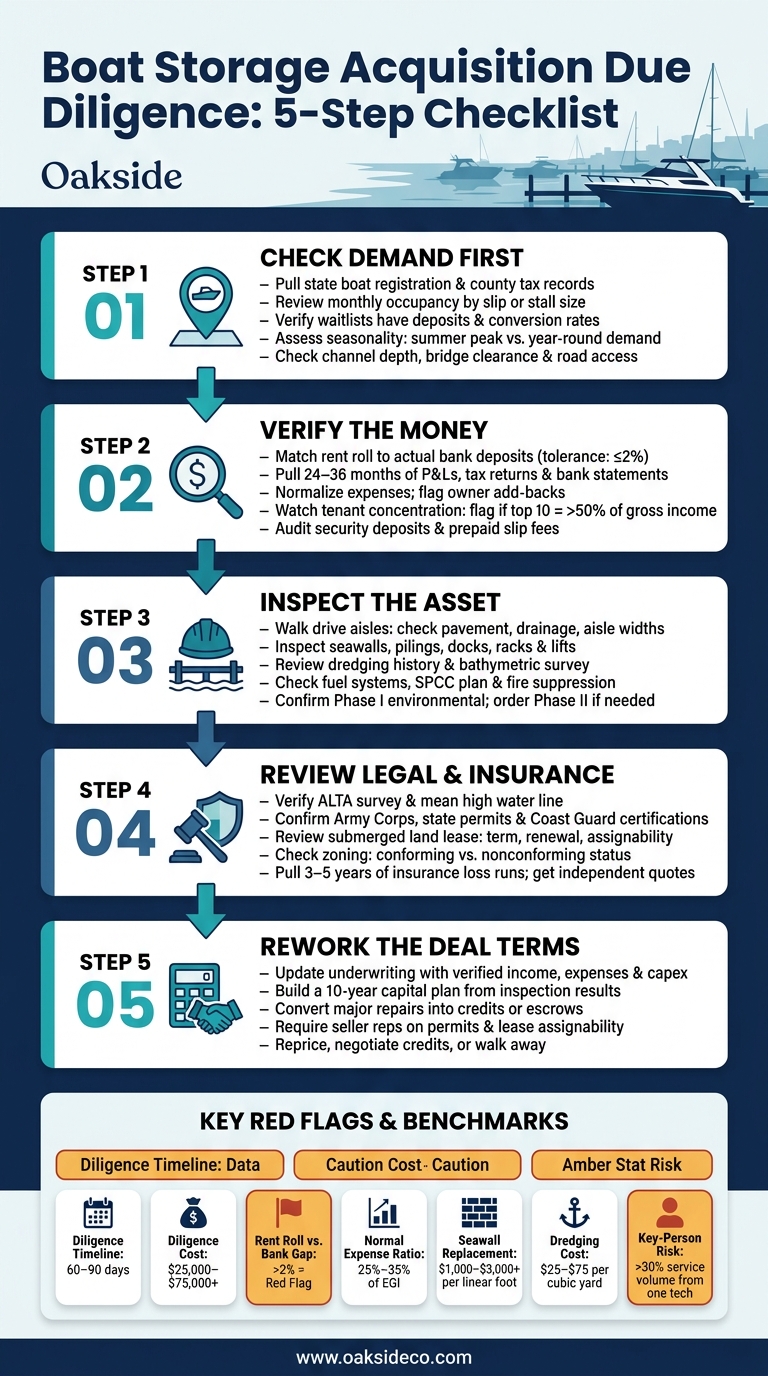
Boat Storage Acquisition Due Diligence: 5-Step Checklist
Market And Demand Checks Before Your Deposit Goes Hard
Before you spend serious time and money on full diligence, make sure the market can actually support the asset. If the trade area looks solid, the next step is demand drivers, seasonality, and nearby supply.
Trade Area, Demand Drivers, And Seasonality
Start with the local trade area. Pull state boat registration data and county tax records to confirm ownership density around the facility. A nearby population center with strong boat ownership usually points to steadier demand. If that base isn’t there, today’s occupancy on the rent roll may not stick after closing.
Then look at monthly occupancy by slip or stall size. This helps you spot slow months, peak-season concentration, and how demand moves through the year. A marina that fills up in summer and drops hard in winter has a very different cash flow pattern than one with more even year-round demand.
You should also check whether transient dockage or local tourism drives a meaningful part of revenue. Don’t take that story at face value. Match it against reservation logs, monthly P&Ls, and work orders. If the seller says tourists fill the place, the paper trail should show it.
Treat waitlists carefully. They only count as demand when they include deposits, recent activity, and a usable conversion rate. A waitlist full of old names and no money behind it isn’t demand. It’s just a list.
Competing Supply, Rates, And Pipeline Risk
Map the nearby competition across the full trade area:
- Wet-slip marinas
- Dry-stack facilities
- Covered storage
- Outdoor storage sites
Then call each one to verify rates and availability. This matters because posted rates and actual rates often don’t match. The same goes for occupancy claims. You want to test the seller’s numbers against what nearby operators are charging and filling.
Rate benchmarks can swing a lot by market and product type. Use the ranges below as a starting point when pressure-testing the seller’s assumptions:
| Storage Type | Typical Rate Range |
|---|---|
| Premium coastal wet slips | $300–$700 per linear foot/year |
| Mid-market regional wet slips | $150–$300 per linear foot/year |
| Inland lake wet slips | $80–$150 per linear foot/year |
| Dry-stack storage | $100–$200 per foot per year |
| Covered outdoor spaces | $100–$180/month |
| Outdoor uncovered spaces | $50–$90/month |
Also dig into local entitlement filings and new construction. New supply nearby can hit occupancy fast. That kind of pipeline risk can tear apart your underwriting before you even close.
Site Access And Location Quality
Physical access has a direct effect on who can use the property. Confirm that approach roads can handle large tow vehicles and trailers without tight turns or low clearances. Walk the entrance and the internal drive aisles yourself. If a trailer can’t move through the site without a headache, part of your customer base is gone.
For wet-slip and dry-stack assets, check channel depth at mean low water. Fixed bridges on the approach can cut demand from sailboats and large motoryachts because they limit vessel height. Nearby launch ramps, fuel docks, and service yards matter too, since they help support repeat demand.
Road access, water depth, and bridge clearance act like demand filters. They shape occupancy and pricing power. If access, depth, or clearance is a problem, price that into the LOI or walk before full diligence.
If demand, supply, and access all look good, move to rent roll and seller financial diligence.
sbb-itb-09b4138
Income And Financial Diligence For Boat Storage Assets
Once you know the market makes sense for the asset, the next job is simple: make sure the income is real. The NOI in the offering package has to line up with bank deposits, leases, and day-to-day records. Start with the rent roll, then check it against deposits and delinquency data.
Rent Roll, Occupancy, And Delinquency Review
Ask for a current rent roll that includes customer ID, slip or stall number, product type, boat length or unit size, monthly rent, any concessions, security deposit amount, move-in date, and delinquency status. Then match that rent roll to actual bank deposits. If stated rent and bank deposits differ by more than 2%, treat it as a major red flag.
A property can look full on paper and still have weak income. Why? Because delinquent tenants, unpaid leases, and concessions can drag down collected revenue. It helps to break occupancy out by product type. Wet slips, dry-stack positions, covered spaces, and outdoor stalls do not perform the same way. Each comes with its own margin profile and risk.
Watch tenant concentration, too. Flag any single tenant that makes up more than 3% of total revenue, or any case where the top 10 customers produce more than 50% of gross income. That kind of concentration can make income shaky.
Seller Financials, Bank Reconciliation, And Expense Normalization
Pull the last 24–36 months of monthly P&Ls, bank statements, tax returns (Schedule C or Form 1120), the general ledger, utility bills, payroll records, property tax bills, insurance premiums, and all service contracts. Then reconcile bank deposits to reported revenue line by line.
Rebuild the monthly P&Ls so you can separate seasonal highs from recurring NOI. From there, strip out owner add-backs and one-time items. If the property accepts card payments, compare card processor reports to bank statements to confirm when collections hit and whether anything is missing. Also audit security deposits and prepaid slip fees to make sure they sit in a separate ledger and can transfer at closing.
Owner add-backs usually include personal expenses pushed through the business, family labor paid below market, and one-time items such as insurance recoveries or legal settlements. For boat and RV storage, operating expense ratios often fall in the 25%–35% of effective gross income range. If the seller shows expenses far below that band, look hard for deferred maintenance or costs that were left out.
| Document | What to Verify |
|---|---|
| Rent Roll vs. Bank Statements | Match stated revenue to bank deposits |
| P&L vs. Tax Returns | Confirm income reported to the IRS matches P&L |
| Leases vs. Rent Roll | Identify below-market or grandfathered rates that won’t transfer |
| General Ledger vs. Utility Bills | Confirm operating costs align with stated occupancy |
| Card Processor Reports vs. P&L | Flag deferred revenue or collection timing gaps |
Red Flags That Change Price Or Kill The Deal
Take a hard look at any sudden revenue spike or occupancy jump in the last three to six months before the listing. Sellers sometimes fill empty spaces with non-paying tenants or deep discounts to dress up the rent roll before a sale. If a lot of move-in dates bunch up right before the marketing period, check whether those tenants are paying.
Cash collections with no clean audit trail are another warning sign. They make revenue harder to confirm and can hide timing problems. Low expense lines deserve the same level of scrutiny, especially insurance, labor, dredging, and routine repairs. If the numbers fall apart once you reconcile them, that either changes the price discussion or tells you to walk.
If the income checks out, the next step is the site’s physical condition and operating controls.
Physical Asset, Marine Infrastructure, And Operations Review
Physical diligence should test a simple point: do maintenance, replacement, and compliance costs line up with the model, or is the budget too optimistic?
Site Condition, Security, And Core Improvements
Start on the ground. Walk every drive aisle and look at pavement wear, drainage flow, and any spots where water sits near storage areas. Check whether the aisles can handle large trailers. For 90-degree parking, you generally want 50–60 feet. For angled parking, 35–40 feet is the target.
Security also needs a hard look. Check fencing, gates, cameras, and lighting. At a minimum, the site should have PIN access, 24/7 surveillance that can read license plates, and full-site lighting.
If the layout makes sense, shift to the waterfront systems. That’s where capex can jump fast and downtime can drag on.
Docks, Dry-Stack, Lifts, And Marine Infrastructure
Inspect all marine infrastructure with one thing in mind: deferred maintenance can get expensive in a hurry.
Seawalls and bulkheads are a major cost item. Replacement can run $1,000–$3,000+ per linear foot. Look for corrosion loss in steel, UV wear in vinyl, and signs of undermining or settlement in riprap.
Pilings need an underwater inspection. For wood, check for marine borer damage. For steel, look for corrosion. For concrete, watch for spalling. Replacement usually falls between $2,000 and $8,000 per piling, depending on depth and material.
With docks and floating structures, inspect flotation, watch for waterlogged floats, and review hardware condition. Cleats, pile guides, and finger-pier connections deserve close attention. Gangway slopes should also meet ADA rules.
For dry-stack properties, inspect rack structures for rust and overall structural condition. Then review maintenance records and load ratings for forklifts and travel lifts.
If there’s a fuel dock, check tank age, tank type, leak detection, fire suppression, and the SPCC plan.
Dredging is another big one. Ask for dredging history and a current bathymetric survey that shows available depth at mean low water. Then compare the depth and shoaling history with the vessel mix in the rent roll. If the marina is serving deeper-draft boats, this matters a lot. Dredging can cost $25–$75 per cubic yard, and new permits can take years to get.
| Infrastructure Item | Key Inspection Point | Estimated Replacement Cost |
|---|---|---|
| Seawalls/Bulkheads | Corrosion loss at mud line, spalling, UV degradation, or settlement | $1,000–$3,000+ per linear foot |
| Pilings | Marine borer damage (wood) or spalling (concrete) | $2,000–$8,000 per piling |
| Docks/Finger Piers | Flotation integrity, hardware condition, ADA slopes | $5,000–$15,000 per slip |
| Dredging | Available depth versus current vessel mix | $25–$75 per cubic yard |
After the physical review, the next step is making sure the property can run without compliance issues or hidden operating risk.
Environmental Risks, SOPs, And Operating Controls
Review the Phase I for recognized environmental conditions. If it points to trouble, order Phase II sampling before closing.
Also confirm flood zone status. Review shore power and transformers for compliance with NFPA 303 and NEC Article 555, and collect written SOPs for storm prep, haul-out, and fuel handling. In hurricane- or snow-prone markets, review storm-hardening steps and confirm that structures are engineered for local wind or snow loads.
Staffing can be a weak spot too. If one technician handles a large share of service work, confirm active OEM certifications and check whether manufacturer warranty authorizations will stay in place after a sale. When one technician accounts for more than 30% of service volume, that’s a serious key-person risk.
Legal Status, Entitlements, Pricing Adjustments, And Final Go/No-Go Decision
Title, Survey, And Water-Access Rights
A property can pass a physical check and still fall apart on legal transfer, financing, or operating rights. Once you understand the condition of the asset and how it runs, the next step is simple: make sure it can legally operate and legally change hands.
Start with the ALTA survey. Verify the mean high water line, which marks the boundary between private upland and public submerged land. Then check for encroachments, easement problems, or boundary disputes that could disrupt day-to-day operations or block future work.
Next, confirm water-access rights and make sure the needed permits are in place: Army Corps Section 10 and 404 approvals, state permits, and Coast Guard fuel-system certifications. If the marina sits on state-owned submerged land, read that lease carefully. Focus on the term left on the lease, renewal rights, how rent is calculated – often as a share of slip revenue – and whether the state must approve an assignment to a new buyer. Lenders, including SBA lenders, usually want the lease term to run through the full loan term.
Zoning matters just as much. Confirm whether the use is conforming or nonconforming, because nonconforming status can limit rebuilding after a storm or block expansion plans. Title defects, missing permits, and zoning trouble don’t just create legal risk. They also affect lender approval and the price you’re willing to pay.
Insurance, Litigation, And Regulatory Exposure
Once title and permits check out, look at insurability and open claims.
Standard property insurance often does not cover docks, marine liability, or pollution. Make sure the asset has access to specialized coverage for marine infrastructure, Marina Operators Legal Liability (MOLL), and pollution liability. Review 3–5 years of claims history, or loss runs, and watch for repeat claims or storm losses that point to weak controls or physical trouble.
Also pull notices of violation, open permit issues, and pending litigation. Review any open environmental findings, then work unresolved exposure into your pricing. This is where deals can get expensive fast. Waterfront insurance premiums can swing by more than 50% year over year, so get your own quotes during diligence instead of leaning on the seller’s old numbers.
Revise Underwriting And Make The Decision
At this stage, every legal, insurance, and permit issue needs to show up in the deal terms. If a problem is real, it should hit pricing, escrow, repairs, or all three.
Update your model using verified income, expenses, capex, and insurance costs. Build a 10-year capital plan based on the physical inspection results. Turn near-term repair items into credits or escrows, especially for seawall failures, dredging, or dock electrical problems. In the purchase agreement, require seller reps on current permits, submerged land lease assignability, and lien law compliance.
Use these hard stops to make the call:
| Decision Trigger | Action |
|---|---|
| Submerged land lease non-assignable | Walk away or resolve with the state before PSA |
| Environmental contamination confirmed | Reprice or require a remediation escrow |
| Rent roll discrepancy >2% vs. bank deposits | Reprice; investigate the discrepancy |
| Nonconforming zoning limits rebuild or expansion rights | Reprice the risk or reconsider the deal |
| Revised underwriting no longer supports the purchase price | Renegotiate or walk |
If those issues are not present and the revised model still backs up your price, you’re in a much better spot to close.
FAQs
What should I review before my deposit goes hard?
Before your deposit goes hard, check the asset’s financial, operational, and physical health so the purchase price lines up with cash flow that can hold up over time.
Review three years of tax returns, monthly profit and loss statements, and a reconciled rent roll. Make sure you’re looking at normalized EBITDA, not just peak-season numbers that make the deal look better than it is. You should also order a marine survey and a Phase I environmental assessment.
On top of that, confirm that all water-access rights, submerged-land leases, and permits can transfer at closing and have enough time left on them to support the business plan.
Which red flags can kill a boat storage deal?
The biggest deal-killers in boat storage acquisitions usually come down to environmental liabilities, infrastructure failure, and legal uncertainty.
That can mean underground fuel tanks, contaminated sediment, hazardous waste from repair work, corroded pier hardware, concrete spalling, major dredging costs, messy financials, waterfront leases that can’t be assigned, or the loss of key permits and zoning rights.
How do I verify marina income and permits?
Review at least three years of financial records: P&Ls, balance sheets, and tax returns. Marina income swings with the season, so don’t stop at annual totals. Normalize EBITDA with monthly revenue by category, then match rent rolls against actual occupancy and audit customer deposits or prepaid fees.
For permits and legal rights, dig into submerged-land leases. Check the lease term, renewal options, and any assignment requirements. Then confirm whether key entitlements can move with the sale, including USACE permits, dredging permissions, and zoning compliance.