Off-market storage deals are private transactions where properties are bought and sold without public listings or mass marketing. These deals are common in niche markets like self-storage and boat/RV storage, where sellers often prefer direct negotiations over traditional methods. For buyers, the appeal lies in reduced competition, direct communication, and opportunities to identify underpriced properties with untapped potential.
Key points:
- What it is: Private property sales without public listings.
- Why it matters: Buyers can negotiate directly and find properties with hidden value.
- How to find deals: Build relationships, use data tools, and attend industry events.
- Seller motivations: Retirement, financial needs, or portfolio adjustments.
- Due diligence: Verify occupancy, rents, legal status, and physical condition.
- Negotiation tips: Use data-backed offers and tailor terms to the seller’s priorities.
Off-market deals require preparation, relationship-building, and thorough analysis to succeed. By understanding seller motivations and focusing on detailed evaluations, buyers can secure profitable opportunities in this less competitive space.
How to Source Off-Market Opportunities
Finding off-market storage deals takes a mix of strategic planning and strong relationships. Each method plays a unique role in building an effective sourcing approach. Let’s break down some key strategies.
Owner Outreach and Direct Contact
Start with a personal touch – reach out directly to property owners. But don’t go in empty-handed. Come prepared with specific data like occupancy rates, rental trends, and how their property stacks up against competitors. This kind of targeted approach sets you apart from generic inquiries. With industry databases tracking over 70,000 storage facilities nationwide, it’s easier than ever to identify owners. Whether the property is thriving or struggling with low occupancy, these insights can open the door to meaningful conversations.
Networking and Industry Events
Building relationships is essential for uncovering off-market opportunities. Attend industry conferences, local meetups, or join online communities like LinkedIn groups focused on self-storage investing. These spaces foster open discussions about market trends, ownership challenges, and future plans. This is also the ideal time to discuss exit planning to ensure a smooth transition when the time comes. You can also connect with advisory firms like Oakside Co, which specialize in self-storage and boat/RV assets. Firms like these often have access to exclusive investor networks where deals are shared privately – offering leads you won’t find through data alone.
Using Data-Driven Research
Data is revolutionizing how buyers identify opportunities. Platforms that use CMBS disclosures provide borrower-reported data on occupancy and financial performance for over $50 billion in assets. This allows you to spot undervalued properties before they hit the public market. What used to take 20 hours to research can now be done in just two minutes thanks to modern tools. For boat/RV storage, pay attention to the property type – whether it’s an open gravel lot, steel canopy-covered spaces, or a converted industrial warehouse. Each format has its own buyer pool and valuation considerations, making tailored research even more critical.
sbb-itb-09b4138
Understanding Why Sellers Go Off-Market
Storage property owners don’t typically decide to sell on a whim. The choice to sell – especially off-market – often stems from a gradual process influenced by personal circumstances, business challenges, or financial goals. Understanding these motivations is what sets successful buyers apart.
Key Triggers That Motivate Sellers
The reasons sellers choose to sell are often straightforward. Retirement is a major factor. Many self-storage and boat/RV facility owners are individuals who built their businesses from the ground up and are now ready to step away. Another common driver is portfolio rebalancing. Institutional owners managing a mix of real estate assets may decide to sell underperforming properties to redirect their capital into stronger opportunities. Tools like facility-level CMBS data can help identify these properties.
Additionally, owners who have completed a value-add phase – improving a property to increase its worth – are often more inclined to sell off-market. This is especially true when data shows the property isn’t performing as well as others in the market.
Timing and Capital Needs
For many sellers, timing can be just as critical as the price. Owners dealing with upcoming loan maturities, refinancing challenges, or an urgent need for cash often find off-market deals more appealing. Unlike traditional listings, which can drag on for months without a guaranteed outcome, off-market transactions offer speed and certainty.
This creates an opportunity for buyers. By providing a clear timeline and demonstrating access to reliable capital, buyers can address the seller’s primary concerns. For sellers who prioritize a quick and dependable deal over squeezing out the highest price, a prepared off-market buyer becomes the obvious choice. Recognizing these motivations is key to crafting effective self-storage evaluation and negotiation strategies, which will be explored further in the next sections.
How to Evaluate Off-Market Deals
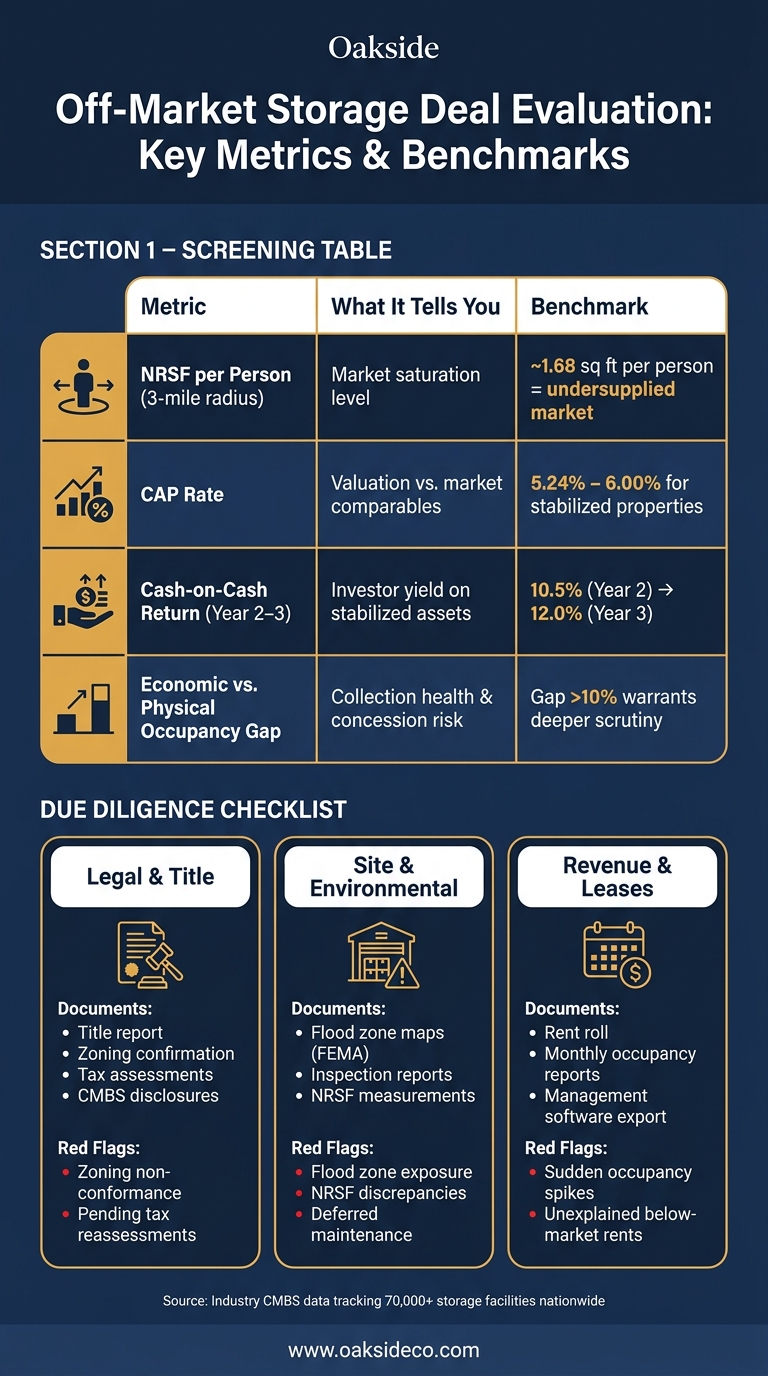
Off-Market Storage Deal Evaluation: Key Metrics & Benchmarks
After identifying a motivated seller and establishing contact, it’s crucial to assess off-market deals quickly and carefully to avoid potential pitfalls.
Initial Screening Criteria
Start with a quick review of key metrics like Net Rentable Square Feet (NRSF), unit mix, unit count, and occupancy rates. Pay special attention to the difference between physical and economic occupancy. If the gap exceeds 10%, it could point to issues like collection problems or excessive concessions, which may need a closer look. Additionally, compare the current rental rates to market averages – below-market rents could signal an opportunity to increase revenue by adjusting rates.
Another important factor is the NRSF per person within a 3-mile radius. A figure close to 1.68 sq ft per person suggests the market may be undersupplied, which could support stronger occupancy and rental growth.
Once these initial metrics check out, move on to a deeper financial analysis.
In-Depth Underwriting
If the property passes the initial screening, it’s time to dive into the numbers. Build a stabilized net operating income (NOI) model using the actual rent roll, verified expense data, and realistic vacancy assumptions. Avoid relying solely on the seller’s projections, as they may not reflect the property’s true performance. Use a CAP rate calculator to find a rate that aligns with recent comparable transactions in the area – recent deals for stabilized properties have shown CAP rates between 5.24% and 6.00%.
Next, project returns over a multi-year hold period. For stabilized properties in high-population metro areas, disciplined underwriting has achieved cash-on-cash returns of 10.5% in Year 2 and 12.0% in Year 3. Also, consider whether the property has room for expansion, like additional entitled acreage or the potential for climate-controlled units. Be sure to assess the property’s physical condition against Class-A standards in the local market and incorporate all necessary capital expenditures (CapEx) into your financial model.
By following these steps, you can uncover hidden value in off-market deals, ensuring a thorough and disciplined evaluation process.
| Metric | What It Tells You | Benchmark |
|---|---|---|
| NRSF per Person (3-mile radius) | Market saturation | ~1.68 sq ft = undersupplied |
| CAP Rate | Valuation vs. market comparisons | 5.24%–6.00% |
| Cash-on-Cash Return (Year 2–3) | Investor yield on stabilized assets | 10.5%–12.0% |
| Economic vs. Physical Occupancy | Collection health and concession risk | Gap >10% warrants scrutiny |
Due Diligence for Off-Market Deals
Once your underwriting checks out, it’s time to dive into due diligence. This step is where you confirm your investment assumptions and uncover any hidden risks. Off-market deals can come with extra challenges – there’s no broker-managed data room, no standardized disclosures, and often less structure from the seller. That means you’ll be running much of the process yourself.
Legal and Title Review
After completing your initial underwriting, the next step is a deep dive into legal and title matters to address the unique risks of off-market deals. Start by ensuring the title is clean, zoning is appropriate, and tax assessments are accurate. For example, confirm that the property is zoned for self-storage or boat/RV use. Zoning issues may pop up more frequently in off-market transactions since these properties haven’t faced the scrutiny of a formal listing process. Don’t forget to review property tax assessments – this will help you estimate ongoing expenses and prepare for any potential reassessments. If there’s existing debt on the property, request CMBS borrower disclosures for a verified look at operating performance and financial history.
Site and Environmental Assessments
A site visit is crucial. Hire a certified inspector to check the structural condition, drainage, pavement, roof systems, and fencing – these are all areas that could lead to expensive repairs. Use physical measurements and records to validate the property’s NRSF (net rentable square footage) to avoid pricing errors. Additionally, check the flood zone status using FEMA maps, as properties in designated flood zones can face financing and insurance challenges. Another key consideration is whether the site has room for expansion. Look for unused acreage or opportunities to add climate-controlled units, as these factors can influence the overall investment outlook.
"Our team blends investment-banking-level analysis with real operator expertise, delivering strategies that are deeply informed, data-driven, and aligned with each client’s unique objectives." – Nolen Masserman, Managing Director at Oakside
Revenue and Lease Verification
Once the physical and legal aspects are reviewed, shift your focus to the property’s financials. Verifying revenue is especially important in off-market deals, as sellers may not have formal or complete financial records. Request key documents like the actual rent roll, detailed monthly occupancy reports, and in-place financial statements – don’t settle for just a trailing 12-month summary. Use industry databases, which track over 70,000 storage facilities, to compare achieved rents with market rates and validate your assumptions.
Pay close attention to the tenant base. A high number of long-term renters can signal stability, while a sudden uptick in recent move-ins might suggest artificially inflated occupancy figures. To ensure accuracy, request a direct export from the facility’s management software. Lastly, check whether the property uses online leasing and digital marketing tools. These platforms often leave a verifiable digital trail, which can support your revenue projections.
By following these steps, you’ll not only validate your earlier analysis but also set the stage for more informed negotiations.
| Due Diligence Area | Key Documents to Request | Red Flags to Watch For |
|---|---|---|
| Legal & Title | Title report, zoning confirmation, tax assessments, CMBS disclosures | Zoning non-conformance, tax reassessments |
| Site & Environmental | Flood zone maps, inspection reports, NRSF measurements | Flood zone exposure, NRSF discrepancies, deferred maintenance |
| Revenue & Leases | Rent roll, occupancy reports, management software export | Sudden occupancy spikes, unexplained below-market rents |
Pricing and Negotiation in Off-Market Deals
Once you’ve completed your due diligence, it’s time to focus on pricing and negotiating the deal. The insights gained from verifying revenue and lease details will guide your approach to valuation and structuring. Unlike listed properties, off-market deals don’t involve bidding wars, competing offers, or even a formal asking price in many cases. This lack of structure can actually work in your favor – if you know how to use it.
How Off-Market Pricing Works
Valuation in off-market deals relies on hard data. Instead of basing your calculations on asking prices or market averages, use actual performance metrics like occupancy rates, achieved rents, and existing financials.
Don’t overlook secondary revenue sources or property-specific details. For example, income from late fees, tenant insurance commissions, or truck rentals can significantly impact cap rate calculations. Similarly, properties like boat and RV storage require adjustments for factors such as coverage type, site depth, and access infrastructure before applying any cap rate benchmarks.
Using Flexible Deal Structures
In off-market deals, sellers often prioritize more than just price. Timing, tax considerations, and capital needs can all play a major role in their decision-making. Addressing these factors can sometimes be more persuasive than simply offering more money.
Take seller financing as an example. This option can reduce your upfront capital needs while giving the seller a steady income stream. Or, if the seller is planning a 1031 exchange, aligning your closing date with their timeline can make your offer stand out – without requiring you to increase the purchase price.
The key is understanding what the seller values most. A seller focused on estate planning will have very different priorities than one seeking liquidity for a new investment. Tailoring your offer to meet their specific needs can give you a competitive edge.
Once you’ve structured an offer that aligns with the seller’s priorities, the next step is negotiating effectively.
Negotiation Tactics for Buyers
In off-market deals, your leverage comes from preparation rather than external competition. Successful buyers present offers backed by solid data – clear, well-reasoned justifications for their pricing that the seller can trust.
Speed is another critical factor. Modern tools can cut research time from days to hours, allowing you to act quickly before the seller loses interest. Arriving at a property tour already equipped with insights on occupancy trends, rate benchmarks, and recent comparable sales shows you’re serious – something sellers value highly.
Face-to-face meetings can also be a game-changer. Touring the property with the seller, discussing your understanding of the local market, and building a personal connection can establish trust that’s difficult to achieve through emails alone. Many off-market sellers choose this route specifically because they prefer a more personal and straightforward process.
"Our team blends investment-banking-level analysis with real operator expertise, delivering strategies that are deeply informed, data-driven, and aligned with each client’s unique objectives." – Nolen Masserman, Managing Director at Oakside
Firms like Oakside Co bring a structured approach to off-market deals. They help buyers craft data-backed offers and navigate unique deal terms, ensuring momentum isn’t lost during the negotiation process.
Conclusion and Key Takeaways
This guide has walked through the essential strategies for navigating off-market storage transactions, emphasizing how preparation and knowledge pave the way for successful outcomes. From sourcing opportunities to conducting thorough due diligence and negotiating effectively, each step plays a vital role in ensuring a smooth and profitable deal.
Off-market storage deals can provide a competitive advantage, but success hinges on a well-prepared approach. Consistent outreach and networking are key to sourcing opportunities, while verifying occupancy, rents, and ancillary income helps avoid unwelcome surprises later. Conducting comprehensive due diligence – covering legal, environmental, and lease aspects – is equally critical. When it comes to pricing and negotiation, having accurate data and customized deal structures is the foundation for success.
Given the complexity of these transactions, having specialized expertise can make all the difference. With over 24 years of experience and more than 41 completed transactions, Oakside Co brings the analytical skills and industry know-how needed to navigate off-market deals effectively.
"Oakside provides senior-level attention, deep sector expertise, and a tailored approach from the first conversation through closing – ensuring every engagement receives the focus required to maximize value." – Nolen Masserman, Managing Director at Oakside
FAQs
What’s the fastest way to find off-market storage sellers?
The fastest way to uncover off-market self-storage opportunities is by leveraging data-driven tools to pinpoint the owners of both high-performing and underperforming properties. From there, you can present a value-add investment strategy tailored to their situation. Working with an advisory firm like Oakside can give you access to institutional-grade analysis and extensive market knowledge. As Nolen Masserman, Managing Director at Oakside, puts it, achieving success means adopting a disciplined, data-backed approach instead of depending on conventional property listings.
How do I spot fake occupancy or overstated income off-market?
To spot inconsistencies in off-market self-storage or boat/RV properties, it’s essential to carry out detailed due diligence. This means verifying the seller’s claims by cross-checking records with bank statements, merchant processing reports, and conducting physical audits of units. As Cameron Vale, President at Oakside, explains, taking a disciplined, data-focused approach is key to identifying the actual value of an asset while reducing potential risks during the acquisition process.
When does seller financing make sense on a storage deal?
Seller financing offers a practical solution for off-market self-storage deals, especially when traditional loans aren’t an option or when there’s a valuation gap between the buyer and seller. In this setup, the seller essentially steps into the role of the lender, which can streamline transactions – particularly those that are time-sensitive or involve complex arrangements. As Cameron Vale, President at Oakside, puts it, their team focuses on crafting terms that align with clients’ objectives while enhancing the overall investment potential.