Boat and RV storage risk usually comes down to four things: damage, fire, pollution, and paperwork errors. If I want fewer claims, fewer payment issues, and fewer legal problems, I need to control all four from day one.
Here’s the short version:
- Screen tenants before move-in
- Check photo ID
- Match the renter to the title and registration
- Get proof of active insurance
- Record the VIN or HIN
- Write tighter lease terms
- Require insurance at all times
- Ban fueling, repairs, and stored fuel items
- Spell out default, notice, lien, and sale steps
- Set up the site to cut loss
- Use separate gate codes for each renter
- Shut off gate access for past-due accounts
- Add lighting, cameras, bollards, and clear lane markings
- Track problems and act fast
- Inspect the site on a set schedule
- Save photos, gate logs, footage, and renter messages
- Review policies each year and after law changes
A big part of the risk is simple math. Boats and RVs are larger, harder to park, and cost more to repair. One bad turn can lead to a claim worth $1,000s. Add fuel, batteries, and state title rules, and the margin for error gets small.
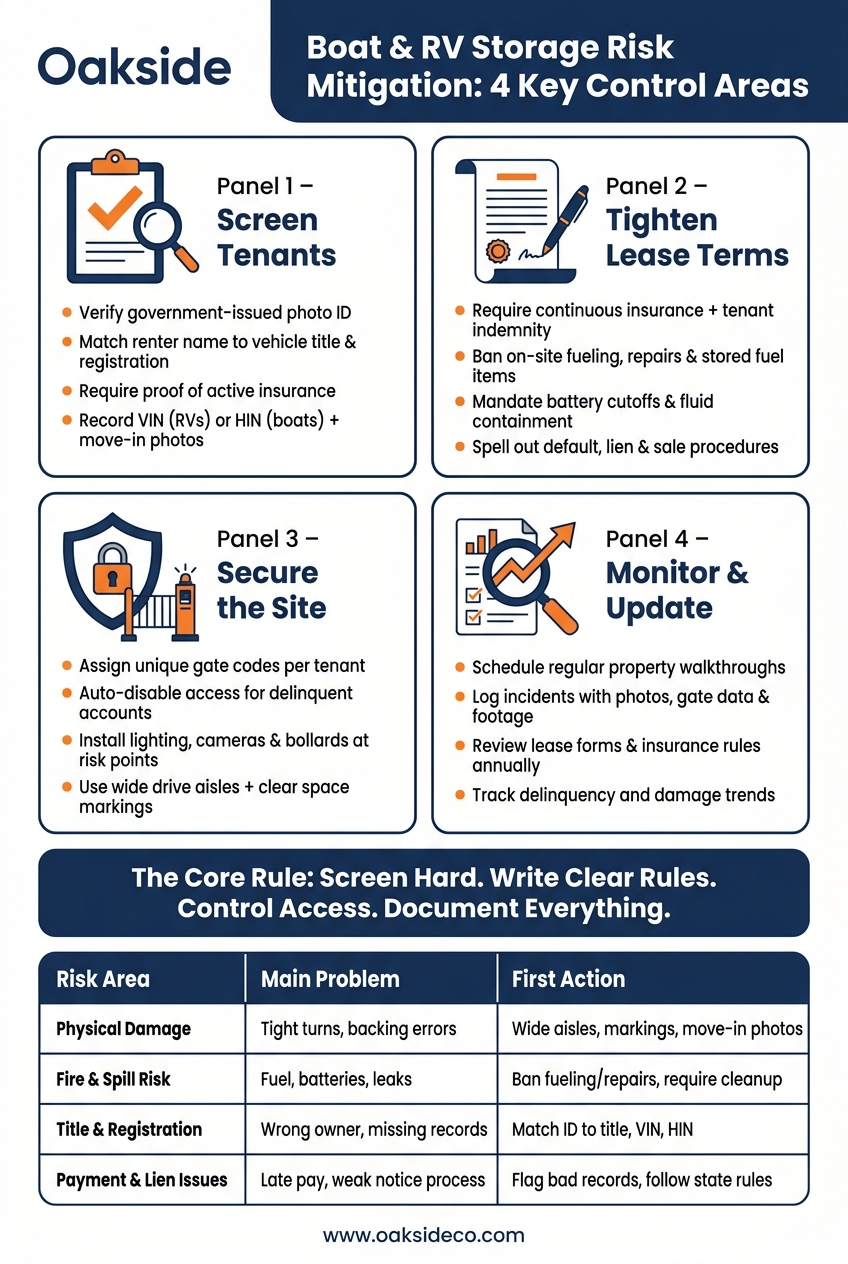
Boat & RV Storage Risk Areas: Problems & Solutions at a Glance
Quick Comparison
| Risk area | Main problem | What I’d do first |
|---|---|---|
| Physical damage | Tight turns, backing errors, site strikes | Use wide drive aisles, markings, and move-in photos |
| Fire and spill risk | Fuel, batteries, leaks | Ban fueling and repairs, require leak cleanup |
| Title and registration | Wrong owner, missing records, filing mistakes | Match ID to title, registration, VIN, and HIN |
| Payment and lien issues | Late pay, bad files, weak notice process | Flag bad records early and follow state rules in writing |
If I had to sum up the whole article in one line, it would be this: screen hard, write clear rules, control access, and document everything.
Step 1: Screen Tenants and Collect Complete Vehicle Records
Screening is your first line of defense. Before move-in, confirm the tenant, the unit, and the paperwork. If you miss something here, it can turn into a much bigger problem later.
Verify Identity, Ownership, and Insurance
Start by collecting a government-issued photo ID and a current physical address for every tenant. Then compare the tenant’s name with the vehicle title and registration. If the names don’t match, stop and verify that the person has permission to store the unit. That’s often a warning sign of unauthorized storage.
Insurance matters just as much. Require proof of active insurance for the vehicle or vessel at move-in, and keep that record in the tenant’s file. Put it in writing that the facility does not insure stored property. That simple step can help cut down on coverage disputes after damage.
After you verify identity and insurance, document the vehicle before move-in.
Record Asset Details and Move-In Condition
Record the year, make, model, color, license plate, and – most importantly – the VIN for RVs or the HIN for boats. Those identifiers help stop fraud and support later enforcement if the account goes into default.
Take photos of all sides of the vehicle at move-in. Also photograph accessories, damage, and any identifying marks. Think of it as your starting snapshot. If someone later claims damage or says an item is missing, you have a record to check.
Those records give you a clear baseline if the account later defaults or a dispute comes up.
Use Risk-Based Account Controls
Once an account is active, the screening process shouldn’t just disappear. Flag any file with incomplete documentation, expired insurance, or a pattern of late payments. These accounts usually carry the most payment and enforcement risk.
Use those flags to ask for updated documents or limit access when needed. That can help you avoid loss before access problems, payment issues, or lien matters get worse.
Step 2: Tighten Lease Terms and Legal Protections
Screening helps at the front door. The lease is what gives those rules teeth.
Once you’ve verified the tenant and the vehicle, put the risk terms into the lease in a way that’s easy to enforce. The lease should spell out what the tenant must do, what they can’t do, and what happens if they break the rules. Each clause should do a job: lower fire risk, limit spill exposure, and make enforcement less messy.
Key Clauses for Insurance, Indemnity, and Value Limits
Require continuous insurance, tenant indemnity, and a clear stated value limit for stored vehicles.
Say the facility’s responsibility limits in plain English. If the facility does not provide insurance for stored property, state that clearly. No hedging, no legal fog. Plain language cuts down on disputes and makes enforcement easier.
Rules for Hazardous Materials and On-Site Activity
Ban on-site fueling, repairs, and storage of combustible materials.
Also require:
- Battery cutoff switches
- Fluid containment
- Immediate cleanup of leaks
- No loose or spare batteries unless they’re secured to the vehicle
These rules help reduce fire and spill exposure before an access problem turns into a liability problem.
Written Default and Lien Procedures
Lay out default notices, cure periods, lien steps, and sale procedures right in the lease.
Each step should match state law, and the process should stay consistent from case to case. When the lease follows state-law-compliant procedures, there’s less confusion and enforcement becomes more direct.
Lease rules matter. But they work best when the property itself backs them up. Next, connect these lease terms with access control and surveillance.
sbb-itb-09b4138
Step 3: Improve Security, Access Control, and Site Design
Physical security is what turns lease terms into day-to-day rules people actually follow. If the site is easy to enter, hard to monitor, or awkward to move through, even a solid lease can fall apart fast.
Control Entry and Track Who Comes On-Site
Each tenant should have a unique access credential. Shared codes and master PINs make it hard to know who entered the property and when. An electronic gate system tied to individual accounts gives you account-level entry logs, which helps a lot during incident review.
It also helps to set time-limited access windows. That lets you limit entry during higher-risk hours without making the facility hard for approved tenants to use. And when an account becomes delinquent, gate access should shut off automatically. That cuts payment risk and helps stop unauthorized site use.
Reduce Damage Through Layout, Lighting, and Surveillance
Boats and RVs aren’t easy to park in cramped spaces. They’re long, wide, and tough to maneuver, especially with trailers. Drive aisles should be wide enough for trailers and motorhomes to move safely without scraping nearby units. Clear space markings help too. So do bollards or crash posts at weak points like row ends and near structural columns, where one bad turn can cause a lot of damage.
Lighting and cameras should work as a pair, not as separate fixes. Bright, even lighting across aisles cuts down on hiding spots for theft and vandalism. At the same time, camera coverage with no blind spots at entry gates, drive aisles, and other busy areas makes incident review much faster.
Track gate and camera events in one place so repeat problems show up in your records. That gives you a better base for incident response and policy changes.
Set Tenant-Level Security Standards
Site security can only do so much if tenants leave vehicles unlocked or packed with expensive gear. Put it in writing that tenants must lock all doors and compartments and remove valuables before leaving the property.
For trailered boats and towable RVs, trailer hitch locks and wheel locks should be required, not left up to personal preference. Higher-value assets need more protection, so it makes sense to set added security rules based on asset type and value.
When security logs start showing patterns, use that information to tighten monitoring and update your policies.
Step 4: Monitor Risk, Respond to Incidents, and Update Policies
Once screening, lease terms, and site controls are in place, you still need to watch how things play out on the ground. Monitoring is what keeps those controls working. It helps you spot trouble early, before a small issue turns into a claim, a dispute, or a hit to NOI.
Inspect the Property and Review Operating Data
Schedule regular walkthroughs of the full facility. Check the fencing for gaps or damage. Make sure cameras are pointed where they should be and are still recording. Look for pavement cracks, drainage problems, gate issues, and unit doors that don’t close or lock the way they should.
Those checks can lower the odds that tenant movement, parking, or day-to-day site use turns into property damage or an argument later.
Then match those walkthroughs with a review of operating data. Delinquency reports, incident logs, and repeat damage or access trends can all point to something worth fixing. If issues keep showing up in one aisle, the layout may be part of the problem. If delinquency jumps in a certain month, that’s a signal to dig deeper.
When you find a problem, document it right away and do it the same way every time.
Build a Standard Incident Documentation Process
Every incident should be recorded the same way, whether it involves damage, theft, fire, a spill, or unauthorized access. Staff should collect:
- Time-stamped photos
- A written report
- Gate logs
- Camera footage
- Tenant communications tied to the event
This paperwork matters. It supports insurance coordination, helps you respond to claims, and gives you a record for lease enforcement and default handling.
It also helps you spot repeat problems. If the same type of issue keeps coming up, that’s usually a sign that a procedure, layout, or control needs to change.
Review Policies Annually and Align With Underwriting and Exit Value
Lease forms, insurance requirements, and operating procedures should go through a formal review every year and after any legal change. Counsel with boat and RV storage experience can check that your documents and processes still match current rules.
Review risk controls each year, and also revisit them at acquisition. That’s when underwriting assumptions and operating plans carry the most weight.
Conclusion: A Practical Risk-Mitigation Framework for Boat & RV Storage
Tenant risk in boat and RV storage needs a system. The four controls covered in this guide – screening, lease terms, site security, and monitoring – work best as a set. If one slips, the others lose strength. Used together, they cut liability and help protect cash flow.
They also help reduce disputes and keep day-to-day operations tighter. Lease forms can drift out of date. Insurance rules can stop matching current risk. And incident patterns can hint at bigger gaps on site. Smart operators treat risk management as a habit, not a one-and-done checklist. What matters most is consistent follow-through. That’s what turns risk controls into protection for income and the property itself.
FAQs
What documents should I collect at move-in?
At move-in, collect the basic items you need for compliance and clean record-keeping:
- Signed lease agreement
- Proof of valid insurance
- Updated contact information
Then log everything in your property management software. Record the lease, verify the tenant’s identity, and document the unit’s starting condition.
As Nolen Masserman, Managing Director at Oakside, emphasizes, strong documentation is key to managing operational risk.
How often should I inspect a boat and RV storage site?
Regular site inspections help cut risk and protect property value. A simple way to do them well is to walk the facility like a buyer would. Look closely at drive aisles, parking areas, fencing, gates, security systems, lighting, unit doors, and drainage.
Keep a detailed list of every issue you spot, along with rough repair costs. Take photos before and after each repair so you have a clear record of the property’s condition over time.
As Nolen Masserman, Managing Director at Oakside, notes, proactive maintenance and clear records help protect your investment.
What lease terms best reduce liability?
To cut liability in boat and RV storage, owners should put standardized leases first. When every tenant signs the same clear agreement, expectations are easier to set and easier to enforce across the property.
Clear, uniform paperwork and operating policies do more than reduce risk. They can help improve tenant quality, discourage artificial occupancy boosts, support retention incentives, protect assets, make day-to-day management easier, and support property value.