If your self-storage or RV/boat facility isn’t performing as expected, you might be missing out on significant revenue. Net Operating Income (NOI) is the key metric to track – it’s the income left after operating expenses, excluding debt and capital costs. By focusing on NOI, you can boost your property value and improve cash flow. Here’s how to identify and address underperformance:
- Spot Red Flags: Look for below-market rents, high physical occupancy but low revenue, and excessive concessions.
- Use Data: Track metrics like Revenue Per Available Square Foot (RevPAF) and expense ratios to uncover inefficiencies.
- Adjust Pricing: Align rates with market demand, implement dynamic pricing, and address delinquent accounts.
- Cut Costs: Automate tasks with property management systems, renegotiate vendor contracts, and streamline payroll.
- Find New Revenue Sources: Reconfigure unit mixes, add RV/boat storage, or offer tenant insurance and smart-unit upgrades.
Boosting NOI requires consistent tracking and strategic adjustments. Even small changes, like a 5% rent increase, can significantly impact asset value. For example, adding $72,000 to annual NOI at a 5.5% cap rate increases property value by $1.3 million. Focus on revenue growth, expense management, and new income streams to maximize your asset’s potential.
Diagnosing Underperformance: A Data-Driven Approach
Using a data-driven approach is key to spotting inefficiencies that can drag down the Net Operating Income (NOI) of storage assets. The process starts with analyzing detailed data to pinpoint specific issues.
Setting Performance Benchmarks
One of the most insightful metrics for storage facilities is Revenue Per Available Square Foot (RevPAF). This figure, which represents annual rental revenue per rentable square foot, goes beyond occupancy rates. It combines rate and demand into a single number, making it easier to compare facilities regardless of size or unit mix.
Pairing RevPAF with the expense ratio – calculated by dividing total operating expenses by Effective Gross Income – can offer even more clarity. A well-managed facility generally has an expense ratio between 35% and 45%. If your ratio exceeds this range, it’s a red flag to dig deeper into cost categories.
When assessing a mom-and-pop acquisition, remember that these owners often skip management fees and underpay for labor. To get an accurate picture of operational costs at scale, factor in a 5%-6% management fee and realistic payroll expenses.
Once benchmarks are established, you can dive into your revenue and expense data to uncover gaps.
Analyzing Revenue and Expense Trends
Start by examining recent profit-and-loss statements and rent rolls to identify patterns. One common issue is revenue stagnation caused by a gap between physical and economic occupancy.
"A building filled with discounted tenants looks the same on a unit-count report as one filled with full-rate payers." – Jennifer Aubert, Author
For example, consider a 500-unit facility with a 10-point gap in occupancy and an average unit rent of $120 per month. This gap could lead to an annual revenue loss of around $72,000. At a 5.5% cap rate, that translates to a potential $1.3 million in lost asset value.
Also, watch for "concession hangovers", where temporary move-in discounts have unintentionally become permanent, quietly chipping away at NOI.
Another red flag is consistently high occupancy (above 90%) paired with stagnant rents. This suggests static pricing inefficiencies – demand could have supported higher rates, but pricing failed to adjust.
These insights lay the groundwork for a closer look at occupancy distribution and unit performance.
Evaluating Occupancy and Unit Mix
Overall occupancy numbers can be misleading. For instance, a facility with 90% total occupancy might have 98% occupancy on 10×10 climate-controlled units but only 70% on 10×30 drive-ups. These differences have direct implications for pricing strategies and capital planning, which aggregate figures might obscure.
Break down occupancy by unit type – such as climate-controlled, drive-up, RV/boat storage (covered or uncovered) – and analyze recent move trends. This can reveal which unit categories are losing tenants faster than they’re gaining them.
"A facility at 90% total occupancy might have 98% occupancy on 10×10 climate units and 70% on 10×30 drive-ups. That matters for rate-setting and capital planning." – Proprise.ai
Cross-referencing delinquency reports with physical occupancy data can also help pinpoint revenue leaks. Delinquent units often appear as "occupied" in dashboards but generate no income, preventing you from renting them to paying tenants. Tracking these discrepancies by unit type provides a clear roadmap for addressing NOI leaks and identifying quick wins.
sbb-itb-09b4138
Optimizing Revenue and Rental Rates
Once you’ve identified where your facility is losing NOI, the next step is to address those gaps with better pricing strategies and stricter collections. These two factors – rate adjustments and delinquency management – can deliver quick and measurable improvements.
Aligning Street Rates with Market Conditions
Your street rate (the price you advertise) and the market rate (the average price competitors in your area charge) are not the same, and confusing the two can lead to missed opportunities. To close this gap, start by identifying competitors within a 3–5 mile radius and track their rates consistently. Keep in mind that online rates often differ from onsite pricing, so check both.
Tools like Radius+ for mapping trade areas and SpareFoot for monitoring competitor street rates can simplify this process. If you’d prefer not to handle this yourself, many local self-storage brokers offer free rental-rate surveys that compare your pricing with the market.
Pay close attention to specific unit types. For example, if your 10×10 climate-controlled units are 98% full, it’s time to raise rates – even if overall facility occupancy seems fine.
"A facility with 85% occupancy at high rates can outperform one at 95% occupancy with low rates, and RevPAF reveals this." – Proprise.ai
These adjustments, based on market trends, lay the groundwork for dynamic pricing strategies that can further boost NOI.
Implementing Revenue Management Practices
Static pricing can hold back your revenue potential. Without adjusting rates to match demand, you risk undercharging during busy seasons and overextending promotions during slower periods.
To address this, set occupancy triggers in your property management software. These triggers, combined with demand forecasting tools and monthly pro forma reports, help fine-tune pricing. For instance, rates can automatically increase when occupancy is high or promotions can activate when occupancy dips. This approach also accounts for seasonal shifts, like the busy May–September moving season versus quieter winter months.
For operators managing multiple locations, platforms like Veritec or Prorize can take this further. These tools incorporate demand forecasting and churn modeling to refine pricing. The impact can be substantial: software-based revenue management often increases annual revenue by 4%–9%, while AI-driven systems can push that to 9%–14% or more. To put this into perspective, a 400-unit facility generating $570,000 annually could see an additional $28,500 per year from just a 5% rate increase.
"Revenue management is the most direct lever available to move average revenue per unit without adding a single new tenant." – Tenant Inc.
Improving Collections and Cutting Delinquencies
After optimizing rates, the next step is tightening collections to ensure projected revenue aligns with what’s actually collected. Delinquencies quietly chip away at NOI. On average, economic occupancy is 3%–8% lower than physical occupancy due to unpaid units – a gap that doesn’t go unnoticed by underwriters.
The solution? Shift from a reactive to a proactive collection process. For instance, if a payment fails, immediately send an SMS with a payment link instead of waiting for tenants to notice their access has been restricted. Integrating your access control system with your payment platform can also streamline the process – restoring gate codes automatically once a balance is cleared.
Additionally, for tenants paying 15%–20% below current street rates, consider implementing a structured rate increase program. Typically, standard tenants see increases starting at month 9, while promotional move-ins might start at month 4. This strategy can recover lost revenue with minimal risk. Industry data shows that fewer than 5% of self-storage customers vacate within 30 days of a rate increase, making it one of the safest ways to boost revenue.
Cutting Operating Expenses Without Hurting Performance
While optimizing revenue is crucial, keeping expenses in check is just as important for maximizing your net operating income (NOI). Boosting revenue only gets you halfway there – uncontrolled expenses can quietly chip away at your gains. Many underperforming storage facilities have room to cut costs without sacrificing service quality.
Prioritizing Expense Categories for Cost Reduction
Key areas to target for cost reduction include payroll, utilities, and maintenance. Payroll is often the largest expense, making it a prime candidate for savings through automation. Tasks like updating rates, verifying insurance, and managing delinquencies can be handled more efficiently with property management system (PMS) automation.
"A system that requires a human to initiate every rate change isn’t revenue management – it’s rate administration." – Tenant Inc.
Start by reviewing your managers’ daily tasks. If they spend significant time on repetitive administrative work, it might be time to adopt automation tools that streamline operations and free up their time for higher-value activities.
Using Technology to Reduce Operational Costs
Cloud-based PMS platforms and remote access tools can transform operations by enabling remote management and 24/7 automated call handling. For instance, solutions like Lumio via Hummingbird PMS can reduce the need for on-site staff while maintaining service quality.
The benefits of such technology are clear. Stor It Self Storage used AI-driven pricing to cut daily pricing tasks from over an hour to just minutes, resulting in a 4.6% revenue increase. Similarly, 10 Federal Storage, which manages over 100 facilities across 13 states, saw a 45% NOI increase in Q1 2025 after implementing an AI platform to automate pricing and operational tasks.
"If technology can increase the productivity per employee and, at the same time, improve the customer experience, then you’re going to have a winning recipe." – Brad Minsley, Cofounder and Principal, 10 Federal
For operators with smaller portfolios (one to five facilities), built-in PMS tools often suffice. Larger portfolios, however, may benefit from specialized platforms like Veritec or Prorize, which can integrate with your core system via open API.
Managing Utilities and Maintenance More Efficiently
Utilities and maintenance are other areas where efficiency can lead to significant savings. A preventive maintenance schedule is more cost-effective than dealing with unexpected repairs. Digitally tracking inspections, vendor work, and service agreements helps avoid costly emergencies. Additionally, renegotiating vendor contracts annually – especially for services like landscaping, pest control, and janitorial work – can cut costs. Securing two or three competitive bids each year ensures you’re getting fair pricing for these services.
Finding New Revenue Streams in Your Storage Asset
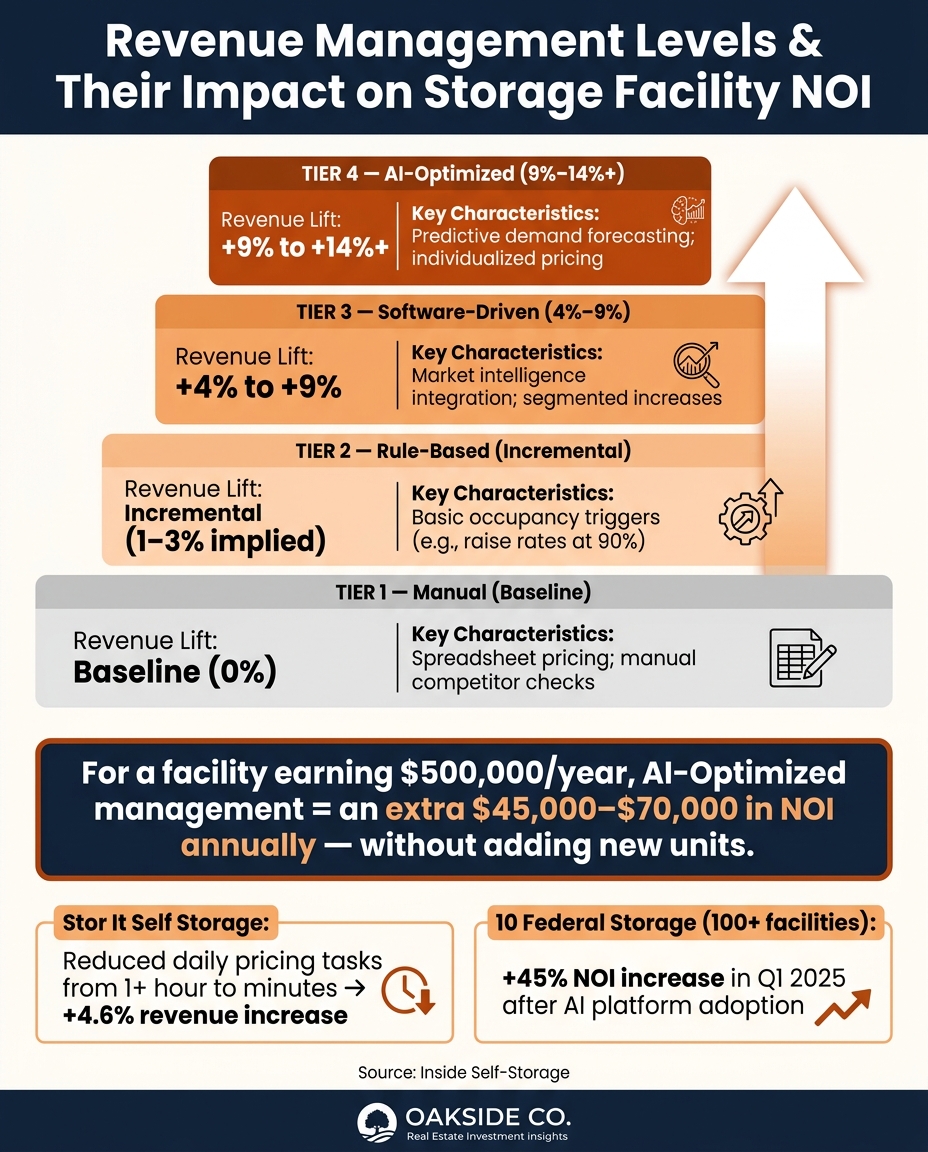
Storage Facility Revenue Management Levels: Manual vs AI-Optimized NOI Impact
After tightening expenses and optimizing your main revenue sources, the next step to boosting NOI is identifying fresh income opportunities. Many storage facilities have untapped potential, often hidden in unused land or underutilized spaces.
Reconfiguring Unit Mix for Higher Rental Income
Start by calculating RevPAF (Revenue Per Available Foot) for different unit types – such as climate-controlled, drive-up, or covered parking. This analysis can reveal overlooked opportunities to enhance revenue. Adjusting your unit mix and using technology can help unlock this potential.
For instance, converting underused interior areas into climate-controlled units can tap into growing demand. These units often command rental rates 25%–50% higher than standard drive-up units. Plus, since the land cost is already accounted for, this type of conversion can deliver returns of 25%–35% on your investment.
In suburban or rural locations, underused parking lots can be transformed into RV or boat storage spaces. With an investment of around $10,000, you can create 10 to 15 rentable spots, offering steady income with almost no maintenance. Monthly rates for covered parking spaces can exceed $400, depending on location and the level of enclosure.
Before making changes, check the local supply within a 3–5 mile radius using tools like Radius+. New competitors entering your market can affect occupancy rates, so make sure your plans align with current and upcoming market conditions.
Adding High-Margin Amenities
Once you’ve cut costs, consider adding services that bring in high margins with minimal upfront investment. Tenant insurance and smart-unit technology are two excellent examples.
Tenant insurance is a win-win for operators. Typically, you keep 30%–50% of premiums, and setting up the program costs nothing. For a facility with 2,500 units, even a 50% insurance adoption rate at $11 per month could generate an additional $66,000 in annual revenue – without needing extra staff or construction.
"There is really no downside, and it has proven to be a very lucrative profit center." – David Hurless, Director of Operations, Stor-It Self Storage
Smart-unit technology is another lucrative upgrade. Installing features like smart locks and individual alarms costs about $1,500 per unit but can justify rental premiums of $15 more per month. As tenants increasingly prefer connected experiences, these upgrades can reduce turnover and support higher rates.
"Many tenants want a hands-on, connected feel to their unit, making smart locks, alarms and enhanced security features attractive premium upgrades." – Randall Mosca Jr., Chief Brand Officer, Columbia Management Group
Tailor your amenities to your market. Wine storage is ideal for high-income urban areas, while RV and boat storage thrives near highways or recreational spots. Before adding vehicle storage or negotiating a cell-tower lease, ensure compliance with local zoning laws and consult an attorney for telecom agreements.
Improving Your Digital Presence and Leasing Funnel
Your website is often your top leasing tool, but many facility websites fall short. Over 60% of storage customers begin their search online, yet some sites still require a phone call to complete a rental. By offering a fully contactless rental process, you could increase move-ins by 20%–40%.
Two digital upgrades can make a big difference. First, integrate value tiering into your checkout process – highlighting "Standard vs. Premium" options can nudge tenants toward higher-value choices. Second, adding payment options like Google Pay can reduce drop-offs during the final steps of the leasing process.
Keeping your listings accurate and up-to-date on platforms like SpareFoot ensures visibility in local searches and provides valuable insights for pricing adjustments. Pair this with an AI voice agent for 24/7 call handling to avoid losing leads outside office hours – a common issue for smaller operators.
The table below shows how different levels of digital and revenue management can impact revenue:
| Management Level | Typical Revenue Lift | Key Characteristics |
|---|---|---|
| Manual | Baseline | Spreadsheet pricing; manual competitor checks |
| Rule-Based | Incremental | Basic occupancy triggers (e.g., raise rates at 90%) |
| Software-Driven | 4%–9% | Market intelligence integration; segmented increases |
| AI-Optimized | 9%–14%+ | Predictive demand forecasting; individualized pricing |
Source: Inside Self-Storage
The difference between manual and AI-optimized management can be substantial. For a facility earning $500,000 annually, this could mean an extra $45,000–$70,000 in NOI – without adding new units. Strengthening your digital leasing process complements other revenue strategies and further enhances NOI.
Conclusion: Tracking Progress and Planning Next Steps
Improving NOI requires consistent tracking, well-defined goals, and expert insights to transform underperformance into increased asset value.
Key Metrics for Tracking NOI Improvements
Boosting NOI isn’t something you do once – it’s an ongoing process that demands regular monitoring. The most important metric to keep an eye on is RevPAF (Revenue Per Available Square Foot). This metric combines rate and occupancy into a single figure, making it easier to compare performance over time and across different facilities.
In addition to RevPAF, pay attention to the gap between physical and economic occupancy, along with the expense ratio, as previously discussed. Here’s a quick summary of the key metrics to track monthly:
| Metric | Formula | Target |
|---|---|---|
| RevPAF | Annual Rental Revenue / Total Rentable SF | Benchmark against local market |
| Economic Occupancy | Actual Revenue / Gross Potential Revenue | Within 3%–8% of physical occupancy |
| Expense Ratio | Operating Expenses / EGI | 35%–45% |
| Physical Occupancy | Units Rented / Total Units | 85%–92% for stabilized assets |
| Cap Rate | NOI / Property Value | 5.0%–7.5% for most 2026 markets |
These metrics should be based on T12 data, including P&L statements, rent rolls, and delinquency reports. Tools such as Store Track and Radius+ can simplify tracking rate trends. With these insights, you can set clear, actionable performance targets.
Setting Targets and Deciding Whether to Hold or Sell
Armed with the right data, you can establish phased, realistic goals. Using the strategies outlined in this guide – like rate optimization, cutting expenses, and introducing new revenue streams – you could see a 20%–40% revenue increase within 12–24 months. If occupancy climbs above 95%, it’s time to consider raising rates. On the other hand, if occupancy dips below 80%, it’s worth investigating potential management or local market issues.
The hold-or-sell decision often depends on where the asset is in its stabilization cycle. Typically, value-add strategies involve a 3–5 year hold period, aiming for equity multiples of 2–3x at exit. Once stabilized, you might consider a 1031 exchange to reinvest gains into a more advantageous property without facing an immediate tax burden. Before selling, ensure expenses – like payroll and management fees – are adjusted to market rates, as institutional buyers will account for artificially low owner-operator expenses.
Having a clear plan and expert advice can make these decisions more effective.
How Oakside Co Can Support Your Asset Strategy
Navigating asset strategies is easier with a knowledgeable partner. Oakside Co is a national advisory firm specializing in self-storage and boat & RV properties. Their expertise spans underwriting, market positioning, and transaction management, offering tailored support for owners and investors at every stage of the asset lifecycle.
Whether you need to benchmark your NOI against market standards or develop a strategy for maximizing sale price, Oakside Co’s data-driven approach aligns with the metrics and strategies discussed here. If you’re ready to refine operations or prepare your asset for the market, their team can help craft a clear, numbers-focused plan.
FAQs
What’s the fastest way to find NOI leaks in my storage facility?
The fastest way to pinpoint NOI leaks is through consistent monitoring and inspections. These practices help identify inefficiencies and unexpected costs before they escalate. Standardized reporting plays a key role here, making it easier to detect irregularities such as utility surges or excessive maintenance costs.
Leverage tools like leak detection sensors and utility alerts to tackle problems as soon as they arise. Additionally, make it a habit to audit invoices regularly. This can help uncover billing mistakes or unnecessary charges, allowing for quick corrections and better overall property performance.
How do I know when to raise rates without losing tenants?
Keeping a close eye on occupancy levels can help you make smarter decisions about pricing. When occupancy hits 90% or higher, it’s a clear sign of strong demand – an opportunity to raise rates and maximize revenue. On the other hand, if occupancy dips below 85%, it might be time to lower rates or introduce promotions to attract more tenants.
Using automated systems can simplify this process. These tools can adjust rates dynamically based on occupancy trends and tenant behavior, helping you strike the right balance between boosting revenue and retaining tenants.
Which add-on revenue streams usually deliver the highest ROI?
Add-on revenue streams that can bring in strong returns often include tenant insurance, truck rentals, and selling packing supplies like boxes. These options are great because they typically make use of resources you already have, allowing you to create extra income without a large initial investment.