Off-market properties – those not publicly listed – offer buyers reduced competition, better negotiation opportunities, and access to high-value assets. Brokers are essential in connecting sellers and buyers for these deals, especially in niche markets like self-storage and boat/RV storage. They leverage industry connections, private databases, and expertise to streamline transactions, ensuring confidentiality and accurate valuations.
Other methods, like direct-to-owner outreach and relationship networks, can also yield results but often lack the efficiency, scale, and precision brokers provide. Each approach has its strengths, but working with brokers is particularly effective for specialized assets or large-scale acquisitions, thanks to their structured processes and deep market knowledge.
1. Broker-Sourced Off-Market Properties
Specialized brokers take a proactive approach by connecting with sellers, maintaining exclusive investor databases, tracking ownership records, and building relationships with operators long before any deals are even discussed. This groundwork opens the door to several key benefits outlined below.
Access to Inventory
Brokers with a focused approach have deep insights into self-storage and boat/RV property markets. They know who owns what and can identify portfolios quietly being considered for sale. This insider knowledge allows them to uncover opportunities that never make it to public listing platforms.
Speed of Acquisition
Thanks to their established relationships with property owners and pre-qualified buyers, brokers can significantly speed up the transaction process. There’s no need for cold calls or widespread marketing campaigns – the connections are already in place, paving the way for faster closings.
Scalability
For investors looking to grow across multiple markets, the broker model offers an efficient solution. A well-structured off-market acquisition program, managed by a single advisory firm, can deliver results that are tough to achieve independently. For instance, one such program secured 12 off-market properties in various U.S. markets over two years, including a two-property deal in Baltimore featuring 1,407 units and over 131,000 net rentable square feet. Beyond scalability, brokers ensure that transactions remain confidential, protecting sensitive information throughout the process.
Discretion
Not all sellers want their intentions made public. Some prefer to avoid alarming tenants, tipping off competitors, or fueling speculation about their business. Brokers act as trusted intermediaries, handling transactions with confidentiality while maintaining a structured and competitive process.
Fit for Specialized Assets
Self-storage and boat/RV properties often require unique valuation methods. For example, a boat storage facility with steel canopies, stacked storage, or valet services is vastly different from a basic open gravel lot – and its pricing should reflect those differences. Brokers with expertise in these niches can accurately assess factors like ancillary income from tenant insurance, late fees, or truck rentals.
These strategies underscore the advantages of broker-sourced deals, offering a clear edge over direct outreach methods.
sbb-itb-09b4138
2. Direct-to-Owner Outreach
Direct-to-owner outreach is a strategy where buyers contact property owners directly to negotiate private sales. This approach offers a personal touch and can lead to unique opportunities, but it also has its challenges when compared to broker-led methods. Buyers can avoid competitive bidding, engage in one-on-one negotiations, and sometimes close deals before the property is widely marketed.
Access to Inventory
One advantage of direct outreach is uncovering unlisted properties. By leveraging public records and local knowledge, buyers can identify potential opportunities. Tools like county assessor data or insights from local markets help buyers create target lists and reach out via mail, phone, or email. However, this method heavily relies on the buyer’s research skills. Without expertise in the sector, there’s a risk of overlooking key properties or misinterpreting an owner’s willingness to sell.
Speed of Acquisition
If conditions align, direct negotiations can lead to faster closings. However, any misalignment in expectations or communication can slow the process down significantly.
Scalability
Expanding a direct outreach strategy across multiple markets is no small feat. The process of identifying property owners, managing ongoing conversations, tracking follow-ups, and coordinating due diligence requires substantial effort and resources. For larger institutional buyers aiming for rapid growth, this method often hits a limit unless supported by professional teams.
Discretion
One of the key benefits of direct outreach is the privacy it offers. Since there are no public listings or marketing materials, transactions remain confidential. This level of discretion is particularly appealing to property owners who want to avoid signaling a potential sale to tenants or competitors. Unlike brokered deals, confidentiality in direct outreach relies entirely on the buyer and seller’s ability to maintain it.
Fit for Specialized Assets
Certain asset types, like self-storage or boat/RV storage properties, come with unique challenges that make direct outreach more complex. For instance, these properties often require specialized knowledge for accurate valuation. Owners may not have a clear understanding of their property’s worth, and buyers without industry-specific expertise might struggle to compare self-storage vs RV storage investment returns to properly assess its value. Take boat/RV storage facilities as an example – some have long-term tenant stability, with 20% of their occupancy coming from tenants who have been on-site for over 20 years. These nuances underscore the importance of sector knowledge when pursuing deals through direct outreach.
Up next, we’ll look at how broader relationship networks can further enhance the process of sourcing off-market deals.
3. Relationship Networks Beyond Brokers
Some buyers tap into established industry connections to uncover off-market opportunities, especially in niche sectors like self-storage and boat/RV storage. These industries often have smaller pools of active buyers and sellers, making informal networks a valuable complement to brokers and direct outreach.
Access to Inventory
Platforms like the Self Storage Investors LinkedIn community enable discreet exchanges of market insights. Such groups can help identify "mom-and-pop" owners who might never consider listing their properties on national platforms. However, inventory sourced through personal connections has its limitations, especially when spanning multiple markets.
Speed of Acquisition
When trust exists between parties, deals can progress quickly. There’s no need for a marketing phase, competitive bidding wars, or navigating formal processes. That said, the lack of structure can also cause deals to stall or fall apart, particularly when expectations between trusted parties don’t align.
Scalability
Building and maintaining strong relationships across various markets is resource-heavy. Tracking ownership changes, evaluating potential assets, and staying on top of follow-ups requires significant effort. Unlike brokers, who rely on established systems, personal networks lack scalability. What works well for one deal in a familiar market becomes much harder to replicate on a larger scale without a solid infrastructure.
Discretion
Deals based on relationships are naturally private. Without public listings or widespread outreach, sensitive information remains contained. However, the level of discretion depends entirely on the trust and reliability of the individuals involved, which can be both a strength and a potential risk.
Fit for Specialized Assets
Relationship networks shine in specialized sectors like boat/RV storage, where the buyer and seller communities are small and closely connected. Still, expertise in the asset class is crucial. For example, understanding the nuances of ancillary income streams – such as tenant insurance or administrative fees – is essential for accurately valuing a facility. While a strong network can open doors, success ultimately depends on a buyer’s ability to combine industry knowledge with precise valuation skills.
Pros and Cons of Each Sourcing Method
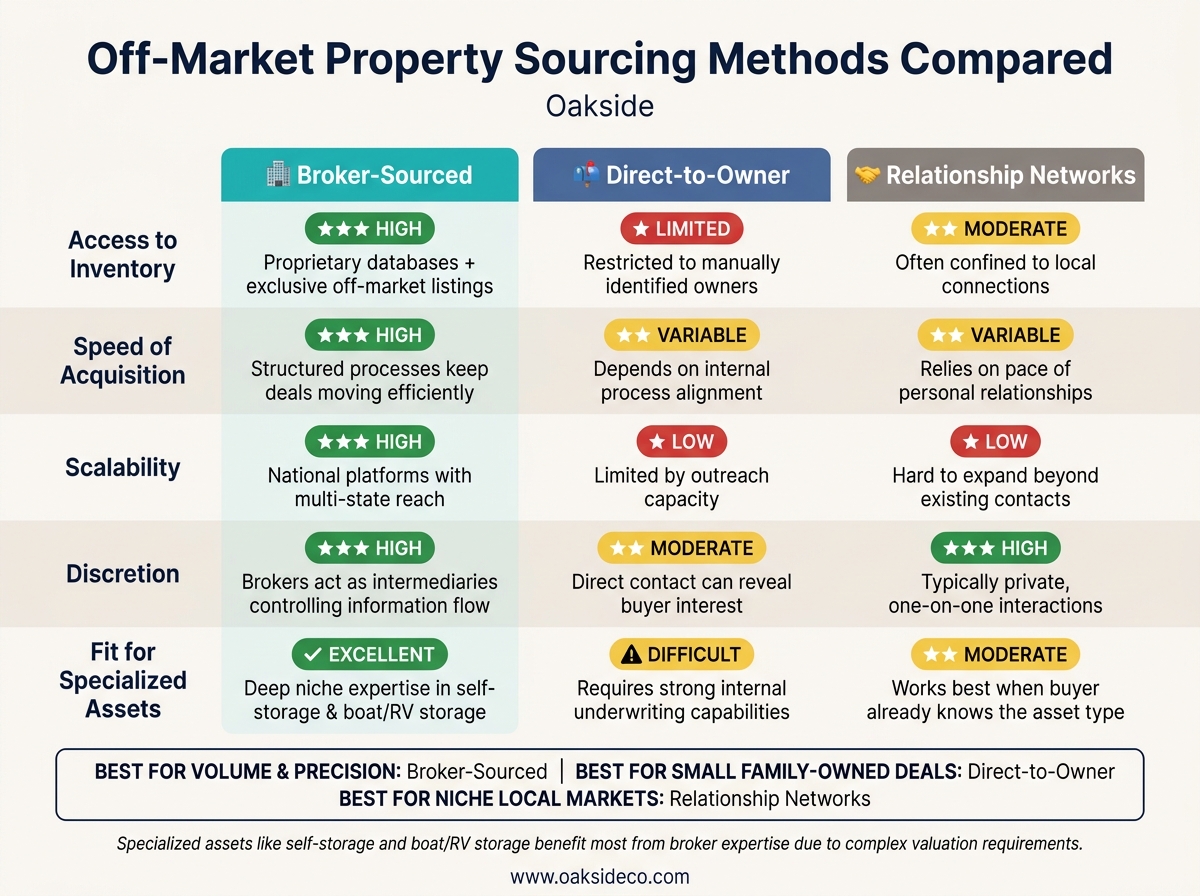
Broker vs. Direct vs. Network: Off-Market Property Sourcing Compared
Each sourcing method comes with its own advantages and challenges. The best choice depends on your specific goals, available resources, and the type of asset you’re targeting. Here’s a quick comparison:
| Feature | Broker-Sourced | Direct-to-Owner | Relationship Networks |
|---|---|---|---|
| Access to Inventory | High – includes proprietary databases and exclusive off-market listings | Limited – restricted to owners you can identify manually | Moderate – often confined to local connections |
| Speed | High – structured processes keep deals moving efficiently | Variable – depends on your internal process | Variable – relies on the pace of personal relationships |
| Scalability | High – national platforms provide reach across multiple states | Low – limited by your outreach capacity | Low – hard to expand beyond existing contacts |
| Discretion | High – brokers act as intermediaries, controlling the flow of information | Moderate – direct contact can quickly reveal buyer interest | High – typically private, one-on-one interactions |
| Fit for Specialized Assets | Excellent – brokers bring expertise in niche areas like self-storage and boat/RV storage | Difficult – requires strong internal underwriting capabilities | Moderate – works best when buyers already know the asset type well |
This table underscores how sourcing methods impact pricing and valuation accuracy.
Brokers often reduce pricing discrepancies by using competitive, data-driven processes. Without such rigor, pricing outcomes can vary significantly. Sellers without professional guidance might accept less than their property’s value, while buyers without real-time market insights risk overpaying. A broker-led process helps mitigate both risks by ensuring decisions are based on accurate, up-to-date data.
For specialized assets like self-storage and boat/RV storage, expertise becomes even more critical. These aren’t standard commercial properties – they require precise valuation metrics that are tough to nail down through direct outreach or informal networks.
"We provide investment‑banking‑level analysis on every deal – because in specialized asset classes like self‑storage and boat/RV storage, the difference between a good outcome and a great one often comes down to how precisely you’ve underwritten the asset."
- Cameron Vale, President at Oakside
While no single method works for every situation, direct outreach and informal networks can uncover hidden opportunities, especially with smaller, family-owned facilities. The trick is knowing when to rely on these methods and when to bring in broker expertise to achieve the best results.
Conclusion
Every sourcing method offers its own advantages, depending on the type of asset, timing, and how much risk you’re willing to take on.
Direct-to-owner outreach is ideal for smaller, family-owned facilities, where avoiding competitive bidding is key. Relationship networks can uncover off-market opportunities, but they tend to work best for buyers with strong local connections, and they’re harder to scale. Meanwhile, broker-sourced deals provide broader access, a structured process, and detailed, data-backed insights – especially for more niche assets like self-storage and boat/RV storage.
By comparing broker-sourced deals, direct outreach, and relationship networks, it becomes clear that the right approach depends on your specific goals. Buyers looking for volume or precision often benefit from working with brokers who specialize in off-market programs. On the other hand, value-add investors may find success targeting mom-and-pop facilities with untapped potential due to outdated management practices.
Boat and RV storage, in particular, comes with its own set of challenges. Factors like proximity to water, local income levels, and lot configurations make these assets trickier to value and increase underwriting risks.
The key is aligning your sourcing method with the unique characteristics of the asset and your transaction objectives to achieve the best results.
"Our team blends investment‑banking‑level analysis with real operator expertise, delivering strategies that are deeply informed, data‑driven, and aligned with each client’s unique objectives." – Cameron Vale, President at Oakside
To maximize your chances of finding the right off-market deal, consider partnering with a national advisor like Oakside, whose expertise can help you navigate the complexities of the market.
FAQs
How do brokers find off-market deals?
Brokers find off-market deals by cultivating solid relationships with property owners and tapping into wide-reaching industry networks. This involves regular follow-ups, keeping an eye on properties close to existing facilities, and targeting owners who may be approaching retirement or considering changes to their portfolios. By combining data-driven insights with proactive outreach, firms like Oakside assist clients in securing private opportunities. As Nolen Masserman, Managing Director at Oakside, explains, having specialized market intelligence is crucial for gaining access to these exclusive assets.
When is direct-to-owner outreach better than using a broker?
Direct-to-owner outreach can be a helpful approach when you’re eyeing a specific off-market property that isn’t currently listed for sale. That said, partnering with a professional advisory firm, like Oakside Co, often delivers stronger results. According to Nolen Masserman, Managing Director at Oakside, and Cameron Vale, the firm’s President, their data-driven strategies and extensive networks streamline off-market acquisitions. This approach helps clients get the most value at every stage of the investment process.
What makes self-storage and boat/RV storage harder to value?
Valuing self-storage and boat/RV storage properties can be tricky because they come with their own set of challenges. For one, non-permanent structures like shipping containers or prefabricated units make it harder to meet the requirements for federally regulated loans. On top of that, these properties vary widely – ranging from simple gravel lots to repurposed warehouses – and often have multiple income sources. Things like late fees, insurance sales, and rental agreements all need to be carefully analyzed to get an accurate picture of their value.