Phase I and Phase II Environmental Site Assessments (ESAs) are critical steps in property transactions, especially for commercial real estate. Phase I identifies potential contamination risks, while Phase II confirms and measures those risks through physical testing. Here’s what you need to know:
Key Points:
- Phase I ESA: Non-intrusive, focuses on records, site inspections, and interviews to flag potential contamination (Recognized Environmental Conditions or RECs).
- Phase II ESA: Intrusive, involves soil, groundwater, or vapor sampling to confirm contamination and assess its extent.
- Costs: Phase I typically costs $2,800–$8,500; Phase II can range from $12,000 to over $120,000.
- Timelines: Phase I takes 2–4 weeks; Phase II takes 3–8+ weeks, depending on findings and scope.
Quick Comparison:
| Aspect | Phase I ESA | Phase II ESA |
|---|---|---|
| Purpose | Identify risks (RECs) | Confirm contamination |
| Methodology | Non-intrusive | Intrusive sampling |
| Cost | $2,800–$8,500 | $12,000–$120,000+ |
| Timeline | 2–4 weeks | 3–8+ weeks |
| Standard | ASTM E1527-21 | ASTM E1903-19 |
Skipping Phase I can lead to legal and financial liability under CERCLA. Start Phase I early in the deal process to avoid delays and unexpected costs. If Phase I flags RECs, a Phase II is often necessary to proceed with confidence.
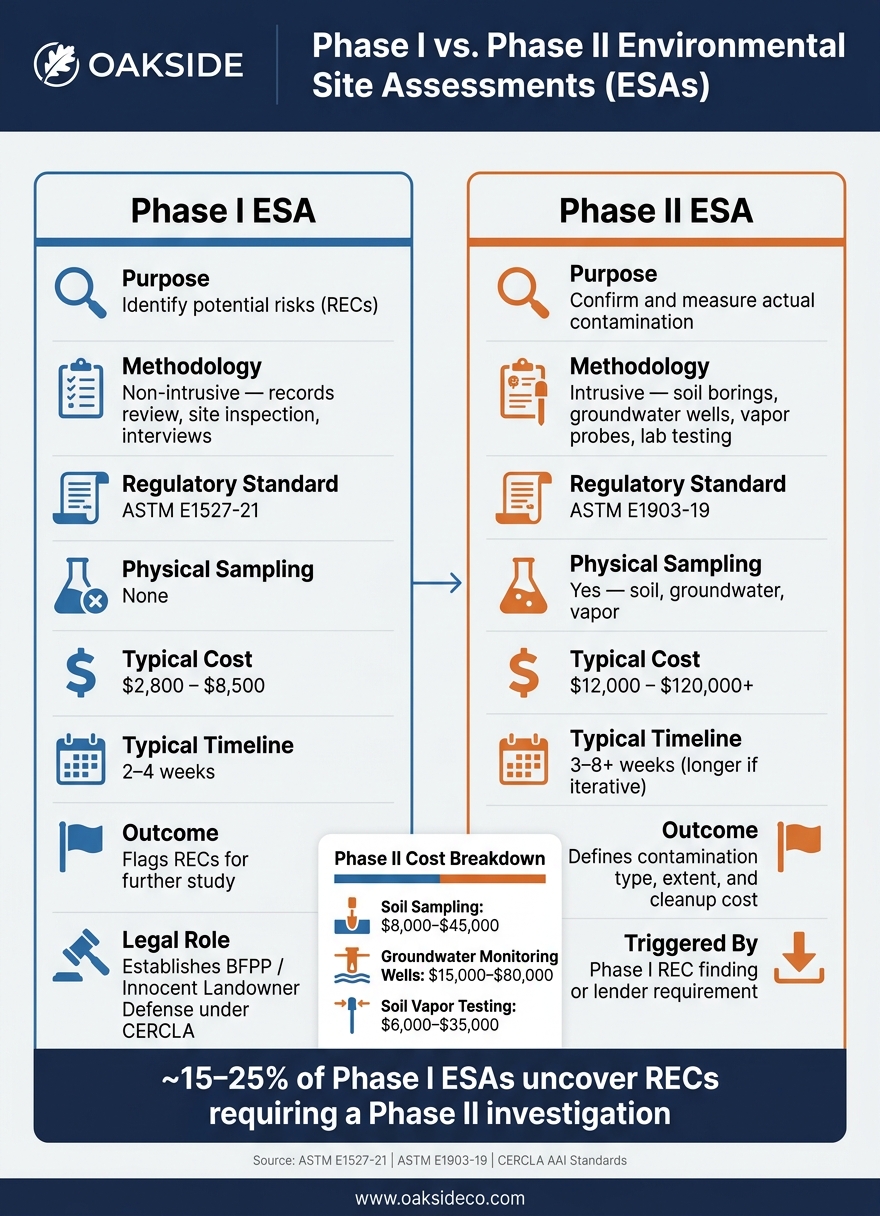
Phase I vs. Phase II Environmental Site Assessment: Side-by-Side Comparison
Phase 1 Environmental Site Assessments: Purpose and Process
Purpose of Phase 1 ESAs
A Phase 1 Environmental Site Assessment (ESA) is designed to determine whether a property might contain environmental contamination before it’s purchased. Its main objective is to identify Recognized Environmental Conditions (RECs) – indicators of potential hazardous substances or petroleum products that could lead to future liability.
But there’s more to it than just spotting potential issues. A Phase 1 ESA also plays an important legal role. It’s the primary way for buyers to establish Bona Fide Prospective Purchaser (BFPP) status under CERCLA. This status protects buyers from being held financially responsible for cleaning up pre-existing contamination. Without completing this assessment, simply owning the property could make the buyer liable for cleanup costs.
This legal protection is especially important for properties with large or complex histories. Think of places like old trucking depots, former agricultural fields, or sites near fuel operations – where undocumented underground storage tanks or chemical residues might still linger.
Scope and Methods Used in Phase 1 ESAs
One defining feature of a Phase 1 ESA is that it’s entirely non-intrusive – no drilling, soil sampling, or lab testing is involved. Instead, assessors rely on four main methods to piece together the environmental history of the property:
- Historical Records Review: This involves examining sources like aerial photographs (sometimes dating back to the 1940s), Sanborn fire insurance maps, city directories, building permits, and land title records to trace the property’s past uses.
- Regulatory Database Search: Federal, state, and local databases are searched – usually within a one-mile radius of the property – to identify nearby contaminated sites, registered storage tanks, or reported spills.
- Site Reconnaissance: An Environmental Professional (EP) performs a visual inspection of the property, looking for warning signs such as chemical odors, stained soil, stressed vegetation, vent pipes, or abandoned containers.
- Interviews: Conversations with past and current owners, site managers, and local officials can uncover undocumented spills or hidden storage tanks that official records might not show.
Modern assessments that follow ASTM E1527-21 guidelines also include a Vapor Encroachment Screen (VES). This evaluates whether volatile organic compounds (VOCs) or petroleum vapors from nearby sources could be migrating onto the property.
It’s worth noting that the EP conducting the assessment must meet specific federal qualifications. Typically, this means being a licensed Professional Engineer (P.E.) or Professional Geologist (P.G.) with relevant experience. Reports signed by unqualified individuals won’t provide the legal protections buyers need.
Together, these non-intrusive methods create a detailed environmental profile that helps guide decisions about the property.
Phase 1 ESA Deliverables and Outcomes
The end result of a Phase 1 ESA is a comprehensive written report. For most commercial properties, these reports range from 50 to 150 pages, but for more developed or complex sites, they can exceed 400 pages. The report, signed by the EP, categorizes findings into one of the following:
| Finding Category | What It Means | What Happens Next |
|---|---|---|
| REC | Current or likely contamination exists | Typically leads to a Phase 2 ESA |
| CREC | Past contamination with ongoing controls in place | Buyer assumes compliance responsibilities |
| HREC | Past contamination fully resolved | No further action required |
| De Minimis | Minor issue posing no material risk | No further action required |
| Data Gap | Missing records or restricted access | Could affect compliance with All Appropriate Inquiries (AAI) if significant |
Interestingly, about 15% to 25% of Phase 1 ESAs uncover RECs that call for further investigation through a Phase 2 ESA. When this happens, buyers often need to adjust both the transaction timeline and budget.
A couple of practical tips: Make sure both the buyer and the lender are listed in the report’s reliance section to avoid closing delays. Also, remember that standard Phase 1 ESAs don’t cover issues like asbestos, lead-based paint, radon, or mold unless these are specifically added as non-scope items upfront.
sbb-itb-09b4138
Phase 2 Environmental Site Assessments: Purpose and Scope
Phase 2 Environmental Site Assessments (ESAs) build directly on the findings from Phase 1, moving from identifying potential risks to scientifically confirming actual issues. While Phase 1 asks, "Could there be a problem here?", Phase 2 takes it further, asking, "Is there a problem, and how severe is it?" This shift marks the transition from research to verification. As NOVA Engineering and Environmental explains:
"Phase 1 is detective work, reviewing historical records… Phase 2 is scientific verification, collecting samples to confirm contamination."
When Is a Phase 2 ESA Required?
Phase 2 assessments are typically triggered when a Phase 1 investigation uncovers a Recognized Environmental Condition (REC). However, even when a Phase 1 report appears clean, some lenders – especially SBA and CMBS lenders – might still require a Phase 2 assessment based on the property’s historical use .
Certain property types and conditions are more likely to necessitate a Phase 2 ESA. For example, sites with a history as gas stations, dry cleaners, auto repair shops, or industrial facilities often warrant further investigation. Additional red flags include stained pavement, unexplained floor drains, evidence of underground storage tanks, or proximity to known contamination sites or leaking underground tanks . These factors often lead to the more detailed, intrusive analysis described below.
Phase 2 ESA Field Work and Sampling Methods
Unlike the document-based Phase 1 process, Phase 2 involves hands-on testing and follows ASTM E1903 standards . Techniques include:
- Soil borings
- Groundwater monitoring well installation
- Soil vapor probing
- Geophysical surveys, such as Ground Penetrating Radar (GPR), to detect buried tanks or pipes
The cost of a Phase 2 ESA depends heavily on the scope of work. For instance:
- Soil sampling: $8,000 to $45,000
- Groundwater monitoring wells: $15,000 to $80,000
- Soil vapor testing: $6,000 to $35,000
In total, a Phase 2 investigation can range from $12,000 to over $120,000 and typically takes 3 to 6 weeks to complete under normal conditions . However, if contamination is confirmed, additional rounds of sampling may be required to map the full extent of the issue, which can extend the timeline to 90 days or more. This detailed work is crucial for determining what remediation might be needed.
Phase 2 ESA Findings and Their Impact on Deals
The results of a Phase 2 ESA don’t necessarily spell doom for a property transaction. As NOVA Engineering and Environmental points out:
"Confirmed contamination doesn’t necessarily kill transactions. The information allows buyers and sellers to negotiate appropriately, adjusting purchase prices, establishing escrow accounts for cleanup costs, or structuring transactions to allocate liability appropriately."
The financial stakes, however, can be substantial. Cleaning up petroleum contamination can cost tens of thousands of dollars, while addressing chlorinated solvent contamination – often linked to dry cleaners – can exceed $2.5 million for more complex groundwater issues . Additionally, lenders typically won’t approve construction loans without an approved remediation plan or a "No Further Action" (NFA) letter from the state .
For certain property types, like storage facilities or boat/RV assets, vapor intrusion poses a unique concern. Volatile organic compounds (VOCs) can migrate from contaminated soil or groundwater into buildings, potentially endangering occupants. In such cases, mitigation measures like vapor barriers or sub-slab venting systems may be required before the property can be safely used . Investors in these asset types should consider adding a 15%–25% contingency to their acquisition budget to account for follow-up testing and potential mitigation if a material REC is identified.
Key Differences Between Phase 1 and Phase 2 ESAs
Phase 1 and Phase 2 Environmental Site Assessments (ESAs) serve different roles. Phase 1 focuses on identifying potential risks using research and non-invasive methods, while Phase 2 dives deeper to confirm contamination through physical testing. As Resource Management Associates explains:
"A well-executed Phase I should answer 90% of your questions. A targeted Phase II fills in the rest."
Scope, Methods, and Level of Investigation Compared
The differences between Phase 1 and Phase 2 assessments come down to their scope and techniques. Phase 1 involves reviewing historical records, conducting site inspections, and interviewing stakeholders – without any physical sampling. Phase 2, guided by ASTM E1903-19, uses intrusive methods like soil borings, groundwater wells, and vapor probes, with samples analyzed in a lab.
| Aspect | Phase 1 ESA | Phase 2 ESA |
|---|---|---|
| Primary Goal | Identify potential risks (RECs) | Confirm and measure actual contamination |
| Methodology | Non-intrusive (records, walkthroughs, interviews) | Intrusive (drilling, sampling, lab testing) |
| Regulatory Standard | ASTM E1527-21 | ASTM E1903-19 |
| Physical Sampling | No | Yes (soil, groundwater, vapor) |
| Typical Cost | $2,800–$8,500 | $12,000–$120,000+ |
| Typical Timeline | 2–4 weeks | 3–8 weeks (longer if iterative) |
| Outcome | Flags RECs for further study | Defines contamination type, extent, and cleanup cost |
Skipping Phase 1 isn’t an option, even if contamination seems likely. Without a completed, AAI-compliant Phase 1, buyers lose eligibility for CERCLA’s "Innocent Landowner Defense", which protects them from liability for pre-existing contamination. Nolen Masserman, Managing Director at Oakside, emphasizes this point:
"The CERCLA defense is procedural, not substantive. Buyers ensure their innocent-landowner shield by performing AAI."
The transition from Phase 1 to Phase 2 often highlights the importance of starting with a detailed initial assessment, especially for properties with complex histories.
Choosing Between Phase 1 and Phase 2 in Self-Storage and Boat/RV Deals
For most self-storage and boat/RV acquisitions in the U.S., Phase 1 is the go-to starting point – and often the only step needed. Whether a Phase 2 is required depends entirely on Phase 1 findings. This makes an initial thorough ESA essential for protecting investment value.
Phase 2 is generally triggered when a Phase 1 flags a Recognized Environmental Condition (REC) tied to the property’s history. For example, self-storage facilities located on former gas station or dry cleaner sites may require further investigation. Similarly, boat and RV storage properties, often situated on large parcels with extensive histories, might have risks tied to past agricultural or industrial activities that only come to light during a detailed Phase 1 review.
A case from 2024 illustrates this process: A Sunbelt cold-storage developer conducted a Phase 1 ESA just 41 days before closing on a 22-acre site near Phoenix. The Phase 1 flagged a nearby 1980s dry cleaner as a potential vapor risk. The developer then commissioned a $48,000 Phase 2 investigation, which included soil-vapor and groundwater sampling. The results confirmed that the contaminant plume had not impacted the property. With documented liability protection and lender approval, the deal closed on time.
How ESA Findings Shape Investment Decisions
Phase 1 findings help determine whether a deal should proceed to further investigation, while Phase 2 results provide the data needed to structure the deal and plan remediation. For example, in April 2025, a buyer looking to convert a former gas station identified petroleum-contaminated soil during a Phase 2 assessment. This allowed them to renegotiate the purchase price and address cleanup costs before closing. Similarly, a buyer in Atlanta used findings from Phase 1 and Phase 2 assessments to secure a $2.8 million discount on a $7.1 million coatings site. The savings more than covered the $1.1 million remediation cost, and the buyer enrolled in Georgia’s Voluntary Remediation Program during due diligence.
For institutional investors managing multiple properties, lenders often require either a clean Phase 2 report or a state-issued "No Further Action" letter before approving construction financing. Environmental findings directly impact deal timelines, financing terms, and long-term returns, making the proper sequencing of ESAs a critical part of any acquisition strategy. These assessments play a key role in managing risks and ensuring informed investment decisions.
Fitting ESAs Into Your Investment Process
Aligning ESAs With Transaction Timelines
Timing plays a huge role in managing Environmental Site Assessments (ESAs). Institutional buyers often wait too long to order a Phase I, leaving little room to address findings before the deal closes.
Here’s the best approach: start the Phase I process as soon as you execute the purchase contract. A Phase I typically takes 2–4 weeks to complete. If the report identifies a Recognized Environmental Condition (REC) and a Phase II is needed, you’ll need an additional 4–8 weeks – or even longer if multiple rounds of sampling are required. Altogether, this could mean you’re looking at 10–12 weeks of environmental due diligence, which must fit within your contract period.
There’s also a legal timeline to keep in mind. Under CERCLA’s All Appropriate Inquiries (AAI) standard, the Phase I site visit and interviews must occur within 180 days of closing. If the report is older than 180 days, you lose eligibility for the innocent-landowner defense. Here’s an example: a logistics sponsor in the Mid-Atlantic region closed on a 38-acre trucking terminal near Baltimore using a 33-month-old Phase I report to save time. After closing, a construction lender required a Phase II, which revealed a benzene plume. Because the Phase I was outdated, the EPA denied the innocent-landowner defense. The result? The owner faced $1.4 million in cleanup costs, $185,000 in legal fees, and a 19-month delay on the construction loan.
Another critical step is confirming lender-specific requirements before hiring an environmental consultant. For instance, SBA loans follow SOP 50 10 8 and have unique ESA formatting needs. Failing to meet these requirements can add 15–45 days to your timeline.
Proper ESA timing isn’t just about individual transactions. It’s also key to managing risks across your entire portfolio.
Managing Environmental Risk Across a Portfolio
Once you’ve aligned ESAs with specific deals, it’s essential to maintain consistent oversight across your portfolio. For institutional investors managing multiple properties – like self-storage or boat/RV facilities across different states – environmental risks don’t disappear after closing. Under CERCLA, property owners must comply with land-use restrictions (Institutional Controls) and take reasonable steps to stop ongoing contamination. These actions are necessary to preserve legal defenses.
"A clean site with sloppy documentation is more exposed than a contaminated site with rigorous documentation."
To stay protected, centralize your ESA reports and keep track of their shelf life. If you’re repositioning or refinancing a property more than 180 days after the original Phase I, refresh the report. And for redevelopment projects, like turning an industrial site into a boat/RV storage facility, integrate Phase II findings into the civil design process. Delaying Phase II data until after site plan approval has been shown to cause cost overruns of 12%–18% on civil site work.
For properties with a history of industrial or fueling uses, it’s wise to set aside 15%–25% of the acquisition cost as a contingency for Phase II expenses.
Conclusion: Phase 1 vs. Phase 2 ESAs
Let’s break down the key differences and practical implications of Phase I and Phase II ESAs for investors in self-storage and boat/RV properties.
Key Takeaways for Storage and Boat/RV Investors
Phase I ESAs serve as a first step, identifying potential risks, while Phase II ESAs dig deeper to confirm and measure those risks. For investors, this distinction can have a direct impact on both costs and deal outcomes. Properties like former industrial sites, strip mall conversions, or locations with a history of fuel storage are more likely to require a Phase II investigation. While more expensive, Phase II findings can provide leverage for negotiating lower purchase prices or securing favorable remediation agreements. They also open doors to price adjustments, escrow holdbacks, or seller-funded cleanup efforts. Skipping the ESA process or relying on outdated reports could jeopardize deals and leave investors exposed to cleanup liabilities, undermining CERCLA innocent-landowner protections.
| Phase I ESA | Phase II ESA | |
|---|---|---|
| Purpose | Identify potential risks (Recognized Environmental Conditions) | Confirm and measure contamination |
| Method | Non-intrusive (records review and site inspection) | Intrusive (drilling and lab testing) |
| Standard | ASTM E1527-21 | ASTM E1903 |
| Typical Cost | $2,800–$8,500 | $12,000–$120,000+ |
| Typical Timeline | 2–4 weeks | 3–6+ weeks |
Understanding these differences equips investors to make smarter, more informed decisions.
How Oakside Co Supports Clients With ESA Insights
Incorporating ESA findings early in the investment process is critical for protecting your financial interests. Environmental due diligence impacts underwriting, deal structuring, and exit strategies, and Oakside Co integrates these insights from the outset – not as a last-minute formality.
For institutional investors handling self-storage or boat/RV assets, Oakside uses ESA data to craft strategies that enhance asset value. This might involve adjusting offer prices, structuring escrow terms, or carefully timing assessments to fit within the 180-day AAI window. As Nolen Masserman, Managing Director at Oakside, puts it:
"Environmental risk is investment risk. The clients who treat ESAs as strategic inputs – not paperwork – are the ones who protect their returns."
The objective is clear: ensure no environmental surprises surface after closing and maximize the value of every assessment finding to safeguard your investment.
FAQs
What triggers a Phase II after a Phase I?
A Phase II Environmental Site Assessment comes into play when a Phase I assessment uncovers Recognized Environmental Conditions (RECs) – essentially red flags that suggest potential contamination. While Phase I relies on non-intrusive methods like records reviews and site inspections to identify possible risks, Phase II takes it a step further with hands-on testing.
This means collecting samples of soil, groundwater, or vapor to determine if contamination is present. It also identifies the specific chemicals involved and measures their levels to see if they exceed regulatory limits. The results provide crucial information for investors and stakeholders, helping them understand and address environmental risks tied to the property.
How long is a Phase I ESA valid for closing and lender use?
A Phase I Environmental Site Assessment remains valid for 180 days from the date its main components – like the site inspection and interviews – are completed, in order to comply with All Appropriate Inquiries (AAI) requirements. If more than 180 days but less than one year has passed, the report can be updated to remain compliant. However, once the one-year mark is reached, the report is no longer valid, and a new assessment must be conducted to uphold CERCLA liability protections.
Will a Phase II finding automatically kill my deal or financing?
A Phase II finding doesn’t necessarily mean the end of a deal or financing. Instead, it offers important insights into potential risks. While contamination might lead to remediation efforts, regulatory reporting, or even project delays, it often serves as a step toward understanding the environmental landscape more clearly. Many transactions move forward, often with adjustments such as renegotiating the price, having the seller address cleanup efforts, or securing environmental insurance to manage risks and safeguard the deal.