Here’s the short answer: the buyer checks the deal, and the seller proves the deal. In most U.S. self-storage sales, due diligence starts a few days after contract signing and usually runs 30 to 90 days. During that time, the buyer tests income, occupancy, title, site condition, zoning, and legal use before earnest money turns hard.
If I had to boil the whole process down, it comes to this:
- The buyer verifies the story behind the price
- The seller supplies records and answers questions
- The issue list is the main tool that moves the deal forward
- Late or missing files often lead to credits, extensions, or termination
- Once contingencies expire, more risk shifts to the buyer
A self-storage deal can look fine at first glance and still have problems in the file. A rent roll may not match bank deposits. Occupancy may look solid in software but weaker in cash collected. Old liens, permit gaps, code issues, roof repairs, or hazardous-material concerns at boat and RV sites can all change value fast.
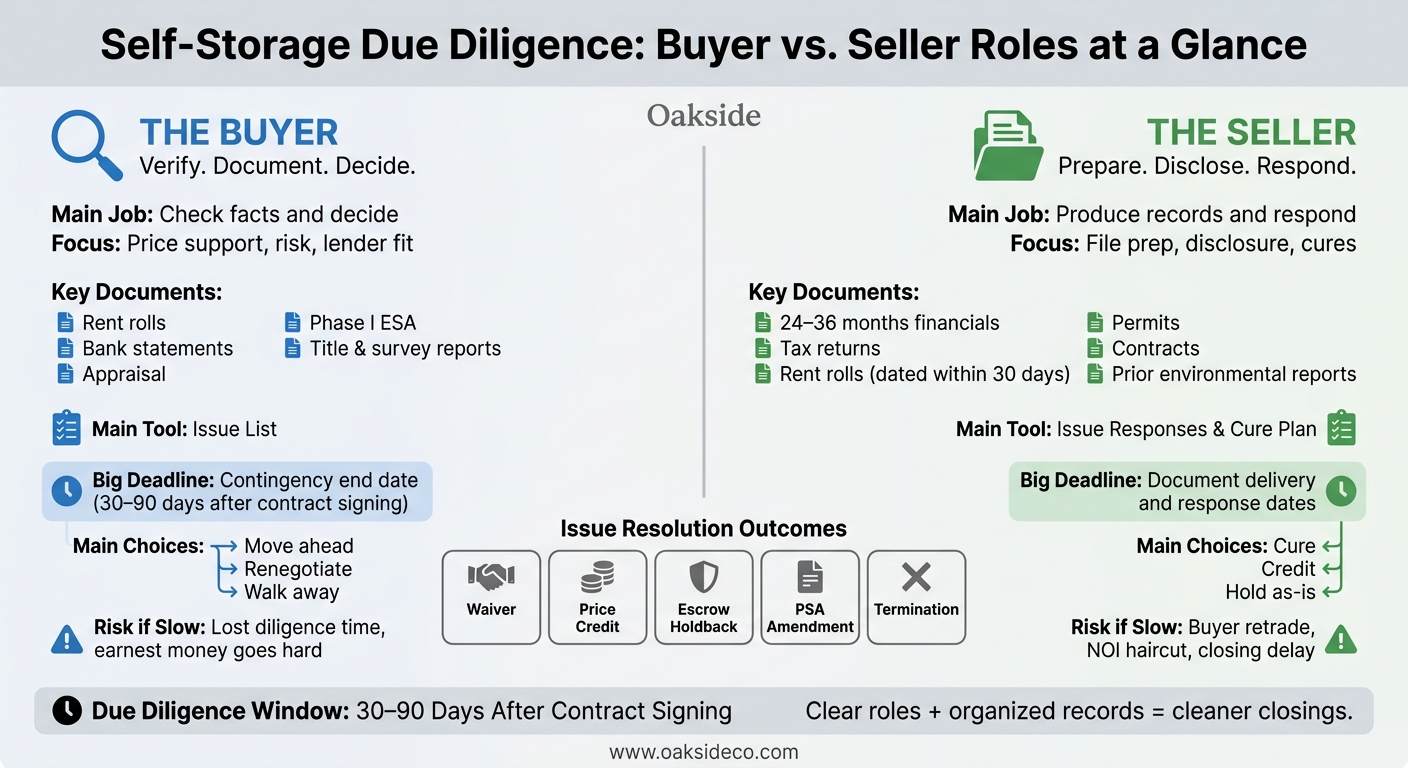
Self-Storage Due Diligence: Buyer vs. Seller Roles at a Glance
Quick comparison
| Topic | Buyer | Seller |
|---|---|---|
| Main job | Check facts and decide | Produce records and respond |
| Focus | Price support, risk, lender fit | File prep, disclosure, cures |
| Key documents | Rent rolls, bank data, reports, title, survey | Financials, tax returns, contracts, permits, prior reports |
| Main tool | Issue list | Issue responses and cure plan |
| Big deadline | Contingency end date | Delivery and response dates |
| Main choices | Move ahead, renegotiate, or walk away | Cure, credit, or hold as-is |
| Risk if slow | Lost diligence time, hard earnest money | Buyer retrade, lower NOI view, closing delay |
The bottom line: if you keep buyer and seller roles separate, track every open item, and deal with missing data early, you give the deal a better shot at closing on the agreed terms.
sbb-itb-09b4138
Buyer responsibilities during due diligence
The buyer’s job during due diligence is simple in theory and demanding in practice: check every major assumption before closing. Income, occupancy, and expenses all need to line up with the records. At this stage, the buyer is doing three things: verify, document, decide.
Reviewing seller files and confirming performance
Start with the main operating file. That usually includes the trailing 12 to 24 months of financials, two to three years of tax returns, bank statements, rent rolls, delinquency reports, and move-in/move-out history.
The buyer also needs details that shape day-to-day income, such as:
- Unit mix
- Climate-controlled versus non-climate-controlled ratios
- Lien-sale files
- Tenant insurance penetration rates
- Late fee income history
The big test here is matching the rent roll to bank deposits. If billed rent and collected cash don’t match, that can point to concessions, write-offs, or occupancy that looks good in the software but falls short in actual cash flow. And if management software exports don’t line up with bank activity, that’s a clear signal to dig deeper before moving ahead.
Once the numbers are reconciled, the buyer shifts to third-party reports and starts building an issue list.
Ordering reports and building the buyer issue list
The buyer orders outside reports, which usually include an appraisal, Phase I environmental assessment, property condition assessment, survey, title review, and zoning review.
For boat & RV storage sites, Phase I ESAs need closer attention. Regulators and lenders are paying more attention to vehicle-storage properties, especially around hazardous materials handling, hydraulic lift condition, drip protection, and waste oil management.
As findings come in, the buyer turns them into a working issue list for seller responses, cures, or price talks. Each item should be logged with its severity and the proof behind it.
| Category | What It Means | Common Examples |
|---|---|---|
| Informational | Minor gaps; no pricing impact | Small document gaps, minor reporting inconsistencies |
| Negotiable | Affects economics; can be cured | Modest deferred maintenance, short-term contracts |
| Material | Changes value, use, or closing risk | Environmental contamination, major title defects, substantial occupancy decline |
That issue list becomes the buyer’s main tool for asking for cures, credits, or termination rights.
Managing deadlines and making the go or no-go decision
After the issues are logged, the buyer needs to work backward from the contingency date. In most U.S. deals, the diligence window runs 30 to 90 days, so document review, site inspections, and internal approvals need to happen well before hard PSA dates.
If data shows up late or doesn’t show up at all, log the gap, assign a deadline, and underwrite conservatively until the point is confirmed. If the asset no longer supports the price, renegotiate or exit before contingency rights expire.
The final go-or-no-go test is plain: does the asset still support the price on income, occupancy, condition, title, and legal use?
The buyer checks the file. The seller provides it. That division shapes every deadline, question, and cure.
Seller responsibilities during due diligence
Once the buyer starts checking the deal, the seller’s job is pretty simple in theory: keep the file complete, current, and easy to review. In practice, that means gathering records, answering questions, and managing risk. A seller who stays organized gives the buyer less room to push for a price retrade.
Preparing the data room and core diligence files
A complete self-storage data room often includes 50 to 100+ documents across at least 10 categories. This isn’t just a digital filing cabinet. It’s the package the buyer will use to judge the asset.
The main folders should include:
- Financials: Trailing 12 to 36 months of P&L statements, general ledger exports, bank statements, and budgets versus actuals.
- Tax returns: Two to three years of federal and state returns for the property-owning entity.
- Rent rolls and unit inventory: Current and past rent rolls showing unit mix, physical versus economic occupancy, move-in dates, concessions, and delinquency. Rent rolls should be dated within 30 days to carry weight.
- Vendor and service contracts: Management, maintenance, security, software, and marketing agreements.
- Insurance and tax records: Insurance policies and claims history, along with real estate tax bills, assessments, and appeals.
- Legal, title, and entitlement documents: Surveys, site plans, zoning letters, certificates of occupancy, permits, and any litigation, lien, or code-enforcement files.
- Environmental and physical records: Prior Phase I/II reports, geotechnical or structural reports, and capex history such as roof replacements, gate systems, and climate-control upgrades.
How the room is set up matters just as much as what’s inside it. Files should be named clearly, with the document type and date. Older versions should go into an Archived subfolder instead of disappearing. A short change log showing what changed and why helps keep everyone looking at the same set of facts.
Once the room is in shape, the next task is quick, written answers to buyer questions.
Answering buyer questions and updating records
After the data room goes live, the seller’s role shifts. Now it’s about replying to buyer questions and keeping records up to date. Follow-up answers should be prompt, in writing, and backed by documents.
If occupancy drops, spell out the reason. Maybe it came from a temporary rate increase, a management transition, new competition, or a marketing shift. Then show what happened to occupancy and rates after that. If an expense jumps, connect it to a specific project and attach the invoice and photos. That kind of plain, documented response builds trust and makes it harder for a buyer to argue for a discount based on uncertainty.
As closing gets closer, sellers should upload updated financials and rent rolls on a set monthly schedule, along with a short note covering any material changes since underwriting. That routine cuts down on last-minute surprises and gives the buyer’s investment committee fewer reasons to delay or reprice.
Site access should be handled the same way: with control and clear communication. One person – often the broker or asset manager – should coordinate inspections, vendor interviews, and contact with on-site staff. For self-storage deals, direct tenant contact is usually limited until later in the closing process to avoid churn.
Handling cures, disclosures, and seller-side risk
When the buyer sends over an issue list, the seller has to make a call on each item: cure it, credit it, or hold the as-is position. That call usually comes down to cost, timing, materiality, and how much leverage the seller has.
Curable title problems, such as old liens, missing releases, or minor easement questions, are often worth fixing before closing because they affect insurability and lender comfort. Smaller physical problems – like asphalt patching or broken security cameras – can also make sense to handle before closing if the fix is cheap and removes an objection. Bigger elective items, like a full roof replacement, are more often handled through a negotiated credit or price cut instead of slowing the deal for construction.
Known material issues – pending code violations, environmental conditions, or active tenant disputes – need to be disclosed early so the buyer can price the risk before deadlines get tight. The seller’s goal is to be accurate and complete without promising more than the records and facts can support if a dispute shows up later.
Seller-side delays come with real costs. Slow document delivery or messy records send a bad signal to buyers and lenders, and they tend to price that risk into the deal. Incomplete financials can lead to NOI haircuts. Open title issues can reduce lender leverage and push up the buyer’s equity need, which then puts pressure on the purchase price. The best move is to start pre-diligence prep before the property goes to market: fix clear title defects, organize at least 24 months of financials, and close out minor code issues.
Oakside can help weigh cure versus credit and protect net proceeds. Those calls feed straight into the buyer vs. seller issue list and the final pricing discussion.
Buyer vs. seller: how issue lists, timing, and risk move through the deal
The buyer is pressure-testing risk. The seller is trying to disclose what matters without giving up price. That split shapes the issue list, extension requests, and price talks between signing and closing. You can see it most clearly in the issue list itself.
Who owns the issue list and who responds to it
The buyer owns the master list. The seller answers it, fixes items, or negotiates the remedy.
At first, the list is mostly document requests and diligence questions. Then it turns into a more formal punch list after third-party reports, title review, survey review, and financial analysis come back. On the seller side, someone usually tracks all of this in-house: what’s been answered, what’s still open, and which items need a legal call or a price decision before closing.
Most items follow the same path: request → explanation → cure or repair commitment → negotiation → final treatment.
That final treatment usually lands in one of these buckets:
- waiver
- price credit
- escrow holdback
- PSA amendment
- termination
The table below shows how the roles usually split across common issue types.
| Issue Category | Buyer’s Primary Role | Seller’s Primary Role |
|---|---|---|
| Document gaps | Flag missing items | Produce records or explain the gap |
| Third-party findings | Evaluate cost, closing risk, and lender impact | Decide whether to cure, credit, disclose, or leave as risk the buyer accepts |
| Title defects | Flag defects and assess insurability and financing risk | Determine whether the issue can be cured, insured over, or addressed with an endorsement, escrow, or credit |
| Physical deficiencies | Quantify capex impact and escalate material items | Frame items as disclosed or ordinary wear and tear, and offer credits when appropriate |
| Financial gaps | Reconcile against underwriting and flag NOI risk | Supply backup schedules and clarify accounting treatment |
| PSA edits | Request amendments, closing conditions, or termination rights | Limit concessions and negotiate remedy scope and language |
How each side handles timing pressure and information gaps
Once issues are logged, speed matters almost as much as the issue itself. The buyer needs enough time to sort things out before contingency rights run out. The seller needs to get key documents over early, so the buyer isn’t forced to ask for an extension at the last minute.
When major items are missing – like delayed Phase I results, permits that can’t be found, or operating statements with holes – those gaps usually lead to one of three places: a formal extension request, a price discussion tied to uncertainty, or buyer acceptance of the gap as leftover risk if it’s limited and explained well.
The bigger problem is when the gaps start piling up.
A missing permit plus an incomplete rent roll plus a delayed survey doesn’t look like simple admin lag. It looks like a deeper recordkeeping or operating-control problem. And buyers tend to price that in.
Where deal risk lands before closing
As closing gets closer, open items can’t just sit there. They have to turn into a price cut, a cure, or a closing-condition call.
Before closing, deal risk usually gets sorted into price reductions, closing conditions, repair items, indemnities, or walk-away items. Smaller physical issues – like lighting deficiencies, unit-door repairs, or minor pavement problems – often get waived or handled with a small credit. Larger items, such as a failed roof section or an unresolved access easement, usually need either a seller repair commitment before closing or a formal escrow holdback.
Title and environmental issues tend to move on a tighter track. If a defect affects lender approval or title insurability, it usually becomes a closing condition or leads to a PSA amendment. As-is PSA language limits contract claims, but it does not eliminate environmental liability after closing.
Conclusion: clear roles lead to cleaner self-storage deals
Once the issue list starts moving, the pace of the deal comes down to one thing: how fast each side closes the gaps. In self-storage due diligence, the process runs better when sellers prepare and disclose, buyers verify and decide, and the issue list pushes findings toward action.
Key takeaways for owners, buyers, and advisors
Sellers who build their data room before going to market tend to move faster and run into fewer last-minute disputes. On the buyer side, a single, centralized issue log helps prevent the mess that shows up when title questions, environmental findings, and financial gaps get scattered across separate email threads.
A few simple rules keep things on track:
- Define response timelines in the PSA. Clear windows for document delivery, report ordering, and escalation points help keep the buyer’s review aligned with the seller’s responses.
- Distinguish minor gaps from material defects early – missing backup or small document errors are not the same as title defects, bad occupancy data, major deferred maintenance, or unresolved environmental risk.
- Coordinate legal, operations, lenders, and vendors from day one.
This kind of discipline matters most when records are thin and deadlines are tight. When both sides stay organized, due diligence turns findings into decisions before they turn into delays.
FAQs
What belongs on the issue list?
The issue list should serve as a complete, documented record of every physical, operational, and compliance-related defect found at the property. That means logging each issue, even small ones, and adding a rough repair cost estimate for each.
Include items such as deferred maintenance, drainage failures, standing water, pavement wear, rusting infrastructure, zoning or permitting inconsistencies, and missing documentation. The goal is simple: put everything on the table.
A clear, transparent issue list helps keep the deal moving and cuts down on price renegotiation when surprise problems show up later.
When should a buyer ask for an extension?
A buyer should ask for an extension if the due diligence timeline starts to slip because key underwriting documents are missing or incomplete. This comes up a lot with messy financials, missing records, or site and compliance issues that still need to be sorted out.
When those gaps create too much uncertainty, it’s smart to ask for more time early. That gives everyone room to work through the open items without drifting into last-minute renegotiations, deal risk, and buyer fatigue.
Which problems usually justify a credit or price cut?
Credits or price cuts usually make sense when due diligence turns up risks that hit value or cash flow head-on. That often includes:
- Deferred maintenance or costly physical problems, such as roofing, drainage, pavement, or security systems
- Water or drainage issues that may point to hidden damage and can affect tenants or NOI
- Zoning or permitting gaps, including unpermitted structures or an outdated certificate of occupancy
- Verified revenue or occupancy gaps tied to collection problems, heavy concessions, or delinquent tenants
This is the kind of stuff that changes the deal math. A worn roof is one thing. A roof problem mixed with drainage issues and tenant complaints is a different story.