If I sell a storage property and want to defer taxes, I need to plan before closing, not after. A 1031 exchange gives me only 45 days to identify replacement property and 180 days to close, but due diligence, lending delays, and deal shortages can eat up that time fast.
Here’s the short version:
- I could face a tax bill in the 35% to 45% range if I sell without an exchange.
- On a $4,000,000 sale, taxes can approach $728,400 depending on basis, depreciation, and state taxes.
- The 45-day ID period is short if I start shopping after the sale closes.
- Storage deals often need 30 to 90 days for underwriting, lease review, inspections, and lender work.
- About 10% of exchanges fail to close, so backup choices matter.
- A DST can work as a backup or partial replacement when a direct deal will not close in time, but it comes with less control, a fixed hold period, and often 10% to 15% upfront fees.
- I also need my qualified intermediary, CPA, attorney, and broker in place before closing.
- If the exchange runs past my tax filing date, I may need to file an extension to keep the full 180 days.
Quick Comparison
| Issue | What I need to know |
|---|---|
| Tax cost of selling | Often 35% to 45% of gain |
| ID deadline | 45 calendar days |
| Closing deadline | 180 calendar days |
| Main risks | Fewer deals, slower loans, ID mistakes |
| Best timing move | Start lining up replacements before listing |
| Backup option | DST interest |
| DST tradeoff | More closing certainty, less control |
Bottom line: if I wait until the sale closes to start the exchange plan, I may run out of time. The main job is simple: line up targets early, check financing early, and keep backup options ready.
sbb-itb-09b4138
Why the 1031 Exchange Window Is Narrowing for Self-Storage and Boat/RV Assets
The 45-Day Identification Rule and 180-Day Closing Rule
The rules are fixed. The market around them is not.
On paper, the deadlines look simple. In practice, the squeeze comes from how little time you have to source, underwrite, finance, and close on a replacement asset. For self-storage and boat/RV owners, the hard part is finding a deal that fits both the 1031 rules and the calendar. The 180-day clock starts the day your sale closes, and the first 45 days are included in that total.
If the exchange will not close before your tax return is due, file an extension to preserve the full 180 days.
Market Conditions That Compress Storage Deal Timelines
A smaller pool of qualified storage listings means owners spend more of the 45-day window chasing fewer options. U.S. commercial real estate transaction volume and lending both fell sharply in recent years, while price gaps between buyers and sellers grew. The result is pretty simple: fewer replacement assets are worth pursuing, and even fewer can close inside the deadline.
Fewer listings, wider pricing gaps, and tighter lending leave fewer storage targets that can realistically close inside 45 days.
Exchange data shows that pressure. The average number of replacement properties identified by exchangers rose 45% year over year, from 1.49 in Q1 2025 to 2.16 in Q1 2026. That does not mean the market got easier. It points to something else: more owners are naming backup options because they know the first choice may not make it across the finish line.
That is why the next loss usually happens in execution, not in the tax code.
Policy Risk Makes Today’s Rules Worth Acting On Now
Section 1031 can change, which is why many owners would rather work under today’s rules than wait for possible limits later. In 2018, Congress narrowed the provision by removing its use for personal property, and proposals to cap or limit real property deferral still come up. That turns timing into part of the tax plan itself: sell now, defer, or reposition. Act now while the current rules still apply.
Once the market tightens, the real issue is where the exchange clock gets spent.
Where Storage Owners Lose Time During a 1031 Exchange
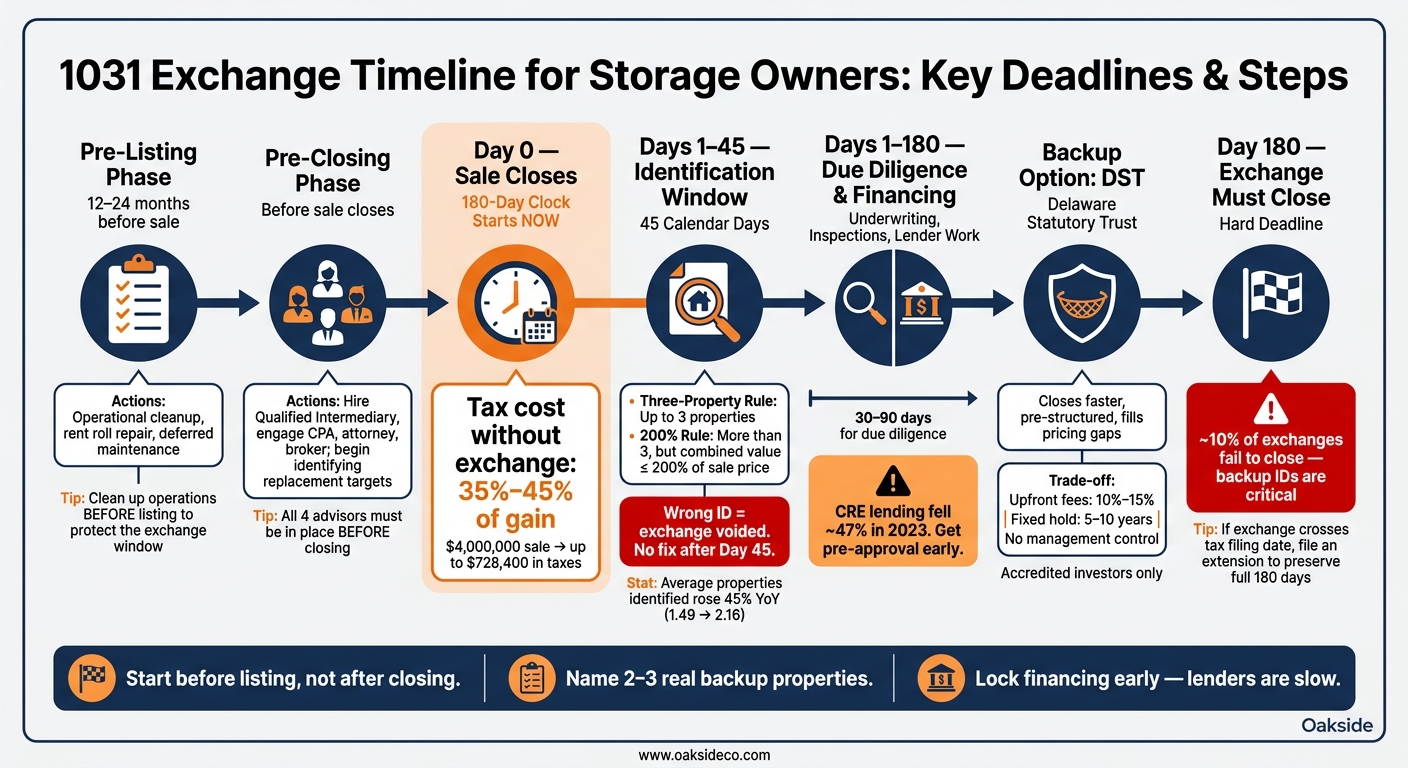
1031 Exchange Timeline for Storage Owners: Key Deadlines & Steps
A Typical Storage Exchange Timeline: From Listing to Replacement Closing
The exchange clock starts at closing. But the prep clock should start much earlier, before the property even goes on the market.
The main issue usually isn’t the deadline by itself. It’s the time owners lose before the exchange starts and while it’s in motion. That time squeeze usually hits first in three places: finding deals, lining up financing, and getting identification right.
Common Execution Risks: Asset Sourcing, Financing, and Identification Errors
The 45-day window should be treated as a confirmation period, not a shopping period.
Why? Because due diligence takes time. Inspections, lease review, and underwriting often take 30 to 90 days. If an owner starts looking after the sale closes, the calendar can get tight fast.
Lender timing has also slowed as credit conditions have tightened. A deal that seems financeable on Day 1 can still get stuck long enough to miss the 180-day deadline. When that happens, the chance to move sale proceeds into a better replacement property can slip away. Owners who skip pre-approval or don’t pressure-test their financing assumptions often find out too late, when there isn’t much room left to change course.
Identification mistakes can also sink an exchange, even when the asset list looks solid. Under the Three-Property Rule, an owner can identify up to three properties. Under the 200% Rule, an owner can identify more than three, but only if the combined value stays below 200% of the sale price. If those rules are used the wrong way – or if the owner names properties that aren’t actually for sale – the identification can be voided in full. And once the 45-day window closes, there’s no fix.
One more rule matters here: the seller cannot take possession of the exchange proceeds. The qualified intermediary has to hold and transfer the funds.
About 10% of exchanges fail to close. Backup options help, but only when those options are real deals – properties that are available, financeable, and likely to close before the deadline.
How Operational Distractions Shorten the Real Planning Window
Running a storage or boat/RV facility during a sale is far from hands-off. Lease-up issues, occupancy swings, deferred maintenance, and rent roll cleanup all compete for attention. And, of course, they tend to show up at the worst possible moment.
If those issues haven’t been handled before going to market, owners can burn through the first part of the 45-day window dealing with property problems instead of underwriting replacement deals. That’s the trap. Once those days are gone, they’re gone.
The better move is to treat operational cleanup as pre-sale work. That keeps the exchange window focused on underwriting, not repairs. Cleaning up rent roll issues and deferred maintenance 12 to 24 months before a planned sale helps free up management time when the exchange clock is live. That’s why pre-listing cleanup should be part of the exchange plan.
Practical Steps to Protect Value Before the Window Closes
Identify Replacement Targets Before Listing the Property
One of the smartest moves a storage owner can make is to start looking at replacement properties before the relinquished asset goes on the market.
That changes the 45-day window from a frantic search into a short period for confirming deals. And that’s a big difference. If you wait until the sale is underway, the clock starts feeling brutal fast.
Before you launch the sale, set your filters in plain terms:
- target market
- asset type
- acceptable leverage
That prep helps you spend the identification window validating options instead of scrambling for them. But this only works if your exchange team is already lined up before closing.
Bring In Your Qualified Intermediary, CPA, Attorney, and Broker Early
A smooth exchange depends on four people working together. And they need to be involved before the sale closes, not after.
The Qualified Intermediary must be hired before closing so they can hold the proceeds and keep the exchange in line with the rules. The CPA runs the numbers on capital gains exposure and depreciation recapture, which is taxed at a mandatory 25% rate no matter your income bracket, and also accounts for the Net Investment Income Tax (NIIT). The attorney deals with entity structuring, checks legal terms, and makes sure the transaction follows federal Section 1031 rules along with any state-level requirements. A broker with storage and exchange experience helps manage timing, pricing, and off-market replacement sourcing so you’re not just buying something to satisfy the rulebook.
Use Backup Identifications and Financing Contingencies That Support the Exchange
Once your advisors are lined up, the next step is simple: identify backup options that can actually close.
Always name more than one replacement property. And make sure at least one is a solid backup. In many cases, that means a Delaware Statutory Trust (DST), since it comes pre-packaged with secured financing and completed due diligence.
Financing matters just as much as identification. Commercial real estate lending volumes fell about 47% in 2023, and credit standards have remained tight. So even if a deal looks fine on paper, it can still drag out long enough to blow past the 180-day deadline if lender talks start too late.
Early planning gives you a better shot at stronger identifications, cleaner financing, and a closing that happens on time. Late planning puts pressure on all three.
Using DSTs and Coordinated Execution When Direct Replacement Is Hard
When a Delaware Statutory Trust Can Serve as a Primary or Backup Replacement
When a direct replacement isn’t ready, DSTs can keep your 1031 exchange on track.
If a direct replacement won’t close within the 45-day identification window, a Delaware Statutory Trust can keep the deal moving. Revenue Ruling 2004-86 treats DST interests as qualifying like-kind replacement property for 1031 purposes. DSTs are already structured, so they often close faster than a direct purchase.
There’s another practical use here too. If your replacement property costs less than your sale price, a DST can help fill that gap and cut taxable boot.
One catch: DSTs are limited to accredited investors.
Direct Ownership vs. DST Interest: Control, Liquidity, and Closing Certainty
The trade-off is pretty straightforward: direct ownership gives you control, while a DST gives you speed and more certainty at closing. Put simply, you’re trading control for speed.
| Feature | Direct Storage/RV Ownership | Delaware Statutory Trust (DST) |
|---|---|---|
| Management | Active (leasing, maintenance, staff) | Passive (professional sponsor) |
| Control | Full – owner makes all decisions | None – sponsor makes all decisions |
| Closing Certainty | Lower (subject to financing and due diligence) | High (pre-structured, ready to close) |
| Ease of Resale | Moderate (can sell, but takes time) | Low (typically a 5–10 year fixed hold) |
DSTs also tend to come with 10%–15% upfront fees. That needs to go into your return math before you move ahead.
Conclusion: Decide Now Whether to Sell, Defer, Reposition, or Scale Up
At this stage, the issue isn’t whether 1031 matters. It’s which exit path protects the most value.
The owners who tend to protect the most value are the ones who plan before the sale closes. That means identifying replacement targets early, lining up your qualified intermediary, CPA, attorney, and broker before closing, and naming backup options that can close within 180 days.
You may decide to sell and defer taxes, move into a different market, scale up into a larger facility, or step away from active management. Whatever path fits, the choice needs to happen now, not after the sale is already in motion. Match the decision to your timeline.
FAQs
When should I start a 1031 exchange plan?
Start planning and searching for a replacement property well before you list your current facility. If you wait until after the sale, the risk goes up fast. Why? Because the IRS deadlines are fixed: 45 days to identify a replacement property and 180 days to close. There’s no extra time if the deal gets messy.
Getting ahead of it gives you room to think clearly. With a short list of possible replacement assets and input from your tax advisors early on, it’s much easier to stay disciplined. That matters, because deadline pressure can push people to overpay or settle for a lower-quality property just to get the exchange done.
What causes a 1031 exchange to fail?
A 1031 exchange usually falls apart when an investor misses IRS deadlines or slips up on the process. The two biggest problems are missing the 45-day identification deadline or the 180-day closing deadline.
It can also fail if the investor takes control of the sale proceeds instead of working through a Qualified Intermediary. On top of that, paperwork mistakes, using a QI that isn’t independent, or financing delays that push closing past the deadline can all derail the exchange.
Is a DST a good backup option?
Yes. A Delaware Statutory Trust (DST) can work well as a backup option for a 1031 exchange.
Here’s why: DSTs are pre-structured investments, and the due diligence and financing are already in place. In many cases, that means they’re available for immediate investment.
That matters when the clock is ticking. If other replacement properties fall through, aren’t available, or start to look shaky, a DST can help investors meet the strict 45-day identification deadline.