If your 1031 exchange fails after a late-year sale, you may still be able to push part of the tax into the next year – but only if the money stayed out of your hands.
When I look at this issue, the main point is simple: a failed exchange does not wipe out tax. It may only shift when some gain is reported. That usually turns on three dates: the sale closing date, the 45-day ID deadline, and the 180-day exchange deadline. It also turns on one big tax rule: constructive receipt.
Here’s the short version:
- If you sold in November or December and the QI held the funds past 12/31, part of the gain may land in the next tax year.
- If you could access the money before year-end, the IRS may treat the sale as taxable in that same year.
- Depreciation recapture may still hit in the sale year, even if other gain shifts.
- You may need Form 8824 for the failed exchange and Form 6252 if installment-sale timing applies.
- A return extension gives you more time to file, not more time to pay.
- This works best as a pre-closing backup plan, not a fix after the funds are released.
A late-year closing creates pressure fast. The 45-day rule can run into January, and the 180-day rule can run into spring or early summer. In bigger self-storage, boat, and RV deals, lender delays, title issues, and thin replacement inventory can make a failed exchange more likely.
| Issue | What to watch |
|---|---|
| Sale timing | November and December closings are the usual setup |
| Fund control | QI must hold funds with no early seller access |
| Tax result | Timing may shift, but tax still applies |
| Reporting | Forms 8824 and 6252 may both matter |
| Main risk | IRS says you had constructive receipt in Year 1 |
I’d treat tax straddling as a narrow timing tool, not a tax escape hatch. If the deal was set up the right way before closing, it may soften a one-year tax hit. If not, the full gain may stay in the sale year.
How Tax Straddling Works After an Exchange Breakdown
Tax straddling is a timing issue that can show up when a real exchange crosses year-end and then falls apart. The key idea here is constructive receipt.
How Gain Recognition Can Shift Into the Next Tax Year
If the seller can get the proceeds, or control them, before December 31, the IRS may treat that money as received in that same year. But if the QI holds the funds and the seller can’t access them, gain recognition will usually wait until the funds are released.
Here’s the basic pattern: if a sale closes on December 28 and the proceeds go to a QI, then the exchange fails in February, gain is generally recognized when the QI releases the funds in the next tax year.
That can look a bit like installment-sale timing under IRC §453, but only on the question of when gain is recognized. For institutional storage owners, that split between recognizing a large gain in December versus January can change estimated tax payments, bracket exposure, and year-end planning options.
That timing edge depends on tight control over the proceeds and clean documentation at year-end.
What Tax Straddling Can and Cannot Solve
Tax straddling can ease the pressure of a one-year tax hit by moving gain recognition into the next tax year. That can help with cash flow timing and estimated payment planning. But it doesn’t erase the tax bill.
| What Tax Straddling May Help With | What It Does Not Solve |
|---|---|
| Shift gain to next tax year | Federal capital gains tax liability |
| Reduce single-year tax pressure | Depreciation recapture |
| Increase planning flexibility | Constructive receipt problems from improper QI access |
| Match taxable recognition to cash flow | Compliance risk from aggressive deferral structures |
Some taxpayers try multi-year installment setups to turn failed-exchange proceeds into long-term notes. That’s risky, and the IRS may not respect it. The plain one-year straddle is the more accepted timing result.
There’s another catch: tax straddling depends on bona fide exchange intent. If the exchange wasn’t set up the right way, the timing benefit goes away.
The timing result only holds if the exchange structure clears the deadline rules and the receipt rules.
sbb-itb-09b4138
Transaction Structure and Timing Rules That Matter
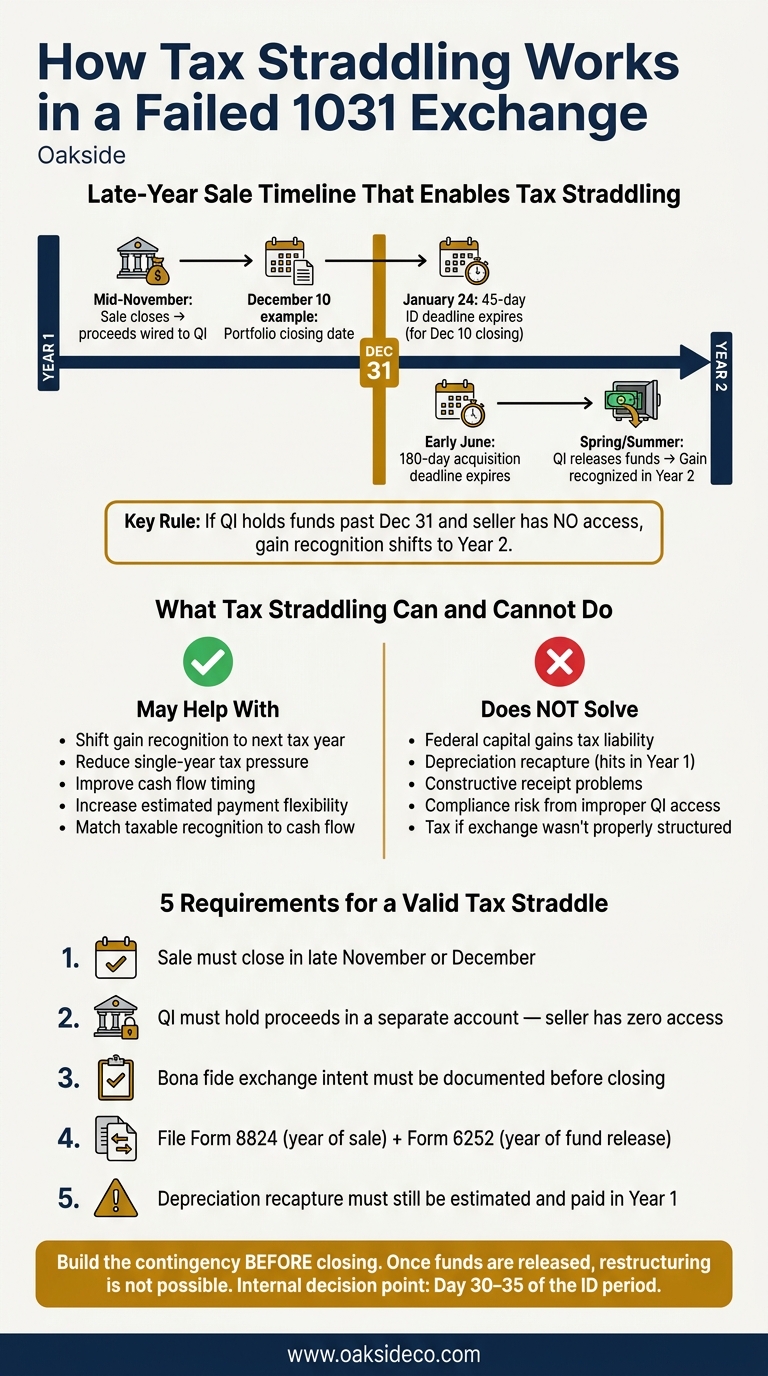
Failed 1031 Exchange Tax Straddling: Timeline & Key Rules
When an exchange falls apart, the next thing to check is the structure. Did it leave enough room on the clock? Tax straddling comes down to two simple rules: the deadlines have to land in the right places, and the seller can’t touch the sale proceeds.
Late-Year Sale Timing and the 45-Day and 180-Day Deadlines
A sale in mid-November or later will often push the 45-day identification deadline into the next year. And a sale in early July or later will often push the 180-day acquisition deadline past December 31.
Here’s what that looks like in practice: if a storage portfolio closes on December 10, the seller has until January 24 of the next year to identify replacement property. The 180-day purchase deadline then lands in early June – squarely in Year 2.
That’s the basic setup behind a straddle. The sale closes in Year 1, but the exchange period – and any later release of funds – falls in Year 2.
But those dates only help if the seller never gets access to the money.
Qualified Intermediary Control and Constructive Receipt Limits
To keep the straddle in place, the QI has to hold the proceeds in a separate account. If the seller can get the funds before the exchange period ends, the IRS may treat that as constructive receipt in Year 1. Once that happens, the straddle is gone.
The closing agent needs to wire the proceeds straight to the QI. The seller can’t have access to those funds before the exchange ends. Clear, written transfer instructions help protect the Year 1 deferral while the exchange is still open.
Common Breakdown Points in Larger Storage Transactions
In large self-storage and boat/RV deals, the 180-day window can shrink fast. A few problems show up again and again:
- Buyer due diligence delays that push Q4 closings later than planned
- Lender underwriting slowdowns
- Competitive bidding on replacement assets that pushes pricing past what works for the exchange
Each delay eats into the exchange period and makes it more likely that gain recognition moves into the next year.
Portfolio deals add one more headache. If several properties close on different dates, each one has its own 45-day and 180-day deadlines. Those mismatched timelines can lead to early fund releases for some assets while others are still inside the exchange period.
Replacement scarcity is common in self-storage and boat/RV markets. Add that to due diligence delays and lender slowdowns, and the window can close before the seller locks up a suitable replacement. At that point, gain recognition shifts, and the seller is left exposed. That pressure on timing is exactly why reporting and return strategy matters.
Reporting Requirements and Main Risks
When a failed 1031 crosses year-end, the timeline matters a lot. You need to track three dates: the sale closing date, the date the Qualified Intermediary (QI) releases the funds, and the extended due date for the return for the year of sale. Once those dates are locked in, the main issue is how the deal gets reported across two tax years.
Form 8824, Form 6252, and Return Extension Considerations
File Form 8824 for the year of sale to report the attempted exchange, even if the exchange later fails.
If the sale proceeds stay with the QI and are released in the next year, Form 6252 is used to report installment sale income in that later year under IRC §453. Depreciation recapture is usually recognized in the year of sale, even when other gain is pushed into the next year. For self-storage owners who have completed cost segregation studies, that recapture can be large. It may need to be estimated and paid by the original return due date, even if the return itself is extended. That timing works only when the QI agreement keeps clear limits on the seller’s control over the funds.
Use a return extension to buy filing time, not payment time.
Coordinating Form 8824 and Form 6252 across two tax years is often the hardest part. It gets even messier in larger deals with multiple entities and lenders, where multi-entity filings and long diligence cycles add more moving parts. A quick review isn’t enough here. Taxpayers should go over the reporting with their CPA and legal counsel before filing the return for the year of sale.
Advantages and Risks of Tax Straddling
| Advantages | Risks |
|---|---|
| Defers gain recognition into the next tax year | Deferral is lost if the IRS determines there was constructive receipt in the sale year |
| Provides cash-flow relief and more planning flexibility before tax is due | Reporting across two years with Forms 8824 and 6252 adds complexity |
| Can help smooth income if the next year has lower taxable income or available losses | The strategy depends heavily on late-year timing, so a closing that shifts can eliminate the benefit |
| Supports broader tax deferral strategies for storage facility owners | The QI agreement must clearly restrict access to the proceeds |
| If the structure does not qualify, the IRS may treat the transaction as a taxable sale in the earlier year |
If the QI agreement does not clearly limit the seller’s ability to access or control the proceeds, the IRS may treat the funds as received in the year of sale. That’s the heart of the constructive receipt issue. Shared accounts and side agreements can make that risk worse.
All agreements, QI instructions, and internal documentation should be reviewed by a CPA and legal counsel before any returns are filed. That extra work is one reason this approach fits only a narrow set of larger storage asset sales. In practice, it tends to make sense only for larger self-storage and boat/RV dispositions where the deal size is big enough to justify the added reporting burden.
When This Approach Fits Larger Storage Asset Sales
Once the deadlines, control rules, and reporting steps are clear, the next step is simple: does a straddle fit the sale at all?
This is a narrow fallback for large late-year sales that are already in danger of breaking down. It is not a default move. It is not something to bolt on after the fact.
Best-Fit Situations for Self-Storage and Boat/RV Owners
The strongest fit usually comes down to timing. The clearest case is a late-November or December closing on a high-value self-storage, boat, or RV asset where the seller began a bona fide exchange but can’t close on replacement property in time.
That can happen for plain, familiar reasons:
- Buyer financing delays
- Title issues
- Environmental problems
- Tight replacement supply
When that happens, the 45-day identification period can slide into January.
This setup tends to matter most for institutional sellers and owners of a single large facility. In those cases, the gain can change bracket exposure, net investment income tax, or offsetting-loss planning.
By contrast, failures from January through June usually don’t work. In most of those deals, both deadlines land before year-end. It also does not fit if the seller can’t show real intent to complete the exchange at closing. The fallback has to be built into the deal documents before closing.
Oakside can model failed-exchange scenarios before closing, including income across both tax years.
Key Takeaways for Planning Before Year-End
If the structure looks workable, the timing of the decision matters just as much as the sale itself.
Build the contingency before closing if the deal meets the timing and control tests. Don’t wait until the exchange is already falling apart. A tax straddle works only when the purchase agreement, QI instructions, and payment structure are in place before closing. Once the exchange fails and the funds are released, the chance to restructure is gone.
A good rule of thumb is to set an internal decision point around day 30 to 35 of the identification period. At that stage, the seller should take a hard look at whether real replacement options still exist.
The sellers who handle this best usually treat tax straddling as a planned backup, not a last-ditch move.
FAQs
Can a failed 1031 exchange still defer tax?
Generally, no. If a 1031 exchange fails – for example, because you miss the 45-day identification deadline, miss the 180-day closing deadline, or take constructive receipt of the funds – you lose the tax deferral.
When that happens, capital gains tax and depreciation recapture tax come due. That’s because a 1031 exchange defers taxes; it doesn’t erase them.
What triggers constructive receipt in a failed exchange?
Constructive receipt happens when you receive the sale proceeds, or have control over them, at any time during the exchange.
To satisfy IRS rules, the money must remain with a Qualified Intermediary in a segregated account from the sale all the way through the closing on the replacement property. If you take possession of the funds, even briefly, or if the QI doesn’t hold them for the entire period, the exchange fails and becomes taxable.
When is depreciation recapture taxed?
Depreciation recapture is taxed in the year you sell the asset.
That means if you sell now, the IRS can tax the part of your gain tied to prior depreciation right away. A 1031 exchange can push that tax off if you roll the proceeds into a qualifying replacement property. If the sale doesn’t meet 1031 rules, though, the tax is due immediately.
For real property under Section 1250, the top recapture rate is generally 25%. Reclassified assets or fixtures under Section 1245 may be taxed at ordinary income rates, which can go as high as 37%.