If you finance the sale of a storage property, you usually do not pay tax on the full gain at closing. In many cases, you report gain as you collect the principal, while interest is taxed separately as ordinary income. But there’s a catch: some depreciation recapture, especially Section 1245 recapture, is often taxed in the year of sale, even when the buyer pays over time.
Here’s the short version:
- Installment treatment under IRC Section 453 can let you spread gain across future tax years.
- Only principal payments are used for installment-gain math.
- Interest does not get installment treatment.
- Gross profit ratio decides how much of each principal payment is taxable gain.
- Section 1245 recapture is usually due at closing.
- State returns may still be required where the property sits.
- Form 6252 is generally used to report installment-sale income each year.
In the article’s example, a $5,000,000 sale with $3,000,000 adjusted basis and $200,000 of selling costs creates $1,800,000 of gross profit. That produces a 36% gross profit ratio, which means 36 cents of each principal dollar is taxable gain.
Before I agree to deal terms, I’d focus on a few numbers first:
- the down payment
- the note term
- the interest rate
- any asset-level recapture
- the state filing rules tied to the property location
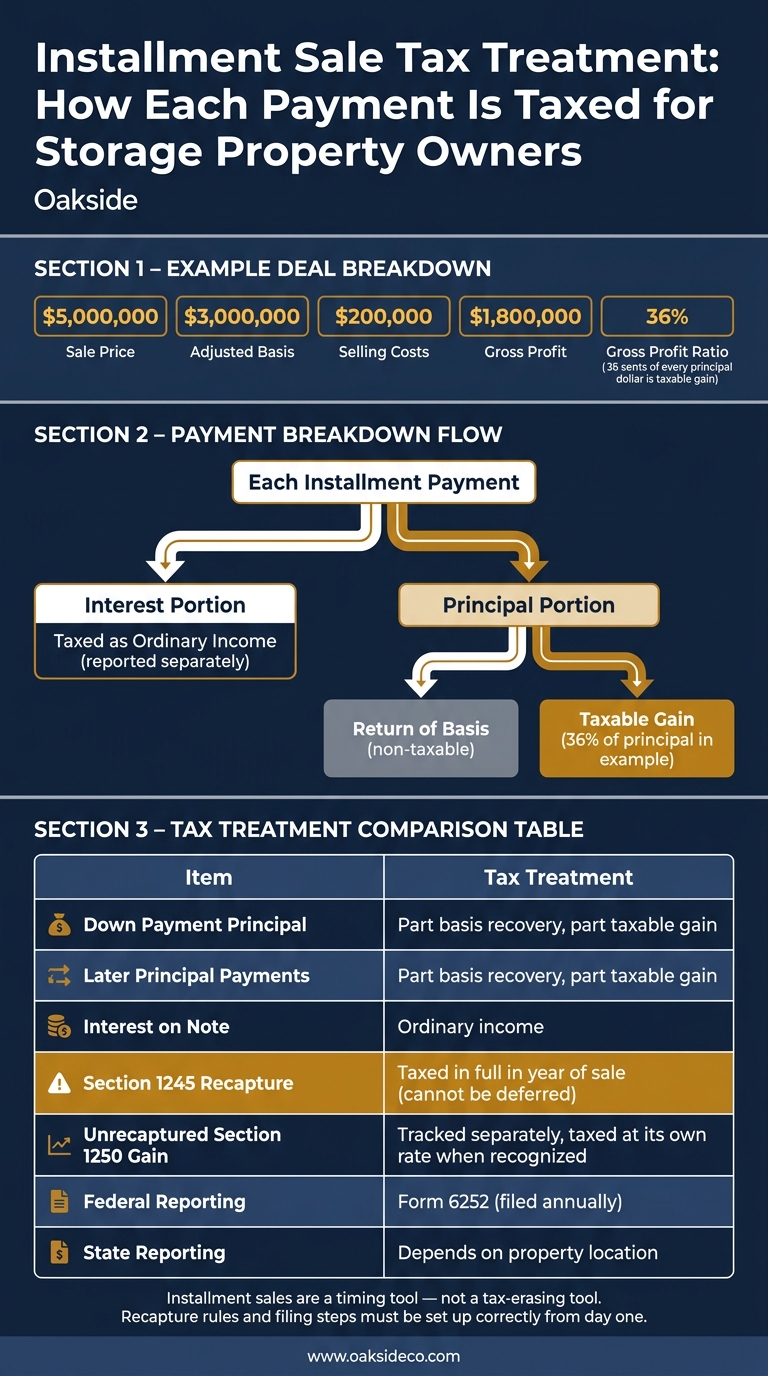
Installment Sale vs. Cash Sale: Tax Treatment for Storage Property Owners
Quick comparison
| Item | Tax treatment |
|---|---|
| Down payment principal | Part basis recovery, part taxable gain |
| Later principal payments | Part basis recovery, part taxable gain |
| Interest on note | Ordinary income |
| Section 1245 recapture | Usually taxed in year of sale |
| Unrecaptured Section 1250 gain | Tracked separately and taxed at its own rate when recognized |
| Federal reporting | Usually Form 6252 |
| State reporting | Depends on the state |
Bottom line: I’d treat an installment sale as a timing tool, not a tax-erasing tool. It can spread gain over time, but the math, recapture rules, and filing steps need to be set up right from day one.
sbb-itb-09b4138
How to break down each payment into principal, interest, basis recovery, and taxable gain
Each installment payment has two main pieces: interest and principal. The interest piece is taxed as ordinary income when you receive it. The principal piece is different. It gets split into return of basis and taxable gain.
That split matters a lot. If you skip it, the tax math goes off the rails fast.
How interest and principal are taxed differently
Interest is reported apart from installment gain. Under IRC Section 453, only the principal portion of each payment goes into the installment gain calculation.
Here’s the simple way to think about it: interest is the cost of financing, while principal is the actual sale proceeds coming back to you over time.
One mistake shows up again and again: the note rate is set too low. When that happens, the note may fail the adequate stated interest rules under the AFR rules. If the rate is too low, the IRS can reclassify part of what you called principal as interest. That changes the tax result and can create a mess after closing.
Set the note rate at or above the applicable AFR for the loan term.
How basis recovery works inside each principal payment
Once you separate interest from principal, each dollar of principal has to be divided again. Part of it is a non-taxable return of basis. The rest is taxable gain. You determine that split with the gross profit ratio – gross profit divided by contract price.
Here’s what that looks like in practice.
Example: $5,000,000 self-storage sale.
| Item | Amount |
|---|---|
| Sale price | $5,000,000 |
| Adjusted basis (after depreciation) | $3,000,000 |
| Selling costs (brokerage, legal, etc.) | $200,000 |
| Gross profit | $1,800,000 |
| Contract price | $5,000,000 |
| Gross profit ratio | 36% |
In this example, the buyer pays $1,000,000 down and signs a $4,000,000 note with $400,000 annual principal payments over 10 years, excluding interest. Each year, 36% of the principal received is taxable gain, and the rest is basis recovery.
That last part is where people slip up. Apply the ratio only after you separate out the interest.
Common allocation mistakes in storage-property installment sales
The costliest mistake is treating all note receipts as taxable gain and skipping basis recovery. That overstates income and can lead to tax payments you didn’t need to make.
Other common problems include:
- Failing to separate interest from principal
- Ignoring liabilities and selling costs when figuring contract price and gross profit
Those errors skew the gross profit ratio and distort gain recognition year after year.
Before closing, build a worksheet that breaks out sale price, adjusted basis, selling costs, liabilities, and asset classes. Then use that worksheet to map each payment the right way.
After that split is set, the next step is testing how depreciation recapture limits installment deferral.
How to calculate the gross profit ratio and account for depreciation recapture
Once you’ve allocated basis recovery through the gross profit ratio, the next step is to check depreciation recapture. This matters because the gross profit ratio only applies to deferred gain. Depreciation recapture follows its own rules, and for some storage assets, tax is due right away before tax deferral strategies even starts.
Gross profit, contract price, and the annual gain calculation
To figure out the deferred gain you recognize each year, multiply each principal payment by the gross profit ratio. That ratio spreads gain over the life of the note as payments are collected.
Why Section 1245 recapture is typically recognized in the year of sale
Cost-segregated items like security systems, gates, and specialized equipment are usually Section 1245 property. Section 1245 recapture is ordinary income recognized in full at closing and cannot be deferred under the installment method.
Any gain left after that moves into the real estate gain bucket, including unrecaptured Section 1250 gain when it applies.
How unrecaptured Section 1250 gain applies to storage real estate
Unrecaptured Section 1250 gain should be tracked on its own because it’s taxed at a different rate when it’s recognized through installment payments. It still stays part of the deferred gain calculation, but it’s taxed separately from ordinary income recapture.
How to report the sale correctly on federal and state tax filings
Once recapture is sorted out, the next step is simple in theory but easy to mess up in practice: report the remaining installment gain on the right tax forms. That applies at closing and in each tax year that follows. If you use the installment method, you need to stay on top of both federal and state filing rules.
When Form 6252 is required and how it supports your annual tax reporting
Use Form 6252 to report installment-sale income as payments come in.
That form helps track the gain tied to each payment over time. So instead of reporting the full gain in the year of sale, you report it as you receive the money under the note. If the note runs for several years, that means annual tax reporting each year payments are received.
State income tax issues for in-state and out-of-state storage owners
State tax rules can get tricky fast, especially if you own property in one state and live in another. Before closing, check the filing rules in the state where the property is located.
State filing depends on where the asset is located and where the seller files, not just on the federal installment method. In plain English, federal treatment doesn’t automatically settle the state side. If the property state requires a return, file it there. Doing that can help preserve penalty relief where it applies.
Cash sale vs. installment sale: reporting and tax timing compared
After the reporting rules are clear, compare the tax timing of a cash sale with an installment sale before you lock in the deal terms.
A cash sale reports the tax result at closing. An installment sale spreads reporting over the life of the note and calls for annual tracking and return filing. That slower timeline can help with cash flow, but it also means more recordkeeping year after year.
How to model installment sale terms before committing to a deal
Once you’ve settled the reporting rules, the next step is simple: stress-test the note before closing. Don’t wait until the deal is signed to see how the numbers play out. Model the down payment, note term, and interest rate first so you can see what the after-tax cash flow looks like.
How down payment, note term, and interest rate affect after-tax results
Most of the result comes from three levers: down payment size, note term, and stated interest rate.
A larger down payment pulls more gain into year one because the gross profit ratio applies to each principal dollar you receive at closing. A smaller down payment pushes more gain into later years, which can help with deferral, but it also leaves you with more buyer-default risk.
The note term matters too. A shorter term packs gain and interest into fewer years. A longer term spreads both over more time. That can help keep annual gain under thresholds tied to the Net Investment Income Tax (NIIT), but there’s a trade-off: you stay exposed to buyer-performance risk for longer, and interest keeps showing up as ordinary income.
That last point is easy to miss. Every dollar of interest is taxed as ordinary income, not at capital gains rates. So it’s worth running a few rate cases – say 5%, 7%, and 9% – and comparing total after-tax cash flow across the full note term.
You’ll also want to check that the stated rate clears the IRS Applicable Federal Rate (AFR) for the month of sale. If it doesn’t, imputed interest rules can kick in and treat part of what you thought was principal as ordinary income instead.
Where transaction-level analysis adds value for storage portfolios
Portfolio deals need more than a single blended model. A one-property view can miss tax differences from asset to asset.
That’s the big reason portfolio sales should be modeled property by property. Recapture can vary. Basis can vary. State filing rules can vary too. If you lump everything together, you can miss where tax hits sooner, where filings get messy, or where one asset changes the shape of the whole deal.
Key deal terms to model before closing
Before you lock in an installment sale structure, review these inputs with your CPA or tax counsel:
- Down payment amount: How much gain hits at closing and how much moves into later years.
- Note term and amortization schedule: How yearly principal payments shape gain recognition and NIIT exposure over time.
- Stated interest rate vs. AFR: Whether the rate clears the AFR test and how much ordinary income the note creates each year.
- Asset-level recapture amounts: How much Section 1245 recapture is due at closing for each asset, and whether the down payment is enough to cover that tax.
- State filing requirements by property location: Whether each property state follows federal installment treatment or uses different timing.
FAQs
Can I use an installment sale for a boat or RV storage property?
Yes. Owners of self-storage and boat/RV facilities can use an installment sale to defer tax liability by spreading capital gains recognition over several years as principal payments come in.
That said, it’s smart to separate the real property from the business assets. Equipment and fixtures may trigger immediate recapture, which can change the tax picture fast.
As Nolen Masserman, Managing Director at Oakside, notes, clear goal definition helps balance liquidity and control.
How do I know how much tax I’ll owe at closing?
Estimate your tax bill at closing by subtracting your adjusted cost basis from the sale price. That gives you your total gain.
From there, the tax hit can come from a few places. You may owe:
- Federal long-term capital gains tax of up to 20%
- Depreciation recapture, often taxed at 25%
- The 3.8% Net Investment Income Tax if you’re a high-income earner
- Any state taxes that apply
As Nolen Masserman, Managing Director at Oakside, notes, tax planning should begin well before the sale.
What happens if my note interest rate is below AFR?
If your seller note’s interest rate is below the IRS Applicable Federal Rate (AFR), the IRS may treat part of the deal as Original Issue Discount (OID). And that can throw off the tax result you were aiming for.
If you want the installment sale to keep its expected tax treatment, set the note’s interest rate at or above the AFR.