If I own or buy a self-storage property, cost segregation can shift part of my depreciable basis out of the 39-year bucket and into 5-, 7-, or 15-year property. That means I may take larger tax deductions earlier, which can improve after-tax cash flow in the first years of ownership.
Here’s the short version:
- I start with the depreciable basis, not the land value.
- A study reviews the property and sorts costs into 5-year, 7-year, 15-year, and 39-year classes.
- In self-storage, the main short-life items are often:
- Security and access systems
- Office fixtures and equipment
- Fencing, gates, lighting, and site work
- Boat/RV parking surfaces and other land improvements
- Many self-storage studies move about 20% to 35% of depreciable basis into shorter lives.
- On a $5,000,000 purchase, that shift can change first-year deductions by a wide margin.
- The building shell still stays mostly on the 39-year schedule.
- I also need to think about depreciation recapture when I sell.
A simple example: if a $5,000,000 purchase includes $1,000,000 of land, the depreciable basis is $4,000,000. If 25% of that basis is moved into shorter-life property, that puts $1,000,000 into categories that depreciate much earlier than 39 years.
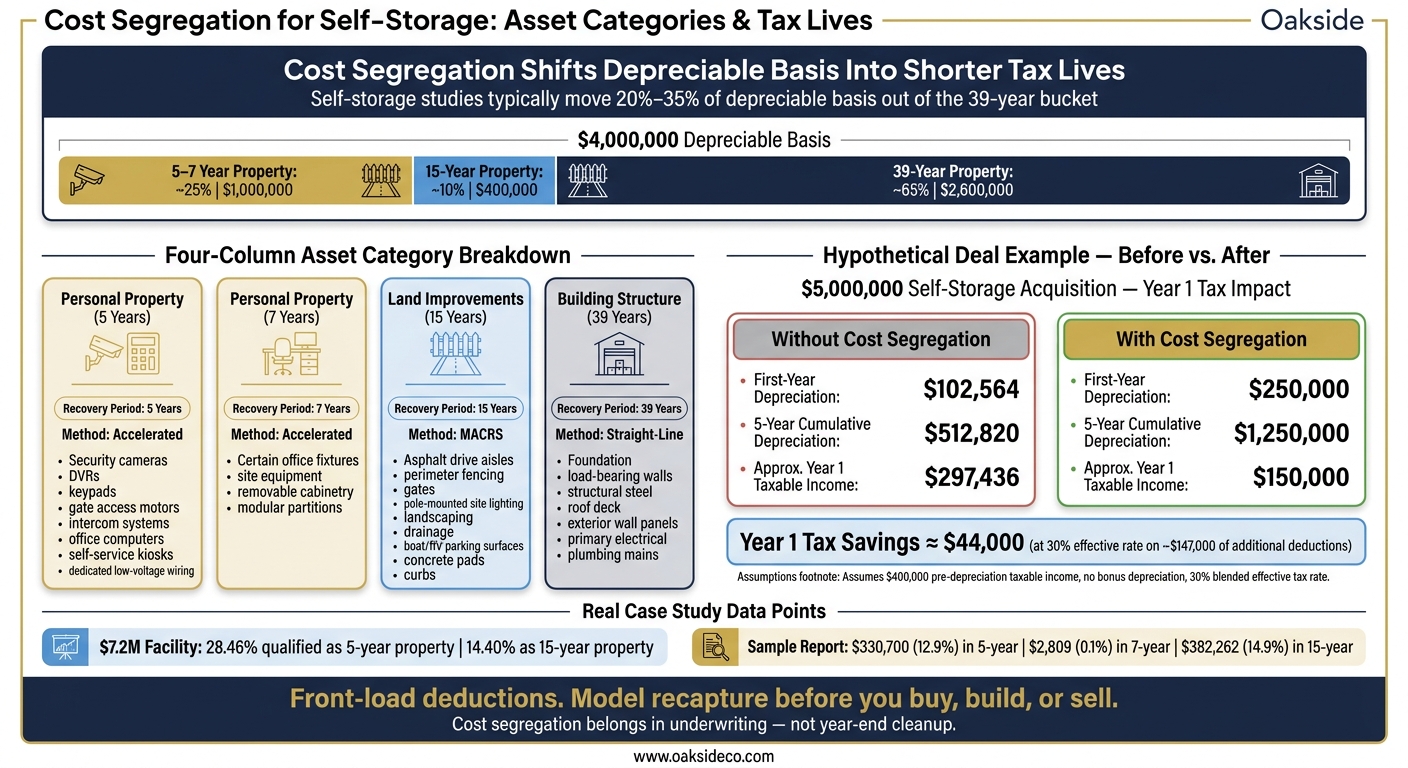
Cost Segregation for Self-Storage: Asset Categories & Tax Lives
Quick Comparison
| Asset type | Common self-storage examples | Typical tax life |
|---|---|---|
| Personal property | Cameras, DVRs, keypads, kiosks, office furniture, some dedicated wiring | 5 or 7 years |
| Land improvements | Fencing, gates, exterior lighting, drive aisles, curbs, drainage, boat/RV surfaces | 15 years |
| Building property | Foundation, roof structure, load-bearing walls, main plumbing, main electrical | 39 years |
Before I order a study, I want key records ready: closing statements, appraisal, depreciation schedule, plans, construction records, and capital improvement history. And before I rely on the tax savings, I want my CPA to model both the upfront deduction and the sale-side recapture.
That’s the core idea of this guide: front-load deductions, but underwrite the full tax picture from day one.
sbb-itb-09b4138
How Cost Segregation Works for a Self-Storage Facility
A cost segregation study breaks a self-storage facility into separate depreciable parts, assigns each one a MACRS life, and gives your CPA a schedule to use on the tax return. In plain English, the specialist and CPA take the depreciable basis, split it into component-level assets, classify each item, and turn that into a report your tax advisor can use right away.
The process starts with the depreciable basis. Land doesn’t depreciate. So if a $5,000,000 purchase includes $1,000,000 allocated to land, the depreciable basis is $4,000,000. That’s the number the study works from.
Next, a qualified engineer performs a physical inspection, or a remote review if that’s allowed. This is where the study gets its backbone. The inspection turns the facility’s physical features into tax classifications that can stand up under review. It captures site work, building systems, and storage-specific equipment, and those items can change a lot based on the facility type. A climate-controlled site won’t look the same as a drive-up facility, and that changes the mix of 5-, 7-, 15-, and 39-year assets.
After the components are identified and costed, the specialist maps each one to its MACRS category. The finished study includes a photo-backed schedule, quantity takeoffs, and cost allocations your CPA can use directly to reclassify basis on the return. Existing properties usually rely on Form 3115 to claim the adjustment in the current year. For new acquisitions or new builds, the revised recovery lives apply from year one. That output leads straight into the next issue: which self-storage components often qualify for shorter recovery periods.
The 4 Asset Categories Owners Need to Know
Every component in a self-storage facility falls into one of four MACRS buckets. That bucket decides how fast you can depreciate it.
| Asset Category | Recovery Period | Depreciation Method | Common Self-Storage Examples |
|---|---|---|---|
| Personal property | 5 years | Accelerated | Security cameras, keypads, office furniture, dedicated electrical circuits |
| 7-year property | 7 years | Accelerated | Certain office fixtures and site equipment |
| Land improvements | 15 years | MACRS | Asphalt paving, fencing, gates, exterior lighting, landscaping, RV canopies, monument signage |
| Building structure | 39 years | Straight-line | Foundation, structural steel, load-bearing walls, roof, core plumbing and electrical |
Documents to Gather Before Ordering a Study
The accuracy of a cost segregation study depends a lot on the records you hand over. If key documents are missing, the engineer may have to lean on estimates. That can make the study harder to defend if the IRS takes a look.
Before hiring a specialist, gather these core items:
- Settlement/closing statement – confirms purchase price and capitalized closing costs
- Appraisal – supports your land-versus-improvement allocation
- Existing depreciation schedule – shows what’s already been claimed and at what lives
- Construction contracts, draw schedules, and change orders – let the specialist tie costs to specific trades, such as site work, concrete, steel, electrical, and HVAC
- Site plans and as-built drawings – identify drive aisles, fencing runs, paving areas, and boat/RV lot dimensions
- Unit mix and square footage by building type – separates drive-up, climate-controlled, and RV/boat areas for tighter allocation
- Security infrastructure details – camera models, gate systems, access control hardware, and placement
- Capital improvement history – any major projects completed after acquisition, with dates and costs
Better source records lead to stronger allocations. Clean cost codes by building or phase also make the work faster and more exact. Those records play a big role in how much of the facility can move off the 39-year schedule.
Which Self-Storage Components Commonly Qualify
Figuring out which parts of a self-storage facility can move off the 39-year schedule is where cost segregation starts to matter in a practical way. In most cases, site work and operating equipment are the main areas that qualify for shorter recovery periods. The building shell, on the other hand, almost always stays put at 39 years.
5- and 7-Year Personal Property: What May Qualify
The clearest 5- or 7-year candidates are assets that support the business operation, not the building itself.
At a self-storage property, that often includes:
- Security cameras
- Digital video recorders
- Keypads
- Gate access motors and controllers
- Intercom systems
- Office computers and printers
- Office furniture
- Self-service kiosks
- Certain dedicated electrical and low-voltage wiring that serves only those systems
These items are often moved into personal property because they aren’t structural, can usually be removed with less disruption, and serve security, access control, or office functions instead of the building’s basic job as storage space.
Inside the management office, some interior items may also qualify. That can include removable cabinetry, check-in counters, modular partitions, carpet, and vinyl flooring when those items support daily operations and aren’t needed for the building’s certificate of occupancy.
There are some gray areas. Built-in millwork or flooring in common corridors, for instance, can fall on either side depending on how permanent it is and why it was installed. That’s why a qualified specialist reviews construction contracts and architectural plans before making the call.
15-Year Land Improvements: Common Site Items
For many self-storage owners, site work is one of the biggest sources of faster depreciation.
Items often placed in the 15-year land improvements category under MACRS include asphalt drive aisles, parking and circulation surfaces, concrete pads and aprons, curbs, perimeter fencing, detached pole-mounted site lighting, landscaping, irrigation, stormwater drainage structures, and improved surfaces for boat and RV parking.
These assets are improvements to the land, not the land itself. That matters because land isn’t depreciable, but these improvements are. And when bonus depreciation is available, a large share of those costs may be written off in year one as part of a broader tax deferral strategy.
The table below shows how self-storage components are often grouped:
| Category | Common Self-Storage Components | Typical Recovery Period |
|---|---|---|
| Personal property | Security cameras, DVRs, keypads, gate controllers, kiosks, office computers and furniture, removable partitions, dedicated electrical/communication lines | 5–7 years |
| Land improvements | Asphalt drive aisles, parking surfaces, concrete pads, curbs, perimeter fencing, pole-mounted site lighting, landscaping, irrigation, drainage, boat/RV parking surfaces | 15 years |
| Building property | Foundations, load-bearing walls, structural steel or framing, roof structure, building shell, primary electrical distribution, primary plumbing, exterior wall panels | 39 years |
The numbers can be meaningful. One case study tied to a $7.2 million self-storage facility found that 28.46% of assets qualified as 5-year property and 14.40% as 15-year property. Another sample report showed $330,700 (12.9%) in 5-year personal property, $2,809 (0.1%) in 7-year personal property, and $382,262 (14.9%) in 15-year land improvements.
Those results change based on facility design, how much site work was done, and how strong the documentation is. Still, they give you a solid sense of the range that may be available.
What Stays on the 39-Year Schedule
Even after a full study, the main structure of a self-storage facility remains on the standard 39-year schedule. That includes foundations and footings, slab on grade, load-bearing walls, structural steel or framing, the roof deck, exterior wall panels, and primary building systems such as main electrical service, plumbing mains, and central HVAC distribution.
These components are permanent and tied to the building’s structural function, so they stay in 39-year property. The point of a cost segregation study is to separate site assets and non-structural components from that core shell, not to shift the structure itself into a shorter class.
When to Order a Study and How to Use It in Deal Planning
Timing the Study Around Acquisitions, New Builds, and Renovations
The best time to order a cost segregation study is the year the property is placed in service. For an acquisition, that usually means soon after closing and before the first tax return is filed. For a new build, it means the moment the facility is ready and available for rent, even if lease-up is still in progress. That window matters because the cost detail is still fresh, and the study can flow into first-year depreciation.
For stabilized self-storage deals, many owners order the study within the first 3–6 months after closing. That gives the CPA enough time to model the tax impact before filing. For value-add or lease-up assets, it often makes more sense to line up the study with the first year of meaningful taxable income.
Big capital projects can also justify a separate study or an add-on study. Common triggers include:
- Climate-control retrofits
- Office remodels
- Paving work
- Expanded boat/RV parking
These projects tend to make sense when they are large enough to materially affect basis.
If you bought a facility in a prior year and never got a study done, a look-back study can still work. In that case, the engineer rebuilds the original purchase price allocation using closing statements, prior tax returns, fixed-asset schedules, and capital project records. The upside is often strongest when you still have several years left in your planned hold.
That timing should feed straight into the acquisition model.
How Accelerated Depreciation Affects Underwriting and Negotiations
Cost segregation does not change a property’s NOI. What it can change is after-tax cash flow.
By front-loading non-cash deductions, it cuts taxable income in the early years of a hold. That can improve after-tax cash flow in pass-through setups like LLCs and LPs.
Here’s what that looks like on a hypothetical $5,000,000 self-storage acquisition, assuming annual pre-depreciation taxable income of $400,000, no bonus depreciation, and a blended effective tax rate of 30%:
| Scenario | First-Year Depreciation | 5-Year Cumulative Depreciation | Approx. Year 1 Taxable Income |
|---|---|---|---|
| Without cost segregation | $102,564 | $512,820 | $297,436 |
| With cost segregation | $250,000 | $1,250,000 | $150,000 |
In this example, accelerated depreciation cuts year-one taxable income by nearly $147,000. At a 30% tax rate, that works out to about $44,000 in year-one tax savings.
On the buy side, this can sharpen negotiations. Some buyers underwrite to after-tax yields, not just headline NOI. That changes how they view price, timing, and deal terms.
On the exit side, recapture exposure is real. Short-life assets may face ordinary income recapture at sale, which can increase the taxable share of the gain. That’s why owners should model exit cases that include estimated recapture taxes alongside capital gains, especially if a sale may happen within five to 10 years of acquisition. A 1031 exchange can defer both, so hold period and exit structure are tightly tied to depreciation planning.
Oakside‘s View on Tax-Aware Transaction Strategy

NOI shows the deal on paper. After-tax cash flow shows what investors keep.
That is why tax-adjusted cash flow belongs in underwriting, not in post-close cleanup.
"For sophisticated self-storage investors, our guidance is straightforward: you should be underwriting to after-tax cash flow over your intended hold, not just the NOI you see on a flyer. Cost segregation, bonus depreciation, and exit recapture all shape what your limited partners actually keep, and ignoring that is leaving a core part of the deal unmodeled." – Cameron Vale, President at Oakside
At Oakside, that means building cost segregation assumptions right into acquisition underwriting. That includes modeled tax savings, recapture at sale, and the way those items interact with distribution waterfalls, instead of treating them like an afterthought. For institutional buyers and sponsors managing multiple assets, this tax-aware approach can help match deal structure to hold-period goals.
Conclusion: A Practical Framework for Self-Storage Owners
The takeaway is simple: use cost segregation to front-load deductions, then model recapture before you buy, build, or sell. For self-storage owners, this asset class tends to fit well because a meaningful share of value often sits in short-lived site and equipment costs that may be moved into shorter recovery periods.
In plain English, a meaningful share of depreciable basis can often shift into 5-, 7-, or 15-year property. That can improve first-year deductions and after-tax cash flow, especially when bonus depreciation applies.
But there’s a tradeoff on the sale side. Accelerated depreciation can create recapture exposure when you sell, and part of the gain may be taxed at ordinary income rates instead of capital gains rates. That’s why it makes sense to model the upfront tax savings and the sale-side recapture together using sensitivity analysis before you set your hold period or lock in exit terms.
Oakside’s view: cost segregation belongs in underwriting, not year-end cleanup. When owners pair a qualified engineering study with disciplined underwriting, they get a clearer picture of after-tax returns, hold-period tradeoffs, and sale planning. Done well, cost segregation sharpens underwriting, improves after-tax returns, and makes the right hold period easier to see.
FAQs
Is cost segregation worth it for a smaller self-storage property?
Yes. Cost segregation can make sense even for a smaller self-storage property.
Here’s why: it shifts parts of the facility off a 39-year depreciation schedule and onto 5-, 7-, or 15-year schedules. In many cases, about 20% to 40% of the depreciable basis can be reclassified this way.
That change can front-load deductions and improve early-year cash flow. And with current bonus depreciation rules for qualifying assets placed in service after January 19, 2025, the timing can be even more helpful.
It tends to work best when it lines up with your exit plan, since that can help you manage potential recapture.
Can I do a cost segregation study on a property I bought years ago?
Yes. You can perform a cost segregation study on a property you bought in prior years.
If you didn’t do a study when you acquired the property, a look-back study using IRS Form 3115 lets you claim missed depreciation deductions in the current tax year without amending prior returns.
How does cost segregation affect taxes at sale?
Cost segregation doesn’t make taxes disappear. It pulls deductions forward, and the IRS may take some of that back when you sell.
When the property is sold, the depreciation you claimed earlier can be taxed through recapture. Section 1245 assets, such as fixtures and equipment, can be taxed as ordinary income at rates of up to 37%. Section 1250 assets are subject to a maximum recapture rate of 25%.
The timing is the part that catches people off guard. Because the tax bill shows up in the year of sale, it can turn into a big cash payment all at once.