Most renters will check your social pages before they call. If your feed shows a clean site, active staff, and clear proof of care, you have a better shot at turning visits into rentals.
Here’s the short version: for storage and boat/RV sites, the best social posts are the ones that show the actual property and answer basic renter questions. The article points to five post types that do that well: customer stories, day-to-day site posts, seasonal posts, local posts, and how-to tips. It also notes that 87% of buyers say social media affects shopping choices, while only 4% of self-storage customers find a site through social media directly. So social is less about first discovery and more about proof.
If I had to boil it down, I’d focus on these:
- Customer stories to show how people use the site
- Behind-the-scenes posts to show gates, lights, cleaning, and checks
- Seasonal posts to match move-ins, travel, storms, and winter prep
- Local community posts to stay visible in the area
- Educational tips to answer unit size and storage prep questions
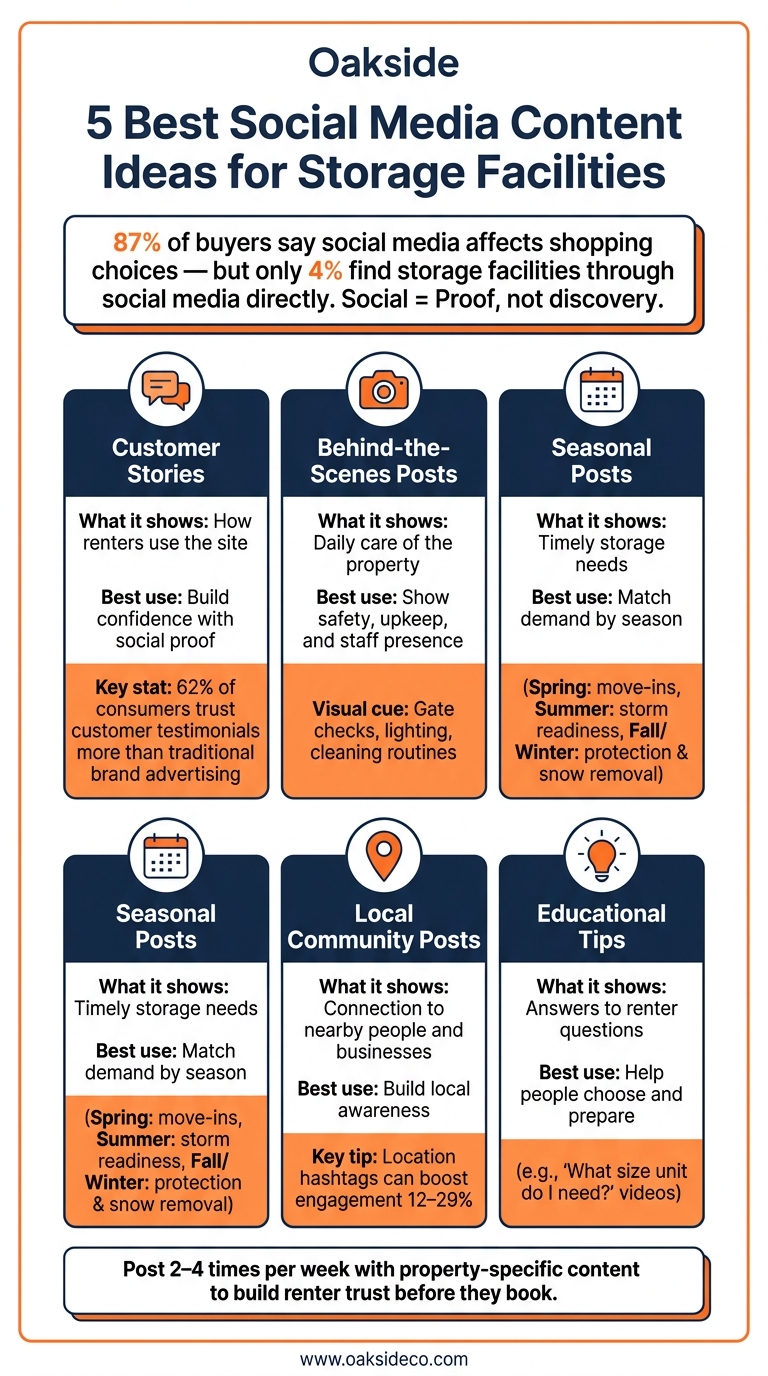
5 Best Social Media Content Ideas for Storage Facilities
Quick Comparison
| Content idea | What it shows | Best use |
|---|---|---|
| Customer stories | How renters use the site | Build confidence with social proof |
| Behind-the-scenes posts | Daily care of the property | Show safety, upkeep, and staff presence |
| Seasonal posts | Timely storage needs | Match demand by season |
| Local community posts | Connection to nearby people and businesses | Build local awareness |
| Educational tips | Answers to renter questions | Help people choose and prepare |
Bottom line: if you post 2 to 4 times per week and keep the focus on what people can see at your site, your social pages can help renters feel more sure before they book.
sbb-itb-09b4138
Why Storage Social Content Works Best When It Is Property-Specific
Generic posts like discount graphics, stock photos, and vague taglines miss the main point. They don’t answer the question people care about most: Can I trust this property with my unit, boat, or RV? Prospective tenants want proof that the property is secure, clean, and actively managed.
If someone is thinking about renting a large storage unit or covered RV parking, they usually want to see the actual place. They want to look at the gate, the lighting, and the drive aisles. A simple smartphone photo of the real facility can do more for trust than a polished stock image because people can tell it’s real and verifiable. That’s why the strongest storage posts show real people, real places, and real day-to-day operations.
A few ideas shape the best content:
- Relevance to tenant needs – security, access, and cleanliness
- Clear connection to the property – show the actual property, staff, and daily routines
- Steady posting through the year – post on a regular basis so the page looks active
In practice, social content should support trust, not do all the leasing work by itself. Social media mostly helps confirm that the property is legit: only about 4% of self-storage customers find their facility through social media directly.
The five ideas below turn that proof into posts people are more likely to trust.
1. Customer Stories
If the facility is the proof, customer stories are the evidence. They take social proof and turn it into something much closer to leasing proof. 62% of consumers trust customer testimonials more than traditional brand advertising. That gives operators a clear edge when they share real experiences connected to the property itself.
The strongest posts usually center on a specific moment in life: moving, downsizing, settling an estate, storing a boat in the off-season, or parking an RV between trips. Those examples land because they speak to the practical side of storage and the emotional side too.
A short customer clip can go a long way. Use a 15-second video with a one-line quote. Instagram Reels and TikTok fit this format well, and short-form video generates 3x more engagement than static social media posts.
One simple angle is a problem-and-solution post. For example:
"How a Local Business Stored Inventory During a Renovation"
Pair that with a real photo or video from the facility. It feels grounded, which is the whole point.
It also helps to ask tenants to tag the facility when they move in. That kind of post can reach local circles and add third-party proof tied to actual move-ins at the property.
These posts tend to do best when they feel close to day-to-day life at the facility.
2. Behind-the-scenes operations
If customer stories show the outcome, behind-the-scenes clips show how the place runs day to day.
Record routine tasks as short videos: unit cleaning, snow removal, gate tests, or lock checks. A clip of a vehicle pulling in, someone using the keypad, and the gate locking again helps people see that access is controlled. Dusk footage of exterior lights does the same for after-hours visibility.
Simple smartphone video works well here. A manager walking the halls or checking cameras can say a lot because it shows active oversight without feeling staged.
The nice part is that security checks and maintenance happen every day, so you almost always have real footage ready to post.
These posts also help fill the space between bigger promotions and keep your feed active.
3. Seasonal campaigns
Seasonal content works for a simple reason: it lines up with what customers are already thinking about.
A boat owner in spring is thinking about getting ready for summer. A renter in winter is thinking about cold-weather protection. When a post speaks to that exact moment, it feels helpful instead of pushy.
This approach works especially well with short seasonal videos. A Seasonal Protection Series can include quick 30- to 60-second clips on spring travel prep, fall winterization, summer humidity, and winter security.
Timing matters too. Post each video when the season makes the topic hit home:
- Spring: move-ins and travel prep
- Summer: convenience and storm readiness
- Fall and winter: protection, security, snow removal, and lighting checks
When you post in those windows, the message lands at the same time customers are making decisions.
A good example is a fall post that walks through winterization steps for boat or RV storage. Show the basics: draining lines, covering the vessel, and confirming gate access. That gives tenants a clear picture of how the facility protects their asset before cold weather sets in.
The point is relevance, not promotion. Seasonal posts don’t need a hard sell. Timely, property-specific content can bring more engagement and visits without cutting rates.
4. Local community content
After seasonal posts, community content helps keep your feed visible between promos. Most self-storage customers live within 20 miles of the facility they pick. That’s why social media can do more than fill space on a calendar. It can help people in your area start to recognize your property.
One simple format is a neighborhood giveaway.
A neighborhood giveaway teams your property up with a nearby business to offer one shared prize. Think a free month of storage paired with a local moving kit or gift card. To enter, people follow both accounts and tag a friend. It’s a simple way to get local reach without sounding like a hard sell.
For example, a facility could partner with a nearby hardware store or moving company for a neighborhood giveaway or community event. This helps place the facility within the neighborhood and builds familiarity with the property itself – the kind of familiarity that supports leasing intent.
You can push that reach a bit further with location-specific hashtags like #TampaStorage or #AustinSmallBusiness, plus location tags on each post. A single relevant hashtag can increase post engagement by 12% to 29%.
Local content doesn’t need to be fancy. A post that tags a nearby business, shares a neighborhood event, or highlights a local charity can signal that your property is part of the area, not just sitting in it. These posts tend to work best when they stay tied to the facility and the people nearby.
5. Educational tips
Educational posts do their best work when they answer a buying question before someone picks up the phone. One of the most useful examples is a "What Size Unit Do I Need?" video. Show common household items – like a mattress or stacks of moving boxes – inside different unit sizes so people can picture the space, aisle room, and move-in layout before they visit. That kind of post clears up one of the biggest questions ahead of a tour and cuts down on back-and-forth for staff.
Short video usually works best here. People can judge fit and layout fast, without digging through a long page.
For boat and RV properties, the same idea fits seasonal prep. A quick post on winterizing boats or getting RVs ready for storms shows the facility knows how seasonal protection works and helps tenants get ready. Posts like these can ease renter stress and position the property as a place that helps owners protect high-value assets.
Final Thoughts
These ideas work best when they show real activity at the property. Match the format to renter intent. For boat and RV assets, that usually means showing security and day-to-day operations. For self-storage, move-related posts and community content tend to fit better.
Across every format, consistency matters most. Posting 2–4 times per week keeps the feed active. And a steady, property-specific content program gives prospective tenants a clearer picture of how the facility operates, which helps build trust before they rent. That trust also helps marketability. If a social presence looks well managed, people are more likely to assume the property is well managed too.
Start with one format and stick with it. Relevance beats volume. So does showing what’s actually happening on-site.
FAQs
Which social platforms should I focus on first?
Instead of trying to be everywhere at once, focus on two platforms you can learn well and use on a steady basis. Facebook and Instagram are the best places to start for storage businesses.
Facebook helps you build local visibility and connect with your community, especially older boat and RV owners. Instagram is a strong fit for showing off your facility and reaching younger audiences that are still growing.
What posts build the most trust?
Posts that build the most trust tend to show three things: security, solid day-to-day operations, and a human touch.
People want proof that their belongings are safe. They also want to feel like the facility is clean, organized, and run by people who care. That’s why the best posts don’t just promote the business. They show what customers can expect.
A few content types work especially well:
- Facility walkthroughs and updates
- Staff highlights
- Customer testimonials and community photos
- Educational tips like packing, maintenance, or seasonal prep
This kind of content makes the business feel more real. A walkthrough can show clean hallways, gated access, lighting, or unit features. A staff post puts faces to the operation. Testimonials and community photos add social proof without feeling stiff. And practical tips give people a reason to pay attention even when they’re not ready to rent that day.
How can I create content with little time?
Focus on quality and consistency over volume. Posting two to three strong updates per week is a better plan than trying to post every day.
Use a content calendar so you’re not scrambling at the last minute. Share simple smartphone photos that show your facility’s security, cleanliness, and staff. You can also recycle seasonal topics and holiday greetings when they fit.
As Nolen Masserman, Managing Director at Oakside, notes, relevant content that answers customer questions drives engagement without burnout.