Your online reputation can affect occupancy, pricing, and property value. If you run self-storage or boat & RV storage, the main things I’d watch are Google rating, review count, recent reviews, and response time.
Here’s the short version:
- Google matters most because many renters compare facilities on Search and Maps first.
- Recent reviews matter more than old reviews. 67% of renters prefer reviews from the last 3 months.
- Response time matters. 80% of reviewers expect a reply within two weeks, and top operators often reply in 1–2 days.
- Reviews affect more than marketing. They can shape leads, conversions, occupancy, rate hold, and NOI.
- A simple review process wins: ask after move-in, after fixing an issue, and at move-out.
- Reply with care: thank happy tenants, move complaints offline, and never post tenant details in public.
- Track more than Google: Yelp, Facebook, Apple Maps, SpareFoot, and SelfStorage.com can all affect choice.
- At the portfolio level, I’d flag sites with falling ratings, old reviews, slow replies, or repeat complaints about security, cleanliness, billing, or access.
A few numbers stand out: 75% of consumers say reviews affect both business choice and local search visibility, 72% use Google Search, 51% use Google Maps, and 76% of people who do a local search on mobile visit a business within 24 hours.
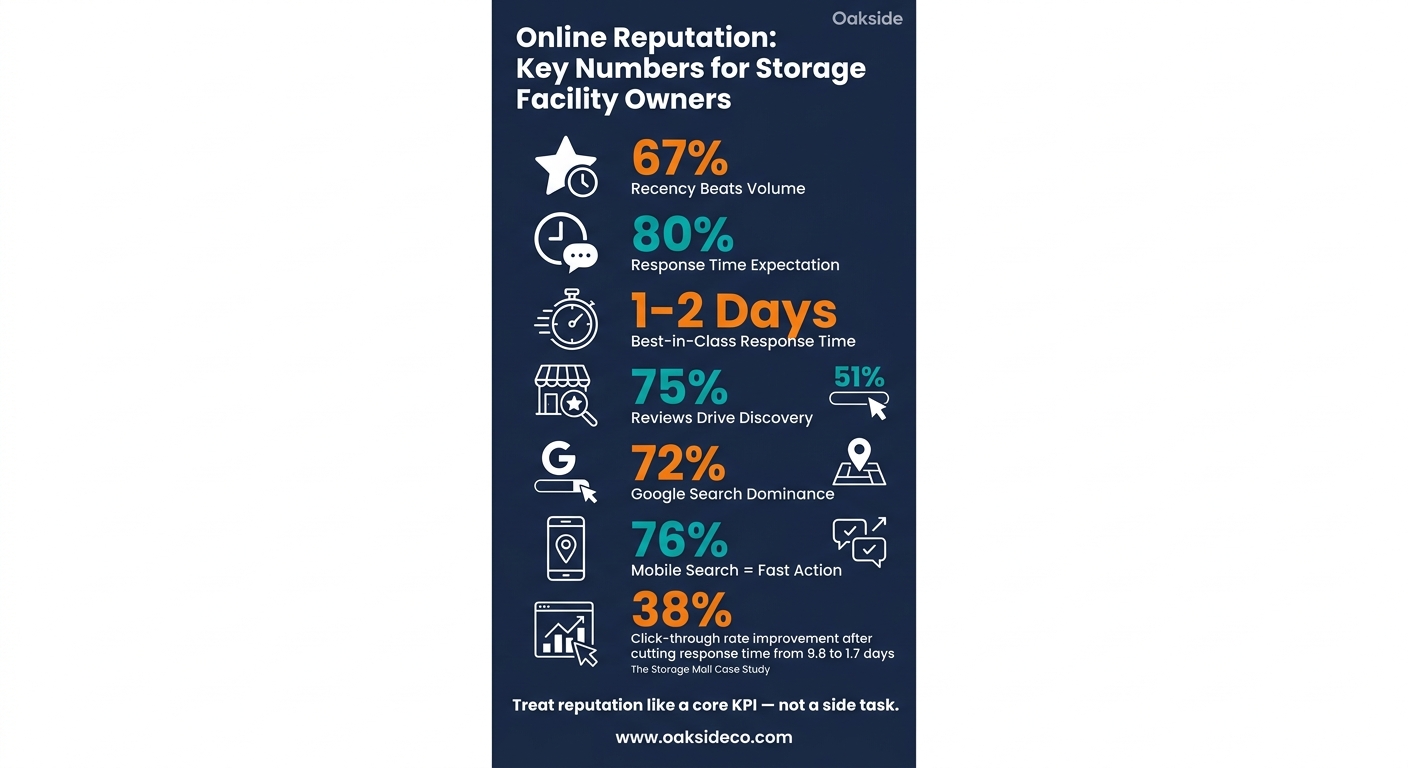
Online Reputation Stats Every Storage Facility Owner Must Know
Quick comparison
| Area | What I’d focus on | Why it matters |
|---|---|---|
| Google Business Profile | Rating, review count, map rank, recent reviews | Drives local discovery and clicks through high-intent keywords |
| Review requests | Move-in, issue resolution, move-out | Gets a steady flow of new feedback |
| Review responses | Reply in 48 hours or less when possible | Shows the site is active and paying attention |
| Property tracking | Rating, recency, response time, review themes | Helps spot site-level problems early |
| Portfolio tracking | Weak sites, repeat issues by market, complaint trends | Helps catch risk before leads and NOI slip |
| Boat & RV storage | Security, lighting, access hours, turning space | These issues show up often in reviews and can hurt demand fast |
If I had to sum it up in one line: treat reputation like a core KPI, not a side task.
sbb-itb-09b4138
The Main Reputation Channels Storage Owners Should Track
Google matters most, but it’s not the only place people check before they book a unit. Prospects often look at a few sources to sanity-check a facility, compare options, and make sure the place feels trustworthy. That’s why storage owners should also watch Yelp, Facebook, Apple Maps, and industry marketplaces like Sparefoot.com and Selfstorage.com.
The simplest way to handle this is to track each channel by where it fits in the customer journey and what metric tells you if it’s doing its job.
| Platform | Role in Customer Journey | Typical User Intent | Key Metrics to Monitor |
|---|---|---|---|
| Google Business Profile | Discovery & Selection | High-intent local search ("storage near me") | Star rating, review volume, local map ranking |
| Yelp | Comparison & Validation | Urban-focused service comparison | Rating, review volume, hidden reviews |
| Social Proof & Trust | Community recommendation and brand activity | Number of recommendations, response rate | |
| Apple Maps | Navigation & Proximity | Immediate directions or location lookup | Direction requests, profile taps |
| Sparefoot / Marketplaces | Comparison Shopping | Price and feature comparison before booking | Marketplace rating, lead volume, conversion rate |
Track these channels every month at both the property level and the portfolio level. That gives you a close-up view of each location, plus a big-picture read on the whole business.
Key Metrics to Track at the Property and Portfolio Level
At the property level, the monthly metrics that matter most are average star rating, new review count, review recency, and response time. If you need to pick one area to watch most closely, focus on recency. 67% of renters prefer reviews from the last 3 months. That makes old praise less useful than many operators think.
It also helps to look past the score itself and read what people are saying. Patterns in review text, like repeated mentions of cleanliness, security, or staff behavior, can point to day-to-day problems before they snowball. In plain English, reviews don’t just shape reputation. They can warn you about operations slipping.
At the portfolio level, the goal is to turn those location-by-location signals into one clear view that spots risk early. Start by flagging facilities with falling ratings, unresolved complaints, or a drop in new reviews. Then look for patterns across markets. If several properties in the same region are getting hit for cleanliness, that’s not just a review problem. It usually points to an operating issue that needs attention fast.
How to Build a Repeatable Review Request Process
Most storage operators already know they need more reviews. The hard part isn’t motivation. It’s having a process.
A repeatable review ask helps turn everyday tenant moments into a steady flow of new reviews. Think move-ins, resolved issues, and move-outs. Those are the points when people are most likely to respond. And because Google often shows the most recent reviews first, a steady stream of fresh feedback can shape what prospects see right away.
The goal is simple: use the right moment and the easiest channel.
When to Ask Tenants for a Review
Use these three triggers:
- 24 hours after a successful move-in. The experience is still fresh, but the tenant has had a little time to settle in.
- Right after a service or billing issue is resolved. If someone had a problem and your team fixed it fast, they’re often more open to leaving feedback.
- During move-out. A good check-out conversation creates a natural opening for the ask.
Email, SMS, QR Codes, and Staff Scripts
Match each trigger to the request method that fits the property’s day-to-day workflow. The table below shows how each channel stacks up by staff time, setup, and timing:
| Request Method | Staff Time Required | Setup Complexity | Best Timing |
|---|---|---|---|
| In-Person Ask | High | Low | After resolving an issue or at move-in |
| SMS (Automated) | Low | Medium | 24 hours post-move-in |
| Staff Script | Medium | Low | During move-out or service calls |
| QR Code Signage | Low | Low | At gate exit or reception desk |
| Email Footer | Low | Low | Ongoing (invoices/confirmations) |
For in-person requests, keep it personal and low-pressure. The manager should ask directly, like one person talking to another, not like they’re reading from a corporate playbook.
QR codes can help cut friction fast. Put them at the payment counter, near the exit gate, and on move-in paperwork so tenants land straight on the review submission page.
Compliance and Consistency Rules
Don’t offer incentives for reviews. And don’t gate requests based on satisfaction. Ask every tenant.
Use one documented SOP across all properties. Set manager targets for review volume and response time. Then write the workflow down so every site follows the same trigger, channel, and script.
That consistency helps protect review volume, recency, and conversion. It also makes results more predictable across the portfolio.
How to Respond to Reviews Without Creating More Risk
Getting reviews is only half the job. Your responses shape trust just as much. They show up right next to the star rating people see in search results, so every reply does some work for you. A well-handled negative review can limit reputation damage, and replying to every review shows the facility is paying attention. Yet only 5% of companies consistently respond to their online reviews.
What to Say in Positive and Negative Responses
For positive reviews, keep the reply short and specific. Thank the tenant, then mention something they actually brought up, like clean units, easy gate access, secure parking, or a helpful staff interaction. That small detail makes the response feel human instead of canned. Good responses help protect occupancy and tenant trust, not just image.
For negative reviews, the goal is to calm things down fast and move the conversation offline. Start with empathy. Stick to the facts. Offer a direct manager contact so the issue can be handled in private. And never share tenant data in public. That opens the door to privacy and trust problems.
The table below shows the gap between replies that help your reputation and replies that make a bad situation worse:
| Feature | Effective Response | Ineffective Response |
|---|---|---|
| Tone | Professional, empathetic, and calm | Defensive or aggressive |
| Specificity | References details like cleanliness, security, or staff | Generic templates that ignore the reviewer’s point |
| Privacy | Moves resolution to phone or email; no tenant data shared | Discloses account details or payment history |
| Risk Mitigation | Sticks to facts; offers a brief apology without admitting liability | Engages in a public argument or makes unverified promises |
Who writes the reply matters almost as much as what the reply says.
If a review looks fake, spammy, or against platform policy, don’t fight in public. Post a short, professional response inviting the reviewer to contact you directly, then report the review through the platform’s flagging process. After that, log the case and move on.
Response Time, Ownership, and Escalation
Speed matters here. Eighty percent of reviewers expect a reply within two weeks. But the operators that stand out are answering in 1–2 days. That gap is hard to ignore. In one case study, The Storage Mall cut its average response time from 9.8 days to 1.7 days. That improved customer engagement and drove a 38% click-through rate on review requests.
Ownership should match the size of the operation. A single-site operator can usually have the owner or on-site manager monitor reviews and reply on a weekly cadence. Multi-site operators need centralized software to keep tone and messaging consistent across properties. For larger portfolios, a centralized team is often the safest way to make sure nothing slips through, especially when a review includes a serious claim.
Some reviews need escalation, not debate. If a review includes a claim of theft, property damage, billing disputes, or discrimination, don’t try to sort it out in public. Reply once and keep it brief. Then route the issue to a senior contact. High-risk claims can affect retention and asset performance, so the public thread should stay short while the issue moves inside the business.
Monitoring, Governance, and Long-Term Asset Protection
Monitoring only helps when someone sees problems fast and acts on them. If there’s no set routine, bad reviews can sit there for weeks with no reply. And across a portfolio, small issues can pile up quietly until they start dragging down occupancy or rate performance. That’s why a fixed review cadence matters. It helps surface reputation problems before they start showing up in leasing results.
Portfolio Reporting and Operating KPIs
At the property level, track review volume, rating, response time, and recency every week so you can spot locations that need help. A good target is to keep response times under 48 hours. At the portfolio level, pull ratings together across all locations to find weaker assets and watch how reputation shifts line up with lead conversion.
The table below shows how monitoring duties should scale as a portfolio grows:
| Operator Size | Monitoring Cadence | Governance Requirement |
|---|---|---|
| Single-Site | Weekly manual check of Google Business Profile | Owner reviews new feedback weekly. |
| 2–5 Sites | Centralized dashboard | Standardized response templates for consistency. |
| Large Multi-Site | Automated alerts and sentiment tracking | Rapid escalation workflows and portfolio-wide reporting |
Review data gets far more useful when you connect it to operating numbers. When reputation trends start slipping, lead conversion is often where the damage shows up first. If you connect those signals early, you get a window to step in before NOI takes a hit.
This data can also help with underwriting, hold-sell analysis, and exit strategy for self-storage and boat & RV assets. Recent reviews at higher volume can point to tenant stability and lower churn risk at disposition.
Specific Risks for Boat and RV Storage
Boat and RV assets need closer issue tracking because review themes tend to be tied more directly to operations and safety. Security and lighting come up often in complaints. After that, access hours and maneuvering space for large rigs are common pain points. Weather events also create more risk here than they do at a standard self-storage site.
For these assets, monitoring should flag mentions of access, lighting, security, and maneuvering space. Those topics can snowball faster than standard self-storage complaints, so they need a faster response before they start stacking up.
Conclusion: A Practical Reputation Framework for Storage Owners
Treat reputation like a core operating KPI, right alongside occupancy, achieved rent, and lead conversion. It helps protect NOI and supports exit value. In plain terms, reputation belongs on the main operating dashboard with the same level of attention as the rest of your key property metrics.
FAQs
How many reviews does a storage facility need?
There’s no set number of reviews a storage facility needs. What matters more is a steady stream of recent, positive feedback.
That helps build trust, improve local SEO, and bring in new customers.
What should I do if a tenant leaves a false review?
We take feedback seriously and appreciate you sharing your concerns. We’re sorry to hear about your experience.
Our team aims to respond in a professional, factual way and look into issues carefully. If you’re open to it, please contact our office directly so we can discuss the situation offline and work through any misunderstanding.
As Cameron Vale, President at Oakside, advises, “Always respond to reviews – both positive and negative – staying factual and professional. Address false reviews calmly, and offer to discuss the matter offline to resolve any misunderstandings.”
How can I connect review trends to occupancy and NOI?
Connect review trends to occupancy and NOI by tracking sentiment and the themes that keep showing up in customer feedback. If people keep mentioning cleanliness, security, or accessibility problems, that’s often a sign of issues on the ground. Leave them alone for too long, and occupancy can slip.
Looking at reviews on a regular basis helps you catch problems early, improve customer satisfaction, and support stronger occupancy and revenue. As Nolen Masserman, Managing Director at Oakside, notes, using review data helps align service quality with customer expectations.