Want more tenants for your self-storage business? Focus on these keywords.
The self-storage industry thrives on local searches and high-intent keywords. Renters often search for facilities nearby when they’re ready to make a decision. To capture this demand, target these five essential keywords:
- "Self storage units near me" – The most common search query with clear intent. Optimizing your Google Business Profile (GBP) and ensuring mobile-friendly performance is key.
- "Storage units in [City Name]" – City-specific terms help you connect with renters who are ready to act. Create unique location pages for each city.
- "Climate controlled storage in [City Name]" – A premium keyword for areas with extreme weather. Highlight benefits like protecting electronics, furniture, and documents.
- "Boat and RV storage near me" – A niche, high-value keyword for recreational vehicle owners. Emphasize security features and proximity to major highways.
- "Cheap storage units and discounts" – Cost-driven searches dominate. Promote online deals and transparent pricing to attract budget-conscious renters.
Quick Tip: Align these keywords with specific pages on your site – like location or service pages – to improve rankings and conversions.
Ready to drive more traffic and leases? Let’s break down how to make these keywords work for you.
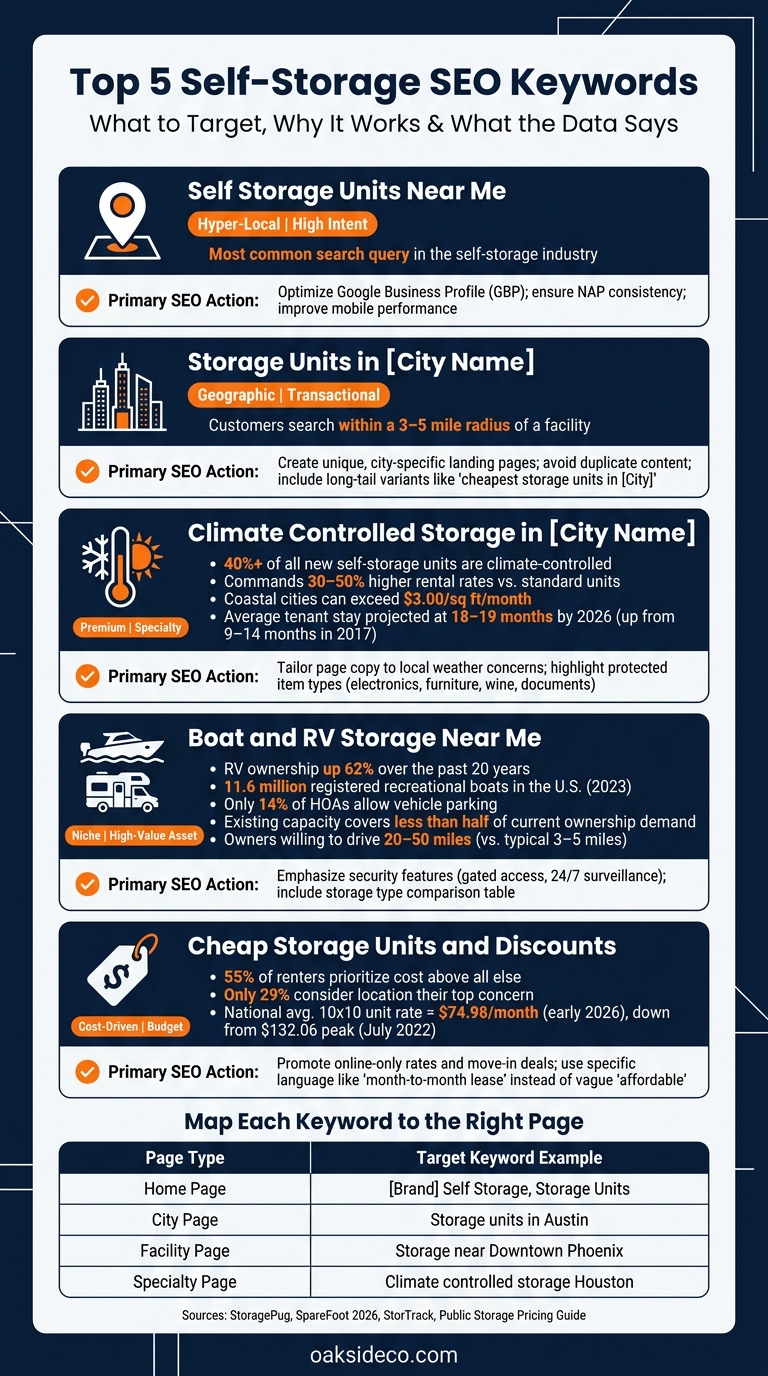
Top 5 Self-Storage Keywords: Stats, Intent & SEO Strategy
How To Find High-Value Self-Storage Keywords
To pinpoint the best-performing keywords, start by defining what makes a keyword worthwhile. The most effective keywords typically have three key traits: high search volume, clear transactional intent, and a local modifier that ties the search to a specific area. These criteria help narrow your focus, making it easier to turn keyword research into actual bookings.
One of the best tools to kick off your search is Google Keyword Planner. Begin with seed keywords like "self storage" or input competitor URLs to get accurate search volume data. Adjust the CPC slider to its maximum setting to reveal precise monthly search volumes rather than broad estimates. For more intent-specific insights, try ClearSERP, which categorizes keywords as Informational, Commercial, or Transactional using live Google Ads auction data.
When analyzing results, sort by "Top of page bid (high range)" to quickly identify keywords that generate revenue. As TryAnalyze explains:
"If advertisers are willing to pay $15 or $20 for a single click on a keyword, that keyword drives real revenue."
High CPCs are a strong indicator of commercial intent, which is exactly what storage facilities need to fill their units.
Once you’ve identified valuable keywords, align them with your facility’s unique features and business objectives. Use transactional keywords on service and location pages, while saving informational terms like "how to pack a storage unit" for blog posts. For example, if your facility offers climate-controlled units in a humid area, prioritize keywords like "climate controlled storage in [City]" on your main landing pages. Similarly, if you offer specialized storage for boats or RVs, broader regional modifiers will help attract customers from a wider area. This focused strategy ensures your keywords are effectively integrated across your website and marketing efforts.
sbb-itb-09b4138
1. Self Storage Units Near Me
The phrase "self storage units near me" dominates search queries in the self-storage industry. As StoragePug explains:
"The most common search term customers use is actually ‘storage units near me.’"
This keyword stands out because it reflects a clear intent to act – people searching for it are likely ready to rent a storage unit.
The local focus of this term is just as crucial as its intent. Self-storage is a hyper-local business, with most customers living close to the facility they choose. Ranking for "near me" searches essentially positions your business to capture these nearby customers – those most likely to visit and sign a lease.
But ranking for this keyword involves more than just sprinkling it into your website copy. Google’s algorithm heavily factors in proximity signals, making your Google Business Profile (GBP) a critical tool. To stand out in the Google Map Pack (the top three local results), ensure your Name, Address, and Phone number (NAP) are consistent everywhere online. Additionally, regular updates and positive reviews on your GBP can significantly boost your visibility.
Since "near me" searches are often made through mobile and voice search, your website’s mobile performance is non-negotiable. With Google’s mobile-first indexing, a slow or clunky mobile experience can quickly drive users away. As Robert Priester from StoragePug points out:
"Users constantly landing on your site and quickly choosing not to rent can hurt your rankings."
Pricing also plays a key role. Competitive rates not only attract potential renters but also improve your local SEO by keeping bounce rates low. This creates a positive feedback loop that helps maintain strong rankings.
This multi-layered approach to optimizing for "near me" searches is a prime example of how Oakside Co tailors SEO strategies for self-storage businesses. Up next, we’ll dive into how location-specific keywords can refine your SEO efforts even further.
2. Storage Units in [City Name]
Focusing on local "near me" searches is a great way to drive conversions, but targeting phrases like "storage units in [City Name]" takes it a step further. These city-specific keywords connect you with users who are ready to act. For example, someone searching "storage units in Austin" or "storage units in Tampa" is likely looking to rent immediately. That’s why these keywords are some of the most effective in the storage industry.
To rank well for these terms, it’s essential to create a dedicated page for each location. Each page should have a unique meta title and description featuring the city name, along with content that feels authentic to the area. Avoid duplicating templates across multiple locations – Google flags duplicate content and penalizes rankings.
Incorporating long-tail keywords like "cheapest storage units in [City Name]" is also important. These phrases align with conversational and voice searches, which are becoming more common. Robert Priester from StoragePug explains:
"Many customers use simple combinations of ‘storage units’ and their local region, whether that’s a city or a smaller area within the city."
Adding these variations boosts your relevance for local searches and helps capture a wider audience of high-intent users.
Another critical factor is bounce rate. If visitors leave your page quickly – perhaps because pricing isn’t clear or the location details are missing – Google could interpret this as a sign your page doesn’t meet the searcher’s needs, which can hurt your ranking. To keep users engaged, make sure your pages are mobile-friendly, load quickly, and provide transparent pricing. These elements not only improve user experience but also strengthen your ability to convert local traffic into paying customers.
Next, we’ll dive into how to optimize for climate-controlled storage keywords in local markets.
3. Climate Controlled Storage in [City Name]
"Climate controlled storage in [City Name]" is a high-performing keyword because it speaks directly to searchers looking for specialized protection for their belongings. This type of storage is considered a premium option, not just because of its higher cost but due to the specific needs it addresses. It’s a goldmine for self-storage SEO.
Currently, over 40% of all new self-storage units nationwide are climate-controlled. These units often command a 30–50% higher rental rate compared to standard drive-up units in many areas. In densely populated coastal cities, this rate can soar beyond $3.00 per square foot per month. Every customer who opts for this service brings in significantly more revenue.
This keyword performs particularly well in areas where extreme weather makes climate control feel essential rather than optional. For example, in the humid Southeast – states like Alabama, Arkansas, and North Carolina – relative humidity often exceeds 70%, which can lead to mold, corrosion, and warping. On the flip side, desert cities like Phoenix and Las Vegas face intense heat that can harm electronics, leather goods, and wooden furniture. Tailoring your page copy to reflect local weather concerns (e.g., "Keep your items safe from Houston’s relentless humidity") can resonate with searchers.
When creating landing pages for this keyword, highlight items that benefit most from climate control, such as:
- Electronics
- Wood furniture
- Wine collections
- Vinyl records
- Musical instruments
- Important documents
This level of detail reinforces why the higher price is worth it. Including a simple comparison table that outlines the differences between standard and climate-controlled units can also help customers make quicker decisions.
Another key factor? Tenants in climate-controlled units tend to stay longer. By 2026, the average tenant stay is projected to reach 18–19 months, compared to just 9–14 months in 2017. This not only boosts conversions but also improves retention rates.
4. Boat and RV Storage Near Me
When it comes to hyper-local self-storage keywords, "Boat and RV storage near me" stands out for targeting a niche group of owners dealing with pressing challenges like HOA restrictions or limited driveway space. This makes it a high-intent keyword tied to valuable assets, offering significant opportunities for businesses in this space.
The numbers paint a clear picture. RV ownership in the U.S. has surged by over 62% in the past 20 years, and as of 2023, there were 11.6 million registered recreational boats nationwide. With only 14% of HOAs allowing vehicle parking, many owners turn to storage facilities to fill this gap. This demand creates an ideal scenario for optimizing landing pages to attract recreational vehicle storage searches.
One unique aspect of this market is the extended search radius. While typical self-storage customers look for facilities within 3–5 miles of home, boat and RV owners are often willing to drive 20–50 miles to find the right storage solution. Highlighting your facility’s proximity to major highways or popular recreational spots can help capture these users as they plan their trips.
A report from StorTrack highlights the supply-demand imbalance:
"Existing Vehicle, RV & Boat Storage capacity represents less than half of what is needed to support current ownership levels." – StorTrack Report
When designing landing pages for this keyword, security should take center stage. Features like gated access and 24/7 video surveillance are major selling points for owners of high-value assets. Clearly outline these features, along with storage options and dimensions that can accommodate larger vehicles. This transparency builds trust and helps potential customers make informed decisions quickly.
Including a simple table with storage options, costs, and protection levels can make your landing page even more user-friendly:
| Storage Type | Monthly Cost Range | Protection Level |
|---|---|---|
| Outdoor Uncovered | $75 – $150 | Minimal (exposed to UV/weather) |
| Covered (Canopy) | $125 – $250 | Moderate (shields from sun/hail) |
| Indoor Enclosed | $200 – $400+ | Maximum (full weather/theft protection) |
For operators in cities like Dallas or Houston – where urban density meets a love for recreation – this keyword can drive substantial revenue. Companies like Oakside Co, which specialize in boat and RV storage, understand how this demand not only boosts marketing but also enhances property value. Up next, we’ll dive into cost-driven keywords that can further strengthen your SEO strategy.
5. Cheap Storage Units and Discounts
When it comes to self-storage, price is the deciding factor for most renters. A 2026 SpareFoot report revealed that 55% of renters prioritize cost above all else, while only 29% consider location their top concern. This strong focus on affordability has shaped promotional strategies aimed at turning searches into leases.
"Rent cost is notably more important to the consumer than where the units were located." – SpareFoot Report
The numbers speak for themselves: the national average monthly rate for a 10×10 storage unit fell to $74.98 by early 2026, a sharp drop from its peak of $132.06 in July 2022. This price correction reflects the intense competition among facilities vying for budget-conscious renters. To stay ahead, many facilities are offering online-only rates and move-in deals like "first month free." These promotions, combined with a simple online reservation process (often with no credit card required), make it easier to convert potential customers into actual renters.
Regional pricing differences also create opportunities for targeted SEO strategies. Renters often travel further to save money, making geo-targeted content essential for capturing these cost-savvy customers. Messaging focused on "cheap storage units" in suburban or outlying areas can resonate with those willing to drive for better rates.
| City | 10×10 Avg. Monthly Rate |
|---|---|
| Los Angeles | $210 |
| New York | $183 |
| Chicago | $128 |
| Las Vegas | $103 |
| Houston | $95 |
| Dallas | $93 |
| Atlanta | $89 |
(Source: Public Storage 2026 Pricing Guide)
While promoting affordability, it’s important not to let the word "cheap" undermine credibility. Instead of vague phrases like "affordable storage", opt for specific terms such as "month-to-month lease, no long-term commitment" or "online prices lower than walk-in rates." Providing clear and structured details – like unit sizes, discounts for students, military, or seniors, and transparent fee breakdowns – builds trust while reinforcing the low-cost appeal. As SEO content strategist Jordan Hale explains, "In marketplace environments, transparency often beats clever copy".
Next, we’ll explore how to align these price-focused keywords across your property portfolio for maximum impact.
Mapping Keywords to Pages Across a Portfolio
After identifying your top keywords, the next step is assigning each one to the appropriate page type. Using the same keyword across multiple pages can dilute your authority and confuse search engines. Instead, think of your website as a structured hierarchy, where each level targets a specific layer of search intent.
| Page Type | Target Keyword | Example |
|---|---|---|
| Home Page | Brand + broad industry terms | [Brand] Self Storage, Storage Units |
| City Page | Geographic intent | Storage units in Austin, Dallas Self Storage |
| Facility Page | Hyper-local + neighborhood | Storage near Downtown Phoenix, [Street] Storage |
| Specialty Page | Service-specific + location | Climate controlled storage Houston, RV Storage near me |
SEO expert John Reinesch highlights the importance of this approach:
"Each facility should have its own optimized page to target specific local searches."
This strategy is especially critical for businesses with multiple locations. A parent brand page helps establish broad authority, while individual facility pages are tailored to capture hyper-local searches that lead directly to leases. Internal linking between these pages allows search engines to crawl your entire portfolio effectively, passing authority from high-ranking pages to newer or less-visible ones. Additionally, publishing evergreen content, such as neighborhood guides, and linking them to facility pages can attract top-of-funnel traffic.
To avoid duplicate content – which can hurt local rankings – each facility page should include unique details about nearby landmarks, local communities, and specific unit features.
For institutional investors managing properties across different markets, aligning keyword strategy with market selection is essential. Renters often search within a 3-5 mile radius of a facility, driven by proximity and urgency.
This is where expert analysis can make a difference. Oakside Co provides data-driven advisory services to institutional buyers and sellers, using investment-grade market intelligence to shape SEO and content strategies for each facility from the outset.
Conclusion
Building on the keywords discussed earlier, your SEO strategy now depends on putting them into action effectively to see real results. The five keywords highlighted – "self storage units near me", "storage units in [City Name]", "climate controlled storage in [City Name]", "boat and RV storage near me," and "cheap storage units" – represent specific search queries that renters use when actively seeking storage solutions.
Ranking for these keywords is crucial in such a competitive space. While visibility sparks interest, converting that interest into bookings requires content that’s both relevant and targeted. According to Tribal Core, facilities that combine hyper-local relevance with clear, operational messaging tend to perform better than those that rely solely on basic keyword strategies. By pairing keyword mapping with transparent pricing, you can optimize your pages to attract search traffic while also converting visitors into customers. This combination strengthens your online presence and ensures your services connect with the right audience.
For operators with multiple locations, the keyword mapping framework outlined here offers a way to transform a scattered online presence into a cohesive, high-performing portfolio. Each location’s page should rank independently, avoiding competition with one another. Firms like Oakside Co specialize in helping institutional clients align market-level SEO strategies with broader investment goals, ensuring that digital visibility directly supports asset performance.
FAQs
Which of these keywords should I prioritize first?
Emphasize high-intent, location-specific keywords such as "24-hour access storage" to improve local visibility and draw in renters who need immediate solutions. Using these terms allows you to connect with users actively looking for storage options in your specific area.
How can I avoid keyword cannibalization across location pages?
To avoid keyword cannibalization, make sure each location page is centered around a unique primary keyword tied to its specific city or neighborhood. Complement this with secondary keywords to enhance relevance. Incorporate localized content such as mentions of nearby landmarks, customer testimonials, or community-specific details to make each page feel tailored.
When setting up internal links, use city-specific anchor text and maintain a clear hierarchy. For example, state-level pages should link directly to their respective city pages, creating an organized structure that search engines can easily follow.
Finally, conduct regular content audits to spot and resolve any overlapping keywords or duplicate content. This ensures that every page maintains its own focus and avoids competing with others in search rankings.
What should I optimize to rank for “near me” searches?
To improve your chances of ranking for "near me" searches, prioritize optimizing your Google Business Profile, crafting localized content and location-specific pages, and actively managing customer reviews. These efforts strengthen proximity signals and enhance local engagement – both critical elements for effective self-storage SEO.