If I had to cut this down to one point, it’s this: the best self-storage CapEx projects do one of three things fast – cut costs, support rent growth, or protect the asset from bigger repair bills later.
I’d put the top priorities in this order:
- Fix the shell first: roofs, leaks, seals, and exterior weak spots
- Then target fast payback items: LED lighting, gates, access control, and smart locks
- Next, improve the customer-facing areas: doors, hallways, office, signage, and landscaping
- After that, look at bigger rent and utility plays: climate-control work and HVAC controls
- Across a portfolio, rank projects by: condition, payback, and how much tenant disruption they cause
A few numbers stand out right away:
- LED retrofits can cut lighting energy use by up to 75%
- Smart HVAC controls can trim heating and cooling costs by up to 15%
- Smart locks often pay back in 12 to 18 months
- Office updates at a 500-unit site can add about $4,000 per month in revenue
- Electricity can make up 5% to 10% of costs at standard sites and 15% to 25% at climate-controlled sites
This also isn’t just about looks. In self-storage, a bad roof, weak lighting, old access systems, or worn asphalt can hurt leasing, push up costs, and chip away at NOI.
Quick Comparison
| Upgrade | Main Impact | Typical Payback | What I’d watch |
|---|---|---|---|
| Roof and envelope repairs | Asset protection, lower leak risk, lower cooling load | About 3–4 years for coatings | Water issues, tenant claims, roof age |
| Asphalt and traffic flow | Safer access, cleaner first impression | About 3–5 years | Surface damage, traffic volume |
| LED lighting | Lower electric bill, fewer lamp changes | 12–24 months | Utility savings, dark areas |
| Security systems and gates | Better site control, lower labor, fewer claims | 12–18 months | Gate failures, access issues |
| Smart locks | More online move-ins, lower break-in risk | 12–18 months | Adoption rate, staffing savings |
| Doors, hallways, office | Better leasing experience, fewer repairs | Often fast | Door failures, visible wear |
| Climate control and HVAC controls | Higher rents in the right markets, lower energy use | 2–3 years for controls | Demand, utility cost, building fit |
| Landscaping, signage, branding | Better curb appeal, stronger street presence | Often fast | Visibility, local competition |
If I were planning a site or a full portfolio, I’d start with deferred maintenance, then move to the projects that have the clearest NOI impact with the least downtime.
What Makes a Self-Storage CapEx Upgrade Worth It
Not every upgrade pays for itself. The ones that do improve revenue, cut costs, lift occupancy, or help the asset last longer. Looks alone aren’t enough to justify the spend.
Measure Revenue Gain Against Project Cost
The best way to judge a project is simple: look at what it does for revenue, expenses, or asset life. In self-storage, the biggest value shifts usually come from higher rents, faster leasing, and extra income streams.
Take a $40,000 office remodel at a 500-unit facility. That project can support a 5% rent increase (+$3,000/month), add more rentals (+$600/month), and increase retail and insurance income (+$400/month). That adds up to about $4,000/month in total gain, or roughly a 120% first-year return.
Smart locks can produce the same kind of result. At retrofitted properties, online move-ins have doubled within 12 months, while delinquency fell below 2%. That’s not a surface-level change. It’s a direct NOI driver.
Account for Expense Savings and Asset Protection
If rent growth is limited, expense cuts can still make a big difference to portfolio NOI.
LED lighting retrofits reduce energy use by up to 75% and usually pay back in 12 to 24 months. Smart climate-control systems lower heating and cooling costs by up to 15% annually, with payback in two to three years. Reflective roof coatings, which usually cost $0.50 to $1.50 per square foot, can cut cooling energy use by 50% and help the roof last longer.
In other words, some projects earn their keep through lower utility bills and fewer maintenance calls, even if rents don’t move much.
Match the Upgrade to Local Market Demand
A project that works in one market can fall flat in another. That’s where a lot of owners get tripped up.
Climate-control conversions make the most sense where tenants expect them and where nearby facilities already offer them. Curb appeal and branding updates matter more when a property is up against newer supply. Security upgrades tend to matter more when the goal is to reduce break-in claims, build tenant trust, and protect online reviews.
The upgrade has to fit local demand. If it doesn’t, even a good-looking project can miss.
Use these tests to rank the upgrades below by return, disruption, and portfolio impact.
The same three tests also help separate fast-payback projects from the ones that take longer to earn out.
| Upgrade Type | Value Driver | Payback | Key Metric |
|---|---|---|---|
| LED Lighting | Expense savings | 12–24 months | Utility bill reduction |
| Smart Locks | Revenue & security | Fast | Online move-in rate |
| Roof Coating | Asset protection | 3–4 years | Cooling energy use |
| Office Remodel | Rent premium | About 12 months | Rental rate growth |
| Smart HVAC | Operational expense | 2–3 years | Climate energy costs |
1. Roof Replacement and Building Envelope Repairs
Roof and envelope work should sit near the top of the priority list because it protects the building, your tenants, and NOI. When a roof fails, the damage can spread fast. Stored goods get hit, repair bills climb, and tenant retention can take a blow. The same thing happens with delayed envelope repairs: the longer you wait, the more expensive the fix usually becomes, and that can drag on value when it’s time to sell. The main challenge is simple: fix the shell without causing avoidable downtime.
For single-story buildings, roof condition has a direct effect on indoor temperature and cooling costs. Reflective coatings can help extend roof life and lower cooling load. But the bigger payoff is often more basic: stopping leaks, preventing tenant damage, and avoiding surprise replacement costs. If a full replacement is needed, retrofit re-roofing can help limit tenant downtime.
Smaller envelope fixes matter too. Door seals and weather stripping can be rolled out across a portfolio in phases to cut energy use and reduce pest intrusion. Done early, these repairs are usually far easier to handle than the larger structural problems they can turn into later.
2. Asphalt Resurfacing and Traffic Flow Improvements
The building matters, of course. But the approach to the site matters too. The parking lot, drive aisles, and gate area help form a prospect’s first impression, and that can affect the rent you’re able to support.
Patching can buy you some time. But resurfacing often leads to a lower long-term cost and a cleaner-looking site.
Looks are part of it. Traffic flow and safety matter just as much. Potholes, cracks, and faded striping can create hazards, slow circulation, and increase the risk of tenant injury or vehicle damage. Repainting striping helps keep traffic moving in a clear way, gives the property a more polished look, and may help cut liability exposure.
For older properties – especially those 15 to 20 years old and going up against newer supply – upgrading asphalt and circulation can sharpen the asset’s overall presentation. Across a portfolio, it makes sense to begin with sites that have the heaviest traffic, the worst surface damage, or the biggest visible gap versus nearby competition. If capital is tight, focus first on the highest-traffic areas and bundle paving with any failing gate or access equipment.
3. LED Site Lighting Upgrades
LED upgrades are one of the fastest ways to cut operating costs and make a site easier to see at night. It’s a fairly low-disruption CapEx project, which is a big reason owners like it. You improve NOI, trim maintenance work, and make the property feel better for tenants at the same time.
Lighting can account for up to 35% of site utility use, and LED systems can cut energy use by up to 75% compared with older fixtures. At Stanwood Self Storage, a June 2025 retrofit lowered lighting energy use by 65% and hit payback in a little over 12 months after rebates.
There’s also the maintenance side of the equation. LEDs last more than 50,000 hours – about five times longer than standard fluorescent bulbs. That means fewer burnouts, fewer service calls, and less labor spent swapping lamps. In low-use areas, motion sensors can add another 25% cut in energy use.
Brighter lighting also helps with visibility and tenant confidence. If a property feels dark or unevenly lit, people notice. Owners can pay for the work through utility rebates, third-party financing, or C-PACE loans to lower upfront capital needs. Before locking in the project scope, an energy audit can show which fixtures are likely to deliver the best return. That same bump in visibility also helps cameras and access control, which the next upgrade covers.
4. Security Cameras, Gates, and Access Control Systems
Better lighting helps people see what’s happening on-site. Security systems take the next step: they turn that visibility into control.
Modern setups can connect gate keypads, access software, and unit-level smart locks in one platform. That matters because security isn’t just another line-item expense. It can directly affect NOI. In fact, operators can charge up to 10% more for units with smart access tech.
Cost comes down to how much work the site needs. If the gate operator is failing, that’s usually a contained fix with fast payoff. It can cut service calls and reduce unauthorized entries right away. Bigger access infrastructure projects take more time to earn back the spend. Smart locks and access control systems, though, often recover their cost in 12 to 18 months.
There’s a labor angle too. Modern access systems can update permissions on their own, which gets rid of manual overlocking and can cut labor by 25% to 40%.
Upgraded security may also reduce break-in claims and help lower insurance costs.
| Security Upgrade | Primary Benefit | Estimated ROI Timeline |
|---|---|---|
| Smart Locks | Reduces break-ins; enables tiered pricing | 12–18 months |
| Access Control | Automates permissions; reduces labor | 12–18 months |
| Gate Operator | Improves site reliability; reduces service calls | Immediate value |
| Infrastructure | Long-term data stability and site security | 3–5 years |
For occupied sites, phase the work. Start with the gate and access control. Then move to unit-level smart locks.
5. Smart Locks and Unit-Level Security Upgrades
Smart locks shift security from the front gate to each unit. That makes remote rentals and move-ins much easier to handle. And the upside goes beyond tighter control: it can also lift NOI by cutting losses and trimming manual work.
Facilities with smart locks have reported up to 95% fewer break-ins than sites using standard padlock-and-hasp systems. In a 2025 retrofit across 18 facilities, online move-ins doubled within 12 months, and staffing dropped by 0.5 employees per site.
The key point here is simple: the result comes from automation, not just the lock itself. Software-based access changes cut down on manual tasks, reduce labor demand, and make phased rollouts easier even at occupied sites.
sbb-itb-09b4138
6. Roll-Up Door, Hallway, and Office Renovations
After security systems, the next layer of value is the part tenants see and use every day. Roll-up door replacements are often some of the fastest-payback CapEx projects because they improve reliability, curb appeal, and leasing speed. On the flip side, failing doors can drag down rental rates and create safety risks.
A smart move here is upgrading to dead axle roll-up doors with factory-lubricated springs. That setup helps cut long-term maintenance costs and can extend the life of the investment. If you replace door seals and weather stripping at the same time, you also tighten up each unit’s access point. Done right, that can reduce facility energy use by up to 10%.
Hallways and the office matter just as much. Clean, well-lit hallways send a simple message: this property is cared for. And the office is often the first in-person touchpoint a tenant has with the facility. That’s why even a modest office refresh can go a long way.
Focus updates on a few visible items:
- New countertops
- New flooring
- A self-service kiosk
- A visible security monitor
The order of work matters too. Start with failing doors first. Then refresh hallway finishes. After that, update the office and other common areas. Once those areas are in better shape, HVAC becomes the next big lever for lowering operating costs.
7. Climate-Control Conversion and HVAC Improvements
After visible repairs and security work, climate control is often the next big rent lever. A climate-control conversion can push rent and NOI higher, but it also adds to operating costs.
The upside can be strong if you handle it well. Smart thermostats and humidity sensors can cut annual heating and cooling costs by up to 15%. When you pair those tools with maintenance and equipment upgrades, total energy use can drop by as much as 30%. That matters because the payback period is often short. In many cases, smart climate-control upgrades recover their cost within two to three years.
This isn’t just about utility bills. Climate control also helps reduce risk. Remote monitoring can catch equipment issues early, before they turn into bigger repair problems. And steady temperature and humidity can help attract higher-value storage customers who care about protecting what they store.
That point hits harder in hot markets. An uninsulated single-story building can run up to 30°F hotter than the outside air. For tenants storing furniture, electronics, files, or business inventory, that gap can be a deal-breaker.
The cost side gets a little easier when incentives come into play. The federal Section 179D deduction offers $0.60 per square foot for qualifying energy-efficiency upgrades. Utility rebates and C-PACE loans can also reduce the upfront cost.
If you move ahead, phase the project so construction doesn’t hurt occupancy. And if a full climate-control conversion doesn’t pencil out, start with lower-cost efficiency upgrades first.
8. Landscaping, Signage, and Exterior Branding Refresh
Once the big operating systems are handled, the exterior is often the fastest way to improve perceived quality. Landscaping, signage, and exterior finishes shape how a prospect reads the property from the street before they ever step into the office. A dated exterior can drag down rent and slow lease-up. A cleaner, more modern look can help a property lease faster and feel more institutional.
Keep this refresh focused on the parts that define the outside of the property:
- Monument and blade signage
- Landscaping
- Paint and façade condition
- Entry presentation
The goal is simple: make the entry drive clean, easy to see, and free of obvious defects. Clean, uniform exterior lines make a stronger first impression and help narrow the perceived gap between the property and newer nearby supply. Add consistent exterior lighting to support safety and visibility at the same time.
There’s also a practical side here. Cleaner exteriors can help support tenant confidence and reduce claim risk. These upgrades tend to matter most where visibility is high, drive-by traffic is strong, and newer nearby supply puts more pressure on curb appeal.
After the work is done, track rent growth, occupancy, online move-ins, retention, maintenance cost, and review sentiment.
How to Prioritize Projects Across a Self-Storage Portfolio
Once your upgrade list is in place, the next job is deciding what gets done first across the portfolio. At that stage, CapEx should be ranked by three things: condition, return, and disruption.
Start With Property Condition and Deferred Maintenance
Start with a Property Condition Assessment (PCA) for each asset. A PCA helps separate urgent deferred maintenance from optional value-add work. Life-safety issues and water intrusion should come first.
After those critical repairs are identified and budgeted, the rest of the project list can be judged on its own merits. That split gives each property its first-priority list. From there, you have a clear first pass at sequencing work across the portfolio.
Rank Projects by Return, Timing, and Disruption
Once deferred maintenance is covered, rank the remaining projects based on payback, leasing impact, and downtime. In plain English: move the projects that are most likely to produce the best return while causing the least amount of disruption.
That matters because a strong project on paper can still create problems if it slows leasing, blocks access, or drags on longer than expected. The best projects don’t just pencil well. They also fit the way the property operates day to day.
Build a Multi-Year Reserve and Execution Plan
Spread projects over several years to protect liquidity, compare bids, and match spending to leasing and exit timing.
Oakside Co helps institutional owners build capital plans aligned with leasing and disposition timing.
Value Impact vs Capital Required: A Quick Comparison
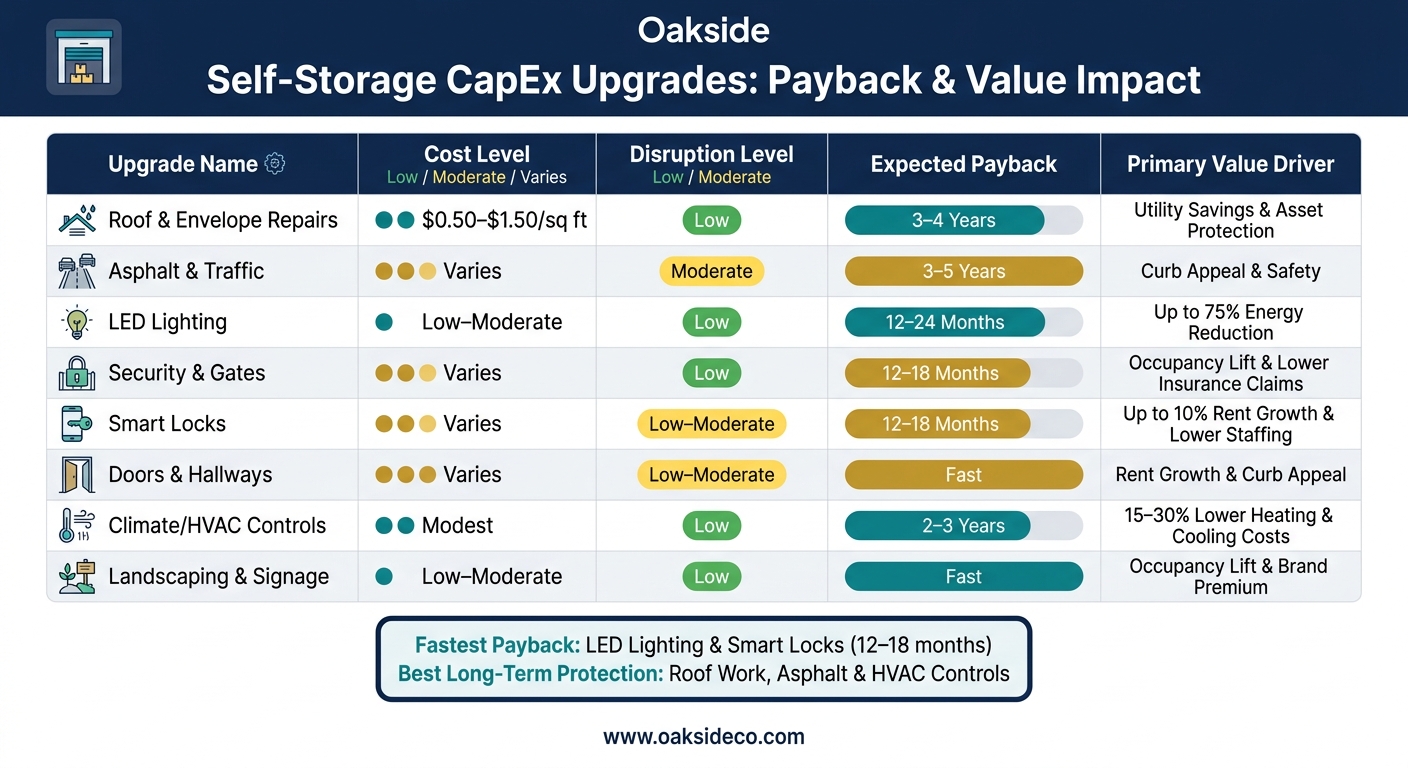
Self-Storage CapEx Upgrades: Payback & Value Impact Comparison
Once you’ve ranked projects by condition and tenant disruption, this table helps you size up capital required vs. payback.
| Upgrade | Cost | Disruption Level | Expected Payback | Value Driver |
|---|---|---|---|---|
| 1. Roof / Envelope Repairs | $0.50–$1.50/sq. ft. (coatings) | Low | 3–4 Years | Utility savings & asset protection |
| 2. Asphalt & Traffic | Varies by scope | Moderate | 3–5 Years | Curb appeal & safety |
| 3. LED Lighting | Low to Moderate | Low | 12–24 Months | Up to 75% energy reduction & lower maintenance |
| 4. Security & Gates | Varies by system | Low | 12–18 Months | Occupancy lift & reduced insurance claims |
| 5. Smart Locks | Varies by unit count | Low to Moderate | 12–18 Months | Up to 10% rent growth & lower staffing costs |
| 6. Doors & Hallways | Varies by scope | Low to Moderate | Fast | Rent growth & curb appeal |
| 7. Climate/HVAC Controls | Modest (controls only) | Low | 2–3 Years | 15–30% lower heating & cooling costs |
| 8. Landscaping & Signage | Low to Moderate | Low | Fast | Occupancy lift & brand premium |
Here’s the short version: LED lighting and smart locks tend to pay back the fastest. Roof work, asphalt, and HVAC controls usually take longer, but they help protect property value over time and can prevent bigger repair bills later.
Conclusion
The pattern across these upgrades is pretty clear: the best self-storage CapEx plans balance fast payback, NOI growth, and asset protection. LED lighting, smart locks, and roof repairs stand out most clearly.
Once you know which projects are likely to pay off, the next move is to put them in the right order. The best capital plans are phased and tied to local demand. Start with deferred maintenance, then rank projects based on return, timing, and how much disruption they’ll cause.
For portfolio-level planning, Oakside Co can help pinpoint which upgrades are most likely to improve NOI and valuation before you commit capital.
FAQs
Which upgrade should I do first at my facility?
Start with must-fix issues before you spend money on looks. If the property has drainage problems, handle site regrading first. That helps reduce the risk of flooding and foundation damage. As Nolen Masserman, Managing Director at Oakside, notes, addressing deferred maintenance is key to avoiding price reductions during a sale.
After you deal with drainage and structural issues, move to high-impact upgrades that improve day-to-day use. Good examples include security systems, smart locks, and LED lighting.
How do I compare fast payback versus long-term value?
Balance short-term cash flow needs with the bigger picture: property value over time.
Some upgrades, like LED lighting or smart lock retrofits, often pay for themselves in 12 to 24 months through lower energy bills or faster rentals. Those wins can show up pretty fast.
Other projects take more patience. Improvements like site regrading or roof treatments may need three to five years to deliver full ROI. Even so, they can help protect NOI, support financing, and give buyers more confidence during due diligence.
When does climate control make sense?
Climate control makes sense if you want to attract tenants storing sensitive items. These units often rent for 25% to 50% more than standard drive-up units, and they appeal to a broader mix of renters.
It can work especially well when you convert underused interior space. In that case, the land cost is already built in, which can lead to 25% to 35% returns. Smart tech can also cut energy use by up to 30%.