Email can help self-storage sellers get more buyer replies, keep deals moving, and support stronger offers. In this piece, I’d boil it down to five things: segment the buyer list, lead with the numbers buyers want first, use a set follow-up schedule, keep every figure consistent, and get help from a self-storage-focused advisor when needed.
Here’s the short version:
- Segment buyers by type so each email fits how they review deals.
- Open with core property data like NOI, occupancy, NRSF, and market stats.
- Use a fixed email cadence over about 14 to 21 days.
- Keep numbers and dates consistent across the email, OM, and data room.
- Use clean formatting and one clear next step in every message.
A few stats stand out. More than 50% of CRE email opens happen on mobile, and about 64% of recipients decide to open based on the subject line. So if I’m sending a self-storage deal email, I’d keep it short, direct, and easy to scan on a phone.
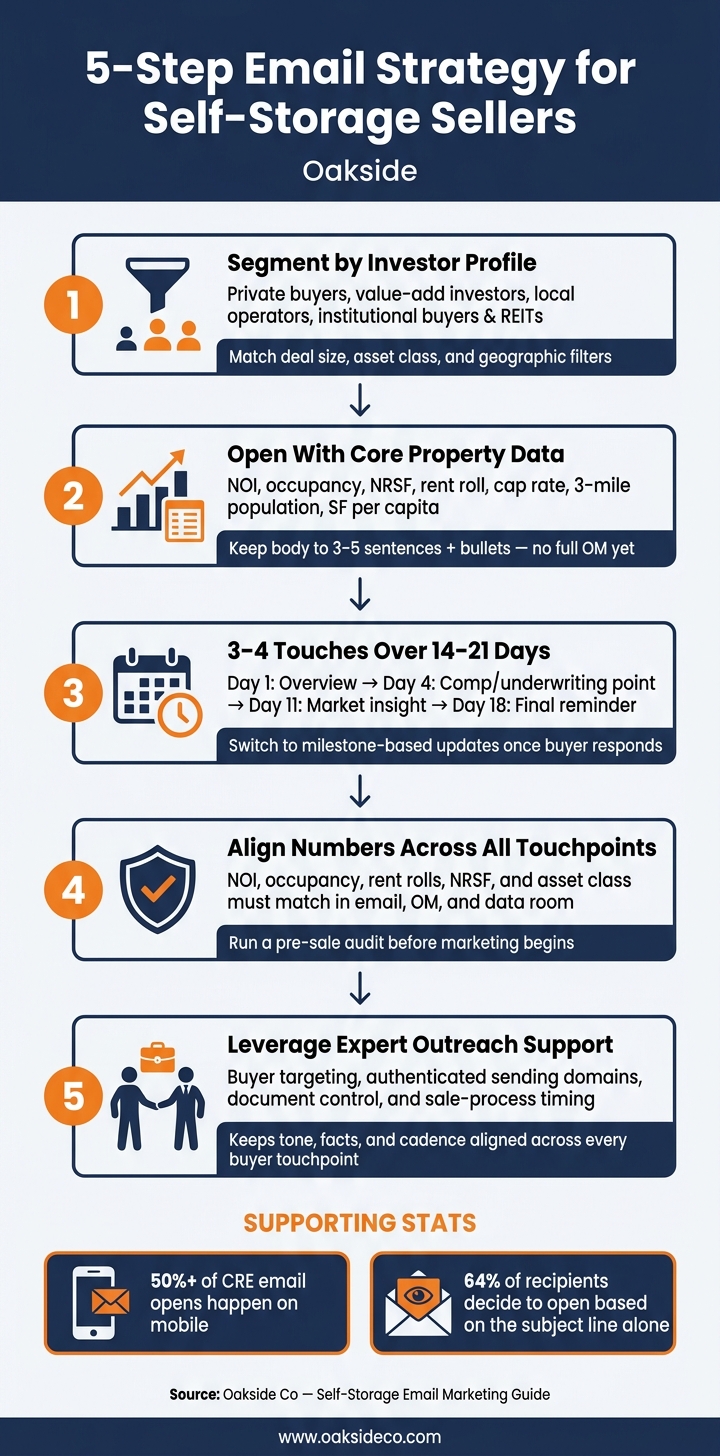
5-Step Email Strategy for Self-Storage Sellers
Quick Comparison
| Tip | What I’d focus on | Why it matters |
|---|---|---|
| 1. Segment the list | Buyer type, deal size, market fit | Buyers look at the same deal in different ways |
| 2. Lead with data | NOI, occupancy, NRSF, rent roll, market data | Helps buyers screen the deal fast |
| 3. Use a set cadence | 3 to 4 touches over 14 to 21 days | Keeps the sale moving without too many emails |
| 4. Keep details aligned | Same figures, dates, and positioning everywhere | Cuts doubt and keeps underwriting on track |
| 5. Use advisor support | Buyer targeting, email flow, document control | Helps keep outreach focused and organized |
If I had to sum up the article in one line, it’s this: the right email, sent to the right buyer at the right time, can make selling a self-storage facility run better.
sbb-itb-09b4138
Why Email Works in Self-Storage Property Sales
Email helps keep self-storage buyers moving from the teaser to the OM, CA, virtual tour, and data-room access. It also gives the sale process some order. Deadlines, links, and next steps stay in one place instead of getting lost across calls and texts.
Institutional buyers want concise, data-driven emails with one clear next step. Put the asset name and submarket in the subject line, then get straight to the point. A single call to action, like "Review the OM" or "Submit your CA," makes it easier for buyers to act. More than 50% of CRE email opens now happen on mobile devices, so short, easy-to-scan messages matter.
Oakside Co can align outreach, underwriting, and buyer targeting so each email, document, and follow-up sequence tells the same story.
A stage-based email plan is much easier to run when every step has a clear job.
| Deal Stage | Email Focus | Buyer Action |
|---|---|---|
| Prospecting | Asset teaser, submarket snapshot | Request the OM |
| Nurturing | Targeted alerts, deal updates | Submit the CA |
| Due Diligence | Deadline reminders, document links | Access the data room |
That step-by-step structure starts with sending each buyer the right message at the right time.
1. Segment Your Buyer List by Investor Profile
Not every buyer is after the same deal. A private investor hunting for a value-add play looks at a property very differently than an institutional group underwriting a stabilized, NNN-leased asset. If both get the same email, the message misses the mark.
Buyer Targeting
Start by sorting your buyer list into a few clear groups: private buyers, value-add investors, local operators, and institutional buyers and REITs. Then tighten each group based on deal size, asset class, and geographic filters like population growth or median income. That gives you a simple way to decide what belongs in the first email. It also shapes who gets the OM, who gets CA instructions, and who should get bid reminders.
Lead With the Right Data
After you define your segments, open each email with the metric that matters most to that buyer.
Institutional buyers usually want to see cap rates, market vacancy trends, and lease structures right away. Value-add investors tend to care more about net rentable square footage (NRSF), rent momentum, and management upside. Local operators often focus on square feet per capita and nearby permit activity, because those numbers help them read supply and demand in that submarket.
Same property, different lens. That’s the whole point.
Sale-Process Timing
Segmentation also affects timing. It shouldn’t just change what you send. It should change when you send it.
For institutional and commercial buyers, run 3–4 touches over 14–21 days, staggered across 2 to 3 weeks. That gives you room to reply to inbound interest, keep the process moving, and protect deliverability.
Credibility and Consistency
A small detail can go a long way here. Mentioning a specific submarket trend or a recent local comp shows you know their market, not just your listing. That kind of detail makes the outreach feel informed instead of generic.
Once the list is segmented, each buyer should get a property overview that fits their underwriting lens, a key step in the self-storage buying and operations process.
2. Lead With a Data-Rich Property Overview Email
Once you’ve segmented your buyer list, your first email needs to do one job well: give each buyer the data they need to decide if the deal is worth a closer look.
That means the email should be easy to scan and simple to underwrite. You’re not sending the full OM yet. You’re giving buyers enough to screen the deal and reply.
Key Data Points
Start with the core numbers buyers look for right away: net rentable square feet (NRSF), NOI trends, occupancy history, and detailed rent rolls. Then add market context that helps them judge demand and fit, like 3-mile population, median household income, and square footage per capita. It also helps to include recent nearby permits or new supply within 1 mile.
| Data Category | Key Data Points |
|---|---|
| Property Specs | Net Rentable SF, Unit Mix, Total Acreage, Expansion Potential |
| Financials | Current NOI, Cap Rate, Revenue Trends, Expense Ratios |
| Market Data | 3-Mile Population, Median Household Income, SF Per Capita Supply |
| Process Info | Call for Offers Date, Tour Availability, Sale Terms (e.g., Seller Financing) |
The key is balance. Give buyers enough detail to screen the opportunity, but don’t turn the email into a full OM.
Sale-Process Timing
Send the first overview email on a weekday morning. Keep the body short – 3 to 5 sentences of narrative. Use bullets so buyers can move through it fast.
Hold back the full OM at this stage. The first email should spark a reply, not answer every question upfront. After that, keep buyers warm with a steady follow-up cadence.
Credibility and Consistency
This is where small things can make or break trust. Send the email from a company domain and include a professional signature. Use one clean, high-quality property photo with minimal branding overlays.
Just as important, make sure every figure in the email matches the OM. If the rent roll says one thing and the email says another, people notice. Audit maintenance records and lease data before sending.
From there, follow with a disciplined cadence of reminders and updates.
3. Use a Disciplined Sale-Process Email Cadence
Use a fixed cadence to keep buyers engaged without flooding their inbox.
After the overview email, stick to a set sequence so buyers know what’s coming next. That small bit of predictability helps the process feel organized instead of random.
Sale-Process Timing
| Touch | Timing | Content Focus |
|---|---|---|
| Touch 1 | Day 1 | Asset-specific overview |
| Touch 2 | Day 4 | Follow-up with a relevant comp or underwriting point |
| Touch 3 | Day 11 | Brief "bump" with a market insight or specific underwriting point |
| Touch 4 | Day 18 | Final reminder with no hard push |
Once a buyer responds, stop relying on scheduled touches and switch to milestone-based updates. During due diligence and closing, tie outreach to the disposition timeline: CA submission, data-room access, bid deadlines, and closing reminders.
Credibility and Consistency
Consistency helps buyers see you as a trusted advisor. It shows you have a process, not just a pile of follow-ups. Use a dedicated outreach domain to protect deliverability.
Stage-Specific Data Points
Early touches should lead with market stats, like vacancy rates, rent trends, and nearby permit activity. Later, the focus should shift to timeline milestones, document access, and closing reminders.
That change in focus keeps each email tied to where the buyer is in the process, from first contact through closing.
4. Keep Every Message Transparent, Consistent, and Accurate
After cadence, accuracy is what keeps buyers engaged. Once your timing is in place, accurate details help protect the deal. One mismatched number can make a buyer second-guess the whole process. Buyers underwrite fast, and inconsistency slows decisions.
Key Data Points
Keep NOI, occupancy, rent rolls, and P&Ls identical across every touchpoint. Even small differences can make a buyer question the reliability of everything else you’ve shared.
The same goes for physical details. The property address, net rentable square feet (NRSF), and asset positioning, such as Class A or a value-add play, should be locked in before the first email goes out and should not shift mid-process.
Sale-Process Timing
Send a short due diligence email with the main milestones and deadlines. If any date changes, update buyers that same day.
Credibility and Consistency
Sellers who treat every touchpoint, from the first overview to the final closing reminder, as a reflection of their credibility tend to attract buyers who trust the process. Clean, accurate messages cut friction and help keep underwriting moving in a self-storage sale.
It also helps to run a pre-sale audit before marketing begins, so maintenance and zoning issues come up before diligence.
A specialized advisor can help keep that consistency in place across every buyer touchpoint.
5. Work With a Specialized Advisor to Improve Outreach
Once accuracy is locked in, the last edge comes down to execution. When your buyer list, cadence, and data are set, a specialized advisor helps keep outreach focused and credible.
Buyer Targeting
Buyer databases, SEC filings on EDGAR for REIT activity, and private investor platforms like PitchBook can help surface active buyers for your asset class. An advisor can sort those buyers by asset type, recent acquisitions, and check size, so your outreach starts with the right people instead of casting too wide a net.
Once that list is in place, the next job is simple: give each buyer the numbers they need to underwrite the deal.
Buyer-Ready Data
Advisors turn raw market data into buyer-ready bullets that support underwriting.
That matters because most buyers don’t want to dig through messy source material. They want clear points they can scan, trust, and use.
Sale-Process Timing
Advisors line up each touch with the live sale-process calendar and help protect deliverability through authenticated sending domains.
In plain English, timing and inbox placement both matter. Even a strong deal can lose momentum if emails land at the wrong time or never make it to the inbox.
Credibility and Consistency
One advisor keeps facts, tone, and timing aligned across every buyer touchpoint.
Oakside Co combines investment-banking-level analysis with a national investor network focused on self-storage assets.
Before sending, standardize U.S. dates, currency, and units.
U.S. Formatting Details to Get Right in Seller Emails
Use standard U.S. formatting in every email so buyers can underwrite faster. Small format slips can slow people down and chip away at trust.
Write prices as $12,350,000. Use one decimal place for occupancy and cap rates, like 92.4% occupancy and 6.5% cap rate. For property size, use SF or NRSF, such as ±18,500 NRSF. For dates, stick with MM/DD/YYYY, like 07/03/2026.
| Data Type | Standard U.S. Format | Example |
|---|---|---|
| Pricing | Dollar sign, comma-separated | $12,350,000 |
| Occupancy / Cap Rate | Percentage with one decimal | 92.4% / 6.5% |
| Property Size | SF or NRSF | ±18,500 NRSF |
| Dates | MM/DD/YYYY | 07/03/2026 |
| Location Reference | Submarket or MSA | Cape Coral–Fort Myers MSA |
Use that same approach for market names and underwriting language too. Stick with recognized MSAs, submarket names, and standard terms like NOI, going-in cap rate, and NNN. That way, the email reads like something a buyer can scan and use right away.
Subject lines should be direct and tied to the property, such as Just Listed: ±18,500 SF | North San Antonio. About 64% of email recipients decide whether to open a message based on the subject line alone, so plain clarity beats clever wording. In the body, use en-US spelling and a clean, professional tone.
When the format stays consistent, buyers can spend their time on the deal itself instead of decoding the email.
Snapshot Tables for Faster Buyer Review
Once your outreach is live, use tables to make the deal easier to underwrite. One table should answer “what is it worth”. The other should answer “what happens next.”
Start with a current vs. pro forma snapshot.
| Metric | Current | Pro Forma |
|---|---|---|
| Occupancy | Actual % from current rent roll | Projected % at market stabilization |
| Net Operating Income (NOI) | Trailing 12-month (T12) | Projected year 1 |
| Rent per occupied SF | Current average collected rent | Projected at stabilized rates |
| Cap rate | Based on current NOI and asking price | Based on pro forma NOI |
This table gives buyers a quick side-by-side view of the asset today and where it could land after lease-up or rate resets. That matters because most people reviewing a deal on their phone don’t want to dig through a long memo just to find the headline numbers.
Use a second table to show the next email and deadline at a glance.
| Email Type | Timing | Purpose |
|---|---|---|
| CA + OM Access | Within 24 hours of inquiry | Secure signed CA and release the full OM |
| First-Round Bid | At launch, when materials are ready | Solicit initial bids by a stated deadline |
| First-Round Reminder | 24–72 hours before bid deadline | Reduce missed submissions |
| Best-and-Final Bid | After first-round review | Invite final pricing and terms from top bidders |
| Best-and-Final Reminder | 24–48 hours before final deadline | Drive timely final offers |
Keep both tables compact so buyers can scan them fast on mobile. Clean tables help move buyers from review to response with less friction.
Conclusion
Self-storage email marketing works best when sellers send the right message to the right buyer at the right time. That takes smart segmentation, clean data, steady follow-up, and plain transparency. Each of the five tips points to that same goal.
Segmentation helps match buyers with the right data. Accuracy builds trust. A steady cadence keeps buyers engaged during a long sales cycle. Transparency helps avoid delays. Execution is what turns these basics into results.
A specialized advisor can help target active buyers, position the asset, and manage outreach sequences. Oakside Co brings data-driven strategy, investor network access, and transaction management.
When it’s handled well, email becomes one of the most effective tools in a self-storage sale. Clear subject lines and snapshot tables give sellers a strong starting point.
FAQs
How do I segment my buyer list?
Use a customer relationship management system to sort buyers by factors like property type preference, investment history, relationship strength, and deal stage.
That makes it easier to send more relevant opportunities and keep prospects engaged instead of flooding them with deals that don’t fit.
As Nolen Masserman, Managing Director at Oakside, notes, precision matters: focus on buyers actively investing in the asset class and deal size you’re selling to help shorten time to close.
What numbers should I include first?
Start with your financial performance numbers, especially NOI, because buyers use that to judge value.
You should also include accurate rent rolls, occupancy history, and maintenance records. And don’t stop at physical occupancy. Show economic occupancy too, which means the rent you actually collected versus the income the property could have produced.
How often should I follow up?
Follow up often enough to stay relevant without overwhelming buyers. For initial outreach, a good target is 2 to 3 touches across 7 to 10 days.
For longer-term pipelines, relationship-building matters more than pure frequency. You can start with an initial sequence of 8 to 10 emails, then shift to a monthly follow-up cadence so you stay top of mind while sellers move through their decision-making timeline.