
If I want repeat investor capital, I need to do 10 things well: match the deal to the investor, report on time, share clean numbers, answer fast, show property results, build personal trust, address problems early, bring the right next deal, and use the same process every time.
That’s the whole playbook.
In plain terms, this article says long-term investor relationships come down to three things: fit, communication, and follow-through. In shaky markets, that matters even more. Higher rates, loans maturing in 2026, and insurance costs that climbed 15.6% per year over a recent five-year stretch can put pressure on cash flow and returns. When that happens, investors want facts, not spin.
Here’s the short version:
- Know who the investor is before offering a deal
- Match deal terms to return goals, hold period, and risk level
- Report on a fixed schedule with the same KPIs each time
- Use clean systems so numbers match from report to report
- Reply fast and give investors a clear way to ask questions
- Show property performance in terms of NOI, occupancy, rent, and expenses
- Treat investors like long-term partners, not one-time checks
- Share bad news early with a plain plan and follow-up date
- Send only the next deals that fit
- Use a repeatable process before and after closing
Quick Comparison
| Tip Area | What I focus on | Why it matters |
|---|---|---|
| Investor fit | Goals, hold period, leverage, cash flow needs | Fewer surprises later |
| Reporting | Monthly, quarterly, annual cadence | Keeps trust steady |
| Data | Same metrics, same format base | Cuts confusion |
| Communication | Two-way, timely replies | Keeps investors engaged |
| Performance | NOI, occupancy, rent, expenses | Shows whether the plan is working |
| Problems | Early notice + action plan | Limits doubt |
| Future deals | Match each investor’s current goals | Helps bring repeat capital |
| Process | Underwriting, docs, post-close tracking | Keeps execution consistent |
What I like about this article is that it stays practical. It’s not about saying more. It’s about saying the right thing, at the right time, with the right numbers.
sbb-itb-09b4138
Why Investor Relationships Matter More in Uncertain Markets
When capital gets tight, trust becomes the deciding factor. It often shapes whether investors will support an extension, fund a bridge, or accept a short-term distribution cut. If they trust the reporting process, they’re more likely to add equity to help cover a gap or stay patient through a dip in payouts. Without that trust, hesitation tends to show up fast.
Higher rates make things harder from several angles. They increase refinancing risk, tighten loan terms, and squeeze distributions. For self-storage and boat/RV sponsors, that usually means less room in cash flow and more pressure on near-term returns. About 17% of outstanding commercial and multifamily mortgage balances were expected to mature in 2026. That can lead to higher refinancing rates and stricter loan-to-value requirements.
Operating costs put even more strain on the deal. Insurance costs rose an average of 15.6% per year over a recent five-year period, including a 26.2% spike in 2023 alone. Numbers like that can eat into returns in a hurry.
That’s why clear communication matters so much. If expenses are moving up fast, investors need to hear why early on, not after the damage is done. A quarterly update that walks through each variance and shows what you’re doing to offset costs – like rebidding insurance or adjusting rents – helps people stay informed instead of blindsided. That is why the next step is matching communication and deal terms to the right investor profile.
1. Define Investor Profiles and Align Deal Structures
Once communication is clear, the next step is matching each investor to the right deal. If you place an income-focused investor into a deal that pays mostly at exit, friction tends to show up later in reporting, distributions, and exit timing. And once that mismatch is in place, it’s tough to fix.
Every investor brings a different risk profile, which affects return targets and comfort with leverage. Map each investor against their target IRR, hold period, leverage, and cash-flow needs. That profile should shape the hold period, leverage, and distribution setup for the deal.
A stabilized, high-occupancy self-storage facility carries a very different risk profile than a value-add boat/RV expansion with permitting risk. A conservative income investor may not be ready for seasonal demand swings and local-use sensitivity. When that’s clear from the start, reporting gets smoother and future capital raises get easier.
A short intake conversation can give you the baseline. Cover:
- Target IRR
- Hold period
- Leverage tolerance
- Reporting expectations
Institutional investors often expect audited financials, stress-tested scenarios, and a clearly defined exit strategy. Smaller private investors may have more flexibility, but they still need plain talk about risk and when income is likely to arrive. The goal isn’t just to stay organized. It’s to make investors feel understood and reduce surprises.
"Our team blends investment-banking-level analysis with real operator expertise, delivering strategies that are deeply informed, data-driven, and aligned with each client’s unique objectives." – Nolen Masserman, Managing Director at Oakside
When the deal structure fits the investor, trust grows – and repeat capital usually follows.
2. Build Trust Through Transparent, Data-Driven Communication
Once a deal fits an investor’s profile, clear reporting helps keep that fit in place. Trust comes from a steady update process tied to actual numbers, not vague check-ins. Data-backed updates can improve investor confidence and participation. That starts with sharing the right metrics on a set schedule.
What "Transparent" Actually Means
Transparency isn’t a slogan. It’s a fixed set of metrics reported the same way every period.
Share the core operating numbers investors need, including:
- Occupancy
- NOI
- Expenses
- Capex
- Leasing activity
- Debt coverage
Verification cuts uncertainty and helps with future capital raises.
Tailor the Format, Not the Facts
Different investors may want the same data in different formats. An institutional investor will often expect detailed spreadsheets with historical and projected cash flows, stress tests on debt coverage, sensitivity analysis on occupancy and rents, and market comparables. A private investor may lean toward narrative explanations, visual dashboards, and plain takeaways like current yield, year-to-date total return, and how the property stacks up against initial expectations.
The key is simple: present the same data in the format each investor prefers, from spreadsheets to dashboards. The facts don’t change. Only the format does. That keeps everyone working from the same numbers while matching each investor’s preferred level of detail.
Sponsors who explain not just what changed, but why, build credibility over time. Once the data is clear, the next move is to deliver it on a regular cadence.
3. Set a Consistent Investor Reporting Schedule
Once your data is in order, a set reporting schedule sends a clear message: you run a tight ship. It also keeps investors from having to chase you for updates.
Why Cadence Builds Credibility
When investors know monthly and quarterly reports will land on a fixed schedule, they can follow performance without extra back-and-forth. That matters. Missed or late reports can wear down trust fast, especially when results start to slip.
A Practical Reporting Framework
A simple layered cadence works well:
- Monthly updates: a short 2–3 page snapshot with occupancy, rent trends, move-ins and move-outs, delinquencies, and any major issues or wins.
- Quarterly reports: full financials, NOI vs. budget, capex progress, leasing and marketing updates, and market context.
- Annual packages: year-end financials, tax documents such as Schedule K-1s, a strategic review, and updated exit assumptions.
- Ad hoc updates: immediate communication for material events like severe weather damage, a major lease-up milestone, refinancing, or a sale.
Handled this way, you can end up with roughly 18–20 investor touchpoints per year.
Self-Storage and Boat/RV Specifics
The core reporting content stays the same for self-storage and boat/RV assets. What changes is timing.
Investors still need the same operating metrics, but your cadence should match seasonality and the stage of the asset. During lease-up or renovations, monthly updates make sense. Once the property stabilizes, quarterly reporting may be enough.
Put that cadence in your offering materials, onboarding packet, and investor portal so no one has to guess what to expect.
A steady cadence only works when the reporting system behind it is accurate.
4. Use Modern Tools and Systems for Accurate Reporting
Once your reporting cadence is in place, the next hurdle is simple: can your systems keep up without mistakes?
Why Software Matters for Investor Trust
Manual spreadsheets lead to errors, and investors spot it fast when numbers don’t line up. Modern reporting platforms pull data straight from your property management and accounting systems, which helps keep financials consistent from one period to the next. And when investors see the same method used every time, they start to trust you more as an operator.
CAPX reported that after moving to an automated investor portal, investor-statement work dropped by 50%–60%, and investors began getting answers directly from the portal. That kind of shift says a lot from the outside. It shows that your team isn’t patching reports together by hand.
That level of accuracy matters even more when your reports follow the metrics investors use to judge performance.
What Good Systems Actually Track
For self-storage and boat/RV assets, reporting needs to cover more than top-line revenue. Investors want to see how the property is performing day to day and whether the numbers support the story.
That usually includes:
- Physical and economic occupancy
- Average rents by unit or space type
- NOI vs. budget
- Delinquency
- Move-ins and move-outs
- Ancillary revenue, such as late fees or insurance add-ons
Well-run self-storage facilities typically maintain operating expense ratios (OER) between 35% and 50%, which means 50% to 65% of gross revenue flows to NOI before debt service. If your system tracks OER automatically over time, investors can compare your property against those norms on their own instead of emailing you for backup.
The same set of data should also work for different investor priorities without forcing your team into separate reporting workflows.
Aligning Tools With Investor Goals
A value-add buyer wants to see rate optimization progress and capex ROI. A long-term income investor is more focused on stable occupancy and controlled expenses. Modern platforms can give each group a different report view from one shared data set.
That matters because you can tailor the presentation without rebuilding the numbers in separate spreadsheets. Same property. Same source data. Different lens. The result is fewer questions and faster confidence.
5. Keep Communication Two-Way and Timely
After accurate reporting, the next thing investors feel is responsiveness. That’s where reporting starts to turn into trust. And when communication goes both ways, investors stay more engaged and are often more willing to reinvest.
Why Response Time Matters
Investors notice how fast you reply, especially when something seems off. A good rule is simple:
- Reply to routine questions within 24 hours
- Handle urgent matters within about 4 hours
The key is to acknowledge the message fast, share when they’ll hear back, and then do what you said you’d do.
Create Real Openings for Dialogue
Once you have a steady communication rhythm, give investors set moments to respond. That can be as simple as a Q&A call after quarterly updates or a short annual survey asking what they’d like to see more of.
For self-storage and boat/RV assets, this matters a lot. Occupancy shifts, rental-rate changes, and seasonality tend to spark questions. When investors know there’s a clear and predictable place to ask them, confidence builds faster than it would from a report by itself.
Don’t Wait for the Next Report to Share Big News
Use that same standard when something unexpected happens. Small issues can wait for the next report. But if a change is material, send a short update sooner.
Major issues, like storm damage or another major operating problem, should be shared promptly. Be clear about:
- What happened
- What the team did right away
- When investors should expect a fuller update
In volatile markets, fast disclosure around major issues is one of the most direct ways to protect trust.
Oakside Co helps owners build response-time standards, escalation paths, and event-driven update processes that meet institutional expectations.
6. Show Strong Performance at the Property Level
Fast replies help build trust. But at the end of the day, steady property results are what prove the case. When an asset performs well, the numbers do a lot of the talking. That’s why the scorecard matters just as much as the story.
What Strong Performance Means
Strong performance doesn’t just mean high occupancy. It means a steady pattern that shows capital is being handled with discipline. That can include:
- Stable or improving net operating income (NOI)
- Low delinquency
- Controlled expenses
- Rent growth that matches or beats the market
For self-storage assets, steady occupancy and disciplined pricing are strong signals. For boat/RV assets, the same idea applies: consistent occupancy and rent growth show the property is moving in the right direction.
Connect Results to Investor Goals
Numbers on their own only go so far. Investors want to know whether those results still support the original thesis. If the plan was yield-focused, show how stable collections are helping support distributions. If the plan was value creation, explain how pricing changes or capital improvements are pushing NOI the right way.
This is where many owners either build confidence or lose it. A metric is just a metric until you tie it back to what you said would happen.
Report Both Wins and Gaps
Good performance reporting isn’t about sharing only the bright spots. Investors tend to trust owners who report results plainly and explain why performance changed, whether the property is ahead of budget or behind it. If expenses went up, say why. If occupancy slipped, explain what caused it and what’s being done now.
That kind of straight talk helps investors decide whether the thesis is still holding up.
Strong performance also supports the personal trust that keeps investors engaged. For self-storage and boat/RV owners, Oakside Co can connect property-level execution with investor-focused analysis.
7. Build Personal Relationships and Mutual Respect
Numbers matter. But long-term loyalty usually comes from trust, responsiveness, and follow-through, not just the spreadsheet. Repeat capital tends to come from treating investors as long-term partners, not one-time funding sources. You can see that mindset in every call, update, and site visit.
Treat Investors Like Partners
A transactional mindset shrinks every conversation down to capital calls, distributions, and deal closings. A partnership mindset goes further. It means sharing your multi-year business plan for a self-storage or boat/RV facility, walking investors through your assumptions on lease-up timelines and rate management, and explaining why you made a decision, even when it trims a short-term return to protect long-term value.
Frequent, personal communication helps investors feel informed and respected. And it gives them a reason to come back.
Respect Investors’ Time and Attention
Once the deal is live, investors start judging you by how you communicate outside the report cycle. Simple habits say a lot. Use the same response standard for every material update. Oakside Co can help sponsors bring that same discipline to investor communication. Those small, timely touches build the kind of confidence that lasts beyond one asset.
Keep It Personal
Strong investor relationships need a human element. Scheduled annual reviews, occasional site visits or virtual property tours, and remembering investor priorities all help build loyalty that lasts longer than any single deal cycle. Over time, trust turns one-time investors into repeat capital partners.
8. Address Problems Honestly and With a Clear Plan
Once reporting is steady, the next test is what happens when performance slips.
Self-storage and boat/RV assets will hit rough patches. Lease-up can take longer than planned. Repair bills can come in high. Rates can get squeezed. The operators who stand out are the ones who explain the problem fast, in plain English, and with a clear next step.
Silence is where trust starts to crack. A direct update – even when the news is bad – gives investors facts instead of guesswork. It also shows you’re dealing with the issue head-on. That’s why every hard update should follow the same simple structure.
Structure Every Problem Update the Same Way
A strong problem update should answer five questions:
- What happened?
- Why did it happen?
- How bad is it?
- What’s the plan?
- When will you know whether the plan is working?
For example, if occupancy drops because a nearby competitor cuts rates, say that plainly. Then show the NOI impact, explain how you’ll respond, and give investors a date for the next check-in. No spinning. No vague language. Just the facts and the plan.
Connect the Problem to the Investor’s Original Goals
Tie the issue back to underwriting and returns. That’s what investors care about most.
If the setback affects distributions, say so. If it could change exit value, say that too. Putting the problem in the context of the original business plan helps investors see where things stand and what the change means.
Keep Reporting Consistent, Especially When Results Disappoint
If the issue is material, send an ad hoc update as soon as the facts are confirmed. Then keep reporting the same core metrics – even if they’re below budget:
- Occupancy
- Rent trends
- Move-ins and move-outs
- Delinquency
Oakside Co follows that same data-driven approach to help owners respond with facts and stay focused on long-term goals. It also makes it much easier to bring those same investors into the next deal.
9. Bring Repeat Opportunities That Fit Investor Goals
Handling problems well builds credibility. After that, the next test is simple: does the next deal line up with what that investor wants now?
Fit matters more than volume. A deal that misses the mark can hurt trust faster than saying nothing at all. Repeat capital usually comes from sending only the deals that make sense for that person.
Know What Each Investor Actually Wants
Before each raise, reconfirm the investor’s:
- expected hold period
- return target
- cash-yield needs
- risk tolerance
Then use that profile as your filter before you send anything.
Match stabilized assets with income-focused investors. Send lease-up or repositioning deals to investors who want growth.
Use Past Results to Support the Next Match
When you bring a repeat opportunity, tie it back to the investor’s past experience with you. Show how the new deal fits their current mandate and how you’re using the same underwriting discipline that led to prior results.
Past execution should back up the fit, not stand in for it. That kind of discipline makes the next raise easier.
Send only opportunities that match the investor’s current mandate.
10. Apply Institutional-Grade Processes With Advisory Support
Once you know the investor fit, the next step is simple: the process has to work every single time. Repeat deal flow only holds together when underwriting, execution, and reporting stay consistent from one deal to the next.
What "Institutional-Grade" Actually Means
Institutional-grade means using the same clear process for underwriting, documentation, and risk review on every deal. Each opportunity should move through a set workflow with actual T-12 operating statements, detailed rent rolls, stress-tested financial models, formal investment memos, and approval standards tied to DSCR and return targets. And each major assumption should be backed by a source document.
For self-storage and boat/RV assets, that also includes local demand analysis, competitive rate surveys, seasonal utilization modeling, and monthly cash flow projections based on realistic lease-up curves. In these property types, disciplined underwriting is often the difference between a credible deal and a hopeful story.
How Advisory Support Raises the Bar
Even a strong process gets better when a seasoned advisor reviews the assumptions before capital goes out the door. If a deal has been vetted by a firm with deep sector-specific knowledge, investors can feel more confident that the assumptions, comparable sales, and risk factors were reviewed with care.
"Our team blends investment-banking-level analysis with real operator expertise, delivering strategies that are deeply informed, data-driven, and aligned with each client’s unique objectives." – Nolen Masserman, Managing Director at Oakside
Oakside Co, which focuses on self-storage and boat/RV assets, provides benchmark assumptions, institutional-quality underwriting models, and structured transaction management from LOI through closing.
Reporting Discipline After Closing
That same discipline should continue after closing so investors can compare actual performance with the original thesis. After the deal closes, report actual results against the original underwriting and explain variances fast. For self-storage and boat/RV assets, that means tracking:
- Occupancy by unit or space type
- Achieved rent
- Average stay length
- Ancillary revenue
"Oakside provides senior-level attention, deep sector expertise, and a tailored approach from the first conversation through closing – ensuring every engagement receives the focus required to maximize value." – Cameron Vale, President at Oakside
That kind of consistency lets investors see the same discipline before closing and after closing.
Investor Profile Snapshot Table
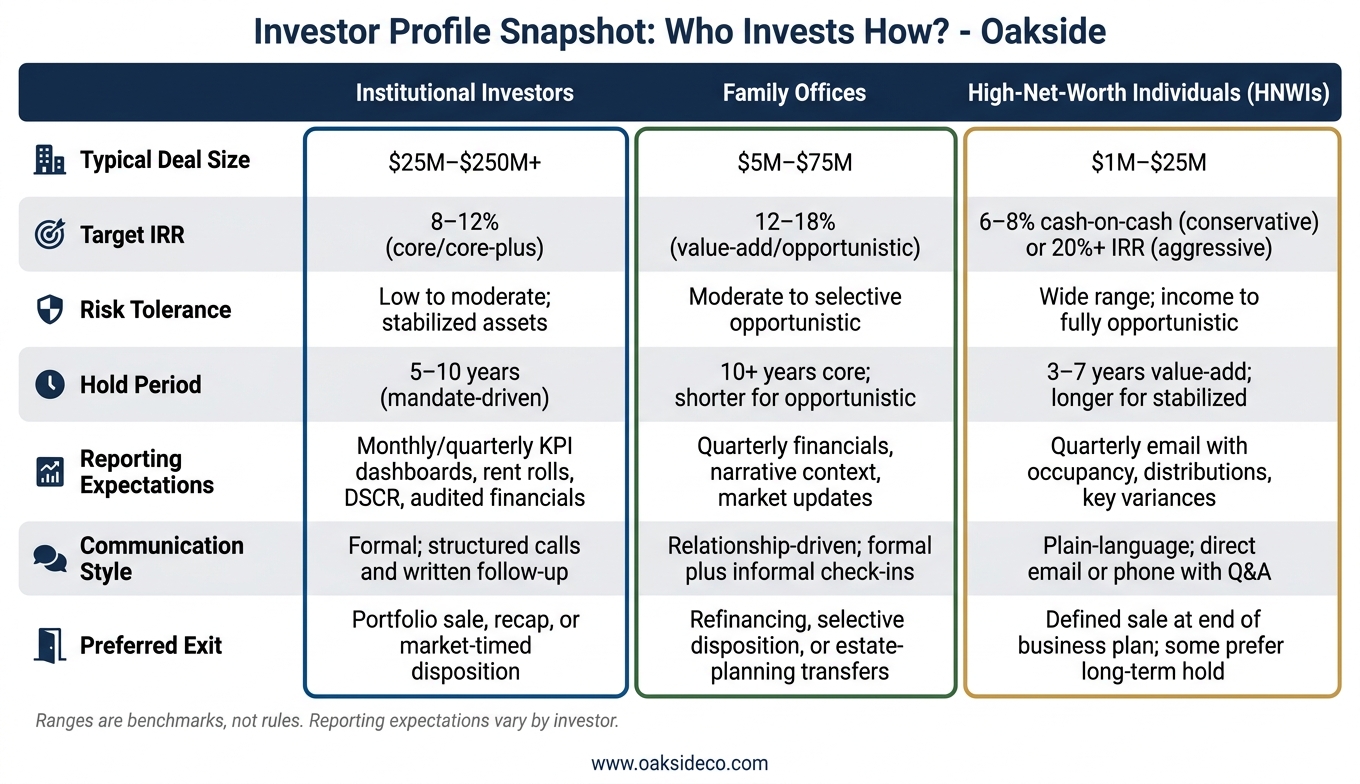
Investor Profile Comparison: Institutional vs. Family Office vs. HNWI
Once the core communication rules are set, the next step is simple: group investors by what they expect from a deal. That makes it much easier to line up deal structure, reporting depth, and communication style with the right audience.
| Category | Institutional Investors | Family Offices | High-Net-Worth Individuals (HNWIs) |
|---|---|---|---|
| Typical Deal Size | $25M–$250M+ | $5M–$75M | $1M–$25M |
| Target IRR | 8%–12% for core/core-plus, with higher targets for value-add or opportunistic deals depending on mandate | 12%–18% for value-add/opportunistic deals | 6%–8% cash-on-cash for conservative deals, or 20%+ IRR for more aggressive opportunities |
| Risk Tolerance | Low to moderate; focus on stabilized assets | Moderate to selective opportunistic | Wide range; income-focused to fully opportunistic |
| Hold Period | 5–10 years; often fund- or mandate-driven | 10+ years for core assets, though opportunistic strategies can be shorter | 3–7 years for value-add, or longer-term for stabilized assets |
| Reporting Expectations | Monthly or quarterly KPI dashboards, rent rolls, variance-to-budget detail, DSCR, and annual audited financials | Quarterly financial summaries, narrative context, distributions, and local market updates | Quarterly email with occupancy, distributions, key variances, and a simple financial snapshot |
| Communication Style | Formal; structured calls, written follow-up, and data-backed discussion | Relationship-driven; formal reports plus periodic informal check-ins | Plain-language; direct email or phone, with accessible Q&A and headline metrics |
| Preferred Exit | Portfolio sale, recapitalization, or disposition timed to market cycles | Refinancing, selective disposition, or estate-planning-driven transfers | Defined sale at the end of the business plan; some prefer a long-term hold on stabilized assets |
These ranges are benchmarks, not rules, and reporting expectations vary by investor type.
In self-storage and boat/RV deals, the pattern is pretty clear. Institutional capital usually expects detailed KPI reporting. Family offices tend to want narrative context around the numbers. HNWIs usually want short, plain updates on distributions and occupancy.
Use this table to segment your investor base before you send any deal materials. A pension fund, a family office, and an individual writing a $2 million check may all like the same asset, but they usually do not want the same kind of update. Getting that right means fewer surprises, cleaner communication, and a better shot at repeat capital.
These profiles also help you set the right reporting cadence for the next table.
Reporting Cadence Comparison Table
Use investor type to set reporting depth, not just frequency. The point isn’t to send more reports. It’s to send the right report at the right time.
Monthly reports help investors follow day-to-day operations. Quarterly reports step back and add financial review plus a bigger-picture update. Annual packages tie up year-end results and tax filing.
That means reporting depth should match two things: how the asset is doing and how the investor prefers to get updates.
| Cadence | Timing | Level of Detail | Typical Contents | Best For |
|---|---|---|---|---|
| Monthly | 10–15 days after month-end | High (operational) | Occupancy rates, move-ins/move-outs, collections, delinquency, brief variance narrative | Lease-up, value-add repositioning, or volatile market conditions |
| Quarterly | Within 45 days of quarter-end | Moderate (financial + strategic) | Budget vs. actual, quarter-over-quarter occupancy trends, NOI and DSCR, capital project updates, distribution details, market context | Stabilized assets and standard institutional LP reporting |
| Annual | By March 15 | Comprehensive (year-end + compliance) | Year-end financials, Schedule K-1s, realized returns, strategic outlook | All investors; tax filing and long-term performance review |
For self-storage and boat/RV assets, cadence often changes with the asset’s stage. A property in lease-up or going through major capital work may need monthly reporting. Once operations settle down, quarterly reporting is often enough.
Set one calendar, one template, and one owner for each cadence. If reporting starts slipping, the problem is usually the process, not the asset’s performance.
Common Challenges and How to Respond Table
No asset performs perfectly every quarter. Self-storage and boat/RV properties run into familiar operating problems, and the way you handle those problems often matters more to investors than the problem itself.
The job is simple: share bad news early, explain the impact in plain English, and pair the update with a clear next step.
Disclose material issues as soon as the facts are confirmed. Don’t wait for the next scheduled report. Immediate disclosure is for material issues. The next scheduled report is for routine updates. That same structure should carry across monthly, quarterly, and ad hoc updates. The response patterns below help keep hard updates short, specific, and useful.
| Challenge | Communication Response | Action Plan | Follow-Up Timeline |
|---|---|---|---|
| Lease-Up Delay | Acknowledge the gap vs. pro forma and explain whether the cause is pricing, lead volume, competition, or seasonality. | Revise the pricing grid for slower-moving unit sizes; increase digital marketing spend; add move-in incentives; review competitor concessions. | Bi-weekly occupancy and lead-tracking updates until occupancy stabilizes. |
| Falling Street Rates | Report current asking rates vs. the prior period and explain the revenue impact in plain language. National average street rates fell about 3.5% year-over-year in 2024, with online promotional rates down 10.2% year-over-year. | Segment rates by unit type; protect existing tenants with a disciplined renewal strategy; monitor conversion on higher-rate products; show the net revenue impact per available unit or space. | Monthly rate-shop and revenue management review. |
| Expense Spike (Taxes, Insurance, Utilities) | Break out the specific line item driving the increase – insurance premiums in storm-prone markets have risen 30% to 50% in recent hard-market years – and quantify the impact on NOI. | Solicit three competitive bids from insurance carriers; file a property tax appeal if warranted; benchmark the expense ratio against your prior budget and local peers. | 30 to 60 days after the appeal filing or bid collection; include the revised budget in the next formal report. |
| Storm or Weather Damage | Send immediate notice – within 24 hours – covering tenant safety, site access, and the extent of physical damage; separate the safety update from the financial impact. | File the insurance claim immediately; engage remediation contractors; document all damage with photos and repair estimates; communicate directly with affected tenants. | 48 to 72 hours for a damage assessment update; weekly restoration progress reports until operations normalize. |
| Slow Collections / Rising Delinquency | Report the specific delinquency percentage and aging buckets (30, 60, and 90 days), and explain the cash-flow impact directly. | Tighten automated follow-up through SMS and email; enforce payment-plan standards consistently; adhere to state-mandated auction timelines to reclaim units; monitor bad-debt provisions against the roughly 0.6% national benchmark. | Weekly delinquency tracking until stabilized; monthly trend reporting thereafter. |
Boat/RV assets call for the same discipline, with extra focus on weather disruptions. When a storm hits, break the update into four parts: claim status, repair cost, deductible exposure, and lost revenue during repairs. That gives investors a clean view of the full financial hit.
What matters most is the pattern. A one-off issue is one thing. A repeated issue may point to a problem with underwriting, pricing, or collections.
Closing Takeaways
These 10 habits work like one system for investor trust. Investor fit, communication, clean data, execution, and repeat capital all connect. One leads into the next. And that same system holds up across acquisitions, holds, refinances, and dispositions. Repeat capital tends to come from sending deals that match what investors actually want.
That system falls apart if investors don’t hear from you on a regular basis. Trust grows when updates show up on time and questions get a fast reply.
Regular contact means more when the reporting behind it is accurate. Clean data is not optional. Investors judge your judgment by your numbers. If reports shift from one version to the next or don’t line up, confidence can drop fast. Standardized templates, reliable core KPIs, and a set delivery schedule help remove doubt before it starts.
This becomes even more important when results miss plan. In that moment, the miss itself isn’t the only thing investors watch. They also watch how you respond. Spell out the issue, name the cause, and share the next step with a date attached.
For sponsors who want a steadier process, advisory support can help. Oakside Co helps sponsors align underwriting, reporting, and investor communication.
FAQs
How do I segment investors by goals and risk?
Move past broad labels and zero in on each investor’s financial goals and day-to-day priorities. Segment by main motivation. Retirees may care most about steady cash flow, while investors focused on estate planning or 1031 exchanges often work with different timelines and a different appetite for risk.
Institutional groups usually want stabilized net operating income and clear, data-backed financials.
What KPIs should I include in every investor update?
Include the core metrics that show performance and help support trust: NOI, economic occupancy vs. physical occupancy, and RevPAF.
You should also report expense ratios, including market-rate management fees of 6% to 8%, along with progress on capital improvements and ancillary revenue growth.
When these KPIs are reported the same way each time, it gives institutional investors a clearer view of how the asset is performing.
When should I share bad news with investors?
Share bad news early – before it turns into a bigger problem. Be direct, open, and ready to explain what happened with data to back it up.
As Nolen Masserman, Managing Director at Oakside, notes, a disciplined, data-backed approach helps maintain credibility. Show that you understand the situation and have a clear plan to reduce risk and protect long-term trust.