If you want the short answer: self-storage fits more rent into less land, while boat and RV storage uses more land so large vehicles can move in and out without trouble.
When I look at these two property types, the split is simple:
- Self-storage often fits 120,000 square feet on 2 to 3 acres
- Boat/RV storage may need 7 to 10 acres for about 100,000 square feet
- Self-storage aisles are often 25 to 30 feet
- Boat/RV aisles are often 40 to 60 feet, and can reach 75 feet for large rigs
- Self-storage can go multi-story
- Boat/RV storage is usually single-story
- Self-storage is judged more by rentable square feet
- Boat/RV storage is judged more by stalls per acre and site layout
That one difference changes almost everything. Self-storage is about fitting more units into the site. Boat/RV storage is about stall size, turning room, gate stacking, service areas, and clear height. Less density, more movement space.
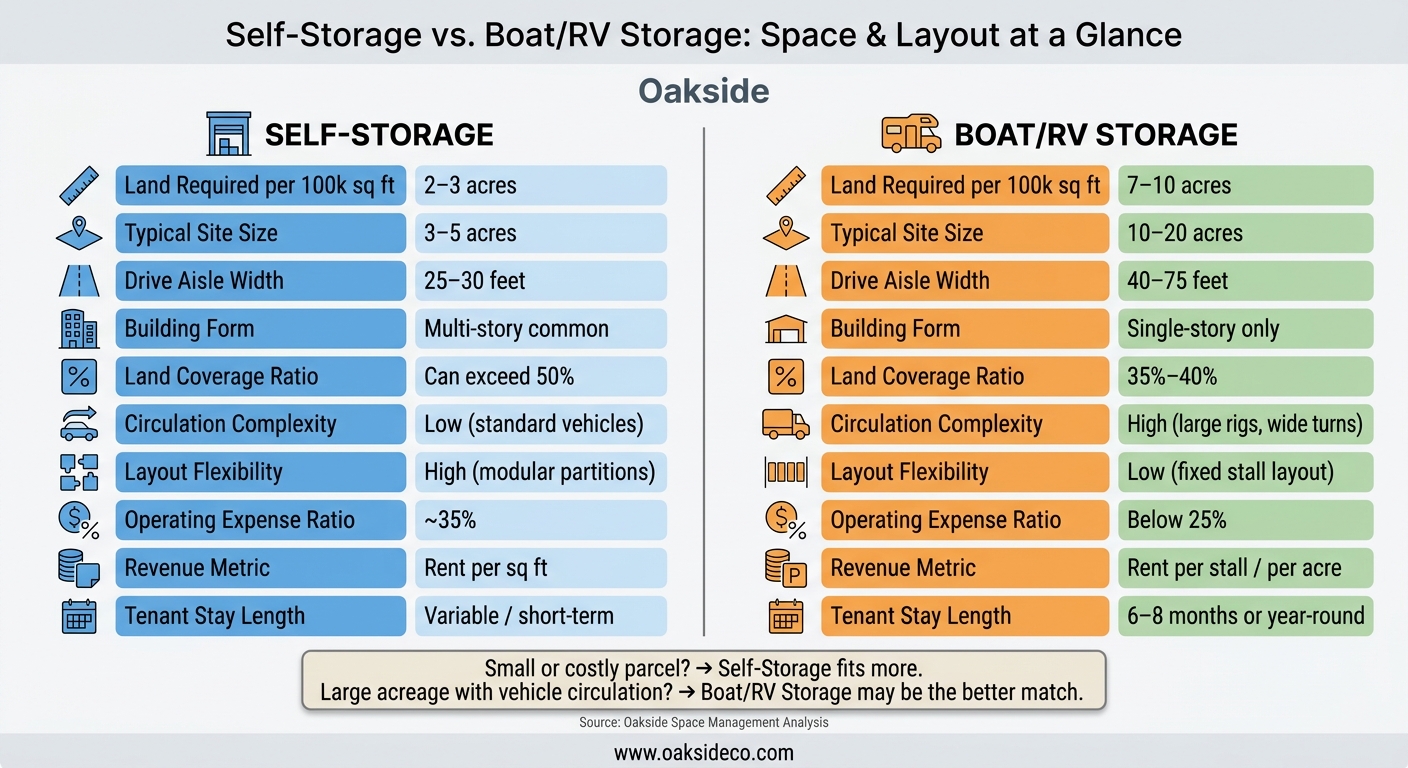
Self-Storage vs. Boat/RV Storage: Space & Layout Comparison
Quick Comparison
| Feature | Self-Storage | Boat/RV Storage |
|---|---|---|
| Land use | Higher density | Lower density |
| Site size | Often 3 to 5 acres | Often 10 to 20 acres |
| Aisle width | 25 to 30 feet | 40 to 60+ feet |
| Building form | Often multi-story | Mostly single-story |
| Coverage | Can go past 50% with stacked space | Often 35% to 40% |
| Flexibility later | More room to change unit mix | Harder to rework stall layout |
| Extra space needs | Lower | Higher due to wash bays, dump stations, charging, and queueing |
| Main revenue lens | Rent per square foot | Rent per stall or per acre |
My takeaway: if your parcel is small, costly, or shaped for stacked buildings, self-storage often fits better. If your site has more acreage and clean vehicle circulation, boat/RV storage may be the better match.
The rest of the article breaks down how acreage, aisle width, stall depth, clear height, and support areas shape each use – and how those choices can affect cost, income, and site fit.
sbb-itb-09b4138
Space Management in Self-Storage Facilities
Self-storage operations are built to squeeze as much rentable space as possible out of a site. When density becomes the target, two design choices matter most: the building footprint and how much space you stack upward.
Building Layout, Coverage Ratios, and Vertical Space
Building up can change the math fast. A 120,000-square-foot facility can fit on just 2 to 3 acres, which helps owners get more out of smaller parcels. That kind of density also helps explain why self-storage can work on higher-cost sites.
Unit Mix and Rentable Area Optimization
Unit mix has a direct effect on how much revenue a property can earn from its rentable area. Smaller units like 5×5, 5×10, and 10×10 often bring in more revenue per square foot than larger ones, so operators tend to lean into those sizes when local demand is there.
Feasibility studies help show which unit sizes are undersupplied in a market. And because modular steel partitions are easier to move around later, operators have more room to rework the mix if demand shifts.
Drive Aisles, Loading Access, and Support Space
Once unit mix is set, circulation space becomes the next big limit on rentable area. Drive aisles don’t bring in rent, so every extra foot has a cost. That’s why operators try to keep aisles as narrow as safety allows.
Most facilities aim for 25 to 30 feet of aisle width so cars and light trucks can load and exit without trouble. Access control for gates, elevators, and units can also make move-ins smoother and cut the amount of support space needed. That means less space going to back-end functions and more space staying in play for tenants.
Space Management in Boat and RV Storage Facilities
Boat and RV storage follows a very different land-use pattern than self-storage. The big trade-off is simple: you give up density to create enough room for large vehicles to move. That shows up right away in stall size and access width.
Parcel Size, Stall Types, and Building Format
Even when a site has plenty of land, coverage tends to stay low – usually 35% to 40% – because drive lanes, setbacks, and support space take a large bite out of the usable area.
Most facilities offer three main storage formats, and each one affects space in its own way:
| Format | Space Implications |
|---|---|
| Open | Lowest footprint per stall; no structural clearance requirements |
| Covered Canopy | Requires roof structure and column spacing sized for large vehicles |
| Enclosed | Largest footprint per vehicle; dictates door width, clear height, and bay depth |
Clear height is a big deal here. A 12-foot door works for about 70% of campers, but larger motorhomes and fifth-wheels need at least 14 feet of clearance. If the clearance is too low, you shut out part of the market.
That same trade-off comes back in stall footprint and access width.
Stall Dimensions, Aisle Widths, and Turning Radii
This is where boat and RV storage parts ways most clearly from self-storage. RV stalls usually range from 12 to 16 feet wide and 30 to 50 feet deep, based on vehicle type.
But the stall itself isn’t the hard part. The aisle is.
Drive aisles usually need to be 40 to 60 feet wide so large rigs can back in without a mess. For a 50-foot rig, operators may need about 75 feet of aisle space just to let the driver straighten out before backing into the stall. That’s a lot of pavement, but without it, daily use gets clunky fast.
Angled layouts can help. Stalls set at about 60 degrees can trim aisle width compared with straight-in 90-degree layouts, and they also make it easier for drivers to line up using side mirrors.
Functional Areas Beyond Parking Stalls
Parking rows are only part of the layout. Shared service areas take up land too. That includes dump stations, wash bays, air compressor stations, potable water fill points, and queueing areas, all of which need their own footprint.
The gate area can become a choke point if it isn’t sized well. The entry lane needs enough stacking room for a full truck-and-trailer setup to stop at the keypad without leaving the rear of the trailer hanging into the street.
Power access matters too. Electrical outlets for trickle charging are in high demand because they help keep batteries from draining during long-term storage. These spaces don’t bring in rent on their own, but they can help support tenant retention and pricing power.
Self-Storage vs. Boat/RV Storage: Key Space Management Differences
Land Efficiency, Circulation, and Reconfiguration Over Time
The biggest split comes down to density. Self-storage turns more of a site into rentable space. Boat/RV storage gives up that density so tenants can actually move large vehicles in and out without a headache.
That leads to three practical trade-offs: land efficiency, circulation, and flexibility.
To build 100,000 square feet of boat/RV storage, a developer may need 7 to 10 acres of land. By contrast, 120,000 square feet of traditional self-storage can fit on just 2 to 3 acres.
Why the gap? Self-storage can stack rentable area upward with multi-story buildings. Boat/RV storage usually stays at ground level, so if you want more capacity, you often need more land.
There’s also a planning difference over time. Self-storage operators can adjust unit mixes with modular partitions. If demand shifts from large units to smaller ones, they have room to make changes. Boat/RV layouts are less forgiving. Stall depth, aisle width, and door height lock in much of the plan. Once that layout is set, there’s less room to tweak it later.
That fixed layout then shapes the next set of trade-offs.
Comparison Table: Space Use and Layout Trade-Offs
The contrast shows up pretty clearly in the layout data below.
| Feature | Self-Storage | Boat/RV Storage |
|---|---|---|
| Land Required per 100k sq ft | 2–3 acres | 7–10 acres |
| Typical Drive Aisle Width | ~25–30 feet | 40–75 feet |
| Vertical vs. Horizontal Use | Multi-story common | Almost exclusively horizontal |
| Land Coverage Ratio | Can exceed 50% with multi-story | 35%–40% |
| Circulation Complexity | Low (standard passenger vehicles) | High (large rigs, wide turning radii) |
| Flexibility to Reconfigure | High (modular interior partitions) | Lower, especially in enclosed layouts |
| Non-Rentable Area | Relatively low | High (maneuvering lanes, service areas) |
The table spells it out: boat/RV storage needs much more raw land to produce the same rentable area, and self-storage gets more work out of each acre.
Operational Impact and Conclusion
Revenue Metrics, Operating Costs, and Asset Performance
Those layout trade-offs show up fast in revenue and day-to-day costs.
Self-storage is usually tracked by revenue per rentable square foot. Boat/RV storage is tracked by revenue per acre and revenue per stall because so much of the property is used for drive aisles and circulation instead of rentable space.
Boat/RV storage also tends to have lower operating expenses. Expense ratios are often below 25%, compared with about 35% for self-storage. A big reason is staffing. These properties usually need fewer people to run them, which helps keep costs down. Tenant behavior helps too. Boat/RV customers often stay 6 to 8 months or even year-round, so turnover is lower and recurring revenue is steadier.
Surface choice matters too. Large vehicles put more pressure on asphalt and concrete, so reinforced paving costs more at the start. But that higher upfront spend can cut long-term maintenance. Gravel may look cheaper on day one, but heavy loads can cause erosion and shifting, which often leads to higher costs later.
Oakside‘s View on Space Strategy
For investors, these numbers shape both underwriting and repositioning plans. At Oakside, we look closely at layout efficiency, stall or unit mix, and places where value can be created across acquisition, operations, and disposition.
Conclusion: Matching Site Design to the Asset Type
Put it all together, and the pattern is pretty clear: space efficiency drives financial results. Self-storage gets more out of a site by building up. Boat/RV storage needs more land, wider drive aisles, and tighter site planning. In return, it can offer lower operating costs and a more stable tenant base with longer stays. The right path comes down to the land in play, local demand, and what the owner wants the investment to do.
FAQs
Which storage type best fits a small site?
Self-storage is often a better fit for a smaller site. In many cases, it needs about 2 to 5 acres. By comparison, dedicated boat and RV storage usually needs 7 to 10+ acres to make the numbers work.
If you already have unused land or extra perimeter space, there’s a simple way to put it to work. Adding uncovered parking or basic vehicle parking can help you monetize that area without major new construction.
How do wider RV aisles affect revenue?
Wider aisles are a must in boat and RV storage. The tradeoff is simple: they eat up land you can’t rent.
In this asset class, aisles usually run 45 to 60 feet wide. In self-storage, they’re more like 20 to 30 feet. That means boat and RV sites need more land, which cuts revenue density per square foot.
Still, those wider aisles serve a clear purpose. They make it easier to move and park high-value assets, and they help support the premium rental rates linked to Class A facilities.
Can a boat or RV facility be reconfigured later?
Yes – if room to adjust is built into the plan from day one. A boat or RV facility can often be reworked or expanded later.
Owners may repurpose industrial or commercial properties for vehicle storage, or add it to an existing self-storage site by using extra land, large parking lots, or oddly shaped parcels. The key is careful planning, especially for wide drive aisles and the right unit sizes.