Solar power is transforming how self-storage and RV/boat facilities are valued. Here’s why it matters:
- Cutting Costs: Solar reduces utility expenses, which are a significant part of operating costs, especially for climate-controlled units.
- Higher Sale Prices: Every $1 increase in Net Operating Income (NOI) can add $10–$13 to property value. Solar-equipped properties often sell for 7%–11% more than non-solar ones.
- Meeting Buyer Expectations: Institutional investors prioritize energy-efficient properties due to Environmental, Social, and Governance (ESG) mandates. Non-compliant assets face valuation discounts of 12%–18%.
- Solar-Plus-Storage Benefits: Adding battery systems helps manage peak energy costs, ensures reliability during outages, and further increases property appeal.
Solar integration isn’t just about saving money – it’s about future-proofing your property for a competitive market. With federal incentives like the 30% Investment Tax Credit (ITC) available until mid-2026, now is the time to act.
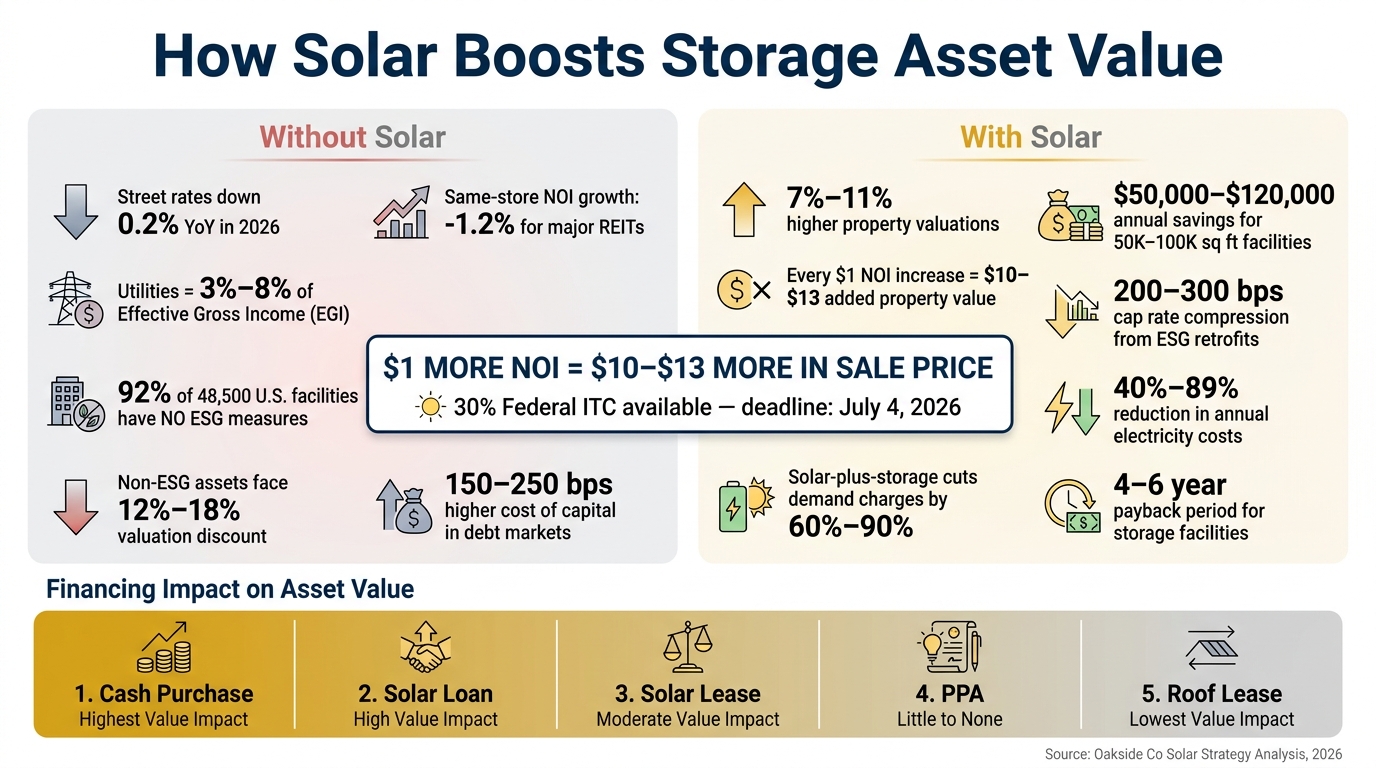
Solar vs. No Solar: Storage Asset Value Impact
Market Challenges Affecting Storage Asset Value
Self-storage and boat/RV facility owners are navigating a tougher business climate in 2026. Street rates have barely budged, dipping just 0.2% year-over-year in early 2026, while rising costs continue to squeeze margins. This has led to a -1.2% drop in same-store NOI growth for major REITs at the start of the year. Independent owners often face even greater challenges.
Rising Operational Costs
Operational costs are becoming a key concern, especially in areas like utilities and insurance. For climate-controlled facilities, utilities can take up 3%–8% of Effective Gross Income (EGI), with older HVAC systems (installed between 1985 and 2005) driving higher energy bills due to inefficiency.
Insurance, particularly in coastal and flood-prone areas, is another significant expense. In these markets, insurance costs can far exceed the usual 2%–4% of EGI, creating a heavy financial burden for many owners.
With revenue growth stagnating, owners are under pressure to manage every expense carefully. Every uncontrolled cost directly impacts NOI, which in turn lowers asset value.
What Institutional Buyers Expect
The buyer landscape for storage assets is shifting. Institutional investors managing $18.7 trillion in assets now operate under strict ESG mandates. This changes what they’re willing to pay for and what they’ll heavily discount.
Energy efficiency is now a key priority. Features like solar panels, energy-efficient lighting, modern HVAC systems with smart controls, and certifications like LEED or Energy Star are no longer optional – they’re expected for institutional-grade assets. For boat/RV facilities, buyers are specifically seeking solar canopies that provide covered storage and integrated RV charging stations.
The financial implications are clear: non-ESG-compliant assets face 150–250 basis points higher costs of capital in debt markets and suffer a 12%–18% valuation discount during portfolio sales. These discounts translate into tangible losses during transactions, underscoring the importance of ESG-aligned upgrades.
Why Standard Value-Add Strategies Fall Short
Traditional approaches like rate hikes and ancillary income are proving insufficient in today’s market. By Q4 2025, the gap between contract rents and street rates had grown to 69%, signaling that many owners are already relying heavily on existing-customer rate increases (ECRIs) to maintain NOI. This strategy isn’t sustainable, and savvy buyers are well aware of its limitations.
Additionally, 92% of the 48,500 self-storage facilities in the U.S. have yet to implement any ESG measures. This presents both a challenge and an opportunity. Owners who fail to adapt risk losing out, while those who invest in ESG-compliant upgrades are seeing better acquisition terms. ESG retrofits, for example, can deliver 200–300 basis points of cap rate compression. These shifts make strategies like solar integration increasingly critical for staying competitive.
sbb-itb-09b4138
How Solar Power Improves NOI and Asset Value
Cutting Utility Costs with Solar
Solar energy transforms unpredictable utility costs into fixed, consistent expenses for more than 25 years. This stability protects property owners from sharp increases in energy costs – like the 76% spike experienced by one commercial property over five years, even though its electricity use remained unchanged.
For a storage facility between 50,000 and 100,000 square feet, installing a 200–500 kW solar system can lead to $50,000–$120,000 in annual savings. At a 7% cap rate, an extra $50,000 in yearly NOI (Net Operating Income) translates into approximately $714,000 in additional property value – all from one operational upgrade.
"By capitalizing that increased NOI at the property’s market cap rate, you instantly generate millions in added asset value."
Aside from lowering operating costs, solar also helps meet ESG (Environmental, Social, and Governance) requirements, making properties more appealing to the market. These consistent savings enhance valuations and attract institutional buyers who prioritize properties with reduced financial risks.
Higher Valuations and Buyer Interest
Solar-equipped storage facilities typically achieve 7–11% higher valuations compared to properties without solar. This premium stems from two key factors: reduced operating costs and lower financial risk. Institutional investors – those managing portfolios worth billions – value the predictability of stable utility expenses.
Take Extra Space Storage‘s large-scale solar rollout as an example. Across 65 sites, the 5.5 MW solar program generated $600,000 in energy savings during its first year (around $9,200 per site) and is projected to save $15 million over 25 years. For REITs (Real Estate Investment Trusts) with sustainability goals, solar-ready properties eliminate the need for retrofits post-purchase, making them far more attractive during negotiations.
Ownership and Financing Options
How solar is financed plays a big role in how much it boosts property value. The financing method determines whether energy savings directly translate into higher asset equity.
| Financing Option | Upfront Cost | Tax Benefits | Asset Value Impact |
|---|---|---|---|
| Cash Purchase | High | Owner claims ITC + depreciation | Highest |
| Solar Loan | Low/None | Owner claims ITC + depreciation | High |
| Solar Lease | Zero | Lessor claims | Moderate |
| PPA | Zero | Developer claims | Little to none |
| Roof Lease | Zero | Developer claims | Lowest |
Direct ownership – whether through cash or loans – provides the greatest value. In contrast, under a Power Purchase Agreement (PPA), the developer owns the solar system, so the energy savings don’t translate into higher property appraisals.
For property owners with federal tax liabilities, the 30% Investment Tax Credit (ITC) combined with 100% bonus depreciation under MACRS can reduce the system’s net cost by 45–60% in the first year. This significantly shortens the payback period – typically down to 4–6 years for storage facilities – and speeds up the point where solar starts delivering pure NOI gains.
The Case for Solar-Plus-Storage Systems
Reducing Demand Charges and Shifting Loads
Solar panels alone can struggle to meet energy needs during peak usage times, especially in the late afternoon or evening when demand surges and solar production drops. These peak periods often lead to the highest utility charges. However, pairing solar energy with a battery energy storage system (BESS) can significantly cut those costs. Facilities using this combination have reduced demand charges by 60%–90% and increased self-consumption from 30%–40% to as much as 70%–90%.
The key lies in how the battery complements the solar array. During the day, the solar system powers the facility and charges the battery. When demand spikes – often after sunset – the battery discharges, preventing costly demand charges. This setup not only saves money but also improves energy independence and operational resilience.
"The most valuable kilowatt-hour is often not the one generated first. It is the one discharged at the most expensive moment." – BoostESS
For instance, in May 2026, a specialty metals manufacturer in Massachusetts installed an 800 kW solar array paired with a 600 kW / 1,200 kWh BESS. The results were impressive: annual demand charges were slashed from $194,400 to $98,800 – a 49% reduction – and total energy expenses dropped by $211,100. After factoring in a 40% IRA tax credit, the net system cost came to $921,000, achieving a 4.4-year payback period.
Backup Power and Site Reliability
For facilities like storage units, grid outages can be disastrous. Security cameras, access systems, and climate-controlled units must remain operational, but traditional diesel generators often take 10–30 seconds to start, risking disruptions. In contrast, a commercial BESS activates in milliseconds, ensuring a seamless transition without voltage dips or equipment failures.
This level of reliability extends beyond just keeping the lights on. A 2025 Annual Outage Analysis reported that 1 in 5 businesses suffered significant reputational damage from major outages over the previous three years. For storage operators, even brief downtime can erode tenant trust. Solar-plus-storage systems eliminate this risk, ensuring critical operations run smoothly no matter what happens to the grid. This not only prevents costly interruptions but also strengthens the facility’s reliability – a key selling point for institutional buyers.
Why Institutional Buyers Favor Solar-Plus-Storage
Institutional investors prioritize minimizing risk while maximizing returns. Solar-plus-storage systems offer a unique advantage: stable and predictable energy costs that remain unaffected by fluctuating utility rates. This financial stability, combined with operational benefits, enhances property values in competitive markets. As Brendan Bell, COO of Aligned Climate Capital, explains:
"Assets that convert upfront capital into decades of predictable output, without ongoing commodity exposure, offer a fundamentally different risk profile than fuel-dependent generation."
This trend is gaining momentum among major real estate investment trusts (REITs). For example, in May 2026, Public Storage partnered with Solar Landscape to install a 408.32 kW rooftop solar system in Evanston, IL, as part of a larger initiative to equip 1,300 properties across 25 states with solar by the end of 2026. Similarly, Extra Space Storage’s Twisted Oaks, FL facility deployed a 117 kW solar system alongside three Tesla Powerwall 3 units. This setup achieved a 62.9% total energy offset while ensuring uninterrupted backup power for security and access systems.
When institutional buyers see these systems integrated into properties, they’re not just investing in a storage facility – they’re acquiring a resilient, energy-efficient infrastructure designed for long-term financial and operational performance.
Structuring Solar Projects to Maximize Asset Value
Building Solar Economics into Financial Models
For solar projects to truly deliver value, their financial models must rely on data that institutional buyers trust. One key requirement? 15-minute interval simulation data. Using hourly averages instead can inflate self-consumption estimates by 4–8 percentage points, which could erode buyer confidence during due diligence.
A solid financial model should account for all potential value streams, including energy cost savings, demand charge reductions, and revenue from grid services. For facilities with storage, demand charges alone can make up 30%–60% of the total electric bill, making them a significant factor in improving net operating income (NOI). Detailed documentation, such as PE-stamped plan sets, three-line electrical diagrams, and performance guarantees, provides the "bankable" data institutional buyers need to confidently underwrite these assets.
Once the financial models are accurate, the next step is leveraging federal incentives to further enhance the asset’s value.
Federal Incentives and Tax Benefits
Federal incentives available through 2026 offer a major opportunity for solar projects, but the window to act is limited. The base Investment Tax Credit (ITC) under Section 48E currently sits at 30%, with additional bonus credits potentially raising it to as much as 50% or even 70% of the eligible project basis.
| Incentive | Benefit | Key Requirement |
|---|---|---|
| Base ITC (§ 48E) | 30% | Construction must begin by July 4, 2026; prevailing wage applies if >1 MW |
| Domestic Content Bonus | +10% | Must use U.S.-produced steel, iron, and manufactured products |
| Energy Community Bonus | +10% | Project must be in brownfields or areas tied to fossil fuel employment |
| 100% Bonus Depreciation | Full deduction in Year 1 | Must be placed in service after Jan. 20, 2025 |
The July 4, 2026 construction start deadline set by the One Big Beautiful Bill Act (OBBBA) is a critical milestone. Projects that miss this deadline and fail to be operational by December 31, 2027, lose the 30% ITC entirely. For projects under 1.5 MW AC, the 5% Safe Harbor method remains an option, while larger projects must meet the Physical Work Test.
Additionally, 100% bonus depreciation allows taxable owners to deduct the full depreciable basis in the first year. When combined with the ITC, these incentives can offset 45%–60% of total project costs upfront, significantly lowering net expenses and boosting asset value. The Inflation Reduction Act (IRA) also permits tax credits to be sold directly to third parties, creating more financing options for owners unable to fully utilize the credits themselves.
How Oakside Co Supports Solar Strategy
Beyond financial modeling and tax incentives, expert guidance plays a crucial role in maximizing solar project outcomes. Translating solar performance into metrics that resonate with institutional buyers is essential. Oakside Co specializes in delivering investment-grade analysis for storage transactions, helping owners present solar economics in terms buyers understand – such as payback periods, NOI impacts, cap rate sensitivity, and 25-year net present value (NPV) projections.
When a storage asset is marketed alongside a well-documented solar system, Oakside Co ensures that energy savings are fully reflected in the property’s valuation. This level of precision and data-driven positioning can be the difference between a competitive listing and one that lingers on the market.
A Step-by-Step Plan for Storage Owners Considering Solar
If you’re thinking about going solar, it’s crucial to start with a thorough property assessment and detailed financial modeling to ensure you’re making a sound investment.
Site Assessment and Load Analysis
First, take a close look at your property. Start by reviewing 12–24 months’ worth of utility bills to understand your actual energy usage and peak demand patterns. This data is essential for determining the right system size, estimating savings, and deciding on financing options.
Check the condition of your roof, too. It should have at least 15 years of life left to avoid costly replacements, which can range from $15,000 to $60,000 and significantly impact your return on investment. Keep in mind that fire safety regulations, like NFPA 1 Section 6.17, require clear access for fire departments, which can reduce the usable roof area by 20–40%.
"Structural failure is the single largest reason commercial solar projects collapse between feasibility and notice to proceed." – Nirav Dhanani, Co-Founder, SurgePV
For accurate load analysis, use 15-minute interval data rather than hourly averages. Hourly data can overestimate self-consumption by 4–8 percentage points, leading to flawed financial projections and potential issues during buyer due diligence.
Modeling Costs, Savings, and Financing
Once you’ve assessed the site, it’s time to build a financial model that potential buyers can trust. This model should reflect demand charge reductions, self-consumption, tax incentives, and the long-term value of the solar system – all calculated with 15-minute resolution.
The numbers can be quite compelling. For example, a 150,000-square-foot facility in Tampa, FL, installed a 250 kW rooftop solar system for $625,000. After applying the 30% federal ITC ($187,500), the net cost was $437,500. This investment cut annual utility costs from $84,000 to $16,800 – an 80% reduction – resulting in projected lifetime savings of $1.5 million and boosting the property’s value by over $1.1 million based on a 6% cap rate.
"CFOs focus on whether the project exceeds hurdle rates, returns cash quickly, and minimizes risks." – Akash Hirpara, Co-Founder, SurgePV
The financing structure you choose will also play a significant role in your ROI. Cash purchases offer the highest long-term returns and full access to tax incentives, while solar loans allow you to preserve liquidity with a smaller upfront investment (typically 10–30% down). Power Purchase Agreements (PPAs) are ideal for owners who can’t fully utilize tax benefits. Regardless of the financing method, plan for inverter replacement costs ($15,000–$25,000 around Year 12–15) and annual operations and maintenance (O&M) expenses ($10–$20 per kW-year).
Once your financial model is solid, gather all necessary records to back up your claims when it’s time to sell.
Keeping Records for Future Sale
Maintaining detailed records of your solar investment is essential for demonstrating its financial benefits when selling your property. Institutional buyers, in particular, will carefully review your documentation, and missing records can derail a deal.
"From a buyer’s perspective, solar is only as valuable as the paper trail supporting it." – Jordan Ellis, Senior Legal Content Strategist
Set up a dedicated digital data room from the start to keep everything organized. Here’s a breakdown of the key documents you’ll need:
| Document Category | Key Items to Maintain |
|---|---|
| Technical | Permits, interconnection agreement, commissioning report |
| Financial | ITC/MACRS records, utility bills, incentive documentation |
| Operational | Production reports, maintenance logs, cleaning records |
| Legal | Ownership docs, warranty agreements, transfer clauses |
| Structural | PE-stamped letter, roofing warranty, flashing details |
To avoid legal headaches, pre-negotiate transfer language in your solar contracts. Clear assignment and assumption clauses can prevent delays or disputes when the property changes hands. Also, check with your insurance broker to ensure your solar system is covered under your policy, including any battery storage. Solar-specific riders typically cost $2–$5 per kW-year.
Finally, if your project is close to the July 4, 2026 ITC deadline, keep records proving compliance with the Physical Work Test or the 5% Safe Harbor spend. This documentation will protect your tax credit eligibility if the IRS questions when construction began.
Conclusion: Making the Case for Solar in Storage Assets
The integration of solar technology is redefining the value of storage assets. By slashing utility bills, solar directly boosts Net Operating Income (NOI), which in turn significantly increases asset value. To put it into perspective, every additional dollar in NOI can raise the sale price of a property by $10 to $13. Solar systems can reduce electricity costs by an impressive 40–89% annually.
Beyond cost savings, solar has emerged as a powerful tool for market positioning. Facilities equipped with solar are increasingly attractive to institutional buyers like Public Storage and Extra Space Storage, who are actively acquiring green portfolios to meet their Environmental, Social, and Governance (ESG) goals for 2025–2030. As Greg Davison of HollenPlus aptly states:
"The ‘business case’ for solar has officially evolved into the ‘valuation case.’"
A solar-plus-storage system not only cuts operating expenses but also signals operational resilience and readiness for the future.
The clock is ticking. The July 4, 2026 Safe Harbor deadline for the 30% federal Investment Tax Credit (ITC) is fast approaching, making now the time to act. Solar is quickly transitioning from a competitive edge to an industry standard for institutional buyers evaluating storage assets.
Successfully implementing a solar strategy – from site assessments and financial modeling to documentation and deal structuring – requires specialized expertise. This is where Oakside Co steps in. As a national commercial real estate advisory firm focused on self-storage and boat & RV assets, Oakside Co provides the in-depth analysis needed to align solar investments with broader disposition strategies. Their approach ensures that the financial advantages of solar are precisely modeled and effectively communicated to institutional buyers. This comprehensive strategy not only maximizes current asset value but also positions properties for long-term success in an evolving market.
FAQs
How do appraisers treat solar savings in a storage property valuation?
Appraisers consider the savings from solar energy as an enhancement to a property’s Net Operating Income (NOI), which directly increases its value. Reduced utility expenses lead to better cash flow, which appraisers often capitalize to determine the additional market value.
For commercial properties, appraisers frequently rely on Discounted Cash Flow (DCF) analysis to project savings over the solar system’s lifetime. In some cases, solar lease payments are treated as extra income. Tools like PV Value are commonly used to provide precise modeling for these calculations.
Should I own the solar system or use a PPA to maximize sale price?
Owning a solar system – whether paid in full or financed – can significantly boost your property’s resale value. Since it’s considered a capital improvement, it directly enhances your property’s worth and makes the sale process smoother, especially for institutional buyers. On the other hand, Power Purchase Agreements (PPAs) function as service contracts rather than property assets. This distinction can complicate sales, as PPAs often require credit checks for buyers and contract transfers, potentially discouraging investors or causing avoidable hurdles.
When does a battery system make sense for a storage facility?
Energy storage systems, like batteries, can be a game-changer for storage facilities dealing with steep demand charges – these charges often make up 30% to 50% of energy bills. Batteries help lower costs by reducing peak demand, ensuring your facility uses less energy during the most expensive times. They also provide backup power during outages, keeping operations running smoothly when the grid goes down.
On top of that, batteries open the door to energy arbitrage in time-of-use markets, allowing facilities to save by using stored energy when electricity prices spike. They can even enable participation in virtual power plant programs, creating a steady stream of additional revenue. Oakside Co works with clients to evaluate these strategies, helping them unlock the full potential of their properties.