Solar can cut one of the biggest power bills at a storage property and push more money into NOI. If I run a climate-controlled site, power can take up 15% to 25% of my costs. At other storage sites, it’s often 5% to 10%. That’s why solar often gets a close look.
Here’s the short version:
- I can lower utility bills by making power on-site.
- Solar lines up well with daytime loads like lighting, HVAC, and dehumidification.
- Installed cost often falls around $1.50 to $3.50 per watt before incentives.
- The federal Investment Tax Credit can cover 30% of installed cost, if I qualify.
- Payback depends on system size, power rates, roof condition, interconnection, and financing.
- I also need to plan for roof checks, tenant access, security, and system monitoring.
A few numbers stand out. Lighting can make up up to 35% of site energy use. HVAC and dehumidification can add another 30% to 35% at climate-controlled properties. Since much of that load hits during the day, solar can offset a good share of it.
If I’m looking at solar for self-storage or boat/RV storage, the decision usually comes down to five things:
- How much power the site uses
- How much space I have on the roof or canopy
- What the net project cost looks like after tax credits and rebates
- How long payback will take
- How the install will affect tenants and site security
This article walks through those points in plain terms so I can judge cost, savings, payback, install planning, and long-term property value without getting lost in the details.
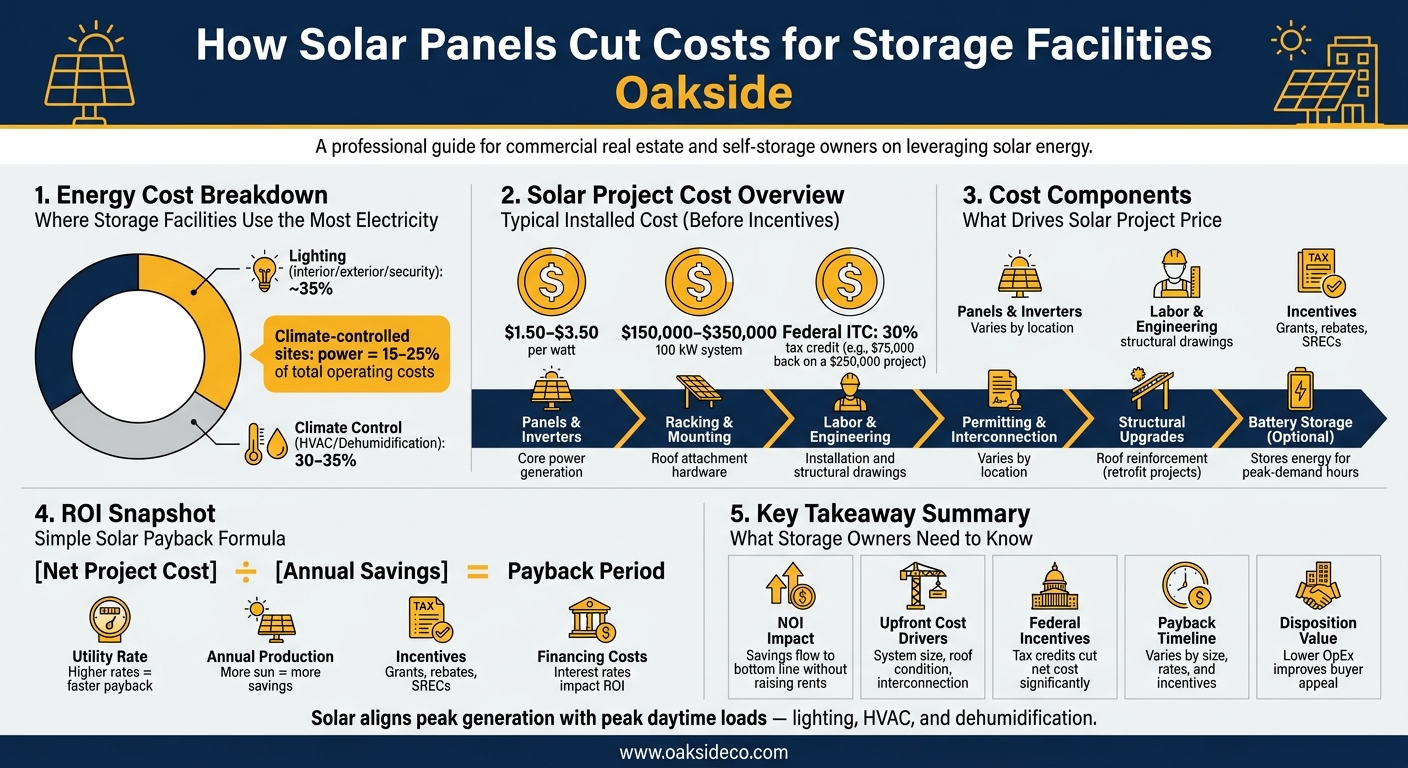
Solar Energy Savings for Storage Facilities: Key Numbers at a Glance
1. How Solar Lowers Operating Costs at Storage Facilities
1.1 Where Storage Properties Use the Most Electricity
At a typical storage property, lighting and climate control make up about 45% of total energy use.
Lighting is often the biggest single power draw, accounting for up to 35% of total energy use. That covers interior corridor lights, exterior lights, and security lighting. And because many of those systems run for long stretches, the bill adds up fast.
Climate-controlled units are another big source of power use. HVAC and dehumidification systems can push a facility’s monthly energy bill up by 30% to 35%. On top of that, office equipment, gate systems, and surveillance cameras create a steady daytime load.
| Energy Load | Share of Total Consumption | Notes |
|---|---|---|
| Lighting (interior/exterior/security) | ~35% | Runs long hours; high solar offset potential |
| Climate control (HVAC/dehumidification) | 30–35% | Peaks during daytime heat; aligns with solar output |
| Other loads (office, gate, surveillance) | Variable | Smaller but steady daytime demand |
That mix matters. A lot of the power use happens during the day, which is exactly where solar has the most impact.
1.2 Why Solar Works Well for Self-Storage and Boat/RV Properties
Storage facilities are often a strong fit for solar because they tend to have large, flat roofs that can hold sizable arrays without much obstruction.
The timing helps too. HVAC systems usually work hardest during the hottest part of the day, and that’s when solar panels generate the most electricity. In plain English: the property is using the most power right when the solar system is producing the most power. That overlap lets owners offset some of the costliest electricity on the bill, including peak-hour demand charges from the utility.
Boat and RV properties can go a step further with solar canopies over parking and covered storage areas. Those structures do two jobs at once: they shield vehicles and produce electricity.
When a property’s power use lines up this closely with solar output, the effect on operating costs can show up fast.
1.3 How Utility Savings Increase NOI
The math here is pretty simple. Lower electric bills reduce operating expenses. If revenue stays the same, NOI goes up.
That’s why solar can be such a useful tool for storage owners. It cuts OpEx without leaning on rent hikes, which gives a property a cleaner path to a better financial profile. It can also make cash flow less exposed to utility rate swings and peak-demand charges.
For climate-controlled properties, those savings can have a clear effect on both cash flow and valuation.
With the savings path laid out, the next step is sizing the system and estimating installed cost.
2. Calculate Solar Project Costs for Your Facility
2.1 Typical Installed Cost Range in the United States
Commercial solar prices in the United States have come down as equipment and installation costs have dropped. For storage facilities, installed costs often land between $1.50 and $3.50 per watt. That puts a 100 kW system at about $150,000 to $350,000 before incentives.
That said, the final price can still swing quite a bit. Roof condition matters. Installation type matters. And if the project needs electrical or structural upgrades, the scope can change fast. New construction is often simpler and less expensive than retrofitting an older building.
Once you have a rough price range, it helps to look at the line items that shape the budget.
2.2 What Drives the Final Project Price
These cost items usually have the biggest effect on the total project price:
| Cost Component | What It Covers | Why It Matters |
|---|---|---|
| Panels & inverters | Core power-generation equipment | Needed for the system to produce electricity |
| Racking & mounting | Roof attachment hardware and framing | Needed for rooftop systems |
| Labor & engineering | Installation crews and structural drawings | Changes with site and system complexity |
| Permitting & interconnection | Local permits and utility grid hookup | Varies by municipality and utility |
| Structural upgrades | Roof reinforcement if load capacity is limited | Often shows up in retrofit projects |
| Battery storage (optional) | Stores excess energy for peak-demand periods | Can cut grid use during high-cost hours |
Permitting and interconnection can differ a lot from one city or utility territory to another. That’s why they belong in the budget from day one. Battery storage adds cost, but it can also move solar power into peak-demand hours, when electricity is often more expensive.
With the main cost drivers mapped out, the next step is to match system size to the site’s actual energy use.
2.3 How to Size a System for Your Site
Start with a professional energy audit or an energy management system (EMS). You need a clear load profile before sizing the array. Without that, you’re guessing – and solar is too big of an investment for guesswork.
A qualified installer should size the system based on site load, roof area, shading, and structural capacity. For boat and RV properties, it’s also smart to look at canopy space over covered parking areas. In some cases, that extra area can open up more room for solar than the roof alone.
With system size and project cost outlined, the next step is to estimate savings, incentives, and payback.
3. Estimate Savings, Incentives, and Payback
3.1 How On-Site Generation Cuts Electric Bills
Start with the system size and load profile from the prior section. From there, the math gets pretty practical: solar offsets one of the facility’s biggest recurring costs.
On high-load sites, solar can offset a large share of daily electricity use. That matters because electric bills don’t just show up once and disappear. They hit month after month, and utility rates tend to climb over time. Solar helps steady part of that expense.
Put simply, solar lets you lock in part of your power cost. That means less exposure to utility rate swings and more control over operating expenses.
3.2 Federal Tax Credits, Depreciation, and Local Incentives
Once you’ve estimated gross savings, the next step is to apply incentives and figure out the net cost. This is where a project can start to look much better on paper.
Federal, state, and utility incentives can cut net project cost by a lot. The federal Investment Tax Credit (ITC) can return 30% of the total installed cost as a dollar-for-dollar reduction in federal tax liability. On a $250,000 project, that equals $75,000.
State and utility rebates can reduce the net cost even more. If you’re building a budget model, this is the point where gross project price and out-of-pocket cost start to look like two very different numbers.
3.3 Build a Simple Solar ROI Model
A simple solar ROI model doesn’t need to be fancy. It just needs to answer one basic question: How long will it take for the savings to cover the cost?
Use this formula:
Simple payback = net project cost ÷ annual savings
To run the model, use:
- Utility rate
- Annual production
- Incentives
- Financing costs
If you finance the project, include repayment in the cash-flow model before you finalize system size. That way, you’re looking at the full picture, not just production and bill offsets. Use the payback result to decide whether the project moves forward.
sbb-itb-09b4138
4. Plan and Execute a Solar Upgrade Without Disrupting Operations
Once the numbers make sense, the job changes. It’s no longer just about savings on paper. Now it’s about making sure the site is ready, the utility signs off, and the property keeps running while the work gets done.
4.1 Check Roof Condition, Utility Service, and Interconnection First
Before moving ahead, check the roof condition, structural capacity, electrical service, and utility interconnection. These items can make or break the project timeline.
It also helps to review the utility interconnection process early. That includes finding out whether the system can export excess power to the grid, because that can change project economics. A system may look good in a spreadsheet, but interconnection limits can change the math fast.
These early checks help protect the savings and payback projected in Section 3.
4.2 Coordinate Installation Around Tenants and Security
The hard part during installation is simple: keep the property working while the crew does its job.
That means preserving access, security, and occupancy during construction. In practice, this usually calls for phased installation, so gate access, lighting, and security systems stay active throughout the job. If tenants can move in and out as usual and the site stays secure, the upgrade is far less likely to create friction.
The aim is to keep operations steady while the project moves forward.
4.3 Monitor Performance and Maintain the System
After installation, monitoring helps protect the savings already built into the ROI model. Use a monitoring dashboard to track output, trends, and alerts. If output drops, you want to catch it early before it starts eating into savings.
Keep tracking system performance so utility savings continue to support NOI.
The dashboard is only part of the picture. You’ll also want a maintenance routine that covers:
- Cleaning
- Inverter checks
- Warranty reviews
For multi-site operators, one EMS can track all systems in one place, which cuts down on on-site oversight.
5. Use Solar as Part of a Broader Asset Strategy
Solar cuts electric bills. It can also improve asset value at acquisition, refinance, and sale. For storage owners, that means solar isn’t just an ops upgrade. It’s also a capital planning move.
When utility costs drop, NOI goes up. And in a sector with more institutional buyers, lower expenses can help with underwriting and make a property more attractive to buyers.
Put simply: lower operating costs can help a facility run leaner and compete better in the market. When you underwrite solar, include incentives, utility savings, and financing costs in the model.
5.1 Key Takeaways for Self-Storage and Boat/RV Owners
Electricity is one of the biggest controllable expenses at a storage facility. Solar can bring that cost down, which lowers operating expenses and increases NOI.
Here’s the short version for owners and investors:
| Factor | What to Know |
|---|---|
| NOI Impact | Electricity savings flow straight to the bottom line without raising rents |
| Upfront Cost Drivers | System size, roof condition, utility interconnection, and location |
| Federal Incentives | Tax credits and deductions can cut net cost |
| Payback Timeline | Depends on system size, utility rates, and incentives |
| Disposition Value | Solar can support buyer appeal by lowering operating costs |
Underwrite solar as part of the capex plan, then track performance against the original pro forma.
FAQs
How much roof space do I need?
Self-storage and boat or RV facilities are often a strong fit for solar because they tend to have large, flat roofs. How much roof space you’ll need comes down to a few things: your facility’s power use, where the property is located, and how much sunlight the site gets.
As Nolen Masserman, Managing Director at Oakside, notes, these properties often have steady power use and common-area loads, which can make the math for solar look pretty good. If you want an exact answer, a solar engineer can assess the site and calculate the precise roof area your system would need.
Will solar work for a non-climate-controlled site?
Yes. Solar can still work well for a non-climate-controlled site.
Even without HVAC demand, these facilities still use electricity for lighting, security systems, and office operations. That power use adds up, and solar can offset a good share of it.
In practical terms, solar panels can help:
- Reduce utility costs
- Cut peak-hour expenses
- Lower the facility’s carbon footprint
So while energy use may be lower than at a fully climate-controlled property, solar can still make a meaningful dent in power bills.
What delays solar payback?
Solar payback can slip if the tax side and paperwork aren’t handled well. And the hit can be big: if records like certified payroll or apprentice logs are missing, the federal investment tax credit can drop from 30% to 6%.
Timing can also work against you. Interconnection delays may push credit eligibility into a later tax year. On top of that, if structural costs are counted the wrong way, you could face audit adjustments and interest penalties.