
A 1031 exchange can defer tax on the sale of a storage or RV property, but only if you follow the rules exactly. In plain terms, you need qualifying real estate, a qualified intermediary before closing, written identification within 45 days, and closing within 180 days.
Here’s the short version:
- Only investment or business real estate counts
- Personal-use property does not count
- You can’t touch the sale proceeds
- You must identify replacement property by Day 45
- You must close by Day 180
- To defer all gain, you usually need to buy equal or higher value and replace your debt
- Cash out or lower debt can create taxable boot
- The same taxpayer should sell and buy
- Poor due diligence can ruin the deal even if the tax steps are done right
A few numbers matter most here: 45 days, 180 days, and often up to 25% for unrecaptured Section 1250 gain if tax is recognized. For many owners, that can mean a large tax bill if the exchange fails.
If I were planning a storage or RV exchange, I’d focus on three things first: property use, deadlines, and control of funds. Get those wrong, and the rest may not matter.
IRS Rules That Govern the Exchange
Once you’ve confirmed a property qualifies, the next step is following the IRS process to the letter. There’s no room for slippage on timing, and one mistake – especially if you receive or control the sale proceeds – can knock out the exchange.
The 45-Day and 180-Day Deadlines
Both deadlines begin the day after the relinquished property closes, and they run at the same time, not one after the other. You have 45 calendar days to identify replacement property in writing and 180 calendar days to close on it. If a storage facility closes on June 1, the 45-day deadline lands around July 16, and the 180-day deadline around November 28.
These are calendar-day deadlines. Weekends, holidays, lender delays, and access issues do not buy you extra time. That’s a big deal for storage and RV deals, where due diligence can take a while. Unit mix, occupancy, lease terms, and deferred maintenance all need review. So it’s smart to have your lender, tax advisor, and broker lined up before the sale closes. Once the clock starts, it moves fast.
If the 180-day window would stretch past your tax return due date, the due date wins unless you file an extension.
Once that countdown begins, the next move is deciding which properties to identify.
The Three Identification Rules: Three-Property, 200 Percent, and 95 Percent
The IRS gives you three ways to identify replacement properties. The identification must be in writing, signed by you, and delivered to your qualified intermediary or another allowed party by midnight of the 45th day.
| Rule | Identification Limit | Common Use Case | Risk |
|---|---|---|---|
| Three-Property Rule | Up to 3 properties, any value | Single-asset sale, straightforward upgrade | Lower complexity, but fewer backup options |
| 200 Percent Rule | Any number of properties; total value ≤ 200% of relinquished property’s value | Multi-market search, portfolio diversification | More planning work; value cap can be tight |
| 95 Percent Rule | Any number of properties, any value; must close on ≥ 95% of identified value | Large portfolio shifts, broad acquisition pipelines | Highest risk – hard to meet if even one deal falls apart |
Pick the rule that fits your buying plan and your backup options.
Identification is only the first part. Value and debt replacement decide how much gain stays deferred.
Value, Equity, Debt, and Boot
Full deferral usually means buying replacement property of equal or greater value, putting all net proceeds back into the deal, and replacing the debt. If you come up short on any of those, the gap can turn into boot, and boot is taxable.
There are two main forms to watch:
- Cash boot: cash you receive or pull out of the transaction
- Mortgage boot: a drop in your debt load that you don’t offset with new borrowing or added cash
For example, if you replace $800,000 of debt with only $500,000, that $300,000 gap can become taxable mortgage boot.
The exchange only holds together if the proceeds never pass through your hands.
Qualified Intermediary Rules and IRS Form 8824
The seller can’t receive or control the sale proceeds at any point during the exchange. If that happens, even for a short time, the IRS can treat it as constructive receipt and disqualify the whole exchange. That’s why a qualified intermediary, or QI, matters so much. The QI holds the proceeds, handles the exchange paperwork, and sends funds straight to the replacement property closing.
The IRS generally bars your attorney, accountant, real estate broker, or investment banker from serving as the QI if that person has acted for you within the prior two years. For storage and RV owners, it’s smart to check QI eligibility early, especially if the deal involves a local broker, property manager, or a family-controlled entity.
After closing, the exchange gets reported on IRS Form 8824, which lists the properties, dates, values, boot, and gain calculation. Your tax advisor should review that form with care because those numbers affect basis carryover and any depreciation recapture analysis, especially when multiple entities or partial exchanges are part of the deal.
With those rules in place, the next step is carrying out the exchange in the right order.
sbb-itb-09b4138
Step-by-Step: How to Complete a Storage or RV 1031 Exchange
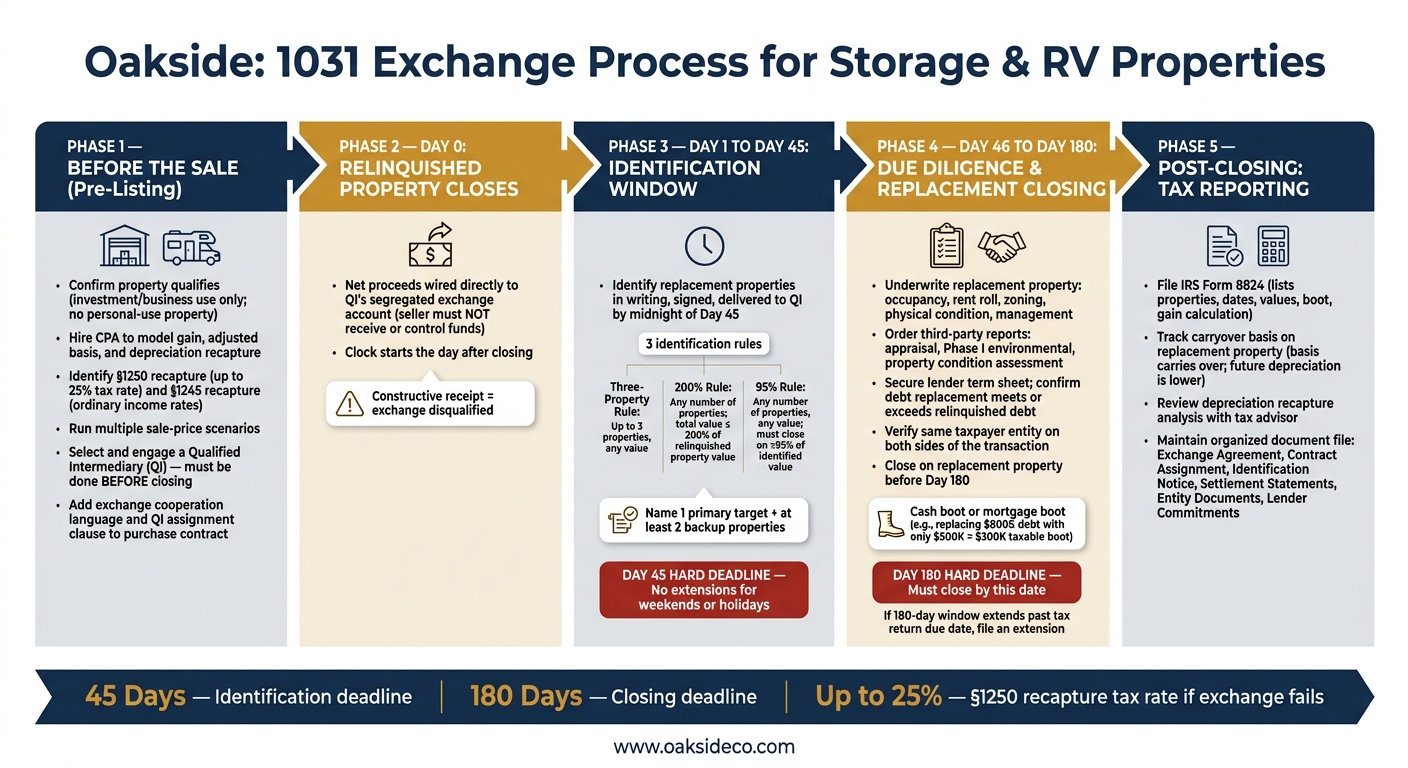
1031 Exchange Process for Storage & RV Properties: Step-by-Step Timeline
Before the Sale: Estimate Gain, Basis, and Depreciation Recapture
Start the tax work before you market the property. A CPA or tax advisor should put together a gain and recapture model based on your original purchase price, capital improvements, and accumulated depreciation. That’s how you get to your adjusted basis. For storage and RV properties, depreciation on site work can be large, so recapture can change the sale math in a big way.
Two kinds of depreciation usually matter.
- §1250 recapture applies to real property components and is generally taxed at up to 25% when recognized.
- §1245 recapture applies to personal property components, such as security equipment, and may be taxed at ordinary income rates, which can be higher.
That split matters more than many owners expect. If you know where each improvement falls, you can get a much clearer view of the tax hit tied to a sale.
It also helps to run several sale-price scenarios. Model gain, recapture, and the equity left to reinvest after existing debt and closing costs are paid. That number shapes your replacement target and the amount of debt you need if you want to keep the deferral intact.
During the Sale: Engage a Qualified Intermediary and Protect the Proceeds
Once the tax picture is mapped out, tighten up the contract and escrow setup. Put the qualified intermediary in place before closing. In practice, that means picking and documenting your QI as soon as the property goes under contract.
Two items should appear in the purchase and sale agreement: exchange cooperation language that states your intent to complete a §1031 exchange, and a contract assignment clause naming the QI. Your closing instructions should also direct all net proceeds straight to the QI’s segregated exchange account. If the seller receives the funds, even for a moment, that can trigger constructive receipt and kill the exchange.
You also need the same taxpayer on both sides of the deal. If ABC Storage LLC sells the relinquished property, then ABC Storage LLC should be listed on the replacement property closing documents too. A mismatch in entity name or structure can unwind the exchange fast.
After Closing: Identify Replacement Properties and Complete the Purchase
After the sale closes, the clock starts ticking. Shift right away from closing mode to identification and underwriting. By Day 45, send a signed identification notice to the QI. Many storage and RV owners name a main target plus one or more backup properties in case due diligence turns up problems or financing slows down.
Start underwriting early. Look at occupancy, seasonality, tenant mix, rental rates, physical condition, and room for expansion. As soon as a replacement property goes under contract, order third-party reports like appraisals, property condition assessments, Phase I environmental studies, and lender underwriting. That early move can make the difference between closing on time and missing Day 180.
Value and debt also need to line up if you want to keep the deferral. Get a term sheet in place early, and make sure it reflects realistic reserves and debt service coverage for a storage or RV property. If the capital stack is off, the exchange plan can start to wobble.
Documents and Closing Items to Track
Use one checklist across underwriting, closing, and tax reporting. One file for both closings is even better. When papers are scattered, delays tend to pile up. The table below shows the core documents to track and when each one comes into play.
| Document | Purpose | When Needed |
|---|---|---|
| Exchange Agreement | Formalizes the QI relationship and fund-holding terms | Before relinquished property closes |
| Contract Assignment | Transfers purchase/sale contract rights to the QI | At or before relinquished property closing |
| Identification Notice | Written, signed list of replacement properties | By Day 45 after relinquished closing |
| Settlement Statements (HUD-1 or equivalent) | Records proceeds, costs, and credits for both properties | At each closing |
| Entity Documents | Operating agreements, articles, EIN confirmations | Before both closings |
| Lender Commitments & Closing Instructions | Confirms debt replacement and fund disbursement | Before replacement property closing |
| Vendor and Management Contracts | Gate systems, security monitoring, management agreements | Prior to replacement property closing |
For storage and RV properties, property-level items such as vendor contracts, management agreements, and rent roll certifications should be pulled together well before the replacement closing. A last-minute hunt for missing management agreements or entity papers can delay funding and put the 180-day deadline in danger. A secure data room helps keep each required document organized and easy to access.
Tax Structuring Options for Storage and RV Portfolios
Trading Up, Consolidating, or Diversifying Assets
Once the exchange mechanics are clear, the next step is structuring the deal around the goal you have in mind.
Owners often use a 1031 exchange to make operations simpler, combine smaller assets, or move into a new market or asset mix. Trading up into a larger, better property can lighten the management load. Consolidating several smaller facilities can cut day-to-day complexity. And rotating from self-storage into boat and RV storage can shift the portfolio toward a different source of demand. That can make diversification an operating decision, not just a tax one.
That choice also shapes the tax result. It affects how much tax gets deferred, how much debt must be replaced, and whether any cash stays out of the exchange.
Depreciation Recapture, Basis Carryover, and Partial Exchanges
A 1031 exchange defers tax. It doesn’t make the tax disappear.
The replacement property takes a carryover basis, which means future depreciation is lower. Owners who have held a storage facility for years tend to feel this more sharply, because the new property starts with a carried-over basis instead of a new stepped-up basis.
Any cash you keep, or debt you fail to replace, is taxable. Still, a partial exchange can be used on purpose. Some owners set it up to pull out a set amount of cash, pay tax on that piece, and defer the rest. The big idea is simple: plan for it up front, not at the closing table.
Entity and Ownership Issues to Resolve Before Closing
If the property is held in an LLC or partnership, ownership structure becomes the next hurdle.
For LLCs and partnerships, ownership changes need to be worked out before the sale, because the exchange has to stay tied to the same taxpayer. This gets messy fast when partners want different things. One investor may want to cash out, while others want to keep exchanging. Because partnership and LLC interests are specifically excluded from 1031 treatment under IRC §1031(a)(2)(D), individual members can’t just exchange their percentage interests on their own.
A pre-exchange distribution of property interests may give each investor more room to move, but it takes lead time and tax review. Making ownership changes too close to the sale can put the exchange at risk. Handle these issues well before any purchase and sale agreement is signed.
When Specialized Advisory Support Adds Value
When an exchange involves multiple assets, shifting ownership, or a tight closing timeline, strategy matters just as much as compliance.
For complex portfolio exchanges, Oakside Co can help with transaction management, replacement-property strategy, and asset-level analysis built for storage and RV deals. For institutional owners or private investors handling a large disposition, that support can help line up the exchange with both tax and investment goals from the first conversation through closing.
Common Mistakes That Can Trigger Tax or Derail the Deal
Most failed exchanges fall apart because of timing, control, or weak due diligence. Not because someone misunderstood tax law.
Missing Deadlines or Identifying Weak Backup Properties
Once the sale closes, the clock starts.
That’s why waiting until closing to look for a replacement is a mistake. It burns time you don’t have. Storage and RV deals often need environmental reports, lender underwriting, and market studies. All of that can chew through the 180-day exchange window fast.
Another common miss is putting all your weight on one deal. If you identify one main replacement property and treat the other two slots like paperwork filler, you’re exposed. If that first deal dies because of financing, title trouble, or a failed inspection, the whole exchange can go with it.
The practical move is simple: line up one main target and at least two backup options before the relinquished property closes. And those backups can’t just be names on a form. Each one should already have reviewed financials and at least early lender interest.
Taking Control of Proceeds or Changing the Taxpayer Entity
Timing mistakes hurt. Losing control of the proceeds is often game over.
If you receive, control, or can get access to the sale proceeds, the IRS may treat that as constructive receipt and disqualify the exchange. This usually happens through avoidable deal structuring mistakes, such as:
- Escrow setups where you can direct disbursement on your own
- Side agreements that let you borrow against the funds
- Earnest money refunds sent to you directly instead of through the qualified intermediary
The same-taxpayer rule is just as strict. The entity that sells the relinquished property must be the same entity that buys the replacement. Shift a storage facility into a new LLC right before the sale, or buy the replacement through a different partnership, and you can break deferral.
Skipping Property-Level Due Diligence
Even if the tax side is handled the right way, a weak property pick can still wreck the exchange.
Occupancy numbers are a good example. A site showing 95% occupancy may look strong at first glance, but that figure can hide long-term parked RVs at deep discounts, non-paying tenants, or concessions buried below the headline number. Then the lender cuts proceeds late in the process, and suddenly you’re scrambling for a backup – or the deal dies outright.
Physical issues can be just as painful. Deferred maintenance on asphalt, drainage, fencing, gate systems, and climate-control HVAC can turn into large capital costs after closing. In RV and boat storage, zoning can be the silent killer. Limits on canopy height, outdoor parking, or future expansion can wipe out a value-add plan before it even gets moving.
That’s why zoning and entitlement reviews should happen early, not after the lender starts asking hard questions.
| Due Diligence Gap | Typical Consequence |
|---|---|
| Unverified rent roll or occupancy | Lender re-trade or reduced loan proceeds |
| Deferred maintenance (paving, drainage, HVAC) | Unexpected capital costs post-closing |
| Zoning limits on expansion or RV parking | Business plan fails; value-add strategy collapses |
| Unplanned management handoff | Short-term revenue decline after closing |
Verify rents, condition, zoning, and management before identification.
Conclusion: Key Steps to Deferring Taxes on a Storage or RV Sale
Start the exchange before you list the property. First, confirm that the asset qualifies. Then map out gain, basis, and depreciation recapture before you commit to the sale. Storage and RV assets often come with meaningful depreciation, and that recapture can have a big effect on what you owe. After that, move into tax modeling so the numbers are clear before the deal starts moving fast.
Once you know the property is eligible and you understand the tax exposure, shift to execution. Bring in the qualified intermediary before closing, route sale proceeds to the QI’s account, treat Day 45 and Day 180 as hard deadlines, and reinvest enough value and debt to avoid boot.
This gets more complicated when a portfolio includes multiple assets or entities. Different entities, staggered closings, and prior cost segregation can make the exchange harder to structure and track. Oakside Co provides deal-level analysis for institutional storage and RV owners, helping keep the exchange compliant and aligned with the exit plan.
FAQs
Can I exchange into multiple replacement properties?
Yes. You can exchange into more than one replacement property, but you need to follow strict IRS rules.
You must identify the properties within 45 days after selling your relinquished property and close on them within 180 days. You also need to use an IRS identification rule, such as the three-property rule, 200% rule, or 95% rule.
Because you can’t add properties after the 45-day window ends, it often makes sense to identify more than one option at the start. That gives you a backup plan if one deal falls through.
What happens if my financing falls through after Day 45?
If your replacement property falls through after the 45-day identification deadline, you can still finish the 1031 exchange – but only if you already identified backup properties in writing with your Qualified Intermediary before Day 45.
Once Day 45 passes, you can’t add new properties to your list. That’s the catch.
So it helps to name more than one option from the start. A common way to do that is the three-property rule, which gives you some breathing room if one deal falls apart before closing.
How do I know if my storage or RV property qualifies?
Your self-storage, boat, or RV property will usually qualify for a 1031 exchange if it’s U.S. real estate held for investment or business use. Primary residences and personal-use vacation homes do not qualify.
You’ll also want to separate real property – like land, buildings, and permanent infrastructure – from business assets such as vehicles, inventory, and goodwill. Those business assets are taxed right away.
Because 1031 rules are strict and time-sensitive, it pays to plan early.