If I want more local move-ins, I need to win four things first: visibility, trust, search, and follow-up. For boat and RV storage, that usually means clear roadside signs, a complete Google Business Profile, plain security proof, steady reviews, seasonal posts, clean on-site signs, local partner referrals, event presence, and lead tracking.
Here’s the short version:
- Make the facility easy to spot from the road with signs drivers can read in about 3 seconds
- Keep branding the same across the site, website, Google, and social pages
- Show security proof, not vague claims
- Match content to the season for boat and RV owners
- Use reviews to lower doubt
- Make the property easy to use with clear gate and wayfinding signs
- Build local referral sources with marinas, dealers, campgrounds, and service shops
- Show up at local events where owners already gather
- Track every lead source so I know what fills spaces
A few numbers stand out right away: main sign copy should stay at 7 words or less, directional signs often work best 300–500 feet before the entrance, and even a light social plan of 2–4 posts per month can keep the facility in front of local owners.
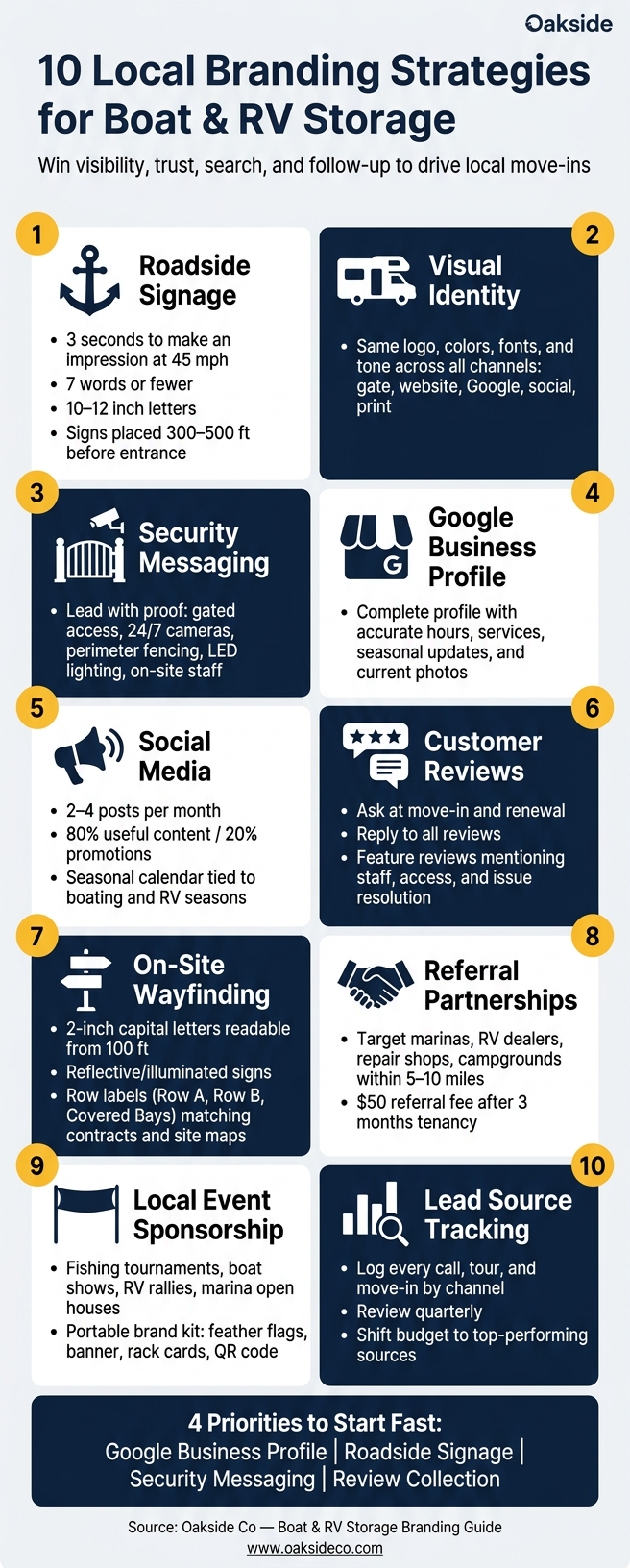
10 Local Branding Strategies for Boat & RV Storage Facilities
Quick Comparison
| Area | Main goal | What to focus on |
|---|---|---|
| Roadside signage | Get drive-by attention | Short copy, big letters, strong contrast |
| Visual identity | Look consistent | Same logo, colors, photos, contact info |
| Security messaging | Build confidence | Gates, cameras, lighting, fencing, staff |
| Google Business Profile | Show up in local search | Current hours, services, photos, updates |
| Social media | Stay timely | Seasonal tips, local tags, light posting schedule |
| Reviews | Add outside proof | Ask often, reply to all, feature detailed reviews |
| On-site signage | Make arrivals easy | Gate instructions, row labels, reflective signs |
| Referral partners | Get local leads | Marinas, RV dealers, repair shops, campgrounds |
| Events | Build name recognition | Booths, QR codes, lead capture, follow-up |
| Lead tracking | Judge what works | Calls, tours, move-ins by source |
This article is about one simple idea: when every local touchpoint says the same thing, people are more likely to remember the facility and rent from it.
sbb-itb-09b4138
Why Local Branding Works Differently for Boat and RV Storage
Boat and RV storage needs its own branding because buyers size it up in a different way. They’re not just looking for “storage.” They’re judging the site based on access, security, and features built for larger vehicles.
That shifts how local branding should work.
Start with access and the details boat and RV owners care about most. Think highway access, marina or campground proximity, wide drive aisles, covered parking, wash-down areas, dump stations, and hookups. If the site is close to a highway, marina, or campground, put that front and center along with the amenities that help the property stand out.
Security also carries more weight in this category. These vehicles cost a lot of money, so people want to see gated access, oversight, and professional management right away.
The strongest local brands in this space blend a clean, professional look with messaging tied to local demand and the property’s best features. In a niche like this, the brand should feel deliberate – built around what boat and RV owners need, not treated like generic self storage.
Those differences shape the tactics below.
1. Build Roadside Signage That Drivers Can Read at Speed
Start with the first thing drivers notice: your roadside sign. In many cases, that sign is their first impression of the facility. At 45 mph, they have about 3 seconds to read it, so each design choice needs to earn its place.
Begin with letter size. Match the lettering to the viewing distance, and on faster roads that usually means primary text in the 10- to 12-inch range. Use high-contrast colors like dark blue on white or yellow on black, along with a bold sans-serif font. Skip script or decorative typefaces because they get hard to read at speed. Put the sign where drivers can spot it before they reach the entrance, and make sure trees, poles, or nearby buildings don’t block the view.
Keep the message tight. Outdoor signage experts suggest seven words or fewer on the main panel. A line like "Secure Boat & RV Storage – 24/7 Gated Access" quickly tells people what you offer. Stick to one call to action, either a URL or a local phone number, not both.
Boat and RV owners are storing expensive property, so security language carries weight. Use phrases like "Gated Access", "Video Surveillance," or "Fully Fenced" only when the facility actually has those features. A clean, well-made sign tells people the property is cared for. Faded vinyl or broken lighting sends the opposite message before a prospect even turns in.
Directional signage matters too. A sign placed 300 to 500 feet before the entrance gives drivers time to slow down and make the turn safely. For a boat and RV storage facility, that small spend can help with both visibility and access.
That first impression should line up with the brand people see once they arrive and when they check you out online.
2. Keep Your Visual Identity Consistent Across the Facility and Online
Once your roadside sign does its job, every other touchpoint should back up the same brand.
That means using the same logo, colors, fonts, and tone across your gate signage, website, Google Business Profile, social media pages, and print materials. When everything matches, your facility looks established and trustworthy. For boat and RV owners, that sends a clear message: security, professionalism, and property quality should come through the same way on every channel.
Photos matter too. Use current, well-lit images of the property, entrances, fencing, wide drive aisles, and covered storage, and other top keywords for self-storage. If your photos are poor or out of date, even a well-run facility can look old or neglected.
It helps to review every customer touchpoint at the same time. Look for mismatches in colors, logo use, messaging, or contact details, and fix them so the brand shows up as one clear identity across every channel.
That same consistency should carry into the local search profile prospects check next.
3. Lead With Security Messaging Aimed at Boat and RV Owners
Boat and RV owners aren’t just renting storage space. They’re looking for a place to keep a high-value asset safe.
That changes the message.
Security isn’t a nice extra. It’s often the thing that tips the decision, especially when two nearby facilities cost about the same.
Once your brand looks professional, get specific with your security message. Skip vague lines like "secure storage." They don’t say much. Show the proof instead: controlled gate access, unique entry codes, 24/7 cameras, perimeter fencing, LED lighting, and on-site staff.
Just as important, let the property back up the claim. Well-lit entrances, clearly posted camera signs, clean fencing, and an organized lot all tell owners the facility is cared for. And if the place looks cared for, people are more likely to trust it with a boat or RV.
Features matter more when you connect them to a plain benefit. Gated keypad entry means peace of mind while an RV sits during the off-season. Access logs show who entered the property. Each feature should point to one clear outcome: less risk while the vehicle sits off-season.
| Messaging approach | What it signals | Conversion impact |
|---|---|---|
| Generic secure storage messaging | Vague, easy to ignore | Low |
| Feature-based messaging | Specific, credible features | Moderate |
| Photos, attributes, and feature descriptions | Proof-based and consistent across channels | Strongest for high-value asset owners |
Use the same security proof across your website, Google Business Profile, on-site signs, and print. That way, owners see the same message everywhere instead of a mixed bag of claims. Carry that same security proof into your Google Business Profile next.
4. Set Up and Optimize Your Google Business Profile for Local Search
A complete Google Business Profile helps local customers find your facility fast. It should reflect the same sense of security and professionalism people get when they visit in person.
Start with the basics:
- Accurate business name
- Address
- Phone number
- Hours
Then add the services and search terms customers use so your profile matches what you offer and lines up with local demand.
Next, use the description and service list to point out the details boat and RV owners care about most. A complete profile gives prospects the key facts they need before they call, visit, or ask for pricing.
As demand changes during the year, post regular updates tied to local boating and RV seasons. That keeps your profile in step with your main offer and any current promotions.
Any time your hours, services, or photos change, update the profile right away so people always see current information.
5. Post Social Media Content Tied to Local Boating and RV Seasons
After your Google Business Profile, social media should carry the same seasonal message. It helps turn local demand into visibility. When boat owners are getting ready for spring launch, or RV owners are looking for winter storage, a well-timed post from your facility has a better shot at getting noticed.
Build a 12-month content calendar around what people in your area need during each season. In spring, post de-winterization tips and early reservation reminders. In summer, talk about things like 24/7 gate access for early-morning departures. When fall rolls in, shift to winterization checklists and urgency-driven copy like Limited covered spaces – reserve by November 1. In winter, focus on maintenance tips and early-bird offers for the next season.
Want those posts to feel local instead of generic? Tie them to your community. Tag nearby lakes, tournaments, or RV shows. Then add location-based hashtags like #LakeTravisBoating or #DenverRVLife so your posts reach nearby owners, not just a broad crowd.
A simple rule helps here:
- 80% useful content
- 20% promotions
Seasonal campaigns can affect off-season demand in a material way. If your team is short on time, batch-schedule 2–4 posts per month. That keeps your business visible without turning social media into a daily chore.
Then watch the signals that matter. See which seasonal themes lead to clicks on your reservation page or spark inbound calls. If one type of post gets more action, lean into it next month and adjust your timing based on what your market responds to.
6. Use Customer Reviews to Build Trust and Support Your Brand
Once your facility looks secure and professional, reviews add the outside proof people want to see. Boat and RV owners don’t just want promises. They want signs that their property will be handled with care and that communication will stay clear from day one. Reviews help lower hesitation because they show your facility can deliver a smooth move-in and access process.
The most useful reviews mention things like staff response, access, and how fast issues were fixed. Those details matter because they speak to the questions prospects often have, even if they never say them out loud.
To get more reviews, make feedback part of your standard move-in and renewal process. Keep it simple and consistent. And when you show reviews on your website or in your marketing, include the reviewer’s name and location.
It also helps to reply to both positive and negative reviews. That shows management is responsive and accountable. And that same sense of clarity should show up on-site too, especially in your signs and directions.
7. Use On-Site Wayfinding and Gate Signage to Signal Professionalism
Once renters pass the gate, your on-site signs become the brand.
At that point, the job is simple: make every turn obvious. Think of wayfinding as one connected system, not a bunch of separate signs. Put directional markers at each decision point, including the entrance, lane splits, row transitions, and the gate itself. Label rows in plain language, like Row A, Row B, Covered Bays, and Boat Storage. Then match those labels to your contracts and digital site maps. That cuts down on confusion, especially for first-time visitors trying to move a large RV or trailer through the property.
Gate signage is one of your most important on-site touchpoints. It should clearly show access hours, keypad instructions, emergency contact details, and a short security summary with actual features such as video surveillance, controlled access, and lighting. When you use your brand colors and fonts, the gate feels organized instead of thrown together.
Keep gate panels, row markers, and directional signs in the same palette and typeface so the property feels like one system. Use one color palette and one font family across all on-site signs. Clean signage, clear directions, and steady design signal professional management. And that’s exactly what boat and RV owners are judging when they decide whether to trust your facility with a high-value asset.
Readability matters more than many operators think. Use 2-inch capital letters for signs that need to be read from about 100 feet away. Size them for drivers in large vehicles, not for people walking up on foot. Reflective or illuminated signs at the gate and along drive aisles help keep that visibility in place during early mornings and evenings, when many boat and RV owners are moving vehicles. That same polished look should carry into local referral relationships.
8. Build Referral Partnerships With Marinas, RV Dealers, and Service Shops
Referral partnerships help spread your local brand through businesses boat and RV owners already know and trust – marinas, boat and RV dealerships, repair shops, detailing services, and campgrounds. Start with the businesses closest to your property, then expand outward.
Marinas and dealers can be especially useful because they meet owners right when storage turns into a pressing issue. Marina staff already hear storage questions, so a referral deal or a place on a recommended-vendors list can put your facility in front of high-intent prospects at the right time. The same goes for dealerships. When someone drives off with a new unit and has no space at home, a sales rep who mentions your facility by name can turn that immediate problem into a lead.
Once you know who the right partners are, stick to one standard outreach package. Map businesses within a 5–10 mile radius, find the owner or sales manager, and stop by in person. Leave a partner packet that includes your facility specs, access hours, and pricing range, plus a flat referral fee, such as $50 after three months of tenancy. To track results, use a unique promo code or add a referral-source field to your lease form. Then send partners a short monthly summary showing what came in. That kind of openness helps keep the relationship active.
For branding, add a Trusted Local Partners section to your website and include partner logos in your welcome packets. Co-branded rack cards or flyers – designed in your facility’s colors and fonts – give partners something physical to keep at the counter. It makes the referral feel more official and easier to remember.
Track which partners turn into signed leases so you can put more effort into the sources that actually send renters.
9. Sponsor Local Events and Show Up in the Community
Referrals help people hear about your brand from businesses they already trust. Event sponsorship does something different: it puts your name in front of boat and RV owners face-to-face, while they’re already in that mindset. It helps build local brand recognition and gets your facility in front of people when the topic already matters to them.
Pick events your target customers already attend, like fishing tournaments, boat shows, RV rallies, marina open houses, lake festivals, and county fairs. The goal isn’t just high foot traffic. It’s showing up where your best prospects already are. A lakeside facility should lean into fishing derbies and marina events. A highway-corridor facility should spend more time at RV expos and dealership events.
Show up with a simple portable brand kit: feather flags, a banner, rack cards, and a QR code that links to your quote page. That gives attendees a fast way to size up your facility and decide if it feels like a fit. At the booth, collect names, emails, and the type of boat or RV each person owns. After the event, that list becomes your follow-up pipeline.
Onsite events can work just as well. Hosting charity drives or local club meetups brings people onto your property. That matters because once people have seen the place in person, it stops feeling like some random lot across town. It starts to feel familiar. The data you gather there should also feed into your lead-source tracking and help shape later positioning.
Timing matters too. Plan spring boat and RV shows, summer marina events, and fall winterization clinics well ahead of time so they line up with boating and RV seasons. Use unique promo codes to track which events turn into leases, then put more of your budget behind the ones that produce results.
10. Track Lead Sources and Brand Data to Sharpen Your Positioning
Most operators track occupancy. Fewer know which branding work actually filled those units.
That gap matters.
If you don’t track which channels drive calls, tours, and move-ins, you can’t tell which branding efforts are pulling their weight. Signage, search, reviews, partnerships, and events only matter if they turn into measurable demand.
Use one system for logging every lead source, then compare each source by:
- Calls
- Tours
- Move-ins
Over time, that gives you a clearer picture of which efforts are bringing in leads and leases and which ones aren’t.
For boat and RV storage, this kind of data-focused approach matters more than a generic playbook. Oakside uses data-driven analysis and operator expertise to keep branding and positioning tied to actual facility performance.
Review the numbers every quarter, then move more budget toward the channels producing the most leads and leases. Pay close attention to search visibility, review volume and ratings, occupancy trends, and lead conversion patterns.
The point isn’t just to report numbers. It’s to sharpen your local positioning.
Use what you learn to adjust your messaging, spending, and channel mix.
Comparison Tables for Key Branding Decisions
Use these comparisons to decide which branding moves deserve more budget, attention, and follow-up. The table below turns branding choices into quick operating decisions. In plain English, it helps you focus on the moves most likely to improve trust, visibility, and lead quality.
| Decision Area | What to Prioritize | Why It Matters |
|---|---|---|
| Signage and visibility | High-contrast, readable signs placed before the entrance | Drives turn-ins from drivers who would otherwise pass by |
| Search and local discovery | Complete, current Google Business Profile with seasonal updates | Puts your facility in front of high-intent local searchers |
| Trust and social proof | Recent reviews that mention staff, access, and issue resolution | Lowers hesitation for owners storing high-value assets |
| Referral and partnership reach | Relationships with marinas, dealers, and service shops | Reaches prospects at the moment storage becomes a need |
| Lead source tracking | Log every call, tour, and move-in by channel | Shows which branding efforts produce leases, not just impressions |
A table like this is useful because branding can feel a little fuzzy. One team spends on signage. Another updates Google. Someone else asks for reviews. All of that can help, but not every move pulls the same weight.
This chart gives you a simple way to sort the nice-to-have from the must-do. If a branding action helps people find you, trust you, and move in, it deserves a closer look.
Oakside Co and the Role of Data-Driven Positioning
The same measurement mindset used to track leads should also shape positioning. Oakside Co is a national commercial real estate advisory firm that focuses on self-storage and boat/RV assets. Oakside uses detailed market and performance analysis to tie branding decisions to occupancy, lead flow, rents, and reviews.
Those numbers matter because local demand should shape the brand message. Local demographics, household income, recreation habits, and proximity to marinas, lakes, and RV routes can show owners which customer groups drive the best returns. From there, they can decide whether to lead with security, convenience, or covered storage.
That choice shouldn’t live in a slide deck and nowhere else. It should shape every core message across the property. The same data-backed brand also helps buyers understand the asset faster. And Oakside keeps that guidance tied to self-storage and boat/RV assets, not broad commercial real estate advice.
Conclusion
Local branding works best when visibility, search presence, trust, and community presence all send the same signal. As the market grows, a clear and steady brand gives your business a real edge.
If you need a place to start, focus on the channels that shape both visibility and conversion: your Google Business Profile, roadside signage, security messaging, and review collection. You can put these in place fast, and they usually don’t cost much.
When each touchpoint repeats the same message, local boat and RV owners are more likely to recognize your facility, trust it, and choose it before they ever tour the property.
FAQs
Which branding tactic should I start with first?
Start with a detailed walkthrough of your facility from a buyer’s point of view. Focus first on curb appeal and day-to-day readiness. The goal is simple: when someone pulls up, the property should look professional, cared for, and ready for business.
That means clean signage, pavement in good condition, and a physical space that feels orderly instead of messy or neglected. Buyers notice small things fast. Faded signs, cracked asphalt, cluttered yards, or a rough-looking entrance can shape their opinion before they even step inside.
As Nolen Masserman, Managing Director at Oakside, emphasizes, property appeal shapes market perception. Once that base is in place, shift your attention to digital marketing and local search optimization.
How much should I budget for local branding?
Put your budget into data-led digital channels and local SEO instead of spending money at random. Many small operators put in $500 to $2,000 per month, but the main thing is simple: track which channels turn into actual move-ins.
As Nolen Masserman, Managing Director at Oakside, emphasizes, data-backed strategies help ensure every dollar supports measurable growth. Put your money first into updates that can make a clear difference, like better lighting and clearer signage.
How do I know which branding efforts drive move-ins?
Track the channels that lead to new rentals instead of looking only at overall occupancy. Occupancy can mask which campaigns are doing the job.
Watch web inquiries, reservations, and call volume in real time. Then use property management software to track occupancy triggers and conversion rates. As Nolen Masserman, Managing Director at Oakside, notes, many operators miss which specific channels are driving performance.