

Higher cap rates mean lower property values - even when income stays flat. At $500,000 in annual net operating income (NOI), moving from a 5% cap rate to 6% cuts implied value by about 16.7%. My starting point: verify NOI and separate market price changes from repair costs and other property issues before accepting a lower offer.
For self-storage and boat-and-RV owners, I’d focus on four steps:
- Support your price: Check income, expenses, revenue stability, and sales of similar properties. Keep future growth separate from current income.
- Test buyer objections: Ask for the math behind bids and price-change requests. Don’t let buyers deduct the same cost twice.
- Prepare before listing: Gather records, address known defects, and compare base, upside, and downside values.
- Compare the full deal: Weigh holding, repricing, repairs, credits, or future payments against cash received, timing, and closing risk.
My rule: <u>judge the deal by net proceeds and the chance it closes</u> - not just the headline price.
Once the property’s value is supported, pricing problems surface in bids, retrades, and slower closings.
Why Buyer and Seller Prices Differ
A bid-ask gap is the difference between the seller’s asking price and the buyer’s supported bid. Most gaps stem from different NOI assumptions, cap-rate targets, or risk discounts.
Sellers may base their price on an earlier appraisal or expected operating gains. Buyers may budget for higher expenses or want risks allocated differently. Unresolved insurance, tax, zoning, expansion, and repair issues can widen the gap.
Ask buyers to break their underwritten bid into NOI, cap rate, identified property risks, and financing assumptions. That breakdown helps show whether the sticking point is price support, underwriting, or the buyer’s ability to finance the purchase.
Check the Basis for Buyer Retrades
A buyer retrade is a request to change the price or terms after an offer, usually during due diligence. Review newly discovered operating, physical, or legal issues. Reject requests based only on a changed return target.
Require the original and revised underwriting, the discovery date, supporting records, and a written calculation of the requested adjustment.
| Retrade type and test | Supporting records | Financial impact to measure | Response before a price concession |
|---|---|---|---|
| NOI retrade | Ledger, payment history, tax bills, insurance quotes | Verified annual NOI change divided by the valuation cap rate | Reconcile disputed entries and correct unsupported adjustments |
| Repair retrade | Inspection report, maintenance logs, contractor bids | Defined repair cost and any operating disruption | Complete repairs, assign warranties, or negotiate a credit for a defined scope |
| Legal retrade | Title commitment, survey, zoning letter, permits | Cure cost or documented loss of usable area or permitted use | Pursue a legal cure or a defined closing condition |
| Expansion retrade | Approvals, utility letters, engineering reports, construction bids | Additional capital required or reduced expansion value | Value expansion separately from existing operations |
| Financing retrade | Loan terms, appraisal, debt-service model | Buyer’s funding shortfall - not automatically a loss in property value | Request more equity, another loan quote, or revised timing |
Don’t count the same problem twice. Separate recurring NOI losses from one-time costs. Then check whether the buyer already accounted for that risk in its cap rate.
Match Sale Problems to Owner Actions
Slow deal flow delays price discovery. Track the assumptions behind offers, not just the lowest bid.
Repeated concerns about required returns or available debt point to market conditions. Repeated concerns about collections, repairs, or permitted use point to the property.
| Sale problem | Likely cause | Records to review | Owner response |
|---|---|---|---|
| Wide bid gap | Outdated price expectations or unsupported growth | Current comparable sales, buyer underwriting, offer history | Reset expectations where the evidence supports it |
| NOI dispute | Missing expenses or aggressive add-backs | General ledger, bank statements, tax and insurance records, contracts, collections data | Provide a line-by-line NOI reconciliation |
| Retrade | New findings or changed assumptions | Inspection, title, survey, zoning, leases, estoppels, environmental reports, original and revised underwriting | Verify the change and cure documented issues |
| Financing shortfall | Appraisal, debt-service limits, or insufficient equity | Loan term sheet, appraisal, lender model, debt-service calculations | Test financing and equity options before cutting the price |
| Extended marketing | High price, weak presentation, or unresolved questions | Inquiry log, showing feedback, offer history, competing listings, data-room activity | Separate price objections from information gaps |
| Failed diligence | Inconsistent disclosures or unresolved defects | Data-room checklist, title commitment, survey, permits, engineering and environmental reports | Resolve the specific failure before restarting marketing |
If these problems persist, move to a pre-listing valuation check.
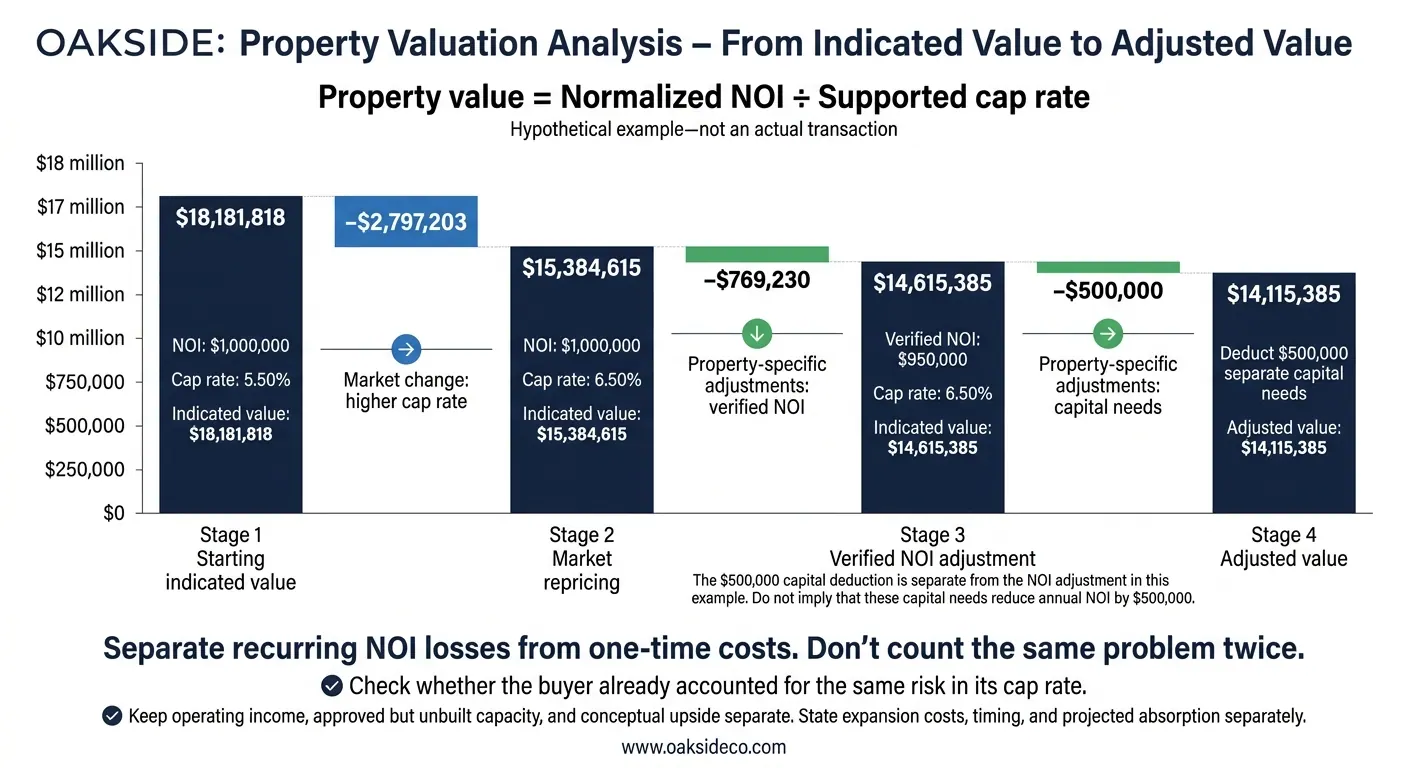
Cap Rate Expansion vs. Property-Specific Value Adjustments
Normalized NOI is recurring operating income backed by records - not a peak month, an owner-specific adjustment, or an unsupported forecast.
Bid gaps grow when buyers discount uncertainty. A valuation backed by records helps limit retrades by separating market repricing from property issues that can be fixed.
Verify NOI and Record Property Risks
Reconcile trailing-twelve-month and year-to-date financials with the ledger, bank statements, rent roll, and collections reports. Gather 24 months of monthly operating reports, plus three years when available. Explain the amount and source of every adjustment. Use updated insurance quotes, likely post-sale property taxes, and a market-level management fee - even if the owner records no management expense.
Back property adjustments with repair estimates, capital budgets, and zoning, environmental, and expansion approvals. Keep operating income, approved but unbuilt capacity, and conceptual upside separate. State expansion costs, timing, and projected absorption separately, too.
Compare Base, Upside, and Downside Values
After verifying NOI, price each scenario separately. This keeps market repricing from getting mixed with property-specific risk. In every scenario, use normalized NOI divided by a supported cap rate. Back the cap rate with current buyer evidence and matched comparable sales. Label assumptions as proven, documented but unrealized, or execution-dependent.
| Case | Cash-flow assumptions | Pricing treatment |
|---|---|---|
| Base | Verified TTM and year-to-date revenue; normalized vacancy, concessions, collections, taxes, insurance, management, repairs, and recurring reserves | Main pricing reference using a supported cap rate |
| Upside | Documented rent increases, signed leases, proven ancillary revenue, completed improvements, or approved expansion | State costs and timing separately; keep future income out of current NOI |
| Downside | Slower lease-up, higher taxes or insurance, weaker collections, delayed expansion, higher repairs, or identified capital needs | Show revenue reductions and expense increases; deduct capital needs separately and exclude unsupported revenue |
Hypothetical example - not an actual transaction: At $1,000,000 NOI, cap-rate expansion from 5.50% to 6.50% lowers indicated value from $18,181,818 to $15,384,615. Verified NOI of $950,000 reduces value to $14,615,385; deducting $500,000 in separate near-term capital needs yields $14,115,385. This example separates market repricing from property-specific adjustments. That separation helps defend price and reduce retrades.
Check Boat-and-RV Revenue Stability
For boat-and-RV assets, revenue stability matters more than occupancy alone. Review occupancy, achieved rent, collections, seasonal churn, and customer concentration across covered, uncovered, enclosed, pull-through, and oversized space types. High occupancy alone does not prove stable revenue; discounts, delinquency, seasonal churn, or customer concentration can still weaken cash flow.
Once the facts support your pricing, focus on terms that protect net proceeds and the likelihood of closing.
Set Price Limits and Offer Requirements
Use the supported valuation to set your asking range and negotiation floor. Define the minimum net proceeds you’ll accept after debt payoff, broker compensation, taxes, credits, repairs, and other transaction costs.
Set limits for closing timing, diligence length, deposits, and extension fees. Have counsel define contract triggers and remedies for verified NOI shortfalls, title defects, environmental findings, and capital items above a stated threshold. Use these limits to guide negotiations - you don’t need to share them in full with buyers.
With those terms in place, assess whether a buyer’s requested change reflects new information or simply a lower return target.
Before marketing, prepare a data room with rent rolls, TTM operating statements, monthly detail, collections history, leases, title commitment, survey, zoning, permits, environmental reports, property-condition reports, and capital budgets.
Require each offer to state:
- Price, going-in cap rate, NOI definition, financing terms, and earnest money.
- Diligence period, closing date, requested credits, and prorations.
- Any lender, appraisal, debt, or investment-committee conditions.
Use the same offer requirements and submission deadlines for all buyers so you can compare bids on equal terms.
Compare Sale Options and Manage Retrade Risk
Once you identify a bid gap, resolve fixable issues before exclusivity where feasible. These may include missing permits, title exceptions, survey discrepancies, unpaid taxes, or incomplete lease files. Track supporting documents, estimated costs, the responsible party, and a resolution deadline for each issue.
Set the diligence scope and response deadlines in the purchase agreement. Require any material price-change request to include evidence and a quantified effect on valuation. Only newly discovered defects should justify a retrade.
If bids still fall short, choose the path that best balances net proceeds, certainty, and time to close.
| Option | Benefit | Costs and execution risks | Best fit |
|---|---|---|---|
| Hold and improve operations | Potential NOI growth before a relaunch or sale | Takes time and capital; improvements may not deliver the projected return | The asset has clear room to improve operations, and the owner can fund and manage the plan |
| Reprice and relaunch | Resets expectations and may attract buyers whose pricing expectations better match yours | May signal weakness, extend marketing time, and create buyer fatigue | Bids consistently fall below the original range, and market evidence supports a reset |
| Accept less for greater certainty | Improves the likelihood of closing and reduces carrying costs and financing risk | Reduces proceeds and may lock in a market loss | The buyer offers a reliable deposit, limited contingencies, and a clear path to closing |
| Offer credits or repairs | Can preserve price and remove known diligence objections | Uses cash and adds scope and timing risk; concerns may remain | The issue is defined, quantifiable, and cheaper to address than a price reduction |
| Use contingent payments | Preserves potential upside from future occupancy, revenue, approvals, or development | Adds collection, measurement, enforcement, and documentation risk; payment may never be earned | The event is objective, independently verifiable, time-limited, and supported by the buyer’s ability to pay |
For contingent payments, specify measurement rules, reporting and audit rights, the dispute-resolution process, payment dates, security, and default remedies. Compare net proceeds and collected cash, not headline price. Oakside Co can support pricing analysis, investor outreach, and transaction management.
Conclusion: Support Pricing With Facts and Clear Terms
Verify current NOI, apply market-supported cap rates, address diligence risks, and set an asking range you can defend with facts. Compare offers by net proceeds, timing, closing certainty, and retrade exposure. Owners cannot control market cap rates, but they can reduce avoidable discounts and make better-informed hold-or-sell decisions.
How much NOI growth would offset rising cap rates?
Net operating income (NOI) must grow in proportion to an increase in the cap rate to keep the property's value steady. The formula is simple: Value = NOI ÷ Cap Rate. Even a small increase in the cap rate can cause a large drop in value.
Increasing revenue or cutting operating expenses can deliver the needed NOI growth. Professional management, dynamic pricing, and more efficient operations can help offset cap rate increases driven by the market.
How can I limit retrades before accepting an offer?
Be transparent and prepare early to avoid surprises during due diligence. Before listing, review your rent roll, operating records, and property condition. Clean up your financials and exclude one-time expenses to show stabilized net operating income. Address structural or environmental concerns that buyers could use to ask for discounts.
Maintain a complete virtual data room with clear documentation of cap rates, economic occupancy, and deferred maintenance. This helps build buyer confidence and reduce price renegotiations.
Should I sell now or wait for cap rates to stabilize?
Whether to sell now or wait depends on your asset and financial goals, not a return to peak-cycle pricing. Buyers focus on steady cash flow and net operating income (NOI). If occupancy and revenue are stable, you may not need to wait.
If property improvements could increase its value, delaying the sale may make sense. Oakside Co recommends preparing 12 to 24 months ahead to clean up financials, normalize expenses, and address deferred maintenance.