If I were buying my first storage deal, I’d pick a broker based on storage closings and underwriting skill – not the highest price opinion.
Here’s the short version:
- I’d look for a broker whose work is mostly self-storage or boat/RV
- I’d ask for a deal sheet and check 2 owner references
- I’d review the BOV for NOI, taxes, management fees, occupancy, rent growth, and cap rate assumptions
- I’d compare offers on price, earnest money, due diligence time, and financing terms
- I’d expect the broker to stay involved through marketing, diligence, and closing
- I’d remember that due diligence often lasts 30 to 90 days, so process control matters
A broker in this niche does more than bring deals or buyers. They help price the asset, frame the numbers, contact the right buyers, sort through LOIs, and keep the deal moving when diligence gets messy. For a first deal, that can be the difference between a clean close and a long stretch of price cuts, weak offers, and retrades.
One more thing: I’d treat the broker as an advisor, not the decision-maker. They guide. I decide. That line keeps the process clear from the first call to closing.
What a Self-Storage Broker Actually Does
A specialized self-storage broker stays involved from pricing through closing. They act as both advisor and deal manager, not someone who finds a buyer or a deal and then vanishes. In practice, that means they help shape the price, frame the story around the asset, manage buyer interest, and keep the deal moving when diligence gets messy.
The work usually starts with the numbers: the rent roll, trailing 12-month P&L, unit mix, occupancy by unit type, and rate history. From there, the broker builds pricing guidance around in-place NOI, current cap rates by market and asset quality, and lender underwriting standards. In boat/RV storage, that review also has to account for seasonality, covered vs. uncovered spaces, and parking configuration. Those details can change how buyers view the asset, and they’re easy for a general commercial broker to miss.
On the marketing side, the broker puts together an offering memorandum that lays out occupancy trends, rate history, unit mix, ancillary income, and upside. Then comes buyer outreach. Instead of sending the deal to a broad, generic list, they contact a targeted group of buyers, such as:
- Regional operators
- Private equity groups
- 1031-exchange buyers
That focus matters. A partially filled facility with documented demand can draw a very different reaction than the exact same property pitched as "underperforming."
Once offers arrive, the job shifts from marketing to negotiation. And that’s not just about headline price. Terms matter too: earnest money amounts, due diligence length, rent prorations, and limits on last-minute price cuts. A broker who knows how storage buyers underwrite can explain why a buyer landed on a certain number, tying it back to underwriting inputs instead of pushing a figure that was never likely to hold up. For first-time sellers, that can make a big difference, especially if they started out anchored to inflated self-storage valuations.
That same storage-focused view carries into diligence. During due diligence – which commonly runs 30 to 90 days – the broker often becomes the central coordinator. They track a checklist that includes rent roll history, delinquency and lien-sale records, unit-by-unit occupancy reports, vendor contracts, property condition reports, environmental reports, and zoning or conditional use approvals. They also manage document flow between the seller, buyer, lender, appraiser, and title company.
Just as important, they watch for the usual trouble spots in storage deals: overstated occupancy, deferred maintenance on gates and security systems, and misclassified climate-control units. The investor still owns the key decisions – hiring inspectors, reviewing title with their attorney, and testing assumptions in their own model – but a good broker keeps the process from drifting off course.
Where Oakside Fits in the Process
At Oakside, that full-cycle role is handled with a data-first process. Oakside works as a full-cycle advisor for self-storage and boat/RV assets, with a team that brings over 30 years of combined experience and more than 51 completed transactions in these asset classes. Each engagement begins with a data-driven Broker Opinion of Value built on detailed underwriting, comparable sales, and scenario analysis, not a headline number meant to win the listing.
"We start with data-driven underwriting and stay involved through closing so the deal stays tied to the numbers." – Cameron Vale – President at Oakside
From there, Oakside manages structured buyer outreach, documented offers and counteroffers, checklist-driven due diligence, and weekly status updates through closing. It follows the same valuation-to-close workflow designed to help first-time investors avoid weak underwriting and inflated expectations.
sbb-itb-09b4138
How to Find and Screen the Right Broker
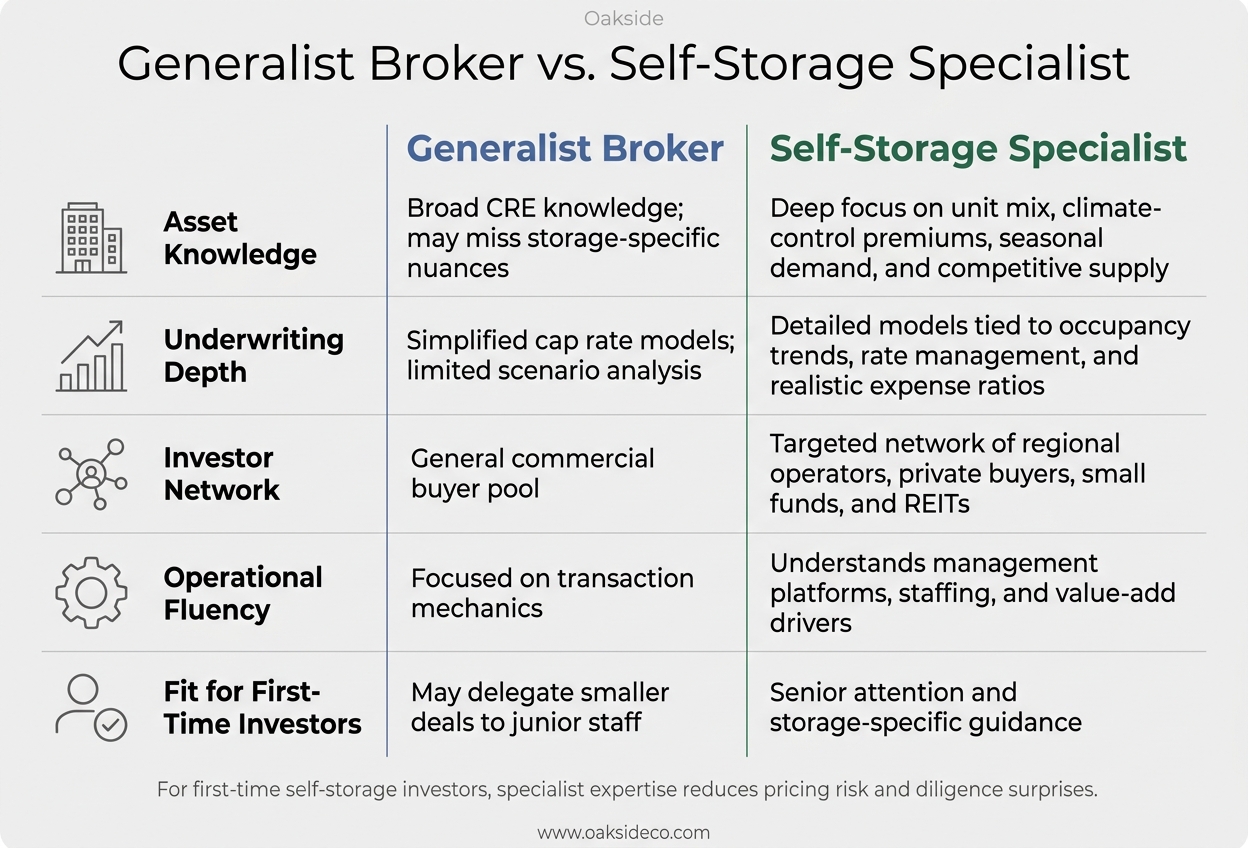
Generalist Broker vs. Self-Storage Specialist: Key Differences
Once you know what a good broker is supposed to do, the next step is simple in theory and messy in practice: prove they’ve done it on storage deals like yours.
That matters more than most sellers think. Some brokers pitch a high number just to win the listing. It sounds great up front. Then the deal hits the market, buyers underwrite to the actual numbers, and the gap shows up fast. That’s when price cuts, weak momentum, and wasted time start to pile up.
A smart place to start is the SSA vendor directory, state associations, and active listings in your target market. You can also pull names from conference sponsors and local CRE groups to cast a wider net. From there, build a shortlist of 8–15 candidates, then trim it based on recent deal activity that lines up with your target asset type and price range.
Before you go any further, do a quick background check on each finalist. Look at active licensing, disciplinary history, and recent storage closings. The main filter is pretty direct: Are most of this broker’s recent deals self-storage or boat/RV? Or is storage just a side category inside a broad CRE practice?
If the answers get fuzzy, move on.
Questions to Ask Before You Sign
A 30–45 minute call with each finalist can tell you a lot. The best questions get straight to the numbers and past the sales pitch:
- "What percentage of your business in the last 24 months was self-storage or boat/RV?" A real specialist will often tell you that self-storage and boat/RV make up most of their volume. If that share is much lower, storage is probably a secondary part of their business.
- "How many self-storage closings have you completed in the last 24 months, and in which markets and price ranges?" Their answer should line up with your target deal size. For example, a broker who mostly works on large institutional portfolios may not be the best match for a smaller value-add facility in a secondary market.
- "Can you walk me through a recent deal similar to mine – one that went smoothly and one that got complicated?" This is where you find out whether they know the work or just know the script. Specific examples matter more than polished claims. If a broker can explain why a buyer landed on a certain cap rate, how they handled a diligence issue, or what led to a price adjustment during due diligence, they’re showing real deal fluency. Ask how they arrive at value, not just what number they want to list at.
Ask for a recent deal sheet. Then call two owners with similar facilities and confirm whether the broker’s first valuation matched the final sale price. That one step can tell you a lot. You’ll learn pretty fast whether the broker prices to win the listing or prices to get the deal closed.
Generalist Broker vs. Self-Storage Specialist
The gap between a generalist and a specialist gets a lot clearer when a deal stops being easy. Think diligence, buyer pushback on pricing, or a value-add story that has to be explained with precision. That’s where the difference shows up.
Here’s how they stack up on the points that matter most to a first-time storage investor in our self-storage guide:
| Factor | Generalist Broker | Self-Storage Specialist |
|---|---|---|
| Asset Knowledge | Broad CRE knowledge; may miss storage-specific nuances | Deep focus on unit mix, climate-control premiums, seasonal demand, and competitive supply |
| Underwriting Depth | Simplified cap rate models; limited scenario analysis | Detailed models tied to occupancy trends, rate management, and realistic expense ratios |
| Investor Network | General commercial buyer pool | Targeted network of regional operators, private buyers, small funds, and REITs |
| Operational Fluency | Focused on transaction mechanics | Understands management platforms, staffing, and value-add drivers |
| Fit for First-Time Investors | May delegate smaller deals to junior staff | Senior attention and storage-specific guidance |
The next test is whether that broker can defend a valuation with real underwriting, not just confidence.
How to Read Pricing Advice and Avoid Inflated Valuations
Self-storage brokers often throw out high price opinions to land a listing. Buyers don’t buy that way.
They underwrite to NOI, realistic expenses, rent assumptions, and cap rates. If those numbers don’t line up, offers come in lower, momentum fades, and the deal drags out. That’s why the main test of a broker isn’t the headline price. It’s whether that price survives buyer underwriting.
If this is your first deal, reviewing common questions about selling a self-storage facility and your BOV should help you see what buyers are likely to pay in the market, not just what sounds good in a pitch.
What to Review in a Broker Opinion of Value
Before you sign anything, ask to see the assumptions behind the number. A defensible BOV should show how the broker got there in plain terms. Start with these points:
- Management fee treatment – Did the broker include a standard fee, or leave it out to make NOI look higher?
- Occupancy normalization – Is occupancy based on a level the property can keep up, not just one strong month?
- Property tax reassessment – Did the broker model a realistic tax reset after closing?
- Rent growth assumptions – Are projected increases tied to property history and current market conditions?
- Cap rate selection – Does the cap rate line up with recent storage sales and what lenders expect?
Then compare the implied value with recent sales and lender-backed debt coverage under current DSCR standards.
Inflated BOV vs. Data-Driven BOV
The gap between an inflated BOV and a data-driven one is not always obvious on day one. Both can look polished on paper. The difference shows up when buyers react.
| Factor | Inflated BOV | Data-Driven BOV |
|---|---|---|
| Pricing Method | Aspirational; designed to win the listing | Disciplined underwriting based on NOI and market cap rates |
| Likely Buyer Response | Frustration; offers significantly below asking | Competitive offers aligned with valuation |
| Timeline Impact | Extended marketing period; often requires price drops | Efficient path to closing with fewer delays |
| Renegotiation Risk | High; price often gets renegotiated during due diligence | Low; numbers are defensible and transparent |
An inflated BOV doesn’t just burn time. It can weaken your position in negotiations too. When a property sits on the market too long, buyers start to ask what’s wrong with it. That kind of market signal is tough to undo when the main issue was overpricing from the start.
Setting Expectations Before You Go to Market
A broker who knows self-storage should set expectations before the first offer shows up, not after an offer misses the mark.
That means having a direct talk about what buyers will underwrite, what lenders will back, and where the realistic price range sits, even if it comes in below what you hoped for. That kind of upfront clarity helps keep the process grounded from the start.
"We start with the downside case first, then price from there." – Cameron Vale, President at Oakside
Straight talk up front separates a broker who is pricing to close from one who is pricing to win the listing. If a broker won’t show you the downside assumptions in the BOV, that broker is not pricing the deal for closing.
Once pricing is set, the next job is keeping the deal on track through marketing, diligence, and closing.
What Working With a Broker Should Look Like Day to Day
Once pricing is set and you’re ready to move, the broker relationship turns into day-to-day execution. This is where the market tests the valuation. The best brokers don’t disappear after the listing goes live. They stay involved, keep momentum, and tie the process back to actual underwriting. The point is simple: keep the deal lined up with the underwriting, not just the asking price.
Set the Scope, Fees, and Reporting Up Front
Before the property goes to market, get the representation agreement in writing and read it closely. It should spell out whether the engagement is exclusive or non-exclusive, how long it lasts, when either side can end it, and exactly when commissions are earned and paid.
The commission section should be plain and specific. In many cases, the fee is a percentage of the purchase price, earned when a binding contract is signed and paid at closing. If there are minimum fees, or different rates for off-market deals versus marketed deals, those terms should be stated up front.
A weekly written update is a solid baseline. It should cover:
- Tours completed
- Buyer inquiries
- Confidentiality agreements signed
- Feedback on pricing or property condition
If buyers keep pointing to the same issue, the broker should bring it to you right away so you can adjust pricing early if needed. Straight buyer feedback is often some of the most useful information you’ll get during the marketing period.
From LOI to Closing: What to Expect on Your First Deal
From an accepted letter of intent (LOI) to closing, a self-storage deal usually takes several weeks to a few months. In most cases, financing drives the timeline. Once tours start, speed and document quality matter more than the sales pitch. Before those tours begin, the broker should have a clean data room ready with current financials, occupancy, and key reports.
When offers come in, your broker should help you look past the headline price. LOIs need to be compared on more than just the top number. Earnest money structure, due diligence length, financing contingencies, and the buyer’s track record in self-storage all shape the odds of getting to the closing table.
Diligence certainty matters just as much as price. A slightly lower offer with nonrefundable earnest money and no financing contingency will often put you in a stronger spot.
During diligence, the broker should manage document flow and keep things moving. That usually means:
- Answering buyer questions
- Updating the data room
- Flagging new issues to buyers still in the process
If a problem comes up, the broker should help both sides work toward a fair fix instead of letting it turn into a surprise retrade at the finish line.
Conclusion: Choose a Broker Who Can Back Up the Numbers
When diligence is handled well, surprises stay small and retrades stay limited. For a first self-storage deal, you want a broker who leads with advice and runs a tight process. That means someone who explains the assumptions, manages the details, and stays involved from the first call through closing. Pick the broker who can show the math, manage the process, and defend the number.
FAQs
How do I verify a broker’s storage experience?
Look for brokers with direct self-storage ownership or operating experience. When you sell a self-storage facility, you’re not just selling a piece of property. You’re selling an operating business. That means the broker should understand the day-to-day side of the job, from occupancy and rate management to tenant turnover and site operations.
It also helps to review their past self-storage and boat/RV deals. A good advisor should be able to point to a solid track record, back up their guidance with data, and speak clearly about valuation points like NOI normalization and operational benchmarking.
What makes a broker’s valuation realistic?
A broker’s valuation is realistic when it’s built on verified, current operating data – not guesswork or old benchmarks.
In practice, that means using stabilized NOI based on actual trailing 12-month income and expenses. It also means removing one-time capital costs and personal expenses so the numbers show how the property is performing as a business.
A solid valuation also needs to match local market conditions, nearby comparable sales, and current market cap rates. As Nolen Masserman, Managing Director at Oakside, notes, self-storage trades on cap rates applied to stabilized NOI – not gross revenue or facility size.
Which offer terms matter most besides price?
Price matters, of course. But in many deals, the other terms can change the outcome just as much.
Timing is a big one, especially in a 1031 exchange, where deadlines can put real pressure on both sides. Seller financing can also shape the deal, along with lender rules such as refinance or take-out rate and DSCR.
Deferred maintenance is another common sticking point. If big-ticket items like HVAC or roofing need to be replaced, buyers will often cut those costs from the offer on a dollar-for-dollar basis.