If I want to know how much a lender may offer on a boat or RV storage project, I start with one rule: the loan is set by the lowest result from LTC, debt yield, and DSCR.
For a ground-up deal, lenders usually look at:
- LTC first, often around 60% to 75%
- Debt yield, often around 8% to 10%
- DSCR, often around 1.20x to 1.35x
- Sponsor net worth and liquidity
- Lease-up risk, including slower absorption, lower rents, and weaker occupancy
Here’s the short version: if total project cost is $10,000,000 and a lender allows 65% LTC, that points to a $6,500,000 loan. But that number can still drop if projected NOI does not support it under debt yield or DSCR tests.
A few points matter most:
- Ground-up deals are sized by cost first, not current value
- Income tests use stabilized NOI, not today’s cash flow
- Lenders often stress lease-up to 36 months
- They may size to about 85% occupancy and lower rents
- More equity and more post-close cash often help the deal get done
This means I would not look at the “best case” loan amount. I would look at the downside case, because that is often where lenders land.
Loan-to-cost and the project capital stack
Lenders usually start with the capital stack. LTC sets the first cap on loan proceeds. After that, debt yield and DSCR check whether the deal’s cash flow can carry the debt.
How lenders calculate LTC for ground-up boat and RV storage
LTC is simple math: loan amount divided by total project cost. If a lender puts up $6,500,000 on a project with a $10,000,000 total cost basis, the LTC is 65%.
The harder part isn’t the formula. It’s deciding what belongs in total project cost.
That total should include:
- Land
- Hard costs
- Soft costs
- Financing costs
- Contingency
- Any lease-up or operating reserve
Lenders underwrite against the full project cost, not just hard costs. Why? Because soft costs and carrying costs can change the risk in a big way, especially if the job runs long or costs more than planned.
Since the property produces no income during construction, lenders often require an interest reserve. That pushes total cost up, which can pull the LTC ratio down. For conventional bank and construction loans in the U.S., many lenders fall in the 60–75% LTC range for ground-up storage projects. Debt funds may go up to 75–85%, but they usually charge higher rates and use tighter draw conditions.
How equity requirements affect proceeds and lender risk
The equity requirement is the other side of the LTC cap. If a lender caps proceeds at 65% of total project cost, the sponsor has to fund the other 35% with cash equity or subordinate capital. That shortfall is the sponsor’s required equity.
Lenders usually want that equity lined up before closing. More sponsor equity gives the lender more room if costs climb, construction gets delayed, or lease-up takes more time than expected. An enclosed or covered project in a proven market may get more leverage. A deal with mostly uncovered stalls in a thinner market may end up near the low end instead.
At 70% LTC, a $12,000,000 project can support $8,400,000 of debt and needs $3,600,000 of equity.
Once LTC sets the proceeds cap, lenders move on to debt yield and DSCR to see if stabilized NOI can support that debt.
sbb-itb-09b4138
Applying debt yield and DSCR to stabilized cash flow
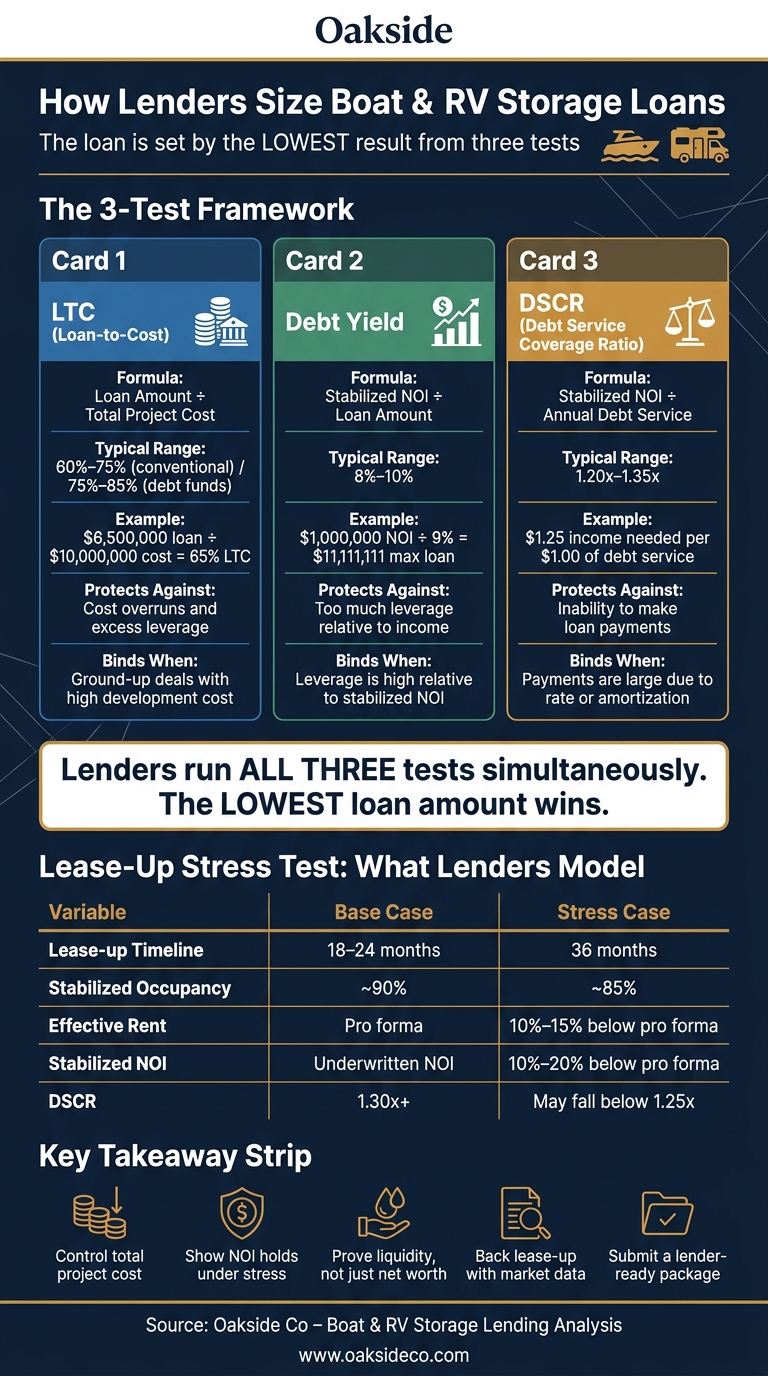
How Lenders Size Boat & RV Storage Loans: LTC vs Debt Yield vs DSCR
Once LTC sets the top end of proceeds based on total project cost, lenders move to the next issue: can the property’s income support that loan? For ground-up boat and RV storage, they don’t underwrite off current cash flow. They underwrite projected stabilized NOI. That means assumed occupancy, rent levels, and operating expenses all feed into the loan sizing model. From there, lenders turn NOI into proceeds. The first income-based cap is debt yield.
Debt yield as a proceeds test independent of loan pricing
Debt yield equals annual stabilized NOI divided by loan proceeds. So if a ground-up boat and RV storage project is expected to produce $1,000,000 in NOI and the lender wants a 9.0% debt yield, the max loan amount is about $11,111,111.
Why does that matter? Because debt yield is simple. It doesn’t depend on the interest rate, and it doesn’t depend on amortization. It’s a straight income-to-loan-balance test. That makes it useful when loan pricing shifts around. Many lenders look for a minimum debt yield in the 8%–10% range for stabilized storage assets. After that, DSCR comes in as the second test, and it’s often the one that ends up being tighter.
The table below shows how debt yield sits next to the other sizing checks lenders run at the same time:
| Metric | Formula | What it protects against | When it most likely binds |
|---|---|---|---|
| LTC | Loan ÷ Total project cost | Cost overruns and too much leverage at the project level | Ground-up deals with high development cost |
| Debt yield | NOI ÷ Loan amount | Too much leverage apart from rate/amortization | When leverage is high relative to stabilized NOI |
| DSCR | NOI ÷ Annual debt service | Trouble making payments under underwritten terms | When payments are large due to rate/amortization |
Lenders run all three tests together and use the lowest loan amount that comes out of them. That’s the binding constraint.
DSCR and whether stabilized NOI can support debt service
DSCR adds another filter: can stabilized NOI cover the annual loan payment? The formula is NOI divided by annual debt service. If a lender wants a 1.25x DSCR, the property needs to produce $1.25 for every $1.00 of debt service. Many stabilized storage lenders target a range of 1.20x–1.35x.
For a ground-up boat and RV storage deal, lenders often put pressure on the DSCR math. They may assume a higher rate than the opening quote, use a tighter amortization period, or model a takeout refinance once the project reaches stabilization. In plain English, DSCR is a payment test. It also acts as a check on whether the loan can be refinanced once the facility is up and running at its underwritten level.
If DSCR gives a lower loan amount than debt yield or LTC, DSCR becomes the controlling limit and the loan gets cut back to fit it. In the end, usable debt proceeds depend on one thing more than anything else: credible stabilized NOI.
Sponsor strength and lease-up risk
After lenders pressure-test the deal, they look hard at the person running it. In ground-up boat and RV storage, the sponsor can matter just as much as the site plan or pro forma. A deal can look solid on paper and still go sideways if the sponsor doesn’t have the balance sheet or the know-how to get through construction and lease-up.
Net worth and liquidity lenders want to see
Most lenders start with the guarantor’s net worth, liquidity, and backup capital. In many cases, they want guarantor net worth that matches or exceeds the loan amount, plus post-closing liquidity around 10% of the loan balance. On a $10,000,000 construction loan, that usually means about $10,000,000 of net worth and $1,000,000 of cash or liquid securities after closing.
Why does that matter? Because those numbers show the sponsor may be able to handle delays, cost overruns, interest carry, and a slower lease-up than expected. If liquidity looks thin, lenders often react fast. They may lower leverage, tighten reserves, or both. In plenty of deals, that balance-sheet support is what sets the limit on how much lease-up risk a lender is willing to take.
Experience matters too. Lenders want to see a track record with similar storage assets, markets, and deal size. A sponsor who has already handled entitlements, construction, and lease-up on a storage project is a very different credit story from one who hasn’t. If the sponsor falls short on liquidity or experience, lenders often answer with full or partial recourse, tougher completion guarantees, and larger reserve accounts. Stronger sponsors, on the other hand, can help support higher leverage, lighter recourse, and better terms. That track record also shapes how cautiously the lender models lease-up.
Lease-up risk: absorption, rents, occupancy, and stress cases
Lenders don’t stop at, "Does this deal work?" They ask a harder question: Does it still work if the lease-up drags?
In balanced markets, lease-up to stabilization often runs about 18 to 24 months. But many lenders underwrite more cautiously and model 36 months instead. In slower markets, even that can prove optimistic.
| Variable | Base Case | Stress Case |
|---|---|---|
| Lease-up timeline | 18–24 months to stabilization | 36 months to stabilization |
| Stabilized occupancy | Around 90% | Around 85% |
| Effective rent | Pro forma rent | 10%–15% below pro forma |
| Stabilized NOI | Underwritten NOI | 10%–20% below pro forma |
| DSCR | 1.30x+ | May fall below 1.25x |
| Debt yield | Stabilized and acceptable | Compressed under stress |
Some lenders push even harder and size the deal at roughly 85% occupancy with no credit for forward rent growth during lease-up. When that happens, the stress case can become the test that drives proceeds.
A lender-ready lease-up plan usually does a few things well:
- It lays out phased occupancy targets
- It uses conservative rent assumptions
- It shows how operating costs build as the project fills up
For properties with covered, uncovered, and enclosed spaces, lenders often underwrite each type on its own. That’s because they don’t lease at the same pace, and they don’t earn the same rates.
How Oakside Co helps sponsors prepare lender-ready underwriting
Clear materials make all of this easier for lenders to size. Oakside Co helps boat and RV storage sponsors put together data-backed loan sizing analysis, underwriting packages, and lender-ready presentations built for self-storage and boat/RV assets. The aim is simple: give lenders the facts they need, fast.
Conclusion: What changes when the deal is ground-up instead of stabilized
The practical takeaway is simple: ground-up loans are sized by cost first, then by projected cash flow. Stabilized deals are underwritten based on in-place NOI. Ground-up deals are judged on total cost, projected stabilized NOI, and execution risk.
That changes how lenders size the deal. On ground-up self-storage, LTC usually hits first. After that, lenders look at debt yield and DSCR to see whether projected NOI can carry the loan.
They also don’t size to the base case. They size to the downside. In plain English, lenders stress-test the deal by cutting NOI and pushing rate assumptions higher to see if the project still holds up when construction drags or lease-up comes in light.
Key takeaways for owners and developers seeking financing
For sponsors, the job usually comes down to a few things:
- Control total project cost. If costs run up, equity needs go up and loan proceeds can shrink.
- Show that stabilized NOI still covers debt under stress. The base case alone won’t cut it.
- Prove liquidity, not just net worth. Lenders want to know you can handle surprises.
- Back up lease-up assumptions with market data. Hope isn’t underwriting.
- Send a lender-ready package with clean assumptions and clear downside cases. A messy file can slow things down fast.
Oakside Co helps sponsors prepare lender-ready underwriting for ground-up boat and RV storage projects through capital stack review and market-feasibility support.
FAQs
Which loan sizing test usually limits proceeds first?
Usually, the DSCR (debt service coverage ratio) test is the first thing that caps loan proceeds. Lenders size the loan based on the property’s stabilized net operating income, and often a downside case too, to make sure debt payments can be covered with some room to spare.
A common target is at least 1.25x DSCR at stabilization. Lenders also build in occupancy or lease-up cushions to account for project risk.
How much equity is needed for a ground-up boat or RV storage project?
Lenders usually want you to have at least 10% equity in the total cost of a ground-up boat and RV storage project.
If you’re using SBA-backed financing, at least 5% of the project cost will often need to come from your own cash.
On top of that, plan for:
- Closing costs of about 2% to 5% of total project cost
- Enough cash on hand to cover 12 to 18 months of tax and insurance escrows
That last piece matters more than many people expect. It’s not just about getting the loan approved. You also need enough liquidity to handle the costs that show up around the deal, not just the build itself.
What assumptions do lenders stress in lease-up underwriting?
Lenders now put lease-up plans under more pressure. A timeline that once stabilized in 30 months may now be pushed to 36 months in underwriting.
They’re also using tighter occupancy assumptions:
- 85% stabilized occupancy
- 70% downside occupancy
On the downside, many lenders build in a 6- to 12-month lease-up delay.
As Nolen Masserman, Managing Director at Oakside, notes, projections should reflect occupancy trends, historical rent data, and hyper-local data rather than broad market assumptions.