If you want storage financing in 2026, plan around DSCR first. For most U.S. self-storage deals, lenders now look for about 1.25x–1.35x DSCR. Self-storage vs RV storage requirements differ, with Boat/RV storage often needing 1.30x+. And because rates are still high, the same NOI now supports a smaller loan.
Here’s the short version:
- Banks: usually want 1.25x–1.35x
- SBA 7(a): formal floor can be 1.15x, but many lenders still look for more
- SBA 504: often underwritten near 1.20x–1.25x at stabilization
- CMBS / life company lenders: often want 1.25x–1.35x, with stress-rate sizing
- Bridge / debt funds: may allow 1.00x–1.10x in-place, but want a path to stronger stabilized coverage
- Construction / mini-perm: usually sized to 1.25x–1.30x+ at exit
What this means for you: lender fit depends more on the asset’s stage than on the lowest quoted rate. Stabilized properties fit bank or permanent debt. For those new to the asset class, our self storage guide covers the full lifecycle from acquisition to operations. Lease-up, value-add, and conversion deals often fit bridge, debt fund, or construction loans.
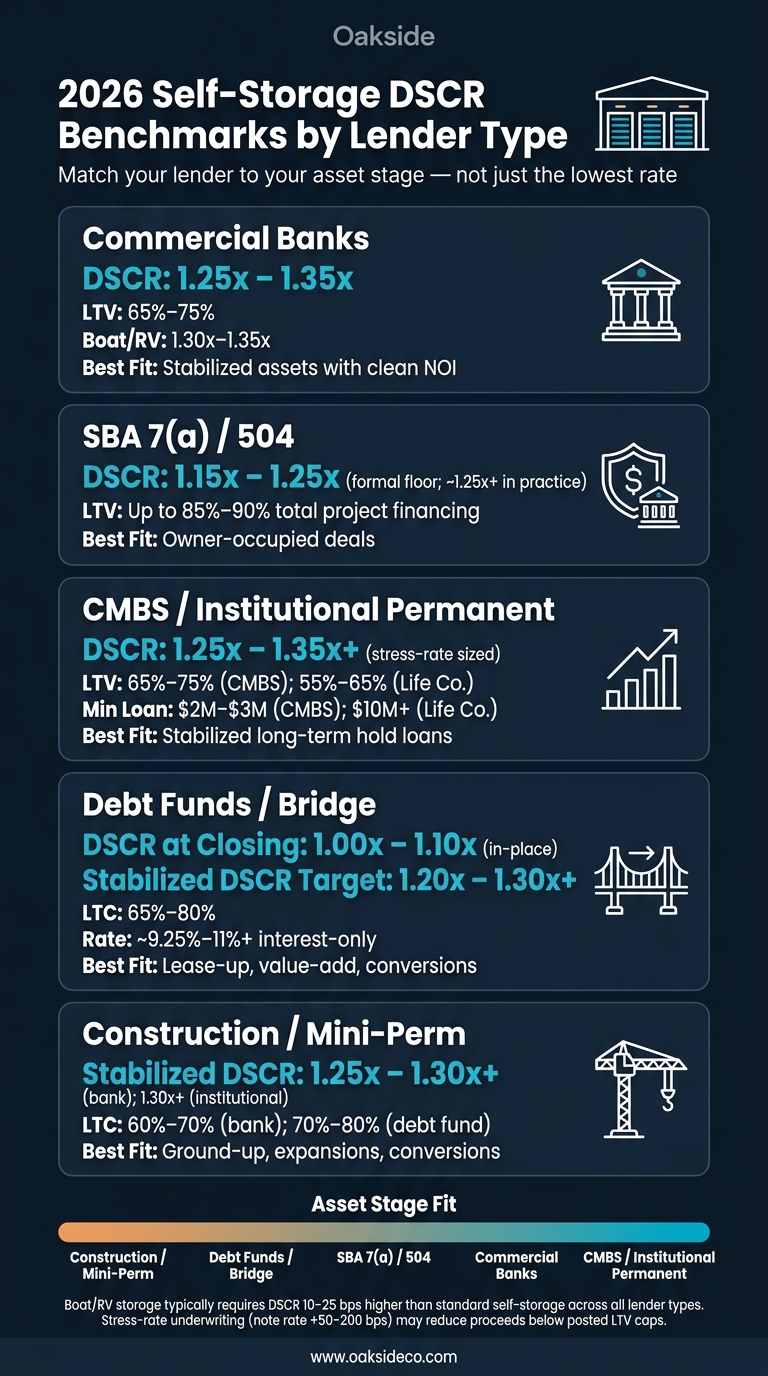
2026 Self-Storage DSCR Benchmarks by Lender Type
Quick Comparison
| Lender type | Typical DSCR target | Best use |
|---|---|---|
| Commercial banks | 1.25x–1.35x | Stabilized storage with clean NOI |
| SBA 7(a) / 504 | 1.15x–1.25x+ | Owner-occupied deals |
| CMBS / institutional permanent | 1.25x–1.35x+ | Stabilized long-term hold loans |
| Debt funds / bridge | 1.00x–1.10x in-place; 1.20x–1.30x+ stabilized | Lease-up and value-add |
| Construction / mini-perm | 1.25x–1.30x+ stabilized | Ground-up, expansions, conversions |
I’d read the rest of this guide as a simple lender map: who will lend, what DSCR they want, how stress tests cut proceeds, and where each loan type fits in 2026.
sbb-itb-09b4138
1. Commercial Banks
Banks usually sit at the conservative end of 2026 storage DSCR quotes. They’re a common source of stabilized self-storage debt, but they tend to underwrite with a tight grip: steady NOI, proven occupancy, and sponsors with a track record. For most bank programs, 1.25x DSCR is the stated floor for self-storage, though lenders in weaker markets often want 1.30x–1.35x.
DSCR Minimums and Stress-Rate Underwriting
That 1.25x floor usually applies only to stabilized deals with strong trailing results – often 85%+ economic occupancy and a clean T-12 NOI. Boat/RV storage usually lands closer to 1.30x–1.35x because lenders see that asset type as less steady.
Some larger regional banks go even further and push requirements to 1.40x for properties in smaller markets or deals with limited operating history. On top of that, most banks underwrite at the note rate plus 50–100 bps. So a deal that works at 1.25x using the contract rate can still miss the lender’s stress test.
Leverage and Pricing
Banks usually lend at 65%–70% LTV on stabilized self-storage and 55%–65% on boat/RV storage. In some cases, they may stretch to 75% LTV when borrower strength and cross-collateralization help support the credit.
In 2026, though, DSCR often matters more than LTV. Put simply, the loan amount needed to keep a 1.25x DSCR may come in well below the program’s posted LTV cap. Pricing usually floats over SOFR or Prime, with lower spreads for stronger sponsors and lower leverage. That makes bank quotes a useful baseline when comparing other lender types.
Best-Fit Deal Types
Banks like stabilized, low-complexity deals. They tend to fit best for:
- Stabilized acquisitions
- Refinances with clean NOI
- Moderate-leverage loans
They tend to be a weaker fit for lease-up deals, boat/RV properties with short operating history, and ground-up construction. Because banks underwrite so conservatively, they often set the floor for what sponsors should expect.
2. SBA 7(a) and 504 Lenders
SBA programs sit in the middle ground between bank loans and long-term permanent debt. For owner-occupied self-storage deals, they’re often the main option when DSCR is too low for a plain bank loan. On paper, SBA programs allow lower DSCR. In practice, though, lender overlays often pull those numbers back toward обычных bank standards.
DSCR Minimums and Stress-Rate Underwriting
Compared with bank debt, SBA can look more flexible at first glance. But the gap often shrinks once lenders apply their own underwriting rules.
Under SBA SOP 50 10 8, the formal DSCR floor for standard 7(a) loans above $350,000 is 1.15x. For smaller 7(a) loans at or below $350,000, the floor drops to 1.10x. That said, many lenders still look for 1.20x–1.25x DSCR on self-storage and similar CRE deals, even when the stated SBA minimum is 1.15x. The reason is simple: they want more room for swings in cash flow, especially on new construction and heavy value-add projects.
SBA 504 does not have a formal DSCR floor written into the program rules. Still, CDCs and partner banks usually underwrite to 1.20x–1.25x at stabilization, and some senior bank participants may want as much as 1.35x depending on leverage. Both programs also run stress tests at 100–200 basis points above the note rate. In many cases, lenders care more about that stressed ratio than the headline DSCR.
SBA 7(a) adds one more layer: global DSCR. That means the lender is not only looking at the property. They also review the sponsor’s business and personal cash flow. Projected global coverage usually needs to be at least 1.15x, with at least 1.0x overall.
Leverage and Pricing
Standard 504 leverage is usually set up as:
- 50% first mortgage
- 35%–40% CDC debenture
- 10%–15% borrower equity
That works out to about 85%–90% total project financing for owner-occupied properties.
Self-storage can sometimes be treated more like a special-purpose property. When that happens, equity needs may move up to 15%–20%, and total leverage may be capped at 80%–85% LTV, especially for newer facilities without much operating history. The owner-occupancy rule stays in place the whole time. 504 is not meant for passive investment-hold storage in the way bank debt or permanent debt can be.
On pricing, 7(a) loans usually float over Prime or SOFR, with spreads tied to credit quality and collateral type. 504 loans mix a fixed-rate CDC debenture with a bank loan that may be fixed or floating. That mix can produce terms that stack up well against conventional permanent financing when leverage is moderate. If stressed DSCR is 1.30x or better, borrowers may get tighter pricing and longer amortization periods.
That matters because SBA debt still needs a clean exit into conventional permanent financing later on.
Best-Fit Deal Types
SBA 7(a) tends to fit acquisitions of operating storage businesses and value-add deals where day-one DSCR misses conventional standards, but stabilized NOI can still clear the 1.15x SBA floor. SBA 504 is usually a better match for ground-up development or larger stabilized acquisitions that need long-term fixed-rate debt, as long as the property meets the owner-occupancy requirement – at least 51% for existing buildings and at least 60% for new construction.
Pure investment self-storage rented only for income does not qualify for 504 at all.
For ground-up SBA deals, lenders often ask for 12–18 months of debt service reserves to cover lease-up. So the DSCR test becomes more than a property math exercise. It also turns into a check on sponsor liquidity and the path to stabilization. If the plan is to refinance later, a smart target is a path to 1.30x+ DSCR for conventional takeout.
For pure investment storage, conventional permanent debt is usually the next standard to measure against.
3. CMBS and Institutional Permanent Lenders
After lease-up, the conversation changes. Lenders stop leaning on bridge-style flexibility and start leaning hard on permanent-debt coverage tests. For stabilized self-storage, the main long-term choices are usually CMBS and institutional permanent debt.
That bucket includes conduit CMBS programs, life insurance companies, and core open-end funds. They tend to offer nonrecourse, fixed-rate debt built for long-term ownership. The catch is simple: underwriting gets tighter, and you have less room to maneuver than you would with bank or SBA debt.
DSCR Minimums and Stress-Rate Underwriting
CMBS lenders usually size loans using a stress rate, often 25–100 basis points above the coupon, and they underwrite with full amortizing debt service. That one detail can shrink proceeds more than many sponsors expect when they first look at the quoted rate.
Put plainly, CMBS is tighter than bank debt because it sizes off stressed debt service, not contract-rate debt service. And the caution doesn’t stop there. NOI assumptions are usually conservative as well, with lenders often wanting 85%+ economic occupancy sustained for at least 6–12 months before they underwrite to stabilized income.
From there, the lender keeps trimming the loan amount until DSCR clears the floor at the stress rate. So even if the asset looks strong, CMBS proceeds can land below what a bank or debt fund might offer on the same property.
Leverage and Pricing
| Parameter | CMBS Self-Storage | Life Company / Institutional |
|---|---|---|
| LTV range | 65%–75% | 55%–65% |
| DSCR minimum | 1.25x–1.35x | 1.30x+ |
| Rate range | High-5% to mid-7% | Generally tighter spreads |
| Term / amortization | 5–10 yr / 25–30 yr | Similar, sometimes partial IO |
| Min. loan size | $2M–$3M | $10M+ (major markets) |
For stabilized self-storage, CMBS execution usually comes with fixed-rate, nonrecourse terms, plus 5-, 7-, or 10-year maturities and 25–30-year amortization. Some deals also include partial interest-only periods. Spreads usually run about 1.75%–2.5% over Treasuries.
Pricing gets better when leverage stays moderate and DSCR sits well above the floor. That’s the basic pattern: cleaner cash flow and more cushion tend to lead to tighter execution.
Best-Fit Deal Types
CMBS and institutional permanent debt tend to work best for stabilized assets with clean T-12s, 80%–85%+ occupancy, and 1.30x+ DSCR under stress. On loan size, CMBS conduit executions often start around $2M–$3M, while life company loans usually begin at $10M+ and skew toward major markets.
This debt is usually a poor match for owners who expect to expand, push a value-add plan, or sell in the near term. Why? Because CMBS prepayment structures, such as yield maintenance or defeasance, can make early payoff expensive. And once a loan is securitized, any change usually runs through a formal servicer process instead of a direct lender conversation.
That’s why CMBS often makes the most sense at the end of a business plan, when the property is stable and the owner wants long-term fixed-rate debt. If the asset is still in lease-up or needs heavier repositioning, bridge lenders and debt funds are usually the better measuring stick.
4. Debt Funds and Bridge Lenders
When a self-storage deal doesn’t have enough cash flow for a bank or CMBS loan, debt funds and bridge lenders often step in. They fill that middle ground for lease-up, value-add, and conversion deals. And that’s the whole point: compared with the 1.25x–1.35x range common for permanent debt, bridge lenders can work with lower in-place coverage. So when a deal isn’t ready for permanent financing, bridge quotes usually matter most.
DSCR Minimums and In-Place vs. Stabilized DSCR
Bridge lenders and debt funds are usually more flexible than banks or CMBS lenders on in-place DSCR at closing. Many will accept 1.00x–1.10x, and some may go below 1.0x for transitional assets if the business plan makes sense.
But that flexibility doesn’t mean they ignore performance. The main test is the projected stabilized DSCR. A good takeout target is 1.20x–1.25x.
Stress-Rate Underwriting
Even with looser going-in DSCR, these lenders still pressure-test the deal. They often size to coupon +100–200 bps, and the loan still needs to clear about 1.0x–1.10x DSCR under that stressed rate.
That can trim leverage more than borrowers expect. A deal that seems to support 75%–80% LTV at the quoted rate may end up closer to 70%–75% LTV after the stress rate is applied.
Leverage and Pricing
| Parameter | Debt Fund / Bridge |
|---|---|
| Leverage range (LTC / project cost) | 65%–80% LTC; some strong-sponsor programs may stretch to 90% of total project cost |
| DSCR at origination | 1.00x–1.10x; below 1.0x may be accepted on credible transitional deals |
| Stabilized DSCR target | 1.20x–1.25x+ |
| Rate range (2026) | ~9.25%–11%+ interest-only; SOFR + 495–670 bps |
| Term | 12–36 months, interest-only |
| Recourse | Non-recourse or limited recourse |
For self-storage in 2026, bridge rates are running about 9.25%–11% interest-only, usually priced off Term SOFR + 495–670 basis points. That’s the tradeoff: higher cost in exchange for speed and looser entry standards.
Best-Fit Deal Types
These lenders tend to fit a narrow set of deals, including:
- Lease-up acquisitions with occupancy below stabilization
- Conversions of industrial or retail properties into self-storage or covered boat/RV storage
- Partner buyouts or recapitalizations where speed and more leverage matter
- Construction loan takeouts for projects that are close to stabilized, but not quite ready for permanent financing
If an asset is already stabilized, has clean trailing income, and shows DSCR above 1.25x, lower-cost loan options covered elsewhere in this guide will often make more sense.
From here, underwriting gets tighter again with construction and mini-perm loans, where lenders also price in lease-up risk and exit risk.
5. Construction and Mini-Perm Lenders
Construction and mini-perm lenders underwrite future cash flow, not current operations. That changes the whole credit discussion. Instead of focusing on today’s income, lenders spend more time on lease-up assumptions, absorption timing, and whether the deal can refinance or sell cleanly at the end.
In the mini-perm stage, the spotlight shifts to exit DSCR and debt yield. That’s why construction and mini-perm quotes are one of the clearest ways to see how lenders price lease-up risk in 2026.
DSCR Minimums
For ground-up self-storage, most bank construction lenders look for 1.25x–1.30x stabilized DSCR. For boat/RV storage, DSCR floors usually run 10–25 bps higher than standard self-storage. In practice, that pushes many bank quotes closer to 1.30x–1.35x at stabilization because lenders view the asset type as more cyclical.
Institutional lenders, including life companies in construction-to-perm deals, usually want 1.30x+ and tend to use more conservative expense assumptions. In the mini-perm stage, lenders often target 1.25x–1.35x DSCR and an 8%–9% debt yield as exit thresholds.
Stress-Rate Underwriting
Construction and mini-perm lenders size proceeds with a stress-rate DSCR test, not the actual day-one coupon. A common bank structure looks like this: the construction loan may be quoted at SOFR + 275 bps during the build, but the lender sizes the mini-perm takeout using a 7.00% fixed stress rate on amortizing payments and requires at least 1.25x DSCR on that stressed schedule.
Debt funds can be even tougher here. Many use a stress rate of 8.00%+ when modeling exit DSCR, especially in tertiary markets or for non-climate-controlled boat/RV product.
That stress test can reduce leverage by 5–10 points of LTC compared with day-one sizing. So if a sponsor wants max proceeds, the pro forma NOI and lease-up timeline can’t be hand-wavy.
Leverage and Pricing
| Parameter | Bank Construction | Debt Fund / Alt. Lender | Mini-Perm (Institutional) |
|---|---|---|---|
| Leverage | ~60%–70% LTC | ~70%–80% LTC | ~60%–65% LTV of stabilized value |
| Stabilized DSCR minimum | 1.25x–1.30x | 1.15x–1.20x | 1.30x+ |
| Pricing (2026) | SOFR + 275–325 bps | SOFR + 425–525 bps | Tighter than debt funds; varies by structure |
| Best fit | Experienced sponsors, well-located projects | Speed-sensitive or higher-risk lease-up | Projects nearing stabilization |
Best-Fit Deal Types
The best fit usually falls into three lanes:
- Ground-up projects: Bank construction financing tends to work best in growing suburban or Sun Belt markets where demographic data and documented absorption support the lease-up timeline.
- Phase-two expansions: Facilities that are already stabilized – often above 1.40x DSCR – can sometimes get more aggressive LTC treatment because lenders blend current income with the added NOI from the new phase.
- Conversions and lease-up refinances: Big-box retail or industrial conversions usually get conservative absorption assumptions from banks, which pushes DSCR sizing toward 1.30x+. Debt funds may accept 1.15x–1.20x on a pro forma basis, but they charge more for that risk. For lease-up refinances moving into a mini-perm, lenders generally want near-breakeven in-place DSCR – about 1.00x–1.10x – plus a documented path to 1.25x+ within 12–24 months.
Those quoted floors still shift with rates and lender liquidity, which is why market conditions matter next.
How 2026 Debt Market Conditions Affect Storage DSCR Quotes
The lender floors above set the baseline. But in 2026, rate conditions are making the bar tougher to clear in practice.
Higher-for-longer rates are keeping most permanent storage quotes around 1.25x DSCR, while top-tier deals can still get to 1.20x. That sounds close on paper. In the real world, it means borrowers have less room for error when lenders run stressed sizing. A thin margin over the quoted minimum often isn’t enough anymore.
Federal Reserve Senior Loan Officer surveys show lending standards tightened through 2024–2025, with the pressure showing up most in construction and land-development loans. On the ground, that usually means a lender may quote a 1.25x minimum but still want the deal to clear closer to 1.30x under stress.
There’s also a big maturity wave still moving through the market. For owners with 2025-origin loans coming due, today’s higher coupons and stricter sizing can drag DSCR below target. When that happens, permanent debt may not pencil out without an equity paydown or a bridge loan first.
Boat/RV storage is feeling more pressure than self-storage. For example, a lender willing to quote 1.25x DSCR and 70% LTV on a stabilized self-storage deal may ask for 1.30x DSCR and 60%–65% LTV on a similar boat/RV property. Some institutional and CMBS capital sources are also steering these deals toward bridge debt until the asset has a longer performance record.
Put simply, the same property now often needs more cash flow coverage and less leverage to get done. Here’s where lender types tend to land in 2026 after that market pressure:
| Lender Type | Self-Storage DSCR Range | Boat/RV Storage DSCR Range | Quote Behavior |
|---|---|---|---|
| Commercial Banks | 1.25x–1.30x | 1.30x+ | Selective; may tighten further in smaller markets or on non-climate-controlled assets |
| SBA 7(a) / 504 | 1.15x–1.25x formal; often ~1.25x+ in practice | 1.30x+ | Higher leverage available, but underwriting still centers on normalized NOI |
| CMBS / Institutional Permanent | 1.25x–1.35x | 1.30x+ | Debt yield is tested alongside DSCR, and both have to clear minimum thresholds |
| Debt Funds / Bridge | Below 1.25x can work on the way in; stabilized target is ≥1.30x | 1.30x+ stabilized | Focused on exit DSCR, with higher pricing to offset risk |
| Construction / Mini-Perm | 1.25x–1.30x stabilized | 1.30x+ stabilized | Stress-rate sizing usually reduces proceeds and lease-up is scrutinized closely |
Pros and Cons by Lender Type
With 2026 rates still keeping DSCR tight, the right lender fit can matter just as much as the headline coupon. A low rate looks good on paper. But if the lender doesn’t line up with the asset’s stage, cash flow, or business plan, that deal can get messy fast.
The table below turns those benchmarks into lender-level tradeoffs.
| Lender Type | Key Advantages | Key Drawbacks | Best Fit |
|---|---|---|---|
| Commercial Banks | Competitive coupons for strong sponsors; relationship-driven process | Full recourse; conservative on occupancy and market strength | Stabilized assets with strong in-place NOI and well-capitalized sponsors |
| SBA 7(a) / 504 | Long amortization (up to 25 years); accessible for owner-operators | Personal guarantees required; more documentation and fees; less useful for larger institutional deals | Owner-operators and smaller qualified deals |
| CMBS / Institutional Permanent | Typically nonrecourse; longer fixed terms; standardized underwriting | Demands clean cash-flow history; less flexible on transitional assets; debt yield tested alongside DSCR | Stabilized, well-documented properties where the borrower wants long-term permanent debt |
| Debt Funds / Bridge | Speed and flexibility; underwrites business plans, not just trailing cash flow | Highest coupons (often 9–13%+); short terms (12–36 months); tighter covenants, reserves, and exit tests; limited recourse with carve-outs and springing covenants | Value-add acquisitions, lease-up deals, recapitalizations, and time-sensitive closings |
| Construction / Mini-Perm | Access to capital before stabilization; funds ground-up, expansions, and conversions | Tight draw controls; takeout risk is real if stabilization misses | Ground-up development and major expansions with a credible path to 1.25x+ DSCR |
The big idea is simple: match the lender to the asset’s stage, not just the cheapest rate.
A stabilized property with steady NOI usually fits best with permanent debt. A lease-up, value-add, or repositioning deal is a different animal. In that case, bridge or construction financing often makes more sense because those lenders are built to deal with moving pieces, shorter timelines, and a business plan that’s still in motion.
Conclusion
In 2026, lender DSCR floors still line up with asset stability. For stabilized self-storage, banks and CMBS continue to set the permanent-debt benchmark, usually landing around 1.25x–1.35x DSCR. CMBS tends to be tighter than bank financing.
SBA loans can work well for owner-occupiers. They usually sit below that benchmark, but only when a deal can handle the program’s stricter structure and documentation rules.
For lease-up or value-add assets, bridge lenders and debt funds are often the better match. These lenders may accept lower in-place DSCR at closing, as long as the underwriting shows a stronger stabilized DSCR within 18–24 months.
In day-to-day terms, 2026 underwriting comes down to coverage, stress rate, and exit, not DSCR by itself. Higher interest rates and tighter stress tests are what push required DSCR up and loan proceeds down. The deals that get done cleanly usually come from matching the lender to the asset’s stage, not from chasing the lowest rate.
FAQs
How is DSCR calculated for a storage property?
DSCR is calculated by dividing a storage property’s NOI by its annual debt service. Put simply, it shows whether the facility brings in enough income to cover its loan payments.
For self-storage, that number shouldn’t be treated like it’s frozen in time. Income can move up or down, so Oakside recommends looking at DSCR as an ongoing measure based on current stabilized cash flow. That means using verified numbers, including T-12 financials and rent rolls, instead of relying on rough estimates.
Why do stress rates lower my loan proceeds?
Lenders use stress rates to account for possible changes in net operating income and interest rates. In plain English, they pressure-test the deal to see whether the property can still cover debt service at the required coverage ratio under more conservative assumptions.
If the stressed cash flow doesn’t support the requested loan amount, the lender cuts proceeds so the loan stays within its required coverage limits.
Which loan type fits a lease-up storage deal?
For lease-up storage deals, construction loans are usually the main financing option. These loans often come with 12- to 18-month terms and interest rates in the 7% to 9% range, which helps cover the gap until the property reaches stabilization.
Because these properties don’t yet have stabilized cash flow, lenders lean hard on data-driven underwriting. That usually means looking closely at lease-up velocity, absorption, and site-specific feasibility.