If your storage loan matures before the property is ready for long-term debt, a bridge loan can cover the shortfall – but only if the exit math works.
Here’s the short version: refinance gaps show up when the old loan payoff is higher than the new loan proceeds. In self-storage and boat/RV deals, that usually happens because occupancy is still too low, NOI is not high enough, site work is unfinished, or rates moved up and cut proceeds. A bridge loan can buy 12 to 36 months to finish lease-up, push rents, wrap up work, and line up a takeout loan.
Before I’d use bridge debt, I’d focus on three questions:
- What caused the gap? Low DSCR, high LTV, weak NOI, or lender pullback
- How long is the gap? Many storage assets need 24 to 48 months to lease up, and some lenders want 85%–90% occupancy plus 90 days to 24 months of history near that level
- Is the exit still there? Bridge debt often costs about 9%–12%, may include fees, and gets expensive fast if lease-up slips
A few numbers show why timing matters:
- Old CRE loans maturing in prior years averaged around 4.3%, while newer originations were closer to 6.2%
- A property stuck at 70% occupancy and $500,000 NOI instead of 90% occupancy and $750,000 NOI can face a gap of $1,000,000 to $3,000,000
- On a $10,000,000 bridge loan at 9.25% interest-only, 3 years of interest is about $2,780,000, before origination, exit, legal, and third-party costs
My takeaway is simple: bridge debt can fix a timing problem, but it does not fix a weak deal. If I can map out the path to takeout financing – with occupancy targets, rent steps, completion dates, reserves, and a downside case – then the bridge may make sense. If not, it may just add cost and push the problem out a bit.
That’s the lens I’d use for the rest of this article.
Where refinance gaps show up in storage deals
These gaps tend to show up in three spots. It usually starts with occupancy. Then it moves to rent growth or unfinished site work. After that, lender terms often make the shortfall worse.
Occupancy and NOI fall short of permanent-lender thresholds
Permanent lenders usually want to see stabilized occupancy and DSCR before they’ll fund a full refinance. In many cases, they also look for a minimum DSCR of about 1.20x–1.35x, based on the lender and the deal’s risk profile.
A property sitting at 60%–80% physical occupancy often won’t hit those marks. And unit count alone doesn’t tell the full story. Economic occupancy matters more. Move-in specials, concessions, and below-market intro rates can pull economic occupancy well below physical occupancy, which cuts into the NOI a lender will underwrite.
Here’s where the math gets painful. A property that was supposed to reach $750,000 in NOI at 90% occupancy but is still at 70% occupancy and $500,000 in NOI when the loan matures can leave a $1 million–$3 million gap. On top of that, many permanent lenders want 12–24 months of operating statements at or near stabilized occupancy before giving full proceeds. So even if a property crossed 80% occupancy shortly before maturity, it may still fall short.
If occupancy is close but the numbers still don’t work, the next issue is often unfinished rent growth or site work.
Rate growth, capex, or expansion work is still unfinished
High occupancy doesn’t always mean NOI is where it needs to be. A lot of storage operators lease up at lower intro rates on purpose, then use revenue management and later rate increases to grow NOI over time. If the loan matures before that repricing plays out, a property can show 85%–90% occupancy and still have in-place rents 10%–25% below market. Lenders underwrite current in-place income. Projected rent growth doesn’t help proceeds at maturity. That can leave appraised value and loan proceeds trailing the pro forma by $500,000–$1,500,000 or more.
Unfinished physical work can make the gap worse. Incomplete paving, drainage, or utility connections – especially for boat/RV storage – can limit usable space and make lenders less comfortable. Deferred roof repairs, lighting, or security upgrades can also hurt appraisal condition scores. Lenders underwrite to as-is condition, not as-complete projections. So if unfinished work affects access or day-to-day operations, lower appraised value and smaller proceeds usually follow.
Even when the property keeps moving in the right direction, lender changes can still cut proceeds.
Lender changes cut proceeds even when operations are improving
Sometimes the deal is getting better on paper – occupancy is climbing, rents are up – and the refinance still misses. The reason is simple: the lending market changed.
When lenders tighten LTVs, set higher debt-yield floors, and price debt at a higher rate, proceeds can drop even if property performance is improving. Interest rates add even more pressure. An owner who modeled a refinance at 4.5% but now faces a 7.0% coupon may see the maximum loan amount fall by $1.5 million–$2.5 million on the same NOI, even with better operations.
sbb-itb-09b4138
How bridge loans can solve the timing problem
A bridge loan fills the gap when a property isn’t quite ready for permanent debt. For self-storage and boat/RV assets, that gap is usually 12 to 36 months. In plain English: bridge debt gives you time, so you don’t have to force a weak refinance at the wrong moment.
How a bridge loan is typically structured
The right bridge loan should fit the reason the refinance fell short.
For storage assets, most bridge loans are interest-only. That keeps cash-flow pressure lower during lease-up. Rates are usually floating, priced over a benchmark, and often land in the 9%–12% range for self-storage bridge debt. Lenders usually size the loan at 65%–75% LTV based on as-is value, while also looking at projected NOI and the DSCR needed for the refinance exit.
Most deals also include reserves for interest, taxes, insurance, and capex. That gives the property some breathing room if absorption drags. If site work or an expansion is still in progress, some lenders may allow added draws tied to construction milestones. Extension options are common too, often 6 to 12 months, but they come with fees in the 25–100 bps range and should be treated as a safety net, not the main plan.
Match the bridge term to the actual gap
The bridge term should match the slowest part of the turnaround, not the best-case version of it.
| Gap Type | What the Bridge Covers | Suggested Term Alignment |
|---|---|---|
| Lease-up shortfall | Time to reach target occupancy and stabilize NOI | Long enough to hit occupancy targets and complete the operating history period |
| Delayed rate increases | Period to roll through rate increases and capture revenue lift | Covers the repricing cycle and the time needed for higher revenue to show up |
| Unfinished site work or expansion | Construction completion plus time for improved performance to show up in the numbers | Completion date plus operating history buffer |
| Lender pullback | Hold the asset until permanent debt terms improve | Long enough to reposition and line up a permanent exit |
A simple example: a self-storage borrower uses bridge financing to move a 60%-occupied facility to an 85% occupancy refinance target. That’s the idea. Set the term based on realistic absorption, not hopeful lease-up math.
What owners should underwrite before closing
Before signing a bridge loan, owners should stress-test the deal under at least two scenarios.
The base case should assume realistic occupancy growth, controlled concessions, and normal expense growth. The downside case should assume slower absorption, softer street-rate increases, higher operating costs, and a longer takeout timeline. It also needs to account for what happens if the floating rate moves the wrong way.
Owners should lock in clear milestones before closing, such as:
- Monthly occupancy targets
- NOI thresholds
- Construction or expansion completion dates
- Rate-increase timing
- Minimum cash flow coverage
The exit needs to be underwritten before closing, not after the bridge is already in place. That means picking the target lender type upfront, whether that’s a bank, CMBS, SBA 504, or another permanent lender. It also means estimating the value at stabilization and knowing what debt terms are needed for the refinance to work.
Most permanent lenders want to see 85%–90% occupancy held for at least 90 days before they will fully size the loan. So the takeout process should start at closing, not a few weeks before maturity.
Tradeoffs, costs, and risks of bridge debt
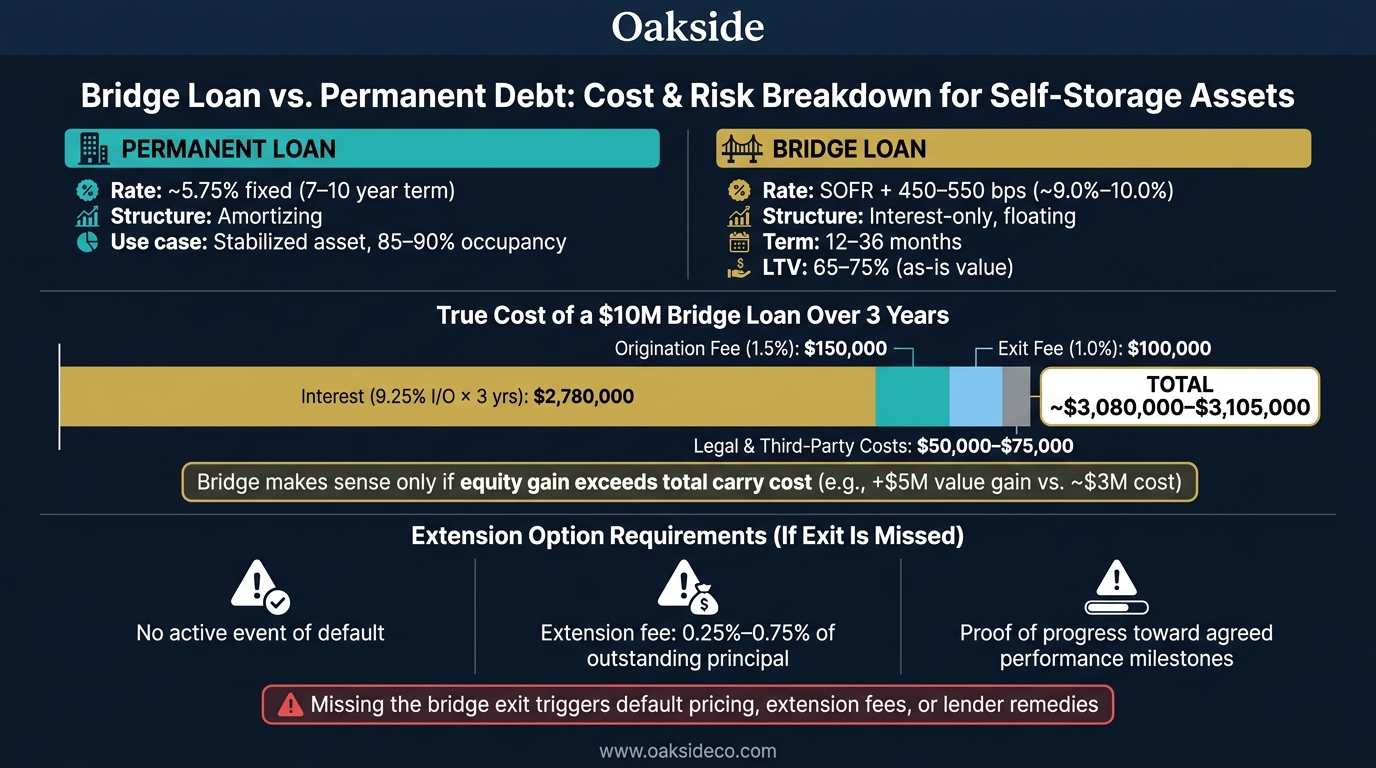
Bridge Loan vs. Permanent Debt: Storage Refinance Gap Breakdown
Bridge debt gives you room to move, but that room isn’t cheap. You get speed and flexibility, but you also take on a higher carry and a much shorter timeline. In plain English: bridge debt fixes a timing issue, not a bad deal.
Higher carrying costs and fee load
Bridge debt costs a lot more than permanent debt. A stabilized self-storage facility might qualify for a fixed-rate permanent loan at about 5.75% for 7–10 years. Put that same asset into a bridge loan during lease-up, and the pricing can jump to SOFR + 450–550 bps, which puts the all-in rate around 9.0%–10.0%.
That spread adds up fast. On a $10 million bridge loan with a 9.25% interest-only coupon, three years of interest runs about $2.78 million before fees. Then stack on a 1.5% origination fee or $150,000, a 1.0% exit fee or $100,000, plus around $50,000–$75,000 in legal and third-party costs. At that point, the carry load starts to feel heavy.
The math has to work. If the plan moves a property from its current value to a stabilized value and adds $5,000,000 in equity, while total bridge financing costs land near $3,000,000, the deal can still make sense. But if the projected bump in value is thin, those fees and interest costs can eat into returns in a hurry.
So that’s the trade: higher cost and a shorter exit window in exchange for speed and flexibility.
The biggest risk is missing the bridge exit
This is where things can go sideways. The main risk is simple: the loan matures before the property meets permanent-lender standards. If lease-up takes longer than planned, street rates stop moving, capex goes over budget, or permanent lenders pull credit tighter, the asset may not be ready for takeout financing when the bridge loan comes due.
Yes, extension options are common. But they come with strings attached. Most require:
- No event of default
- An extension fee of 0.25%–0.75% of outstanding principal
- Proof that the deal is moving toward the agreed performance targets
If the exit gets missed, the cost can climb fast through default pricing, extension fees, or lender remedies.
When a bridge loan is disciplined versus when it just delays the problem
This is the part that matters most. A bridge loan should give the asset enough time to reach the point where permanent debt makes sense. If that path is clear, the bridge serves a purpose. If not, it may just be an expensive pause button.
"A disciplined bridge loan funds a clearly articulated path – from current performance to permanent-lender metrics – with checkable milestones and contingency capital, whereas undisciplined bridge use simply adds higher-cost leverage to an asset whose story does not change." – Cameron Vale, President at Oakside
That’s the line in the sand. A bridge loan is disciplined only when it funds a measurable path to permanent debt. If it only buys time, it adds cost without closing the gap.
Conclusion: A bridge loan works when the path to permanent debt is clear
In self-storage and boat/RV deals, refinance gaps usually come down to timing. The loan comes due before the property hits the marks needed for permanent debt, whether that’s occupancy, NOI, completed site work, or lender terms.
That’s where bridge debt can help. But it only works when the exit is realistic and the bridge term lines up with the actual gap. Put simply: the plan only works if the property is close enough to permanent-debt standards to get there on schedule.
So the issue isn’t whether bridge debt exists. It usually does. The issue is whether the exit is real.
And that’s the test that matters most: can the refinance exit be supported within the bridge term, with enough reserves in place to handle delays?
For owners dealing with a near-term maturity, the next move is a hard look at whether that bridge exit holds up. Oakside Co helps owners evaluate debt timing, stress-test stabilization plans, and line up capital decisions with the asset’s lifecycle.
Key takeaways for owners facing near-term maturities
When maturity is close and refinance options are getting tighter, discipline matters. Before closing on bridge debt, run it through three filters:
- Diagnose the gap precisely. Is the issue occupancy, NOI, capex, or a lender problem? The source of the gap shapes the right bridge structure and term.
- Size the bridge to the real plan, not the optimistic one. Model a downside case: slower lease-up, flat street rates, or a construction overrun. Then check whether the asset can still support the exit under those conditions.
- Start takeout planning at least 6 months before maturity. Lender talks, updated operating data, and a clear milestone timeline all take time to put together. Wait until the bridge is almost due, and your leverage shrinks while your options get squeezed.
If the takeout path isn’t clear, bridge debt can add cost a lot faster than it adds value.
FAQs
How do I know if my refinance gap is temporary or structural?
Run a sensitivity analysis on your underwriting model. In plain English, pressure-test the deal before the lender does.
Stress-test occupancy, rent growth, and debt service coverage. Try slower revenue months and downside cases, not just the rosy version on the first tab of the spreadsheet. If the property still supports the lender-required debt service coverage ratio – typically 1.20x to 1.35x – the gap is more likely temporary.
If it doesn’t, the issue may be structural. That’s when the numbers start telling a tougher story. A wide spread between levered and unlevered IRR, along with a clear equity-wipeout point, are major warning signs.
What occupancy and NOI levels usually make a storage asset financeable?
Lenders usually look for a DSCR of at least 1.3x and stabilized occupancy in the 82% to 92% range for self-storage financing.
But occupancy alone doesn’t tell the whole story. Most lenders pay close attention to economic occupancy, not just physical occupancy, to make sure revenue isn’t being padded by concessions or weakened by delinquencies.
As Nolen Masserman, Managing Director at Oakside, notes, self-storage assets trade on capitalization rates applied to stabilized NOI.
When does a bridge loan solve the problem instead of just delaying it?
A bridge loan helps when the property just needs more time to get to stabilization. That usually means giving the asset enough runway to hit the marks permanent lenders want, such as 82% to 92% occupancy. It tends to make sense for short-term timing gaps, like lease-up delays or minor site work.
But a bridge loan doesn’t fix a property with deeper problems. If the market has oversupply, occupancy is still sliding, or the deal has a built-in cash flow shortfall, the loan may just push the problem down the road. In those cases, the property may still miss lender targets by maturity, including a 1.20x to 1.35x DSCR.