If cash flow is uneven, I’d lean more on equity. If the property is stable, I’d lean more on debt. That’s the short answer.
In self-storage and boat/RV storage, the capital mix changes three things fast: how much of the deal you keep, how much pressure the property faces each month, and how much personal risk you take on. The article’s core point is simple: equity gives you breathing room but cuts into ownership, while debt costs less on paper but adds fixed payments and loan limits.
Here’s the full picture in plain English:
- Equity
- You give up part of the upside
- You may need investor approval on major decisions
- There are no set monthly loan payments
- It often fits lease-up, development, and value-add
- Return targets are often much higher than debt, with many deals aiming around 17%–24%+ IRR
- Debt
- You keep ownership
- You must make fixed payments
- Lenders may set DSCR tests, borrowing limits, and distribution limits
- Personal guarantees may apply, especially on smaller or boat/RV loans
- It often fits stabilized assets
- Senior loan pricing often lands around the mid-7% to 8%+ range
- Typical self-storage stack
- Senior debt often covers about 60%–75% of project cost
- Equity often fills 25%–40%
- With mezzanine debt, total leverage may reach 75%–80%
- New construction or conversion often needs about 25%–35% equity, and in some lease-up deals 35%–50%
- What I’d watch first
- Can the property cover debt service now?
- Is NOI steady or still ramping?
- How much control am I willing to share?
- Am I signing full recourse?
- What happens if revenue drops 10%–15%?
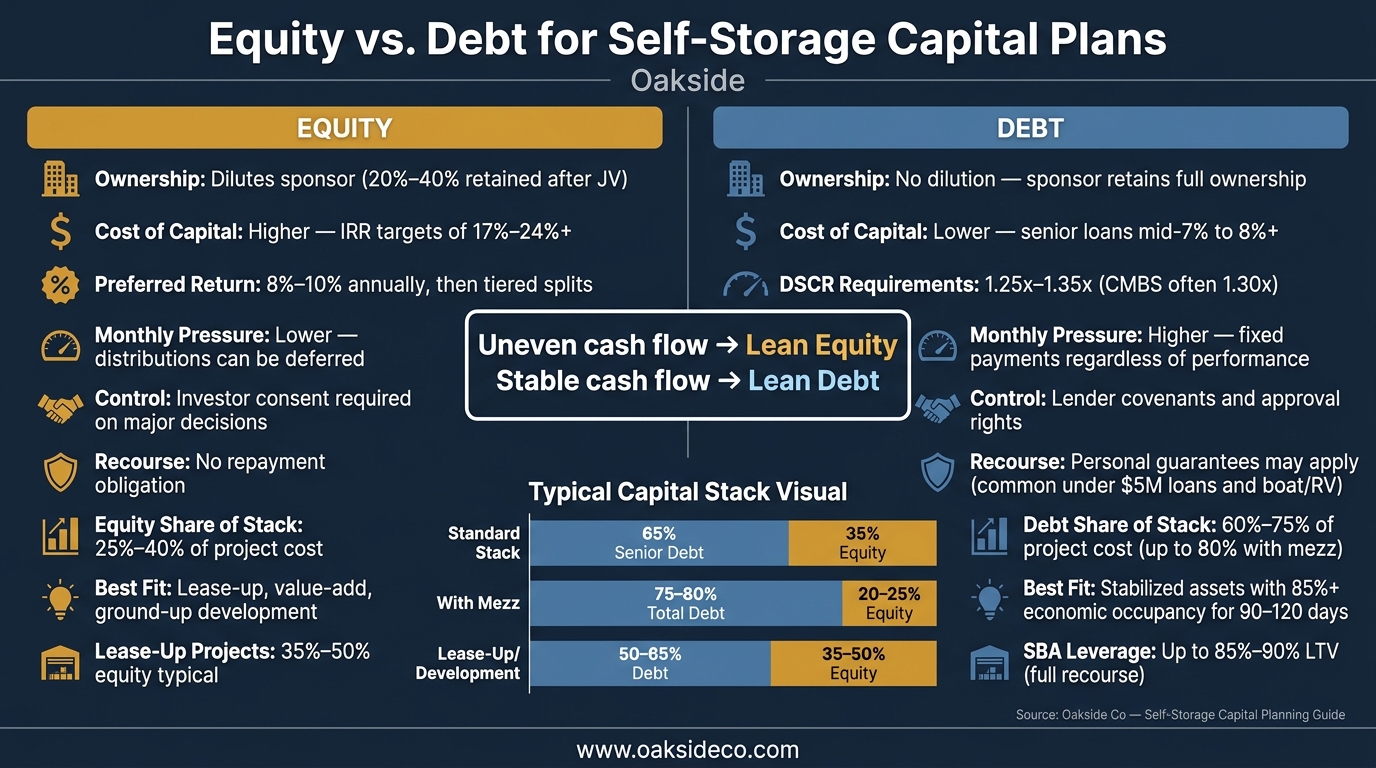
Equity vs Debt for Self-Storage: Side-by-Side Capital Structure Comparison
Quick Comparison
| Factor | Equity | Debt |
|---|---|---|
| Ownership | Dilutes sponsor | No dilution |
| Cost | Higher expected returns | Lower nominal cost |
| Control | Investor consent on big items | Lender covenants and approvals |
| Monthly pressure | Lower | Higher |
| Recourse | No repayment duty | May include personal guarantee |
| Best use | Lease-up, value-add, development | Stabilized cash-flowing assets |
Bottom line: I’d match the capital plan to the property’s current cash flow, not the hoped-for exit. That’s what this article is driving home.
sbb-itb-09b4138
Equity: More Flexibility, More Dilution, Higher Return Expectations
Equity takes the first hit when a deal underperforms. Because of that, it comes with the highest return target. In self-storage and boat/RV storage deals, equity investors often aim for levered IRRs of 17%–22% for ground-up development and 18%–24% for value-add or expansion projects. That’s far above senior debt coupons.
What Owners Give Up and Gain With Equity
Outside equity means giving up part of the upside. It dilutes ownership and splits sale proceeds, refinance proceeds, and cash flow. A sponsor who once owned 100% of a facility may keep only 20%–40% after forming a joint venture with an institutional partner. In many cases, returns are paid through an annual preferred return of 8%–10%, followed by tiered profit splits.
Equity partners usually want a say in big decisions too. That often includes approval rights over major capital moves. Sponsors tend to keep control of day-to-day operations, but they no longer have total authority over decisions that could change the business plan in a material way. Institutional partners also want regular reporting on financial performance, occupancy, and capital projects.
That trade-off on control helps explain why equity is often the better fit at the start of a deal.
What does the sponsor get in return? Flexibility. Equity does not come with mandatory monthly principal and interest payments. That means cash can go toward conversions, marketing, and rate management during lease-up instead of going straight to debt service. For a project that still needs time to find its footing, that room matters.
Once cash flow settles down and becomes more predictable, debt often starts to make more sense.
How Equity Fits Value-Add and Lease-Up Deals
For properties with uneven cash flow – like a rebrand, conversion, or lease-up play – using more equity lowers the risk of loan default. It also gives sponsors space to spend on operational changes that may hurt income in the short term. That’s one reason many banks now ask for 25%–35% equity in new self-storage construction or conversion deals: they want a buffer before they lend.
A common development capital stack is about 65% debt and 35% equity, with an 18- to 30-month lease-up period where equity covers operating losses. In plain English, debt is sized to current cash flow, and equity carries the ramp-up period. It’s a disciplined setup that helps avoid covenant stress while the plan is still being executed.
That higher cost is the trade for flexibility, and flexibility matters most before the asset reaches stabilization. Debt can lower the cost of capital, but it also brings payment pressure and recourse risk.
Debt: Lower Cost, No Dilution, More Cash Flow Pressure
Where equity gives you room to breathe, debt gives you cheaper capital but asks for something in return: fixed payments. That tradeoff is why debt usually works better for stabilized assets than for lease-up deals or heavy value-add projects.
Senior Debt, Covenants, and Recourse Risk
Self-storage and boat/RV deals usually rely on bridge debt, construction debt, or permanent debt based on where the asset sits in its life cycle. Bridge loans are short-term, usually 12 to 36 months, and often come with interest-only periods. They’re often used for lease-up or value-add deals when permanent financing isn’t on the table yet. Permanent loans are the long-term route: usually 5- to 10-year fixed-rate terms with 25- to 30-year amortization for self-storage, and 15- to 25-year amortization for boat/RV storage.
Debt may be cheaper, but it comes with lender guardrails. Those guardrails usually show up as covenants, such as:
- Minimum debt service coverage ratios (DSCR)
- Limits on more borrowing
- Restrictions on cash distributions
- Lender approval for big moves like a sale, refinance, or major capex
For stabilized self-storage, lenders often want 1.25x to 1.35x DSCR, which means NOI must cover debt service by that margin. CMBS lenders often ask for 1.30x, while SBA 504 programs usually target 1.25x.
Recourse is the other big risk on the ownership side. In boat/RV storage, banks often require full recourse. In plain English, that means a personal guarantee backs the loan, and the lender can go after the borrower’s personal assets if the property defaults. Nonrecourse terms are more common when leverage is lower, and some institutional lenders will offer them on stabilized self-storage deals. SBA 7(a) and 504 loans can push leverage higher, up to 85% to 90% LTV in some cases, but they’re usually full recourse and may come with heavy prepayment penalties.
Why Debt Often Fits Stabilized Assets Best
Most permanent lenders want to see 85%+ economic occupancy held for 90 to 120 days before they view a property as stabilized and ready for long-term financing. Once a facility gets there, it can often support 65% to 75% LTV with a fixed rate.
Here’s the hard part: when NOI drops, debt doesn’t adjust with it. The payment still has to be made. If coverage slips below the covenant line, the lender may have the right to step in. That’s why high leverage on a property that hasn’t fully stabilized can turn a manageable deal into a stressful one.
That tradeoff stands out even more in a side-by-side look at dilution, control, and cash flow pressure.
Equity vs. Debt: Side-by-Side Comparison for Capital Planning
Dilution, Control, and Recourse
Equity means giving up part of the deal. Investors share in the upside, but they also usually get approval rights over major decisions. Debt works differently. You keep ownership, but you take on loan covenants, lender oversight, and the risk of default remedies if things go sideways.
In self-storage and boat/RV deals, that tradeoff often comes down to one thing: can the property carry fixed payments now, or does it need room to breathe during lease-up? That choice affects control, cost, and the pressure you’ll feel while operating the asset.
Recourse is another line item that deserves close attention. It can put the sponsor on the hook personally. Many commercial loans under $5 million are recourse and backed by a personal guarantee. And even when a loan is labeled nonrecourse, that doesn’t mean the sponsor is fully off the hook. Carve-outs for fraud, misuse of funds, or voluntary bankruptcy can still trigger full personal liability.
Cost, Closing Speed, and Operating Pressure
If you look only at pricing, debt usually wins. Senior self-storage loans often land in the mid-7% to 8%+ range. Common equity investors in value-add and development deals often target 12% to 18% IRR, and in some ground-up development cases, 18% to 25%+. That gap is a big reason sponsors lean toward debt when the property can support the payments.
Closing speed is less about whether the money is debt or equity and more about how much work needs to get done. Lenders usually need an appraisal, title work, an environmental review, and sometimes a property condition report. Equity can move fast if the money is already lined up. But when a deal involves a syndication with many investors, the legal and deal-structure work can slow things down too. In plain English: speed comes down to diligence and how ready the capital is.
The biggest difference in day-to-day operations shows up in cash flow pressure. This pressure is often tied to how self-storage cap rates influence valuation and exit strategies. Debt service is fixed. It doesn’t shrink when occupancy slips or seasonality hits revenue. Equity is more flexible. Distributions can be reduced or deferred so cash can go toward leasing, marketing, or property upgrades while the asset is still ramping up.
Equity vs. Debt Comparison Table
| Factor | Equity | Debt |
|---|---|---|
| Ownership dilution | Yes – investors share in upside and downside | No – sponsor retains full ownership |
| Cost of capital | Higher return expectations | Lower nominal cost |
| Control | Investor consent rights often apply to major decisions | Lender covenants and approval rights; no ownership transfer |
| Recourse | No repayment obligation; capital is at risk | Possible; personal guarantees may apply |
| Closing speed | Can be faster with committed capital, slower with multi-investor syndications | Driven by third-party reports and lender underwriting timelines |
| Cash flow pressure | Distributions are discretionary and can be deferred during lease-up | Fixed debt service regardless of short-term performance |
| Best fit | Value-add, lease-up, development, or heavy repositioning | Stabilized assets with dependable cash flow |
Choosing the Right Mix by Asset Type and Investment Goal
Guidelines by Asset Type: Value-Add, Lease-Up, and Stabilized
Use the comparison above to line up leverage with the asset’s cash-flow swings. The right capital structure comes down to risk, income, and timing.
For value-add deals, a heavier equity mix and less debt usually makes sense. These deals have more execution risk, so extra equity gives you breathing room while you renovate, reposition, or fix operations. Lenders often underwrite them at 55%–65% LTV, and keeping senior debt in that band can help keep DSCR in check during the business plan instead of pushing the deal into covenant trouble.
Lease-up and ground-up projects usually need the most equity. Early cash flow is often thin, or even negative, so these deals commonly need 35%–50% equity of total project cost. That’s often paired with construction loans that have built-in interest reserves. A project set up at 65% debt and 35% equity has much more room to handle a slow lease-up than a deal stretched to 80% debt.
As occupancy improves and NOI becomes steadier, the capital mix can lean more toward debt. That’s where stabilized assets stand out. Predictable NOI can support 65%–75% LTV permanent financing, and lower-cost debt can lift equity returns when income is steady. Owners of stabilized facilities with consistent DSCR above 1.35x–1.50x are often in a good spot to use more debt, as long as they stress-test the deal first for a 10%–15% revenue drop and a higher refinance rate before moving ahead.
Conclusion: Match Capital to Risk, Cash Flow, and Control Priorities
Use equity when the path is less certain, debt when cash flow is steady, and a mix when the deal sits somewhere in between. The best structure should follow the asset’s operating profile, not wishful thinking.
Oakside Co uses asset-level data and scenario modeling to test how different debt-to-equity structures perform across base, upside, and downside cases.
FAQs
How do I choose the right debt-to-equity mix?
Choose the right debt-to-equity mix by stress-testing how much of a market drop or cap rate expansion your equity can take. In plain terms, you want to know how much pain the deal can handle before the numbers start to break.
Track DSCR every month, not just with fixed assumptions in a spreadsheet, and try to keep it in the 1.20x to 1.35x range even during slower revenue periods. That monthly view gives you a much better read on whether the property can carry its debt when income softens.
It also helps to model closing costs line by line as early as the LOI stage. Small items add up fast, and if you wait too long, your upfront cash needs can look a lot different than you expected.
The right structure comes down to the size of the deal, how much cash you need at closing, and whether the plan can handle volatility, including refinancing risk.
When is a self-storage deal considered stabilized?
In Oakside’s self-storage underwriting, a deal is usually treated as stabilized once occupancy hits about 85% to 90%.
You’ll often see this called the 85%–90% occupancy threshold.
How much recourse risk should I accept?
The right level of recourse risk comes down to two things: your cash needs and how much personal liability you’re willing to take on.
Non-recourse debt can help shield your personal assets. The tradeoff is that lenders often set tighter conditions.
Recourse debt can sometimes help you get better loan terms. But there’s a catch: if the borrower defaults, you may be on the hook personally.
One more thing to nail down: if a buyer takes over your current debt, get written proof on whether any personal guarantee will be released. Don’t leave that to a handshake or a verbal promise.