If I own an original Opportunity Zone investment, I need to plan for a tax bill on December 31, 2026 even if I do not sell. That is the big takeaway. From there, I usually have three paths: sell before year-end, keep holding until I can use the 10-year tax rule on later growth, or use a refinance or recap to help pay the 2026 tax.
Here’s the short version:
- The 2026 tax event is automatic for deferred gain that is still in the QOF.
- Selling is optional. I can still hold after 2026.
- If I hold at least 10 years, later growth may be free from federal capital gains tax when I sell, if the election is made the right way.
- A 2026 sale can create one large tax year because the deferred OZ gain and the sale gain may both hit the 2026 return.
- Refinancing or bringing in a new partner can create cash to cover taxes without a full exit.
- Self-storage and boat/RV owners need to watch pricing, debt costs, and local buyer depth.
- In 2026, self-storage acquisition debt is running around 5.5% to 6.5%.
- Stabilized self-storage cap rates are around 5.8% to 6.2%.
- Boat/RV transaction volume fell from 142 deals in 2022 to 59 in 2024, so selling fast may be harder in that niche.
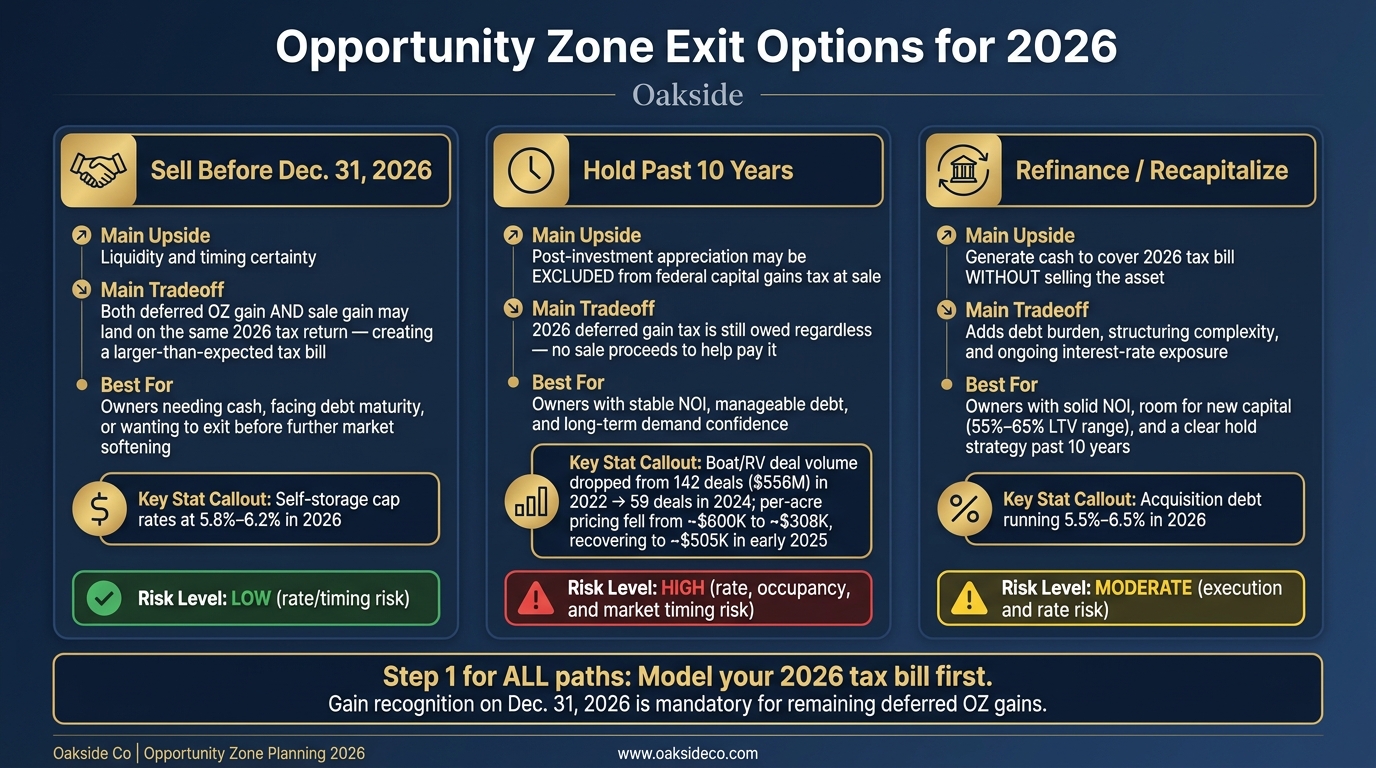
Opportunity Zone Exit Options 2026: Sell, Hold, or Refinance?
Quick comparison
| Option | Main upside | Main tradeoff | Best fit |
|---|---|---|---|
| Sell before Dec. 31, 2026 | Liquidity and timing certainty | Tax may hit hard in 2026 | Owners who want cash or need to exit soon |
| Hold past 10 years | Later growth may avoid federal capital gains tax | I still owe the 2026 deferred-gain tax first | Owners who can carry the asset and wait |
| Refinance / recap | Cash for the 2026 tax without a full sale | Debt, partner, and structuring issues | Owners with solid NOI and room for new capital |
My bottom line: I should model the 2026 tax bill first, then compare sale, hold, and refinance paths based on cash flow, debt, and what buyers in my market will pay.
Exit Option 1: Hold Past 10 Years and Sell Later
For investors who can keep holding after year 10, 2026 is a tax checkpoint, not a forced sale date. The deferred gain comes due in 2026, but if the owner keeps the investment, they can still exclude all post-investment appreciation from federal capital gains tax when they sell later.
That shifts the 2026 decision from Do I have to sell? to Is this asset worth waiting for? That question matters most for self-storage and boat/RV owners. These assets can produce enough cash flow to support a longer hold, but they can also be harder to sell fast when buyer demand is light.
When a Sale After 10 Years May Lead to a Better After-Tax Result
This route tends to make more sense when the property can cover debt service and still produce steady cash flow after 2026. Self-storage and boat/RV assets with durable NOI and debt that isn’t too heavy are stronger fits.
After 10 years, owners have two main sale paths: they can sell the QOF interest, or the QOF can sell the property. Either path can qualify for the exclusion if the election is filed the right way. That’s why tax counsel should be involved early, not at the last minute.
2026 Market Factors That Support or Hurt a Longer Hold
A longer hold only works if the market gives owners a reason to wait. In plain terms, that usually means cap rates need to compress or financing costs need to come down.
For self-storage, stabilized assets in 2026 are trading at cap rates of about 5.8% to 6.2%. If financing gets easier later in the decade and cap rates move down, owners who push through today’s pressure could sell at much better values later. And if that gain qualifies, the appreciation may be tax-free at the federal level.
Boat/RV storage is a bit trickier. National transaction volume fell from 142 trades ($556 million) in 2022 to 59 trades in 2024. Over that same stretch, per-acre pricing dropped from about $600,000 to about $308,000. Early 2025 showed some bounce, with pricing recovering to about $505,000 per acre, but the buyer pool is still thin.
So for boat/RV owners, holding longer may be less about tax upside and more about waiting for the market to catch up.
Table: Sell in 2026 vs. Hold Past 10 Years
| Factor | Sell in 2026 | Hold Past 10 Years |
|---|---|---|
| Post-investment appreciation | Taxable at sale | Potentially excluded from federal capital gains tax |
| Execution timing | Must close before Dec. 31, 2026 | Can sell any time after year 10 |
| Buyer demand (self-storage) | Moderate; cap rates elevated | May improve if rates normalize |
| Buyer demand (boat/RV) | Thin; volume still recovering | More time to aggregate or reposition |
| Financing risk | Exits before future rate uncertainty | Exposed to loan repricing and credit cycles |
| Operational burden | Ends at closing | Requires sustained management through hold period |
| Best fit | Owners needing liquidity or facing debt maturity | Owners with stable NOI, manageable debt, and long-term demand confidence |
Owners who need liquidity before year-end should compare this route with a sale before Dec. 31, 2026.
Exit Option 2: Sell Before or Near December 31, 2026
If a longer hold doesn’t fit the asset or the balance sheet, the next move is a clean sale before year-end. This path is often about certainty, not maximum tax deferral. Sell before Dec. 31, 2026, and you bring the tax bill forward, but you also remove a lot of waiting and timing risk.
Why Some Owners Are Selling Earlier
Some owners are moving sooner to lock in today’s pricing before higher rates, weaker property performance, or less buyer interest puts pressure on values. That logic shows up a lot in self-storage and boat/RV deals, where occupancy or rent growth may be losing steam. If the market feels like it’s starting to cool, waiting can get expensive.
Property condition also matters. In some cases, owners would rather sell now than write checks for upgrades in the near term. A boat/RV facility with major capital needs coming up is a good example. If that spend is around the corner, selling before it hits may make more sense than funding it and hoping the market bails you out later.
Tax and Process Items to Review Before Listing
Before listing, it helps to do a tight pre-sale review. The goal is simple: protect the sale price and avoid tax surprises.
That review should cover three direct items: confirm QOF compliance with the 90% qualified asset test and other OZ rules; verify the holding-period dates with precision, including the date the QOF interest was acquired; and refresh valuations using current self-storage and boat/RV sales comps so the tax modeling reflects the market as it is now, not six months ago.
You’ll also want tax advisors to model federal and state cash tax needs in U.S. dollars for each timing path. A sale before Dec. 31, 2026 can put both the deferred OZ gain and the sale gain on the same 2026 return, which can make the total tax bill much larger than some owners expect at first glance. That’s why the math should be done before the property goes to market, not after bids come in.
Table: Sell in 2025, 2026, or Hold and Sell Later
The tradeoff here is pretty plain: take liquidity earlier, accept a larger 2026 tax hit, or wait for a later exit tied to the 10-year plan.
| Factor | 2025 Sale | 2026 Sale (before Dec. 31) | Hold and Sell Later |
|---|---|---|---|
| Tax impact | Deferred gain recognized earlier; earlier tax event | Both deferred OZ gain and sale gain typically land on the 2026 return | Deferred gain recognized Dec. 31, 2026 regardless; future sale may still qualify for the 10-year appreciation exclusion |
| Net proceeds timing | Cash available sooner for redeployment | Proceeds can help cover the 2027 tax payment | Tax bill arrives in 2027 without sale proceeds; future sale proceeds arrive later |
| Rate and timing risk | Lowest; exits before potential further rate volatility | Moderate; depends on rate conditions through year-end | Highest; exposed to loan repricing and cap-rate shifts through the hold period |
| Leasing/occupancy risk | Lowest; exits before potential softening | Moderate; some early-2026 markets already showing rent and occupancy pressure | Highest; sustained operational performance required through the hold |
| Best fit | Owners wanting maximum pricing certainty and faster capital redeployment | Owners balancing tax timing with current buyer demand | Owners with stable NOI, manageable debt, and confidence in long-term demand |
sbb-itb-09b4138
Exit Option 3: Refinance, Recapitalize, or Restructure Instead of Selling
If a sale is too costly, the next move may be to pull cash out without giving up the asset. That usually means a refinance or recapitalization. Both can create liquidity while keeping the qualifying QOF investment in place.
Using a Refinance or Recap to Cover the 2026 Tax Bill
One of the clearest non-sale options is a cash-out refinance. A stabilized self-storage or boat/RV property with strong net operating income can often support new debt in the 55% to 65% LTV range. If the deal is set up within basis and QOF rules, those cash-out proceeds may help pay the 2026 tax bill without forcing a sale.
A partial recapitalization can do much the same thing. Instead of using debt only, the owner brings in a new equity partner who puts in fresh capital in exchange for an ownership stake. That creates liquidity for legacy investors and can still preserve the OZ structure if the recap is mapped out with care.
There’s also a practical debt choice here. Fixed-rate debt gives more payment certainty. Floating-rate debt can work too, but only if the owner is comfortable with rate swings. For family-held assets, the same liquidity event may also open the door to governance changes.
Restructuring for Estate Planning and Post-2026 Positioning
2026 can also serve as a natural moment to reset the ownership setup. Because the 2026 inclusion is basically a cashless event, it makes sense to look at liquidity planning and estate planning side by side.
For a family-owned OZ self-storage portfolio, one workable path is to pair a refinance with a reorganization into family LLCs or trusts. That can make governance, voting rights, and distribution rules much clearer. Voting and non-voting interests may also separate control from economics while keeping long-term upside with the next generation.
Future OZ rule changes are worth watching, but 2026 decisions should be built around the legacy rules in place now.
Table: Refinance or Recap vs. Full Sale
| Factor | Refinance / Recap | Full Sale |
|---|---|---|
| Cash generation | Loan proceeds or new equity; typically non-taxable if structured correctly | Full liquidity at closing, net of debt payoff and closing costs |
| Tax timing | 2026 tax remains due; refinance cash can fund it | Immediate exit and sale-side tax planning at closing |
| Interest-rate exposure | Ongoing; fixed or floating debt adds carrying cost and rate risk | Eliminated at closing |
| Long-term upside | Retained; owner keeps future appreciation and potential 10-year exclusion | Given up at sale |
| Execution complexity | Moderate to high; requires lender underwriting, OZ compliance review, and legal structuring | Moderate; standard sale process with pre-sale tax modeling |
| Best fit | Owners with stable NOI, manageable debt, and a clear hold strategy past 10 years | Owners who want certainty, capital redeployment, or who own assets with near-term capital needs |
Conclusion: Choose the Exit Path Based on Taxes, Liquidity, and Buyer Demand
There isn’t one exit path that fits every OZ self-storage or boat/RV owner in 2026. The right move depends on a few hard numbers: tax liability, leverage, asset performance, and what buyers are willing to pay. And even that framework only helps if the market lines up with the path you pick.
That matters more in 2026 because market conditions are still uneven. Self-storage fundamentals are getting better, but the rebound hasn’t happened evenly across the board. Low-supply markets tend to look better. Boat/RV assets, on the other hand, still trade at wider cap-rate spreads, which can put pressure on sale proceeds. So if you’re counting on a sale to cover both debt payoff and the 2026 tax bill, you need to run those numbers with care.
Main Points for 2026 Planning
With pricing and financing still uneven, this decision comes down to execution. In plain English, owners usually face three paths:
- Sell for certainty
- Hold for the 10-year exclusion
- Refinance or recapitalize to pay the 2026 tax bill while keeping the asset
All three paths start in the same place: model the 2026 tax bill first, then test each option against it. For original OZ investments, gain recognition on December 31, 2026 is mandatory for remaining deferred gains. Pricing, financing, and deal structure can all be shaped around that deadline, but only if planning starts early enough.
Oakside Co supports self-storage and boat/RV owners with disposition planning, buyer outreach, and transaction execution.
FAQs
How much tax could I owe in 2026?
When you sell a commercial property in 2026, taxes can eat up as much as 40% of your gains.
Here’s where that bill can come from:
- Federal long-term capital gains tax can reach 20% on appreciation
- Depreciation recapture is usually 25%
- High-income earners may also owe the 3.8% Net Investment Income Tax
- State taxes can push the total even higher
That’s why planning early matters. A sale can look great on paper, then feel very different once the tax bill shows up.
As Nolen Masserman, Managing Director at Oakside, notes, “Tax planning should begin years ahead of your sale so that tax liability is never an unexpected hurdle at closing.”
Should I sell in 2026 or hold past 10 years?
It comes down to your financial goals, tax plan, and how the property is doing.
In 2026, higher cap rates and borrowing costs have changed the math. Buyers care less about old pricing ideas and more about stabilized NOI and current cash flow. Put plainly: they want to see what the asset earns now, not what it might earn someday.
Holding the property may help with estate planning because of the stepped-up basis under IRC 1014. Selling may make sense if you want liquidity or if you’d rather move capital into another deal through options like a 1031 exchange or a DST.
Can a refinance help cover my 2026 tax bill?
Yes – refinancing can free up cash. That gives you money to handle obligations while keeping control of your facility. It can also help fund other business needs without the immediate tax hit that often comes with a full sale.
That said, a refinance does not create a tax deduction for an existing tax bill on its own. Its main job is to unlock equity.
If your goal is to defer or spread taxes tied to a sale, owners usually look at options like:
- 1031 exchanges
- Installment sales
- Deferred Sales Trusts