The best deal is not the one with the lowest sticker price. It’s the one that still works after diligence, lender review, credits, prorations, and closing math.
When I buy a self-storage or boat/RV site, I don’t treat negotiation as a one-step price fight. I treat it like a process that starts with T-12 NOI, rent roll checks, and occupancy history, then moves through the LOI, PSA, lender timing, retrade choices, and final closing adjustments. A deal can look fine at 65% to 70% LTV and a 1.20x to 1.25x DSCR, then fall apart if the rent roll is off, occupancy slips from 92% to 85%, or closing credits get missed.
Here’s the article in plain terms:
- I need a clear underwriting base before I bid
- I should set return limits and a hard walk-away number early
- I should negotiate terms, not just purchase price
- I need the PSA to lock in deposit rules, reps, credits, and remedies
- I should turn title, survey, physical, and financial findings into dollar asks
- I need lender deadlines to match diligence deadlines
- I should know when to ask for a credit, retrade, holdback, or exit
- I must check prorations, deposits, prepaid rent, and closing statements line by line
A few numbers shape most deals:
- Earnest money: often 1% to 3%
- Diligence period: often 30 to 60 days
- Roof work: often 1% to 3% of purchase price
- Small issues: often under 1% to 2% of price
- Mid-level deal changes: often 2% to 5%
- Major problems: often above 5% to 10%
If I had to sum up the whole guide in one line, it would be this: I protect my net price by tying every part of the deal to verified numbers, written terms, and closing checks.
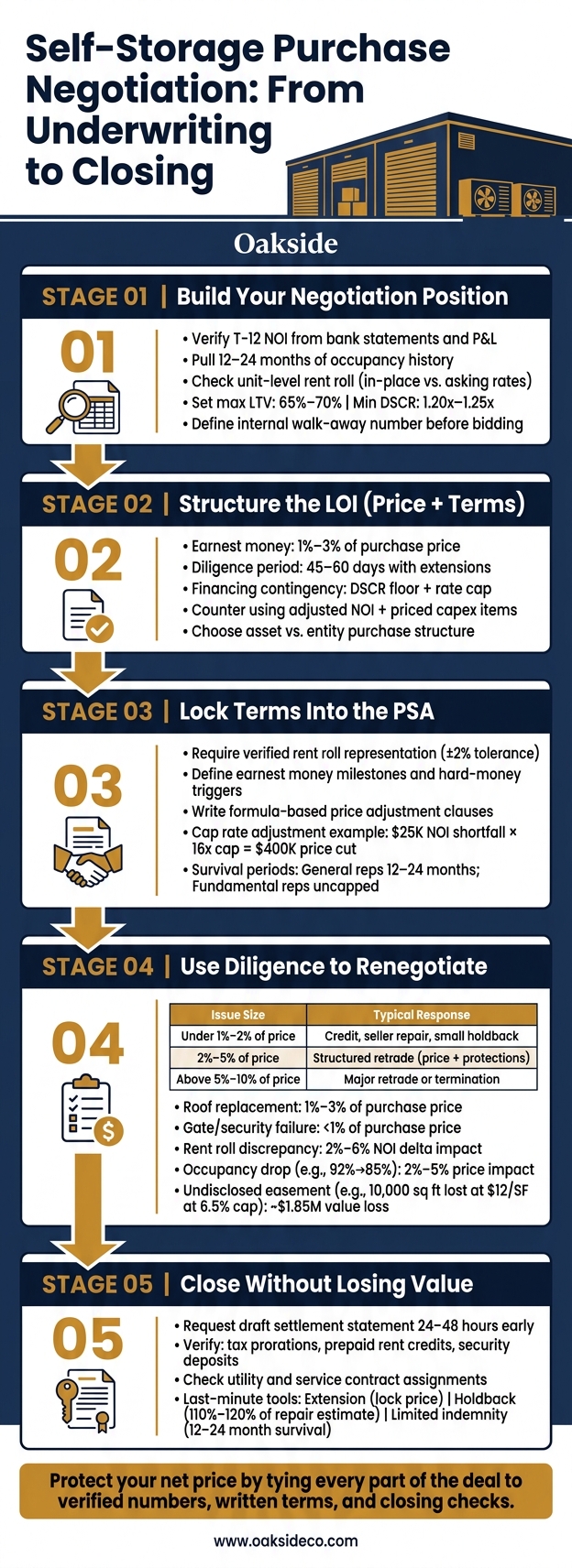
Self-Storage Deal Negotiation Process: From Underwriting to Closing
1. Build Your Negotiation Position Before the First Offer
Start with a verified underwriting base, clear return limits, and a firm walk-away point.
Underwrite to T-12 NOI, Occupancy History, and Verified Rent Roll Data
Build your offer from T-12 NOI, not from the broker package. Pull every revenue line item from the source records: rents, admin fees, late fees, tenant insurance commissions, and any boat/RV or parking income. Check those figures against bank statements, monthly reports, and profit-and-loss statements. Do the same for expenses. If a cost shows up in the package, make sure it shows up in the actual numbers too.
Ask for 12 to 24 months of occupancy data, a unit-level rent roll with actual in-place rates versus current asking rates, rate-change logs, and delinquency history. Then tie that back to bank deposits. This matters more than it may seem at first glance. A facility can report 95% occupancy and still miss revenue expectations if concessions are heavy or if tenants simply aren’t paying on time.
Clean up NOI for one-time items and known tax resets at closing. Underwrite to what the property is doing now, then model upside on its own. That keeps you from mixing current performance with future hopes.
Once the base case is clean, test the deal against your return targets.
Set Return Targets, Leverage Limits, and Walk-Away Points Before Bidding
Before you talk price with the seller, set your limits. Pick your target cap rate based on market comps and asset risk. Set your max LTV, which is often 65% to 70% for self-storage deals. Set a minimum DSCR too. Many lender stress tests use a 1.20x to 1.25x floor.
From there, add your IRR and equity multiple targets for the full hold period. Run base, upside, and downside cases. The goal isn’t just to find a number that works on paper. It’s to see where the deal stops working.
Your walk-away point matters just as much as your target price. Run sensitivities on:
- Price per square foot
- Cap rate
- Interest rate
- Capex
That exercise shows where IRR or DSCR drops below your minimums. Write that number into an internal deal memo before talks begin. Then, if diligence uncovers $300,000 of deferred HVAC work that wasn’t in the capex budget, you already know the answer. Do you need a price cut, a credit, or do you walk? No scrambling. No last-minute guesswork.
That kind of discipline keeps the team lined up when pressure starts building and counters come in fast. Set those limits before the seller responds. They should shape the LOI, not sit buried in an internal file.
Structure the LOI Around Price Plus Terms, Not Price Alone
The LOI should deal with both price and risk. Don’t treat it like a one-line bid. Use it to set earnest money, diligence timing, financing contingency, extension rights, and closing timing along with the purchase price.
A good LOI keeps your first deposit fully refundable during a clearly defined diligence period. Portions should go hard only after set milestones are met. It should also include a financing contingency tied to specific loan terms, such as a minimum DSCR and a max interest rate. That gives you cover if debt markets move between LOI signing and closing.
You can also build in extension rights for lender-driven delays. In many cases, that comes with a small extra deposit so the seller stays comfortable while the deal stays alive.
Use the LOI to lock down these points before legal drafting starts. Here’s how a price-only LOI stacks up against one built around both price and terms:
| LOI Element | Single Fixed-Price LOI | Price-Plus-Flexible-Terms LOI |
|---|---|---|
| Purchase Price | High headline number, thin on supporting assumptions | Grounded in T-12 NOI and market data, with explicit adjustment mechanisms |
| Deposit Risk | 2–3% goes hard quickly, often at LOI acceptance | 1% initial deposit, refundable through diligence; portions go hard only at milestones |
| Diligence Period | Short and fixed (20–30 days), limited extension rights | 45–60 days with built-in extensions tied to lender and third-party report timing |
| Financing Protection | Weak or absent; buyer absorbs rate and underwriting risk | Clear contingency based on defined loan parameters (DSCR floor, rate cap) |
| Seller Financing | Typically none | May include a junior note or structured carryback to bridge valuation gaps |
| Closing Risk | Appears strong but fragile if diligence or debt issues arise | Built around lender and operational timelines, more likely to close at the agreed net price |
A strong term package can beat a slightly higher offer that’s weak where it counts. Next, carry those terms into the PSA.
sbb-itb-09b4138
2. Negotiate LOI Economics and Deal Structure
Once underwriting is set, the next move is price and structure.
Counter on Price Using Operations and Market Evidence
A vague counter doesn’t help. It gives the seller nothing concrete to react to, and it can make it look like your number is just a guess.
Build your counter with specific issues you can verify. If economic occupancy trails physical occupancy because of delinquency or concessions, lay out that math side by side. If payroll or other expenses sit above market peers, benchmark them. If the roof, asphalt, or gate systems have been pushed off, support that with contractor bids, photos, or inspection reports. Each issue should tie back to either an NOI adjustment or a priced capex item.
Then bring in the market data. Pull current asking rents by unit size, note any new supply coming online, and compare that with the seller’s actual rent roll. That contrast matters. It shows where the story lines up with the numbers, and where it doesn’t.
When you send the counter, keep it simple: a short memo or an updated underwriting summary works well. Put the seller’s pro forma next to your adjusted underwriting so the basis for your price is easy to follow.
Present the counter as adjusted NOI and capex, not as a complaint.
After price is anchored, turn to the structure that makes the deal work.
Choose Asset Purchase or Entity Purchase Based on Liability, Tax Basis, and Lender Fit
Asset versus entity structure affects lender fit, old liability, and tax basis. Most buyers lean toward an asset purchase because it limits old liability and fits lender requirements.
| Aspect | Asset Purchase | Entity Purchase |
|---|---|---|
| Tax treatment | Buyer often gets a step-up in basis, which can help with depreciation planning. | Basis step-up may be more limited; tax planning is more nuanced. |
| Liability profile | Buyer can choose more carefully which obligations to assume and leave old liabilities behind. | Buyer usually takes on entity-level liabilities unless those are carved out. |
| Closing complexity | Needs a deed transfer and contract assignments, but most lenders and title companies know the process well. | Can cut down on operational disruption, but needs more corporate documents and consents. |
| Diligence burden | Focuses on property-level diligence: title, survey, environmental, rent roll, and operating records. | Adds diligence for formation documents, tax returns, litigation, and governance. |
| Financing impact | Usually preferred by lenders. | May lead to more lender review and added covenants. |
An entity purchase can still make sense in some cases. Maybe permits sit with the existing entity. Maybe a fast handoff matters. Maybe the seller has tax reasons for keeping the entity in place. But it does add moving parts, and lenders often want more diligence before they agree to finance an entity-level transfer. Get lender approval on structure before you lock entity-level terms into the LOI.
If structure by itself doesn’t close the gap, use credits or seller paper.
Use Seller Financing, Credits, or 1031-Friendly Terms to Improve Execution
When your price and the seller’s number are apart – but not by a mile – structure can bridge it.
A seller carry note can help when conventional lenders are tightening. In many cases, 12–36 months of interest-only payments gives you time to stabilize occupancy and handle deferred maintenance before full debt service starts.
If deferred maintenance shows up before the PSA is signed, a lump-sum repair credit can preserve the headline price while still sharing the cost in economic terms. Be specific in the LOI about the amount, the purpose, and how the PSA will treat that credit. If you leave it fuzzy, it can shrink later.
For sellers focused on taxes, bring up 1031 exchange timing early. You can make the offer easier to accept without changing your economics by offering:
- a defined closing window
- limited extensions tied to extra earnest money
- clear qualified intermediary language
Also state that exchange costs and tax treatment stay with the seller.
Carry these economics into the PSA before diligence starts.
3. Convert the LOI Into PSA Terms That Protect Net Pricing
Turn the LOI’s economic terms into PSA language you can enforce. This is where deal points stop being general business terms and start becoming contract terms that deal with risk, refunds, and closing value.
Negotiate Representations, Covenants, and Diligence Access for Storage Operations
Ask for a representation that the rent roll is true, correct, and complete as of a stated date. It should cover occupied units, rental rates, concessions, delinquencies, and prepaid rents. Also ask for a representation that the unit mix – sizes, climate-controlled versus non-climate, drive-up versus interior – and stated square footage are accurate within a set tolerance, such as ±2%. Add a representation that all tenant agreements use the seller’s standard form attached to the PSA, with no undisclosed side letters or other terms that differ in a material way. If square footage or lease terms are off, NOI moves with them.
Lien law is state-specific, and it controls notices, auctions, and how partial payments are handled. Your PSA should include a representation that all lien sales were conducted in line with applicable state law, and any breach should connect straight to the indemnity clause.
On operating covenants, require the seller to run the property in the ordinary course between signing and closing. Rate changes above 5% by unit type, or above 10% for a tenant block, should need written consent. New concessions should be capped too. For example, no free-rent offers longer than three months without approval.
For diligence access, don’t settle for a one-time document dump. Require weekly software exports, monthly operating statements, bank deposits, and updated rent rolls. Those records become the baseline for diligence and lender review.
Define Earnest Money Milestones and Hard Money Triggers Carefully
Use a refundable deposit during diligence, then let it go hard only after clear, objective milestones. A fully refundable deposit during diligence – often 30–60 days from the PSA effective date – gives you room to test the deal. It should harden only after written diligence waiver, financing approval, or a set go/no-go date.
Institutional earnest money often lands in the 1%–3% range of purchase price, with one piece going hard at diligence waiver and the rest at a later trigger. You can also negotiate one or two extensions of the closing or diligence period in exchange for non-refundable extension fees that apply to the purchase price at closing. Be exact with notice rules – email plus overnight courier, by 5:00 p.m. local time – so no one ends up arguing over whether notice was sent on time.
Even after the deposit goes hard, keep a full refund carveout for a few specific cases:
- seller default
- failure of a defined closing condition outside your control
- an environmental issue above a stated cleanup-cost threshold
Write these carveouts with dollar-based tests, not fuzzy materiality wording. That keeps retrade leverage tied to actual findings instead of delay tactics.
Write Price Adjustment and Indemnity Clauses That Address Known Risks
Price adjustment clauses should turn diligence findings into formula-based PSA remedies, not last-minute haggling at the closing table. For deferred maintenance, put the items in a schedule, assign agreed costs, and state that the buyer gets a closing credit for those amounts. For rent roll gaps, use a capitalization-based adjustment. If actual in-place rent at closing differs from the represented level by more than a set threshold, the purchase price should drop by the NOI variance multiplied by a pre-agreed cap rate multiple. Example: a $25,000 NOI shortfall capitalized at 16x cuts price by $400,000, which helps hold your target yield without reopening the headline number.
| PSA Clause | Buyer-Favorable Version | Seller-Favorable Version | Likely Pricing Effect |
|---|---|---|---|
| Rent Roll Rep | True, correct, and complete as of a specific date; discrepancies trigger price adjustment or termination | General accuracy rep with broad "as-is" language | Protects net price by preserving underwriting assumptions |
| Lien Sale Compliance Rep | Explicit rep plus indemnity for pre-closing violations | Limited or knowledge-qualified rep | Stronger compliance language reduces exposure to tenant claims |
| Rate Change Covenant | Material rate changes require buyer consent | No restriction on pre-closing rate changes | Unchecked rate cuts can erode in-place NOI before closing |
| Earnest Money Hardening | Milestone-based, tied to objective written waiver | Hard at PSA execution or after a very short free-look period | Earlier hardening limits retrade leverage |
| Deferred Maintenance Credit | Specific schedule with agreed amounts credited at closing | Seller discretion to repair or no credit obligation | Clear credits preserve net pricing |
| Indemnity Cap | Higher cap for general reps and uncapped for fundamental reps | Lower cap across more reps | Lower caps reduce post-closing recovery for undisclosed issues |
| Survival Period | Longer survival for general, tax, and environmental reps | Short survival across all reps | Shorter survival limits ability to recover on breaches |
For indemnities, match survival periods and caps to the risk in the deal so the agreed price still means something after closing. General business reps often survive 12–24 months. Fundamental reps – title, authority, and ownership – should last longer, or have no cap. A tipping basket also helps. Once the threshold is hit, recovery starts from dollar one. That can matter a lot when several smaller problems pile up into a meaningful post-closing claim.
Once the PSA sets the reps, remedies, and deposit triggers, diligence has a clear job: test whether the deal still supports the agreed net price.
4. Use Due Diligence and Lender Requirements to Renegotiate Effectively
Use the PSA remedies you already locked in to turn diligence findings into a dollar ask. The goal is simple: test whether the PSA price still fits the asset. If it doesn’t, turn that gap into a specific credit, retrade, holdback, or termination right.
Translate Title, Survey, Physical, and Financial Issues Into Deal Terms
Every material finding should tie to both a dollar amount and a contract remedy before you go to the seller. Documented, priced requests tend to land. Vague complaints usually don’t.
Title and survey issues are one of the most common missed retrade openings. Many self-storage lenders will not close without an ALTA/NSPS survey showing that drive aisles, access roads, unit buildings, and gate locations are inside the legal property lines, while also flagging easements that may affect traffic flow or future expansion. If the survey shows an undisclosed easement that cuts off expansion or blocks signage, put the loss into plain value terms. For example, losing 10,000 rentable sq. ft. at $12/SF/year at a 6.5% cap rate points to about $1.85 million of value loss. That gives you a clear basis for a price cut or a credit tied to lost value. If the issue is an encroachment, get bids for the fix and negotiate either a curative agreement backed by a holdback or a price cut for the risk that remains.
After the title math is done, apply that same standard to physical and financial findings.
Physical findings from a property condition assessment (PCA, ASTM E2018) should be priced with contractor bids before you approach the seller. A roof replacement on a multi-building storage site often costs 1%–3% of purchase price, depending on building size and replacement cost. For boat/RV lots, badly worn pavement or drainage failures are common and can get expensive fast. In those cases, a credit or repair escrow with a clear scope of work usually makes sense. Gate and security system failures in self-storage are often smaller items, often under 1% of price, and sellers often handle them through pre-closing repairs when a lender treats them as life-safety or key operating items.
Financial discrepancies often hit price the hardest. If verified T-12 NOI comes in below the offering memo, rerun your underwriting and apply the agreed or market cap rate to that shortfall. Then show the seller the math, backed by the reconciled rent roll and access system records. That’s not gamesmanship. It’s the paper trail for a price change. Use price cuts for repeat value problems. Use indemnities for one-time, past-period issues. That keeps the ask tight and easy to defend.
Coordinate PSA Deadlines With Lender Underwriting and Third-Party Reports
Lender timing can chip away at your leverage fast. If your financing contingency expires before the appraisal shows up, you’ve lost a key piece of support for a renegotiation.
Map report timelines before you sign the PSA. Title and survey review usually take 3–5 weeks. Phase I ESAs (ASTM E1527-21, usually $2,500–$5,000) and PCAs each take about 2–4 weeks. Appraisals vary by market, but they often run alongside the other reports. Build PSA deadlines around those timelines, not around what sounds good to the seller. It also helps to hold off on ordering the appraisal until you have a handle on early title and survey issues. If a major encumbrance appears after the appraisal is underway, the lender may get blindsided, and your response window can shrink in a hurry. Automatic extension rights tied to third-party delays can help too, so a slow Phase I doesn’t force you to waive diligence too soon.
Lenders underwrite against current rent rolls, access logs, and T-12 NOI, and they may require minimum occupancy or DSCR levels before loan committee. Because of that, require the seller to deliver updated rent rolls and occupancy reports at set times and again before loan committee submission. If occupancy slips between LOI and closing – for example, from 92% to 85% – that is both a loan issue and a negotiation lever. The lender’s updated underwriting and revised DSCR give you outside support for a price cut or a short-term performance escrow.
With timing lined up, the next step is deciding whether the issue calls for a credit, a retrade, or an exit.
Decide When to Push for a Retrade, Accept a Credit, or Walk Away
Not every diligence item deserves a retrade. The issues that matter are the ones that change price, risk, or day-to-day operations. A common rule of thumb looks like this:
- Issues under 1%–2% of purchase price are often solved with credits, seller repairs, or small holdbacks.
- Issues in the 2%–5% range may support a structured retrade, often a mix of price changes and deal protections.
- Issues above 5%–10% of purchase price often support a major retrade and, if the seller refuses to move, a sound reason to terminate.
The table below shows how common findings often turn into buyer responses and net price effects:
| Diligence Finding | Typical Buyer Response | Negotiation Lever | Approximate Effect on Net Price |
|---|---|---|---|
| Roof at end of useful life | Price reduction or closing credit | PCA report + contractor bids | 1%–3% of purchase price |
| Pavement/drainage failure (RV/boat lot) | Credit or escrow holdback with repair plan | PCA + contractor bids | Varies by scope and repair cost |
| Gate/security system failure | Seller repair pre-closing or modest credit | Lender life-safety condition | <1% of purchase price |
| Rent roll discrepancy vs. offering memo | Full underwriting refresh; potential price retrade | Verified rent roll, access logs, T-12 reconciliation | 2%–6% depending on NOI delta and cap rate |
| Occupancy drop between LOI and closing | Price reduction or performance escrow; possible loan resizing | Lender’s revised DSCR and updated appraisal | Varies; often 2%–5% |
| Undisclosed easement limiting expansion | Price reduction based on lost NOI model | Survey + cap-rate-based value impact analysis | Proportional to lost rentable area |
| Encroachment on neighboring land | Curative action + holdback or price discount | Survey + boundary-line agreement | Depends on reconfiguration cost and residual risk |
| Phase I ESA recognition condition | Monitor only, or Phase II if warranted | Phase I report under ASTM E1527-21 | Minimal unless Phase II confirms contamination |
If you do retrade, bring one package, not a scattershot list of complaints. Tie each ask to a report page, photo, or financial reconciliation. Show exactly how the revised deal still works for both sides. And if the combined issues drag projected returns below your walk-away line and price or terms can’t fix it, termination is the right move. Closing at the wrong price isn’t a win.
5. Close the Deal Without Losing Value in Final Adjustments
Once diligence is done, the last negotiation is the settlement statement. After the PSA is signed, the closing statement is where the deal terms turn into actual dollars.
Review Pre-Closing Deliverables, Prorations, and Credits Line by Line
Ask for the draft settlement statement at least 24–48 hours before closing. Then compare it line by line against the PSA, the lender term sheet, and the updated diligence package. You should also check lender closing conditions and fees, because changes there can shift the buyer’s cash to close.
The spots where value usually slips are pretty predictable: property tax prorations, prepaid rent credits, security deposits, utility adjustments, and service contract assignments.
- Prorate property taxes based on the certified bill and the closing date.
- Credit prepaid rent for the period after closing.
- Credit security deposits in full, since the buyer takes on the refund duty.
Also check that utilities and service contracts – software, pest control, gate maintenance, and marketing – are prorated or assigned the right way, and that any seller prepayments are credited to the buyer after closing. Run each proration on its own and match it against the settlement statement before you sign anything.
If the closing statement doesn’t match the PSA economics, fix it before funds move.
Handle Last-Minute Issues With Extensions, Holdbacks, or Limited Indemnities
If something still needs to be solved, use time, escrow, or indemnity – not a quiet price giveback.
When a material issue comes up right before closing, the fix usually falls into one of three buckets:
- Short extension for timing issues that can be fixed: keep the purchase price locked, require the seller to maintain normal operations, and tie the extension to specific deliverables and a clear deadline. If the seller caused the delay, ask them to pay any lender rate lock extension costs.
- Holdback for repair items with a known price: set it at 110% to 120% of documented repair estimates, spell out the release timeline, and state exactly what proof releases the funds.
- Limited indemnity for open risks that haven’t been fully priced: keep the scope tight, set a cap as a percentage of the purchase price, and include a 12–24 month survival period.
Conclusion: The Best Negotiated Price Is the One That Survives Diligence and Closing
The best negotiated price is the one that survives diligence, prorations, and closing.
FAQs
How do I set a walk-away price before making an offer?
Calculate the minimum net proceeds you’re willing to accept after taxes, broker fees, and closing costs. Set that number early. It gives you a clear line in the sand and helps you stay disciplined instead of reacting on emotion when offers start coming in.
Then run a sensitivity analysis to see where the deal stops meeting your return targets. In plain English: test how much price, income, or expense movement the deal can handle before it no longer works for you. Use conservative downside cases so your walk-away price is based on realistic, stabilized performance – not best-case assumptions.
When should I ask for a credit instead of a price cut?
Ask for a credit when due diligence turns up clear, measurable problems like needed repairs or deferred maintenance. A credit can help offset your out-of-pocket closing costs without the extra hassle of reopening the full purchase price discussion.
A price cut usually makes more sense when you’re dealing with a broader valuation gap or a major shift in property performance benchmarks.
What closing adjustments matter most in a storage deal?
The biggest closing adjustments in a self-storage deal are usually prorations and lender-required reserves. Why? Because they have a direct impact on the final cash you need to bring to closing.
The main items to watch are prepaid tenant rents, property taxes, upfront reserves for taxes, insurance, and replacement costs, along with transfer taxes that can vary by jurisdiction.
These line items can shift the final amount due in a meaningful way, so it makes sense to build them into your underwriting early.