


I’d increase self-storage rent only when the lease and local law allow it - and the added income outweighs losses from move-outs. Before sending notice, I’d check the required timing: 30 days isn’t a nationwide rule, and New York City requires at least 60 days’ advance disclosure for occupancy-fee increases.
Here’s the checklist I’d use:
- Check the lease. Month-to-month rates can generally change for a future rental period. Fixed-term increases usually need an enforceable escalation clause.
- Do the math. Compare local rates and demand, then subtract expected vacancy, concessions, collection losses, and rollout costs.
- Plan the notice. Confirm the lawful effective date, use permitted delivery methods, and keep proof.
- Prepare staff. Explain the change plainly, document move-out options, and set limits for concessions.
- Measure the results. Review retention, complaints, payments, and net revenue at 30, 60, and 90 days.
My bottom line: <u>higher billed rent isn’t the same as higher income</u>. I’d judge each increase by what remains after tenant losses and costs - not by the new rate alone.
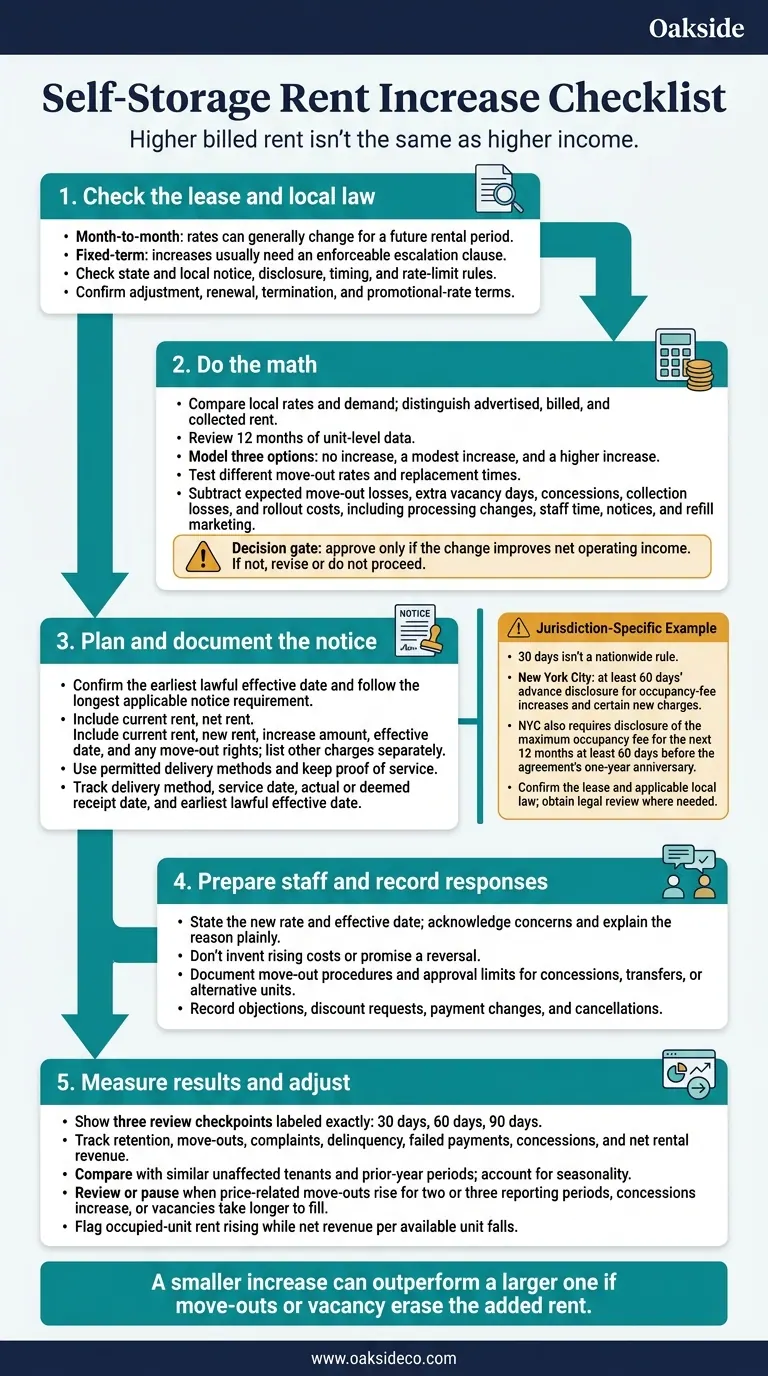
Self-Storage Rent Increase Checklist
Rate-change rules depend on the lease type, notice timing, and local law.
Month-to-month and fixed-term rate changes
Month-to-month rates can generally change for a future rental period. Fixed-term rates generally stay the same until the term ends, unless a clear, enforceable escalation clause allows a mid-term increase. Determine the effective date using the lease term, renewal date, or holdover rules.
Before setting that date, check both the lease and the law.
| Lease or legal issue | Owner action |
|---|---|
| Month-to-month renewal | Confirm that you can adjust rent at renewal. |
| Fixed-term occupancy | Verify that an enforceable escalation provision allows a mid-term rent increase. |
| State and local requirements | Check notice, disclosure, timing, and rate-limit rules. |
Notice timing
Thirty days is a starting point, not a national rule. Follow the longest notice requirement that applies. New York City’s self-storage licensing guidance requires at least 60 days’ advance disclosure of an occupancy-fee increase and certain new charges. It also requires disclosure of the maximum occupancy fee for the next 12 months at least 60 days before the agreement’s one-year anniversary.
Include the current rent, new rent, increase amount, effective date, and any move-out rights in the notice. List other charges separately. Use permitted delivery methods and keep proof of service. For each tenant, track the delivery method, service date, actual or deemed receipt date, and earliest lawful effective date.
The lease language must match how you give notice.
Rate-change clause requirements
State which amounts may change: base rent, recurring fees, administrative charges, and other permitted charges. Define the notice and delivery requirements described above, rental-period timing, and termination rights. Address promotional discounts and insurance-related charges separately. That way, an expired discount or coverage charge won’t look like an unexplained rent increase.
A clause allowing future adjustments isn’t automatically enforceable everywhere. Have counsel review any 30-day clause and any fixed-term escalation formula. Avoid vague rights to change charges, hidden fees, and retroactive increases.
Legal permission is just the starting point. The increase still needs to improve returns. Estimate the added monthly revenue, then subtract expected losses from move-outs, extra vacancy days, concessions, and collection loss. Also account for payment-processing changes, staff time, notice costs, and marketing to refill units. Approve the change only if it improves net operating income. Base the decision on unit-level performance, not billed rent alone.
Compare New-Customer and Existing-Tenant Rates
Review 12 months of unit-level data: current rent, billed rent, collected rent, occupancy, move-ins, move-outs, transfers, days vacant, delinquency, discounts, and collection loss. Group the results by unit size, climate-controlled or drive-up configuration, access features, and boat or RV space.
Compare advertised rates with actual move-in rates, and keep billed rent separate from collected rent. An advertised rate doesn’t tell you what tenants actually pay. Introductory discounts can make it a poor benchmark for increases on occupied units.
Check proposed rents against recent leases for comparable units at your property and reliable local pricing data. High occupancy offers little protection if move-outs are picking up or replacement tenants need larger discounts.
Model three options: no increase, a modest increase, and a higher increase. Test each with different move-out rates and replacement times. Then match the increase to demand timing and property conditions.
Assess Demand, Costs, and Property Performance
Time increases around inquiries, conversions, move-ins, move-outs, and average days to re-rent - not simply the calendar. Factor in housing turnover, college schedules, military relocations, and new storage supply.
For boat and RV storage, assess demand by space length and access needs. Then review local boating, travel, and winterization cycles. Weigh insurance, labor, maintenance, taxes, and utilities against realistic revenue gains.
The next issue is how repeated increases affect retention. This is especially critical as market trends shift toward longer tenant stays.
Once a rent increase is lawful and financially viable, check whether it pays off after tenants respond. Net revenue after move-outs is the test.
A permitted increase can still cost you a tenant. Repeated or abrupt changes can weaken trust and bring planned move-outs forward. Retention also depends on local demand, available alternatives, and tenant needs.
Compare Increase Frequency and Move-Out Risk
Use this table to compare retention risk - not to set prices. Test the frequency of increases separately from their size, comparing similar tenants by unit type, tenure, channel, and prior increases. Record each change in dollars and as a percentage. Keep fees, policies, and unit service levels unchanged during the test. If retention risk grows, focus next on front-line communication.
| Adjustment approach | Revenue opportunity | Customer reaction | Notice cycles, disputes, and errors | Retention effect |
|---|---|---|---|---|
| Moderate, well-spaced adjustments | More gradual revenue gains | May be easier to accept when clearly explained | Fewer notice cycles and potentially fewer disputes | May limit avoidable churn; verify with property data |
| Frequent or abrupt adjustments | Faster potential gross-rent growth | Greater risk of complaints or move-outs | More notice cycles, more disputes, and more room for error | Can weaken retention and offset revenue gains |
How Should Staff Respond to Customer Objections?
Give staff a consistent script: state the new rate and effective date, acknowledge the concern, and explain the reason plainly, such as a pricing review or market shift. Don’t invent rising costs or promise a reversal.
Staff should provide the documented move-out procedure, including required notice, access deadlines, payment obligations, and any refund rules that apply. Document who can approve concessions, transfers, or alternative units, along with their approval limits. Then measure whether the script reduced complaints, concessions, and move-outs.
Track Net Revenue After Rate Changes
Review results at 30, 60, and 90 days, comparing them with similar unaffected tenants and prior-year periods. Track move-outs, retained tenants, delinquency, failed payments, complaints, concessions, and net rental revenue. Break down results by tenant tenure, unit type, channel, and prior increase history. Account for seasonality and storage needs ending before linking every departure to price.
Review or pause the program when price-related move-outs rise for two or three reporting periods, concessions increase, or vacancies take longer to fill. Another warning sign: occupied-unit rent rises while net revenue per available unit falls.
A smaller increase can outperform a larger one if move-outs or vacancy erase the added rent. Compare both over the same period, including replacement rent and turnover costs.
Once a rent increase is lawful and financially justified, use this checklist to put it into effect and track results. Flexible leases allow rate changes only within the lease and local law. Weigh market timing and tenant retention results to decide whether the increase is worth it.
- Confirm the pricing structure: month-to-month, fixed-term, or promotional.
- Review the lease clauses for rate adjustments, renewals, termination, and notice.
- Check state and local rules, including caps, formulas, promotional-rate conditions, and emergency restrictions.
- Calculate the new rent and lawful effective date using the current contract rate and required notice period.
- Send written notice through a method permitted by both the lease and the law.
- Keep records: the exact notice, calculations, and proof of delivery.
- Record tenant responses, including objections, discount requests, payment changes, and cancellations.
- Track move-outs, delinquency, complaints, and net revenue. Review pricing regularly rather than increasing rents automatically.
What if my lease and local notice rules conflict?
The law comes before your lease terms. If local law requires more notice for rate changes than your lease allows, you must follow the local notice period.
Check with a local attorney to confirm that your lease language follows current state and local rules where your property is located. This helps reduce risks in running your property and avoid tenant disputes.
How do I calculate a rent increase’s break-even move-out rate?
Find the break-even point where added revenue from a rent increase equals the income lost when tenants leave. There’s no one-size-fits-all formula. Look at how rent changes affect turnover, since larger increases can cause tenants to move out sooner.
Track your monthly move-out rate - move-outs divided by average occupied units - to see whether turnover stays at a healthy level you can maintain after adjusting rents.
How can I test increase frequency without hurting retention?
Start testing rent increases with long-term tenants who consistently pay on time. Keep changes gradual: 3%–8% annually, or smaller increases of $10–$15 every 3–6 months. Avoid steep hikes, especially those above 50%, which can cause a sharp drop in tenant retention.
Time changes around seasonal demand and market conditions. Use your property management software to track each unit’s performance and occupancy, balancing revenue growth with steady, long-term occupancy.