If I had to sum it up in one line: self-storage turns faster, while boat/RV storage stays fuller for longer but moves with the seasons.
Here’s the short version:
- Self-storage usually sees 5% to 8% monthly churn and about 12 to 18 months of average stay.
- Boat/RV storage often runs at 1% to 2% monthly churn with average stay past 24 to 36 months.
- Self-storage move-outs are often tied to life events like moving, downsizing, divorce, or job changes.
- Boat/RV move-outs are tied more to seasonality, vehicle use, and space type.
- In self-storage, promo roll-off, rent increases, and delinquency can push tenants out.
- In boat/RV, enclosed units usually hold tenants the longest, while uncovered parking turns more often.
If you own, buy, or review these assets, this matters fast. A self-storage site may need more leasing and more unit turns, while a boat/RV site may look steadier but can feel the loss of just a few large stalls.
Quick comparison
| Asset | Monthly churn | Average stay | Main turnover driver | Higher-retention setup |
|---|---|---|---|---|
| Self-storage | 5%–8% | 12–18 months | Life events, pricing, delinquency | Climate-controlled, business tenants |
| Boat/RV storage | 1%–2% | 24–36+ months | Seasonality, vehicle use, stall format | Enclosed units |
I’d read the article this way: self-storage gives you more leasing volume and more day-to-day movement, while boat/RV storage gives you longer stays, stronger seasonality, and more income risk per vacant space.
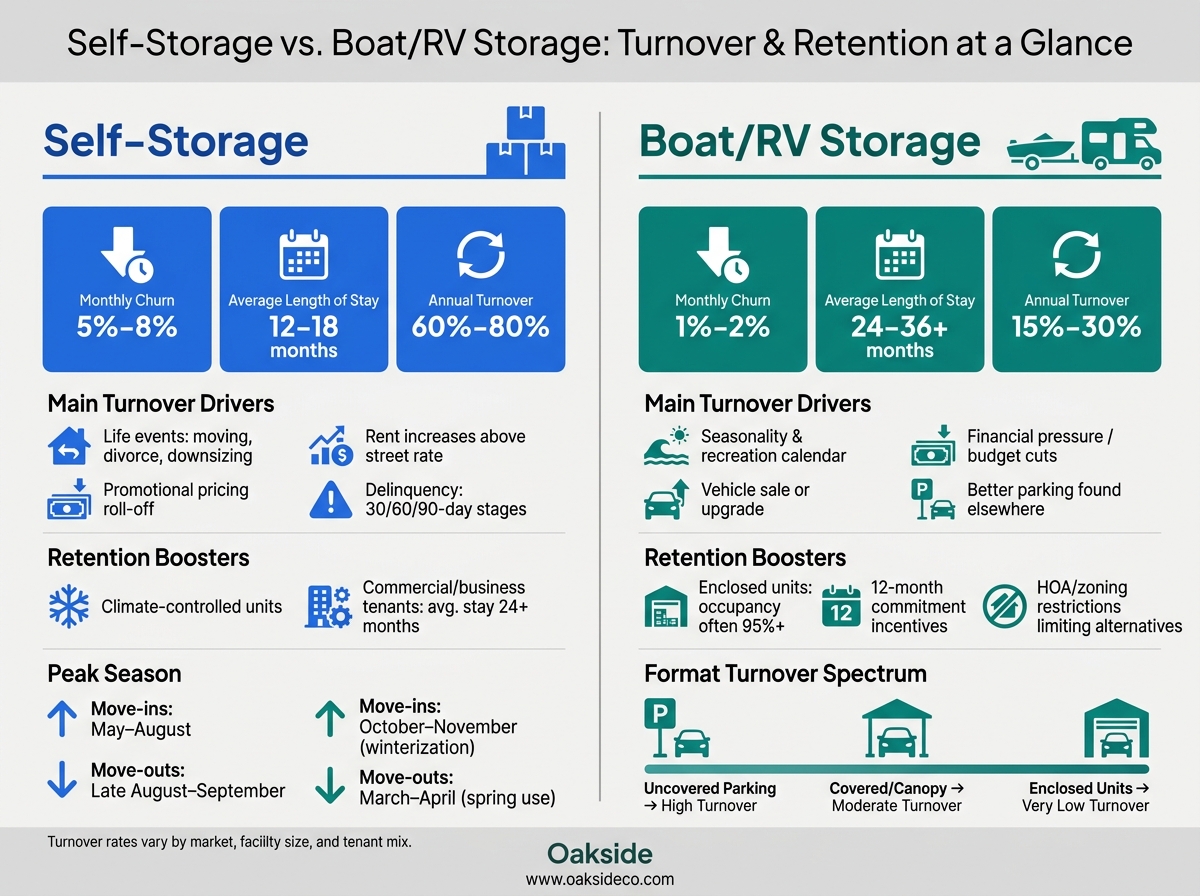
Self-Storage vs. Boat/RV Storage: Turnover & Retention at a Glance
1. Self-Storage
Seasonality
Self-storage demand tends to move with the U.S. housing market and the school calendar. Move-ins usually peak from May through August, while move-outs pick up in late August and September. Winter is typically slower.
That pattern matters for one simple reason: self-storage leases are short. Tenants can leave fast when pricing strategies, so seasonal swings show up in occupancy more quickly than they do in property types with longer leases.
Lease Behavior
Month-to-month leases make it easy for tenants to get started. They also make it easy to leave, often with just 10 to 30 days’ notice. The upside is low friction at move-in. The downside is that turnover reacts faster to pricing pressure and delinquency.
Two of the biggest churn drivers are promotional pricing roll-off and existing customer rent increases. When intro offers expire – like $1 for the first month or 50% off for three months – price-sensitive tenants often decide it’s time to go. The same thing can happen when in-place rents move well above the street rate being offered to new customers at nearby properties. At that point, even long-term tenants may stop and think, Why am I paying more to stay?
Delinquency is another clear warning sign. Tenants in the 30-, 60-, and 90-day delinquency stages face a high risk of vacating or moving into the lien and auction process.
Property Format
Climate-controlled units tend to keep tenants longer. People often use them for sensitive or longer-term storage needs, including electronics, antiques, and documents. That usually leads to longer average stays.
Drive-up units are different. They’re more often tied to an event-driven need, like a home move. Once that need ends, the tenant leaves. In most markets, that means drive-up churn runs higher than climate-controlled churn.
Unit type affects how long people stay. But in practice, tenant type often tells you even more.
Customer Use Cases
Tenant mix matters just as much as unit mix. Residential users – such as movers and downsizers – usually stay for 12 to 15 months on average. Their storage need is often temporary, so they’re more likely to move out once that life event passes.
Commercial tenants, like small businesses storing inventory or equipment, tend to be stickier. Average stays often run past 24 months. A property with a bigger commercial mix usually has lower turnover and more stable occupancy. Put plainly, more business users often means fewer surprise move-outs and less churn.
Those same retention patterns shift in boat and RV storage, where seasonality and storage format have a much bigger effect.
sbb-itb-09b4138
2. Boat/RV Storage
Seasonality
Boat/RV storage doesn’t behave like self-storage. Turnover tracks the recreation calendar.
Move-ins usually jump in October and November as owners winterize and shield their vehicles from off-season weather. Then the pattern flips. Move-outs tend to peak in March and April when people start getting back on the road or water. Facilities near lakes, rivers, and coastal areas feel this even more, since occupancy often moves with spring launch dates and fall winterization windows.
Lease Behavior
That swing in timing doesn’t usually mean short stays. It mostly changes when tenants leave.
Boat/RV ALOS runs 24 to 36 months, which is much longer than self-storage. And that makes sense. Large-format stalls with wide turning radiuses and 40-plus-foot depths are hard to find. Once tenants find a space that fits, they usually don’t want to give it up.
Some operators also use seasonal-stay discounts or 12-month commitment incentives to lower the chance that tenants leave during the months when they use their vehicles most.
Property Format
Storage format also plays a big role in turnover. A tenant paying for uncovered parking behaves very differently from someone renting a fully enclosed unit.
| Format | Turnover Rate | Tenant Profile | Price Sensitivity |
|---|---|---|---|
| Uncovered parking | High | Budget-conscious | High |
| Covered/canopy | Moderate | Mid-range | Moderate |
| Enclosed units | Very low | High-value owner | Low |
Enclosed units post the lowest turnover in this asset class, with occupancy often staying above 95% because big, fully enclosed spaces are hard to come by. That’s the key point: when the space is hard to replace and fits the vehicle well, switching becomes a hassle. Most tenants would rather stay put.
Customer Use Cases
Use case matters just as much as format. In plain English, how often someone uses the vehicle often shapes how long they stay.
Occasional recreational owners who take out their boats or RVs a few times a year tend to deliver steady occupancy and longer stays. Full-time RV owners, on the other hand, often use storage between trips, which can lead to faster and less predictable churn. HOA and zoning restrictions also limit off-site options, which helps support retention.
Turnover Profiles: Pros and Cons by Asset Class
These two asset classes behave very differently on turnover, and that changes both day-to-day work and how steady the property feels over time.
Self-storage usually sees 60% to 80% annual turnover. That means a steady stream of move-ins, move-outs, unit cleanouts, and re-marketing. Boat/RV storage is much lower at 15% to 30% annual turnover. The tradeoff is pretty straightforward: self-storage takes more hands-on work, but it also gives you a much larger pool of replacement tenants. Boat/RV storage is calmer to operate, but when a tenant leaves, filling that space can take more effort.
You can see those tradeoffs most clearly here:
| Asset Class | Advantages | Disadvantages | Likely Move-Out Triggers |
|---|---|---|---|
| Self-Storage | High demand density; recession-resistant; granular revenue across many units | High monthly churn; marketing-intensive; frequent unit turns required | Residential move, home renovation completion, downsizing, death, or divorce |
| Boat/RV Storage | Sticky tenants; low daily management overhead; strong occupancy where replacement parking is limited | Discretionary demand; sensitive to fuel prices and economic downturns; smaller replacement tenant pool | Vehicle sale, financial pressure, or a better parking setup |
This gap becomes most important when vacancy hits a smaller site. In Boat/RV storage, vacancy can create concentrated revenue risk fast. Each stall is large, so losing even a handful of tenants at a small facility can hit net operating income in a noticeable way. Self-storage spreads that risk across dozens, or even hundreds, of units.
Retention also tends to be strongest when demand comes from need rather than choice. Self-storage holds up better because it is tied to life events, not optional spending. That gives it a stronger demand hedge. Boat/RV storage does not have the same floor. When household budgets get tight, vehicle storage is often one of the first bills owners rethink. In many Boat/RV portfolios, rising delinquency tends to show up early when that pressure starts.
Conclusion
Put it all together, and the pattern is pretty clear: self-storage and boat/RV storage do not turn over the same way.
Self-storage usually moves faster and stays more consistent month to month. Much of that turnover comes from life events like moving, divorce, downsizing, or job changes. Boat/RV storage tends to move more slowly and with more seasonality, since demand is tied more closely to recreation cycles and how people use their vehicles.
That gap changes the way you run the asset. With self-storage, it makes sense to focus on frequent rent changes and a high volume of new leads. With boat/RV storage, the bigger win often comes from amenities that make the experience easier and help tenants stay longer, especially with enclosed units.
The main drivers of turnover risk are seasonality, lease behavior, property format, and customer use cases. Your pricing, lease terms, and capital spend should line up with the turnover pattern of the asset.
FAQs
Which asset is easier to keep full?
There’s no one-size-fits-all answer here. It comes down to what’s driving demand in a given market.
For self-storage, the main factors are usually population density, household formation, and in-migration. If more people are moving in, forming new households, and living in tighter spaces, demand tends to follow.
Boat and RV storage plays by a different set of rules. It leans more on access to recreation, vehicle ownership, and local rules like zoning limits or HOA parking restrictions. In some places, people simply can’t keep a boat or RV at home even if they want to.
Oakside Co notes that because RV owners are storing high-value assets and often don’t have many other options, these properties can see low turnover and strong retention.
How much does seasonality affect occupancy?
Seasonality can have a big effect on occupancy across storage asset classes, but it doesn’t hit every category the same way.
In self-storage, demand often climbs from May through September. That stretch usually lines up with moves, home sales, school breaks, and job relocations.
Boat and RV storage tends to swing more sharply. Occupancy often tracks boating and camping seasons, so demand can rise and fall in a more noticeable way than it does in self-storage.
Regional trends matter too. In places like Florida and Arizona, snowbird migration can push demand up in the fall and lead to declines in late spring.
What property features improve tenant retention?
In self-storage, retention tends to improve with climate-controlled units. These units often keep tenants longer than standard units. And that matters, because longer stays usually mean steadier occupancy and less turnover.
Smart-unit features can help too. Things like smart locks and individual alarms can support premium pricing while also making the tenant experience better. It’s a simple tradeoff: more convenience and peace of mind for the renter, and fewer move-outs for the operator.
In boat and RV storage, retention comes down to quality and access. If the site is easy to use and built for how owners store and move large vehicles, people are more likely to stay.
Features that help include:
- Electrical trickle-charge outlets
- Dump stations
- Wash bays
- Wide drive aisles
- Pull-through access
- Secure, well-lit facilities
Those amenities make day-to-day use easier, which can help encourage long-term occupancy.