If I had to boil it down to one line: boat/RV storage is a long-term lifestyle storage play, while self-storage is mostly a short-term life-event storage play.
That one difference changes almost everything: who rents, how far they will drive, what they will pay for, how long they stay, and what the site must offer. I’m looking at two storage types that may look similar from a distance, but they serve very different jobs. Boat and RV renters are often storing high-dollar vehicles all year and may keep a spot just so they do not lose it. Self-storage renters are more often dealing with a move, remodel, downsizing, or one of the “4 Ds”: death, divorce, departure, and decluttering.
A few numbers make the split clear:
- Nearly 25 million U.S. households own a boat, RV, or specialty vehicle
- There are fewer than 5,000 purpose-built boat/RV storage sites
- Boat/RV customers often accept a 7 to 10 mile drive, and some travel much more for seasonal use
- Self-storage customers usually want a site within 3 to 5 miles
- Boat/RV sites often need 40- to 60-foot drive aisles and 12- to 14-foot door heights
- Self-storage sites often work with about 25-foot aisles
- Enclosed boat/RV storage can earn a 40% to 80% rate premium
- Boat/RV properties often run at expense ratios below 25%, versus about 35% for self-storage
Here’s the plain-English takeaway:
- Boat/RV storage is about vehicle protection, route access, and long stays
- Self-storage is about nearby location, clean indoor space, and price
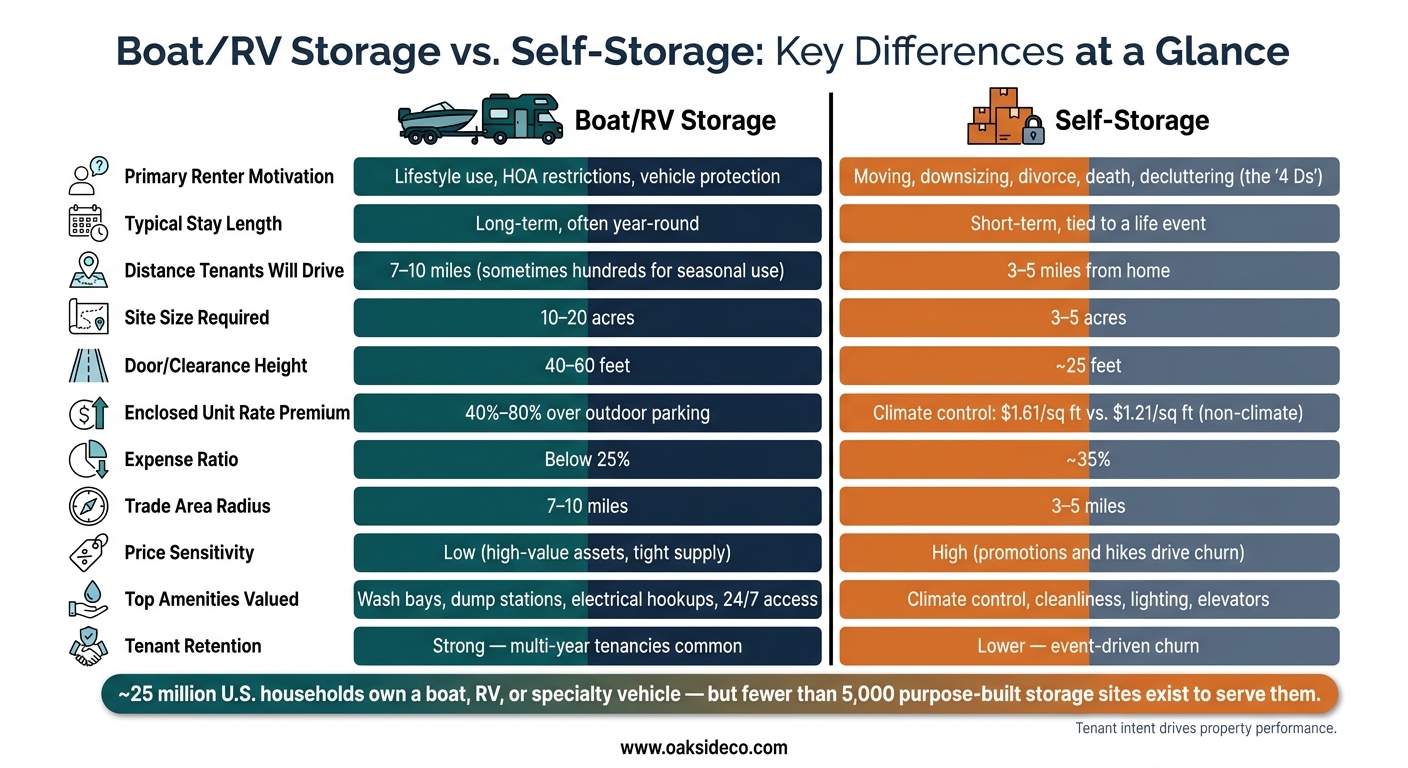
Boat/RV Storage vs. Self-Storage: Key Differences at a Glance
Quick Comparison
| Criteria | Boat/RV Storage | Self-Storage |
|---|---|---|
| Main reason people rent | Lifestyle use, HOA limits, no room at home | Moving, downsizing, remodels, family changes |
| What is being stored | Boats, RVs, trailers, specialty vehicles | Furniture, boxes, documents, household goods |
| Usual stay length | Long, often year-round | Shorter, tied to a life event |
| Distance people will drive | About 7–10 miles, sometimes more | About 3–5 miles |
| Site needs | Large lots, high clearances, big turning room | Smaller footprint, simple in-and-out access |
| Top concerns | Security, cover, vehicle care | Price, cleanliness, climate control |
| Price sensitivity | Lower | Higher |
So if I’m comparing these two asset types, I would not treat one like a version of the other. Tenant intent shapes demand, layout, rent levels, churn, and site economics from day one.
sbb-itb-09b4138
Consumer Profile and Rental Purpose
Each storage type tends to draw a different kind of renter, and the reason they rent usually isn’t the same.
Boat and RV Owners: Lifestyle-Driven Storage Demand
Boat and RV owners are often older, higher-income homeowners who have the extra cash to buy and maintain expensive recreational vehicles. About 8 million U.S. households own an RV, and millennials account for 38% of RV ownership in the U.S..
What pushes these owners into off-site storage usually isn’t a major life change. It’s day-to-day living. HOA rules, smaller residential lots, narrow driveways, and tight side yards can make parking at home difficult or flat-out impossible. In many cases, off-site storage isn’t a backup plan. It’s the default.
And once owners lock in a good space, they usually stick with it. Boat and RV renters often keep their units all year so they don’t lose the spot.
Self-Storage Tenants: Life-Event and Space-Constraint Demand
Traditional self-storage serves a much broader mix of people. Age, income, and homeownership status can vary a lot. What ties these renters together is the reason they show up: a transition, not a leisure purchase. They may be moving, downsizing, remodeling, or just trying to clear out space.
The biggest triggers are the 4 Ds: death, divorce, departure, and decluttering.
You can see the gap most clearly in who rents and what sparks the rental:
| Feature | Boat/RV Storage Tenants | Traditional Self-Storage Tenants |
|---|---|---|
| Age Tendencies | Older adults and retirees | Broad range – Gen Z through seniors |
| Income Profile | Higher disposable income; affluent households | Broad/moderate household income |
| Homeownership | Very high; often in HOA-governed communities | Mixed; stronger renter representation |
| Primary Rental Triggers | Leisure, HOA restrictions, and vehicle protection | Moving, divorce, death, renovation, and lack of space |
There’s also some overlap. About 30% of boat and RV storage tenants also rent a standard self-storage unit, usually for related gear like bikes, kayaks, or hobby equipment. So these groups aren’t totally separate. Still, their main reasons for renting are very different.
Those differences also affect where people are willing to store their property and how fast they expect to get to it.
Location, Access, and Space Design Preferences
Where a facility sits – and how the site works once a customer pulls in – has a direct effect on demand. But the idea of “convenience” changes a lot by tenant type.
For boat and RV renters, convenience usually means easy route access and enough room to drive, turn, and park without stress. For self-storage tenants, it usually means close to home, easy to spot, and fast to get in and out.
Boat/RV Storage: Highway Access, Wide Circulation, and Easy Weekend Use
Boat and RV renters will often drive farther if the site fits their needs. A 7-mile radius is a common underwriting benchmark, and 10 miles is often seen as the outer edge of the core market. That said, some owners – especially snowbirds – store vehicles near a seasonal destination and may travel hundreds of miles to do it.
In practice, sites usually fall into two buckets. Near-home sites are close to major interstates and higher-income neighborhoods where HOA rules can make driveway parking hard. Recreation-area sites are near lakes, national parks, or coastal markets, so owners can keep the vehicle close to where they use it.
The math can make that choice pretty simple. A $4,500 to $6,000 transport bill can make $1,500 to $4,000 per year in nearby storage look like a fair trade. That’s why highway access and smooth circulation often matter more here than being tucked into a nearby neighborhood.
The site design needs to match how these renters behave. Large vehicles need room – plain and simple. Drive aisles should be 40 to 60 feet wide so big rigs can move safely. A driver towing or backing a 50-foot rig needs about 75 feet of space just to straighten out and back in. Dead ends are a headache and should be avoided.
Enclosed units also need enough vertical clearance. 12- to 14-foot door heights are standard so fifth-wheels and Class-A motorhomes can fit. Surface choice matters too. Asphalt or reinforced concrete holds up much better than gravel under heavy vehicle loads.
Access hours matter for a simple reason: many owners leave before sunrise or come back late. Because of that, 24/7 gate access is often close to table stakes. About 36.7% of boat/RV facilities already offer it.
Self-Storage: Neighborhood Convenience and Fast In-and-Out Access
Self-storage renters usually want the shortest trip possible. Most rent within 3 to 5 miles of home, and the need often comes up during a move, downsizing, or a home renovation. In that moment, people aren’t looking for a long drive or a complicated property. They want something easy.
That shifts the site priorities. Visibility matters. Entry should feel simple. Daily convenience tends to matter more than extras or lot size.
The design is much tighter too. Standard self-storage drive aisles are about 25 feet wide, which fits the smaller vehicles and faster turnover common in this segment. The goal is smooth access, not oversized maneuvering space.
Common features include:
- Drive-up units for ground-floor convenience
- Elevators and loading carts in multi-story properties
- Straightforward access control
- Standard gate hours, often 6 a.m. to 10 p.m.
Those hours usually line up well with move-related and renovation-driven visits.
| Feature | Boat/RV Storage | Self-Storage |
|---|---|---|
| Usage Pattern | Low-frequency, weekend- and summer-heavy | Frequent during move periods |
| Distance Tolerance | 7–10 miles; recreation-area sites near lakes, parks, or coasts | 3–5 miles from home |
| Access-Hour Expectations | 24/7 or extended hours for early/late trips | Standard hours (e.g., 6 a.m.–10 p.m.) |
| Most-Valued Site Features | Wide aisles (40–60 ft), dump stations, wash bays, power hookups | Climate control, cleanliness, elevators, carts, proximity |
Protection, Amenities, and Willingness to Pay
Once a location works for the tenant, protection and price usually decide the deal. And those two things depend a lot on what the tenant is storing.
Boat/RV Storage: Security and Vehicle Protection Drive Premium Demand
Boat and RV owners are often storing assets worth well into six figures, so they’re more willing to pay extra for protection and convenience. That makes sense. If someone owns a big Class A motorhome or a high-end boat, storage isn’t just about finding an empty spot. It’s about protecting a major purchase and making the next trip easier.
Enclosed and climate-controlled storage can command a 40% to 80% premium over basic outdoor parking. Monthly rates range from $67 to $332, with Maryland at $332 per month. That pricing holds up because of the value of the vehicles, the small amount of enclosed supply, and high security expectations.
Amenities matter too, but mostly after move-in. Wash bays, dump stations, electrical hookups, and air stations tend to support retention more than initial lease-up. In plain English: these extras help keep tenants around. Many continue paying to hold their space even when the vehicle is out on the road.
That same premium pattern doesn’t carry over as strongly to self-storage.
Self-Storage: Climate Control, Cleanliness, and Value Perception
Self-storage tenants are usually storing household goods like furniture, electronics, documents, and seasonal items. Those items matter, of course, but they’re not the same as storing a vehicle worth $80,000 or $150,000. And because self-storage demand is often temporary, price tends to matter more than add-ons.
Climate control is the clearest premium driver here. Nationally, climate-controlled units average $1.61 per square foot, compared with $1.21 per square foot for non-climate-controlled units. That gap is easy to understand. People worry about heat, humidity, and damage to items they can’t easily replace.
Outside of climate control, tenants pay close attention to cleanliness and lighting. A dusty unit or a poorly kept hallway sends a bad signal fast. It suggests the property may have other upkeep issues too. For indoor self-storage, cleanliness isn’t a nice extra. It’s the baseline.
Price pressure is also much stronger in this segment. Promotions and rent hikes lead to churn, and tenants often move when they spot a better deal nearby. That makes self-storage a much more price-sensitive business.
Those differences stand out in the comparison below.
| Boat/RV Storage | Self-Storage | |
|---|---|---|
| Preferred Amenities | Wash bays, dump stations, electrical hookups, air stations | Climate control, indoor access, bright lighting, cleanliness |
| Security Expectations | Perimeter fencing, monitored cameras, individual alarms, 24/7 patrols | Gated access, surveillance cameras, keypad entry |
| Main Premium Driver | Enclosed or covered bays protecting from sun, snow, and theft | Climate-controlled units protecting from humidity and pests |
| Rate Sensitivity | Low; high asset value and tight supply reduce price pressure | High; promotions and price hikes drive churn |
| Cleanliness Standard | Paved surfaces and no debris | Dust-free interiors, pest control, well-lit hallways |
What These Consumer Differences Mean for Owners and Investors
Using Consumer Demand Signals in Underwriting and Asset Strategy
Boat/RV and self-storage can look alike at a glance. In practice, they lead to very different underwriting choices.
For Boat/RV storage, owners need to plan for larger trade areas, bigger sites, and leaner operating costs. The trade area radius usually stretches 7–10 miles. Land needs often land in the 10- to 20-acre range, compared with 3 to 5 acres for self-storage. Expense ratios also tend to run lower, often below 25%, versus about 35% for self-storage. That’s why self-storage assumptions don’t carry over neatly.
Those site needs also affect lease length and day-to-day cash flow. Boat/RV renters often stay longer because they’re storing high-value vehicles they want to protect. That longer stay cuts churn and helps smooth revenue and increase property value. Self-storage works differently. It’s often tied to moves, downsizing, divorce, or other life changes, which means more turnover and more price sensitivity.
Unit mix matters too. A property should reflect the kinds of vehicles in its market. That can mean:
- 30- to 50-foot enclosed bays for Class A motorhomes
- 12-by-25-foot spaces for fishing boats
Conclusion: Different Use Patterns Require Different Operating Models
One of the biggest mistakes owners and investors make is treating these asset types like plug-and-play substitutes. They’re not. The gap shows up fast in underwriting, operations, and even exit planning and timing.
| Factor | Boat/RV Storage | Self-Storage |
|---|---|---|
| Capital intensity | High; wide aisles, reinforced paving, enclosed bays | Moderate; standard construction and interior fit-out |
| Site size | 10–20 acres | 3–5 acres |
| Expense ratio | Sub-25% | ~35% |
| Trade area radius | 7–10 miles | 3–5 miles |
| Retention profile | Strong; multi-year tenancies common | Lower; price-sensitive, event-driven churn |
| Exit flexibility | Constrained supply improves pricing power at disposition | Broader buyer pool; more rate-sensitive at exit |
The operators who do well in each category usually understand one simple thing: tenant intent drives property performance.
Boat/RV storage tends to work best when the site is built around vehicle size, highway access, and features that help keep renters in place. Self-storage tends to work best when it leans into neighborhood convenience, clean interior space, and sharp pricing. Mix those playbooks together, and performance often slips on both sides.
FAQs
Which storage type has more stable tenant demand?
Boat and RV storage tends to see steadier tenant demand than standard self-storage. Monthly churn usually lands around 1% to 2% for boat and RV storage, compared with 3% to 5% for self-storage.
Stays also tend to last much longer. Tenants often remain for 2 to 5 years, versus about 17.5 months in self-storage. That longer stay can help support steadier cash flow once an asset is stabilized.
When does enclosed boat/RV storage justify higher pricing?
Enclosed boat and RV storage can charge more when it gives owners a stronger level of protection for high-value assets. That matters when you’re talking about luxury motorhomes and boats that can cost well into six figures.
That higher price makes sense when the facility offers things owners can see and use: climate control, tighter security, and solid weather protection. Extras like electricity, automated doors, and wash bays can also support the premium, especially in coastal areas or places with intense UV exposure.
How should location strategy differ for each facility type?
Traditional self-storage tends to do best in dense, infill areas, where visibility and close access to residential neighborhoods play a big role in how customers choose a facility.
Boat/RV storage is a different animal. It usually needs much larger sites – often 10 to 20 acres – plus 40- to 60-foot turning radii so big vehicles can move in and out without a headache. These properties often perform well near highways, lakes, marinas, and recreation areas.
In many cases, the biggest location factors are pretty practical: HOA parking restrictions and the need for secure, easy-to-access storage for high-value boats and RVs.