If I’m selling or refinancing a self-storage, boat storage, or RV property, a broker opinion of value usually takes 3 to 7 business days once the broker has a full data package. My timeline gets longer when records are missing, the property is in lease-up, or the deal includes mixed income streams or multiple sites.
Here’s the short version:
- A BOV is an early pricing tool, not a lender appraisal
- Most sellers need four core items fast: current rent roll, monthly T-12, unit mix, and 12 months of occupancy history
- Value is usually shown as a range, such as $9.5 million to $10.5 million
- That range is based on NOI, cap rates, and recent comps
- I can use a BOV before listing, for refinance planning, buyouts, estate matters, or recap talks
- Buyer outreach changes by deal type – stabilized metro assets often fit institutional groups, while smaller or value-add sites may fit regional buyers or owner-operators
- Loan sizing for refinance is often estimated at 60% to 70% of the BOV range, though lenders still use their own underwriting and an appraisal
A few numbers matter most up front: 3–7 business days, 60%–70% loan-to-value, 45 days to identify and 180 days to close in a 1031 exchange, plus a clear NOI and comp set to support pricing.
If I want a tighter range and fewer follow-up questions, I need clean records, a plain explanation for odd swings in revenue or occupancy, and notes on major property work done in the last 24 to 36 months.
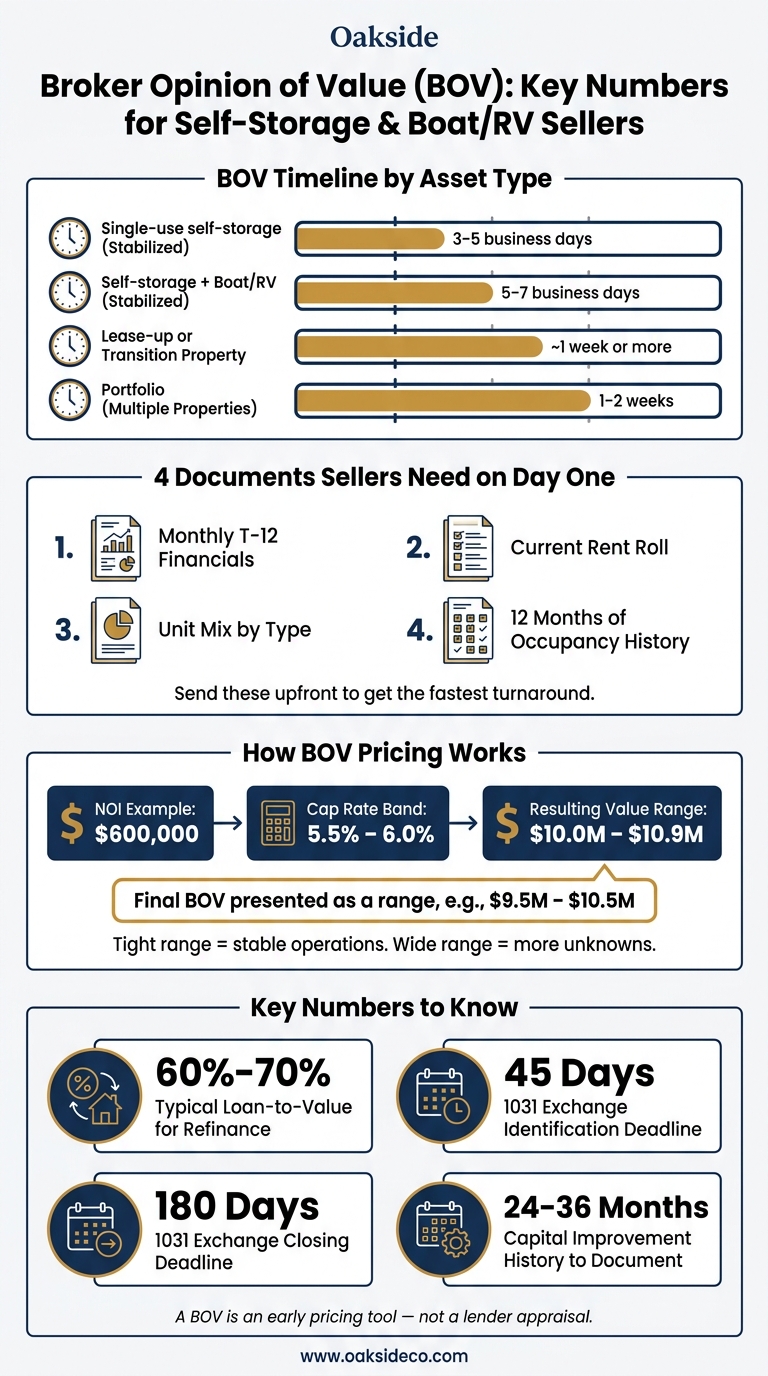
Broker Opinion of Value (BOV): Timeline & Key Numbers at a Glance
How Long It Takes to Prepare a Broker Opinion of Value
For most self-storage, boat/RV, and properties with multiple income streams, a BOV is ready in 3–7 business days after the broker gets a complete data package.
The timeline mostly comes down to the asset type and the property’s current operating condition:
| Asset Type | Status | Typical Timeline |
|---|---|---|
| Single-use self-storage | Stabilized | 3–5 business days |
| Self-storage + boat/RV | Stabilized | 5–7 business days |
| Lease-up or transition property | – | About 1 week or more |
| Portfolio (multiple properties) | Varies | 1–2 weeks |
What Can Delay the Timeline
The biggest holdup is usually incomplete or inconsistent operating data. A missing rent roll is a major problem. Without it, the broker can’t verify in-place revenue, check current rent accuracy, or confirm occupancy by unit type. That can stop the analysis or force weaker assumptions in the value range.
Gaps in trailing 12-month (T-12) financials create a similar issue. If income and expenses are only shown as a yearly summary instead of month by month, it’s much harder to see seasonality, trend lines, and actual operating performance. And when a property has mixed income streams – like climate-controlled units plus outdoor boat/RV parking – the process takes longer because each income source needs its own review before the broker can build one value range.
Recent expansions can also slow things down when lease-up data isn’t separated from stabilized operations. In that case, the broker has to review both the pro forma and the existing asset.
In plain terms, the schedule is usually driven more by document quality than by property complexity.
How Sellers Can Speed Up Delivery
The clearest way sellers can speed things up is by sending a complete package on day one. The fastest turnaround usually comes from having these items ready up front:
- Monthly T-12 financials
- A current rent roll
- Unit mix by type
- 12 months of occupancy history
It also helps to include a short note for anything unusual, like a sudden occupancy dip, a one-time expense, or a recent rate change. Brokers tend to flag odd patterns during their first review, and a simple explanation can keep things moving instead of kicking off another round of questions.
The same goes for recent capital expenditures. A short list of major improvements made in the past 24–36 months gives the broker useful context without the need for a separate follow-up request.
That package also tees up the next step: pricing the asset and getting buyer outreach ready.
sbb-itb-09b4138
What Documents and Property Details Sellers Need to Provide
Once the timing is set, the next step is simple: the broker needs the right documents to price the asset with confidence. The stronger the package, the tighter the value range tends to be.
Financial and Operating Information
Start with the core operating records. That usually means a current rent roll, a T-12 operating statement, and year-to-date financials. Sellers should also share occupancy history, rate changes, bad debt, delinquency, concessions, and ancillary income like tenant insurance, late fees, admin fees, and retail sales.
On the expense side, provide payroll, utilities, insurance, repairs and maintenance, marketing, and property taxes. If there are one-time or unusual costs, break those out on their own.
These records are the backbone of the pricing analysis. If they’re thin or messy, the estimate gets a lot less precise.
Property Details That Affect Value
For a self-storage or boat/RV asset, a broker also needs the physical details that shape income and buyer interest. That includes unit mix by type, net rentable square footage, land area, year built, and occupancy with achieved rates by unit type. The breakout should cover climate-controlled, non-climate-controlled, drive-up, covered parking, and uncovered parking so the asset can be compared cleanly against market comps.
For boat and RV properties, the split between covered and uncovered parking spaces matters a lot. So do access, circulation, site visibility, and paving condition. A good site on paper can lose some shine fast if customers have a hard time getting in and out.
If the property includes expansion land, be specific. State whether the land is entitled, zoned, and free of limits such as drainage issues, setbacks, or utility problems. A broker can only give credit for future development if that upside is realistic and backed by documents like surveys, site plans, or zoning letters.
Also document any capital improvements made in the past 24–36 months.
Those details help the broker line the asset up with the right buyer group instead of tossing it into the market with a vague story.
Ownership and Lease Information
Ownership structure and lease terms can shift both pricing and transferability. Sellers should disclose any ground leases, property management agreements, vendor contracts, third-party income streams, and master leases up front. These items affect net income, transferability, and closing complexity, so the broker needs them in the pricing assumptions from day one.
It also helps to flag any easements, encroachments, nonconforming use, zoning limits, or title defects early. A property can perform well and still lose buyers if a zoning or title issue shows up during due diligence. When that happens, buyers often price in the risk or ask for a fix before closing. Clean title and zoning records help keep the BOV lined up with how buyers will underwrite the deal in practice.
How Pricing Is Presented and When a BOV Is Used
Once the broker has the data package, the next step is turning it into a value range. That range becomes the working price for the next part of the sale process.
Why the Opinion Is Presented as a Value Range
A BOV usually comes back as a range, such as $9.5M–$10.5M, because commercial property pricing changes based on how buyers view the deal, what financing costs look like, and what level of performance they expect.
Most of the time, that range comes from two main checks.
- The income approach starts with the property’s net operating income, or NOI, and applies a cap rate band. For example, $600,000 in NOI at a 5.5%–6.0% cap rate points to about $10.0M–$10.9M.
- The sales comparison approach checks that result against recent comparable sales using price per square foot ($/SF) or price per unit or space, depending on the asset type.
The width of the range says a lot. A tight range usually points to stable occupancy and clean financials. A wider range usually means there are more unknowns, like uneven occupancy, messy financials, or a value-add story that buyers may price in very different ways.
That same range then becomes the basis for broker outreach and buyer targeting.
Using a BOV Off Market or for Refinance Planning
A BOV isn’t just for a live listing. Brokers also use it before a property ever hits the market.
One common use is pre-sale planning. The broker’s analysis can show which operating changes might push the property from the low end of the range to the high end. That could mean better rate setting, trimming expenses, or dealing with deferred maintenance before launch.
For partnership buyouts, estate planning, or recapitalization discussions, a BOV gives everyone a market-based starting point. In internal talks and deal structuring, that broker range is often the first number set that helps people get on the same page.
Refinance planning is another common use. If you apply a standard lender loan-to-value ratio, usually 60% to 70%, to the BOV range, you get a rough sense of debt capacity. A $10M–$11M BOV range, for example, points to about $6M to $7.7M in possible loan proceeds, depending on lender standards and DSCR requirements. Lenders still underwrite based on in-place or stabilized NOI and use formal appraisal rules, so the broker’s opinion and the lender’s number won’t always line up.
It can also help show which buyer groups are most likely to support that pricing once the property goes to market.
How the BOV Shapes Buyer Outreach and Next Steps
Once the BOV sets the price range, it also shapes who the broker should go after and how the deal should be brought to market.
Using the BOV to Define the Buyer List and Marketing Approach
A stabilized self-storage facility in a major metro, with clean financials and strong in-place NOI, will usually draw interest from institutional buyers and REITs.
On the other hand, smaller assets or deals that need more hands-on work tend to pull in a different crowd. Boat and RV storage sites, along with properties that have clear value-add upside, often appeal to regional operators and owner-operators. These buyers are used to underwriting lease-up risk and day-to-day management. For 1031 buyers, the BOV can also help line up the sale process with the IRS deadlines: 45 days to identify a replacement property and 180 days to close.
The BOV also helps decide the marketing path. That might mean a broad campaign, a more focused process, or quiet off-market outreach. If the asset is performing well and the value range is tight, a broad process usually makes sense. That gives the property wide exposure and sets up a clear bid timeline. If the value range is wider because operations vary from month to month, a more selective approach tends to work better. In that case, the broker can focus on buyers who already know how to underwrite that kind of risk.
Key Seller Takeaways
Once the buyer group and process are locked in, the BOV becomes the guide for launch timing and the order of the marketing steps.
It sets your asking posture, buyer list, and process type. Clean financials and a current rent roll can tighten the value range and help keep launch timing lined up with buyer demand windows and key marketing milestones.
FAQs
How accurate is a BOV?
A Broker Value Opinion (BOV) is a professional estimate of value. But how close it is to market reality comes down to two things: the data and the broker’s judgment.
That’s why a BOV works best as a starting point, not a final price.
The most accurate BOVs are built on verified trailing 12-month NOI. They also look beyond the headline number and weigh details that can shift value in a big way, such as:
- occupancy quality
- revenue mix
- market risk
- normalized operating expenses
In plain terms, a BOV isn’t just about plugging income into a formula. It’s about looking at how the property actually performs and where the weak spots or upside may be.
Can I get a BOV with incomplete records?
Yes, but incomplete records can sharply reduce a Broker Value Opinion’s accuracy and reliability.
If you want a valuation you can stand behind, share three years of profit and loss statements, tax returns, 24 months of occupancy history, and current rent rolls. When data is missing or doesn’t line up, buyers and brokers tend to apply lower valuation multiples. It also makes late-stage price renegotiations more likely.
What should I fix before requesting a BOV?
Before you request a Broker Value Opinion (BOV), get two things in order: your records and the property itself.
Start with the paperwork. Pull together your last three years of financials, debt schedules, current rent roll, and 24 months of occupancy history. When those records are clean and easy to review, brokers can assess the asset with less guesswork.
Then look at the property condition. Take care of deferred maintenance items like roofing, pavement, and gate systems before they become red flags. Buyers tend to notice those issues right away, and they can use them to push for price cuts late in the process.
It also helps to confirm that zoning, certificates of occupancy, and ADA records are up to date. Clean, organized documentation gives your value estimate more support and can help reduce last-minute renegotiations.