Most tiered pricing problems come down to 7 fixable mistakes: weak rent comps, pricing by size alone, fuzzy tier rules, too many choices, stale rates, mixed messaging, and poor tie-in to underwriting.
If I want tiered pricing to work, I need to keep it simple: 3 tiers, 1 clear feature difference per tier, and set review dates. For example, if three 10×10 units rent for $120, $135, and $150 per month, each price gap should map to something a renter can see, like climate control, drive-up access, or floor level.
Here’s the whole article in one glance:
- Benchmark local rents every 90 days
- Price by features, not just square footage
- Write tier rules down so staff can explain them fast
- Keep choices to 3 tiers or fewer
- Review rates on a fixed schedule
- Match pricing across web, phone, and site
- Tie tier pricing to NOI, rent roll, and exit plans (often validated through sensitivity testing)
Quick Comparison
| Mistake | What goes wrong | Simple fix |
|---|---|---|
| Skipping rent benchmarks | Rates drift too high or too low | Survey nearby rents every 90 days |
| Pricing only by size | Premium units get underpriced | Charge more for visible features |
| Vague tier definitions | Staff and renters get confused | Give each tier one plain value point |
| Too many overlapping options | Shoppers stall and leasing slows | Use 3 tiers or fewer |
| Leaving pricing static | Old rates miss demand shifts | Review rates monthly or quarterly |
| Poor presentation | Different messages hurt trust | Keep names, features, and prices the same everywhere |
| No link to underwriting | Pricing story breaks at sale or refinance | Match tiers to pro forma and exit materials |
Bottom line: if I keep tiered pricing clear, current, and tied to unit features, it can protect rent levels and support stronger NOI.
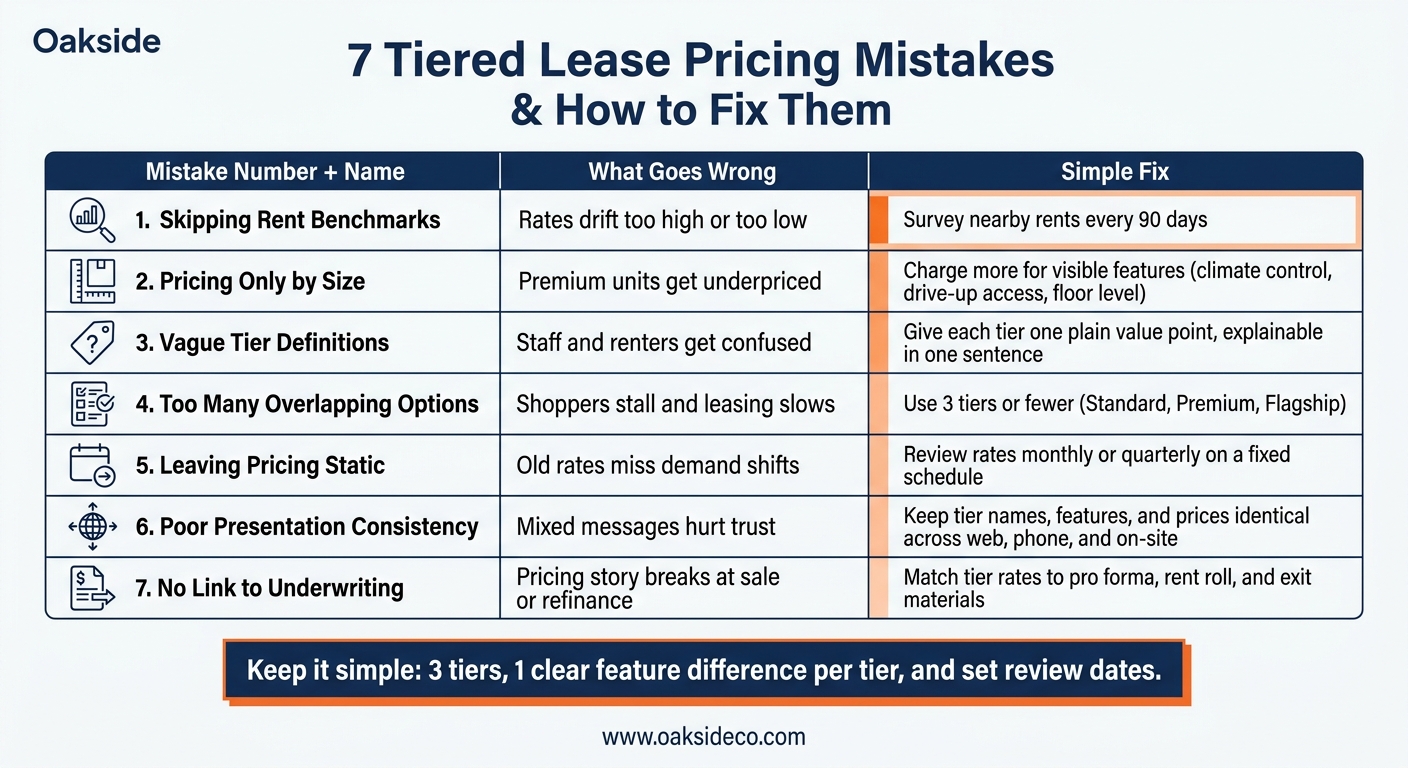
7 Tiered Lease Pricing Mistakes & How to Fix Them
The 7 Mistakes to Avoid
These problems tend to show up when owners set prices by gut feel instead of looking at the market, the unit itself, and the plan behind the property.
Mistake 1: Skipping Local Market Rent Benchmarks
Start with local rent comps for each tier. That baseline gives you a reality check. Without it, you can’t tell if your premium makes sense or if you’re just guessing.
Mistake 2: Pricing Only by Unit Size
Size matters, but it shouldn’t do all the work. Price by feature too. Climate control, easier access, and day-to-day convenience should shape the gap between tiers.
Mistake 3: Using Vague or Inconsistent Tier Definitions
If your staff can’t explain the premium in one sentence, the tier isn’t clear enough. Each tier should connect to one visible feature or a plain use case that customers can grasp right away.
Mistake 4: Building Too Many Overlapping Options
Keep it to three clear tiers instead of a long menu of almost-the-same choices. Too much overlap slows people down and makes the sales pitch weaker.
Mistake 5: Leaving Pricing Static Instead of Reviewing It Regularly
Set a schedule to review your tiers. Demand changes over time, and old pricing can leave money on the table.
Mistake 6: Presenting Tiers Poorly to Customers and Staff
Use the same tier names, feature sets, and prices everywhere: online, on-site, and in staff scripts. Mixed messaging makes people uneasy and slows leasing.
Mistake 7: Failing to Connect Pricing to Underwriting and exit planning
Pricing has to work in the underwriting file, not just at the front desk. Each tier should back up the rent assumptions in underwriting and the value story you plan to tell at sale. If the pricing story falls apart in a pro forma, it won’t hold up in an exit either.
sbb-itb-09b4138
How to Execute Tiered Pricing More Effectively
Once you’ve sidestepped the usual pricing mistakes, the next step is using simple pricing strategies to keep the model simple enough to use day to day. Three rules help a lot.
Build a Simple Good-Better-Best Structure
Stick with three tiers and tie each one to one clear feature difference. A straightforward Standard, Premium, and Flagship lineup makes comparison easy for customers and keeps your team on the same page.
Each tier should have a feature set that’s clear and measurable. That way, the price gap feels logical instead of arbitrary. It also makes rate reviews much easier to handle and easier to explain.
Review Rates on a Set Schedule
Review tier pricing on a set schedule so rates stay in line with market demand and property performance.
In each review, look at occupancy and leasing speed by tier. If one tier keeps outperforming the others, or if premium units are leasing more slowly than expected, that’s a sign to revisit pricing or adjust the tier setup.
Present Tiers Clearly Online and On Site
Tiered pricing works best when customers see the same language everywhere they interact with your property. That means your website, online rental flow, call center scripts, and on-site leasing conversations should all match.
- Use one tier name per channel
- Use one feature set per tier
- Show pricing the same way everywhere
Use the same language in the pricing audit below.
Implementation Checklist for Owners and Operators
Use this checklist during monthly or quarterly pricing reviews, annual budgeting, or sale planning. Treat it like a working document: assign an owner, set a deadline, and review it on a fixed schedule.
The goal is simple. You want to make sure your pricing model still lines up with the market, the property, and the underwriting file.
This audit helps you catch pricing mistakes before they hit NOI or exit value.
7-Point Pricing Audit
Go through each check below, flag any gaps, document what you find, and assign a follow-up deadline.
| # | Audit Check | What to Verify |
|---|---|---|
| 1 | Benchmark local rents | Are current tier rates based on a rent survey from the last 90 days across a 3- to 5-mile trade area, with street rates and promos tracked in dollar terms? |
| 2 | Price by features, not just size | Does each tier reflect a visible feature difference? |
| 3 | Define tiers clearly | Are tier definitions written down, non-overlapping, and coded the same way in your software? |
| 4 | Limit complexity | Do you have three tiers or fewer? Are there near-duplicate options that should be merged? |
| 5 | Align premiums with revenue goals | Have you measured the NOI impact of each tier change? |
| 6 | Verify presentation consistency | Is tier naming and pricing the same across all channels? |
| 7 | Connect pricing to underwriting | Do tier rates and occupancy assumptions match your rent roll, underwriting, and exit materials? |
If those gaps affect valuation, the next move is deeper underwriting support.
When Outside Advisory Support Makes Sense
If the audit shows a disconnect between pricing and valuation, bring in outside support before a refinance, acquisition, or sale.
Oakside Co helps owners look at pricing as both an operating issue and a valuation issue. As Nolen Masserman, Managing Director at Oakside, puts it:
"Our team blends investment-banking-level analysis with real operator expertise, delivering strategies that are deeply informed, data-driven, and aligned with each client’s unique objectives."
Conclusion: Keep Tiered Pricing Simple, Defensible, and Tied to Value
Tiered lease pricing works best when it’s simple, easy to defend, and tied to what each unit actually offers. Every pricing mistake points back to the same idea: match price to local demand and to value a renter can see. Put plainly, price by visible value, not by habit.
Use visible features to support each tier, like climate control, drive-up access, floor level, and gate proximity. And keep the structure tight: Economy, Standard, and Premium.
Check your tiers against local market rents, occupancy, leasing velocity, and revenue per square foot. That helps keep pricing lined up with current demand instead of last year’s assumptions.
When pricing is clear, consistent, and tied to actual asset performance, it can support stronger NOI and a more credible valuation. That kind of discipline also helps rent growth, day-to-day operations, and valuation. When pricing stays clear and current, it supports value at every stage.
FAQs
How do I choose the right feature for each tier?
Start by grouping units by clear value-add features like location, accessibility, and climate control. Then set pricing tiers based on local market data, not gut feel, so your rates match what people in your area are willing to pay.
It also helps to look at unit performance alongside occupancy. If a unit type hits 85% to 90% capacity, that can be a strong sign that it should move into a higher pricing tier.
How often should I adjust storage rental rates?
Adjust rates on a regular basis based on data, not just once a year. Watch occupancy triggers and demand at the unit level. For example, you might increase rates when a unit type reaches 85% to 90% occupancy.
For current tenants, take a gradual approach. That can mean annual increases of 3% to 8% or smaller $10 to $15 bumps every 3 to 6 months. As Nolen Masserman, Managing Director at Oakside, notes, aligning changes with seasonal demand and market benchmarks helps support NOI while preserving tenant relationships.
How does tiered pricing affect NOI and valuation?
Tiered lease pricing can lift average rental rates by grouping units based on features like floor level, accessibility, and climate control instead of charging one flat rate for everything.
That extra income flows into NOI, and that matters because buyers use NOI and the market cap rate to figure out what a property is worth. As Oakside notes, even small rate increases can have a meaningful effect on asset value.