
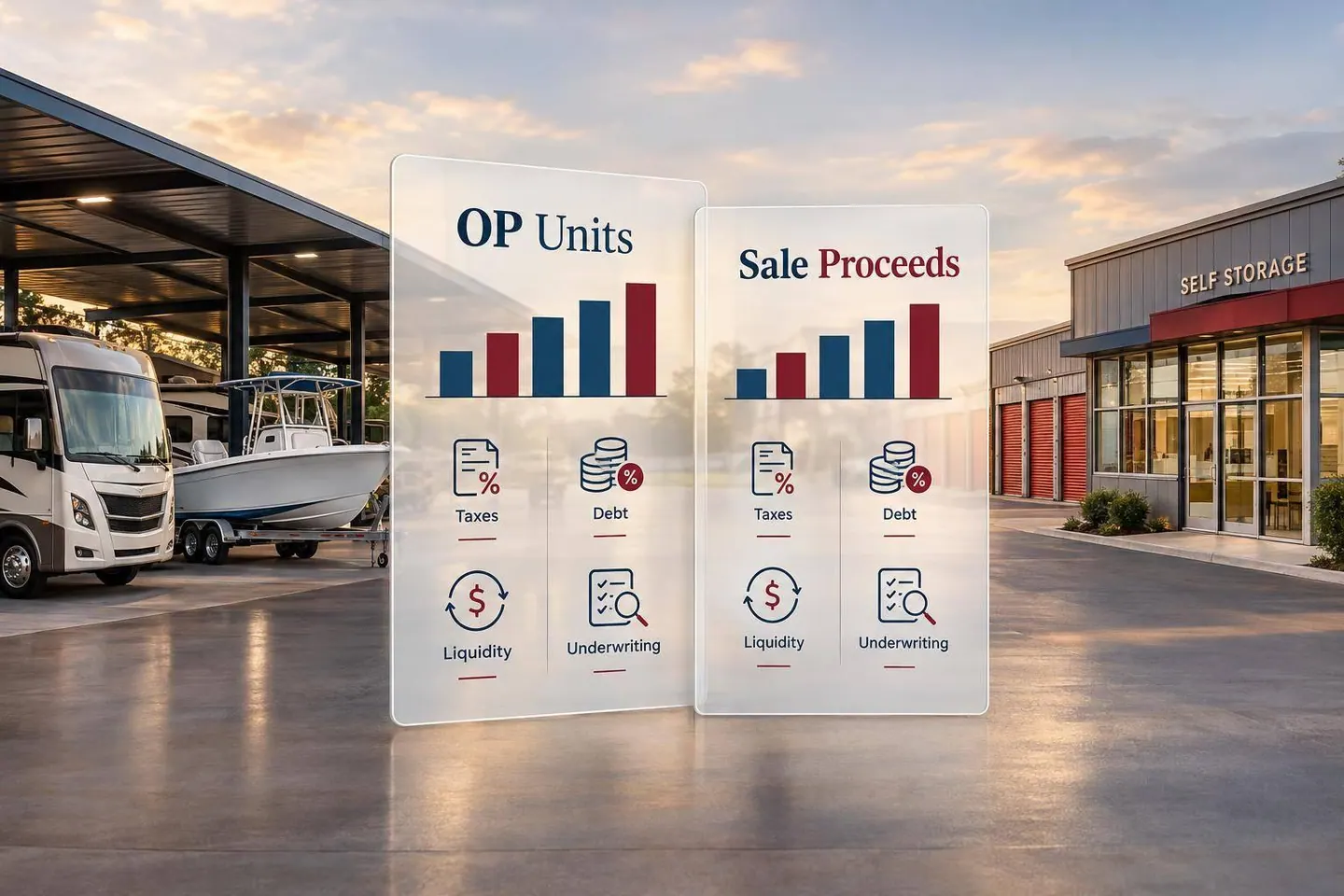
A Section 721 UPREIT contribution can defer tax - but you receive OP units, not cash or replacement property. I’d compare the units’ after-tax value, debt treatment, and exit restrictions with the cash you could keep from a sale before agreeing to contribute.
When comparing self-storage vs RV storage for a contribution, I’d check three things:
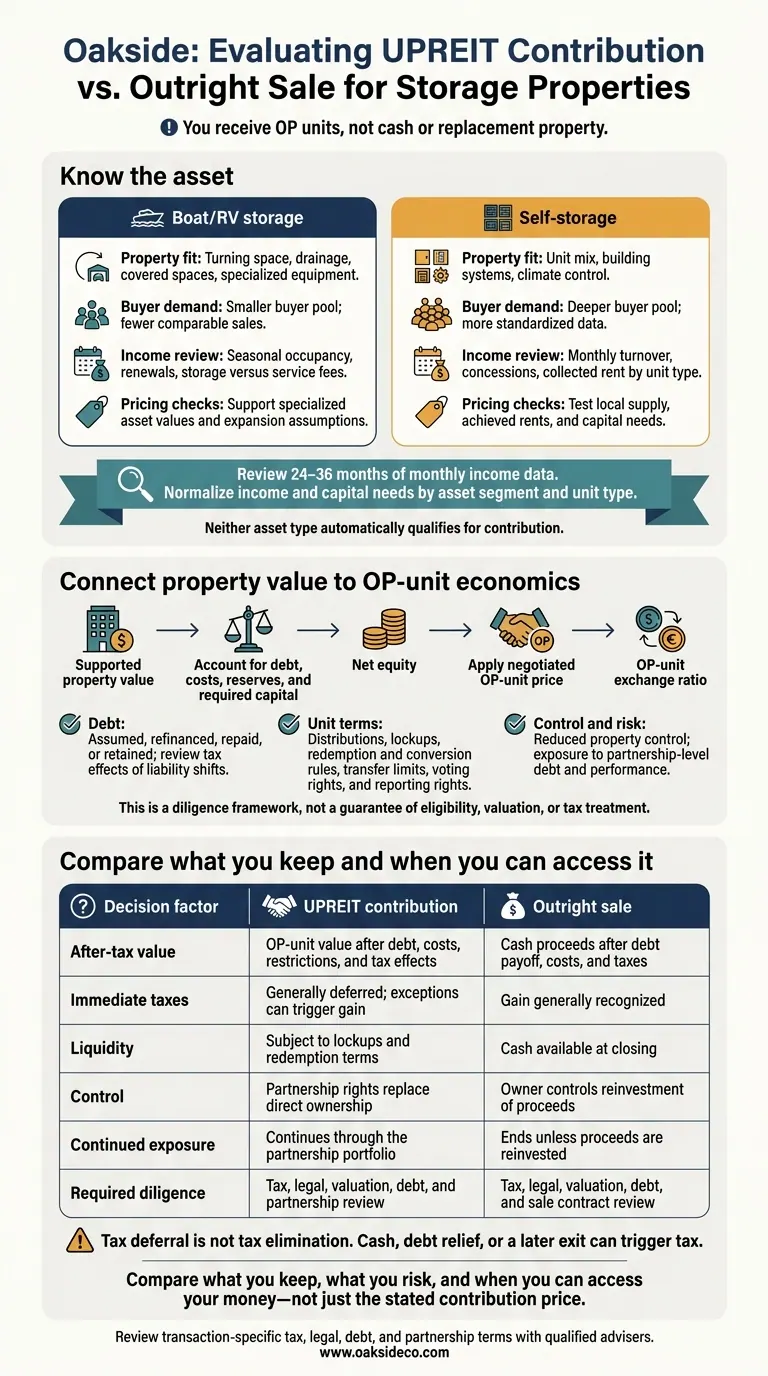
- Property and income: Review condition, local demand, lease terms, collections, and repair costs. Boat/RV storage needs closer checks on seasonality, rig access, and service income. Self-storage needs unit-level checks on rents, concessions, and turnover.
- Taxes and debt: Confirm ownership, tax basis, built-in gain, and liability shifts. Tax deferral is not tax elimination; cash, debt relief, or a later exit can trigger tax.
- OP-unit terms: Check the exchange ratio, distributions, lockups, redemption rights, and loss of property control.
Quick Comparison
| Check | Boat/RV storage | Self-storage |
|---|---|---|
| Property fit | Turning space, drainage, covered spaces, specialized equipment | Unit mix, building systems, climate control |
| Buyer demand | Smaller buyer pool; fewer comparable sales | Deeper buyer pool; more standardized data |
| Income review | Seasonal occupancy, renewals, storage versus service fees | Monthly turnover, concessions, collected rent by unit type |
| Pricing and terms | Support specialized asset values and expansion assumptions | Test local supply, achieved rents, and capital needs |
I’d review 24–36 months of monthly income data and model both a contribution and a sale with tax and legal advisers. My bottom line: <u>compare what you keep, what you risk, and when you can access your money</u> - not just the stated contribution price.
UPREIT Contribution vs. Sale: Boat/RV and Self-Storage
Underwriting boat and RV storage depends as much on access, maneuverability, and exposure as it does on size.
Asset Quality and Property Features
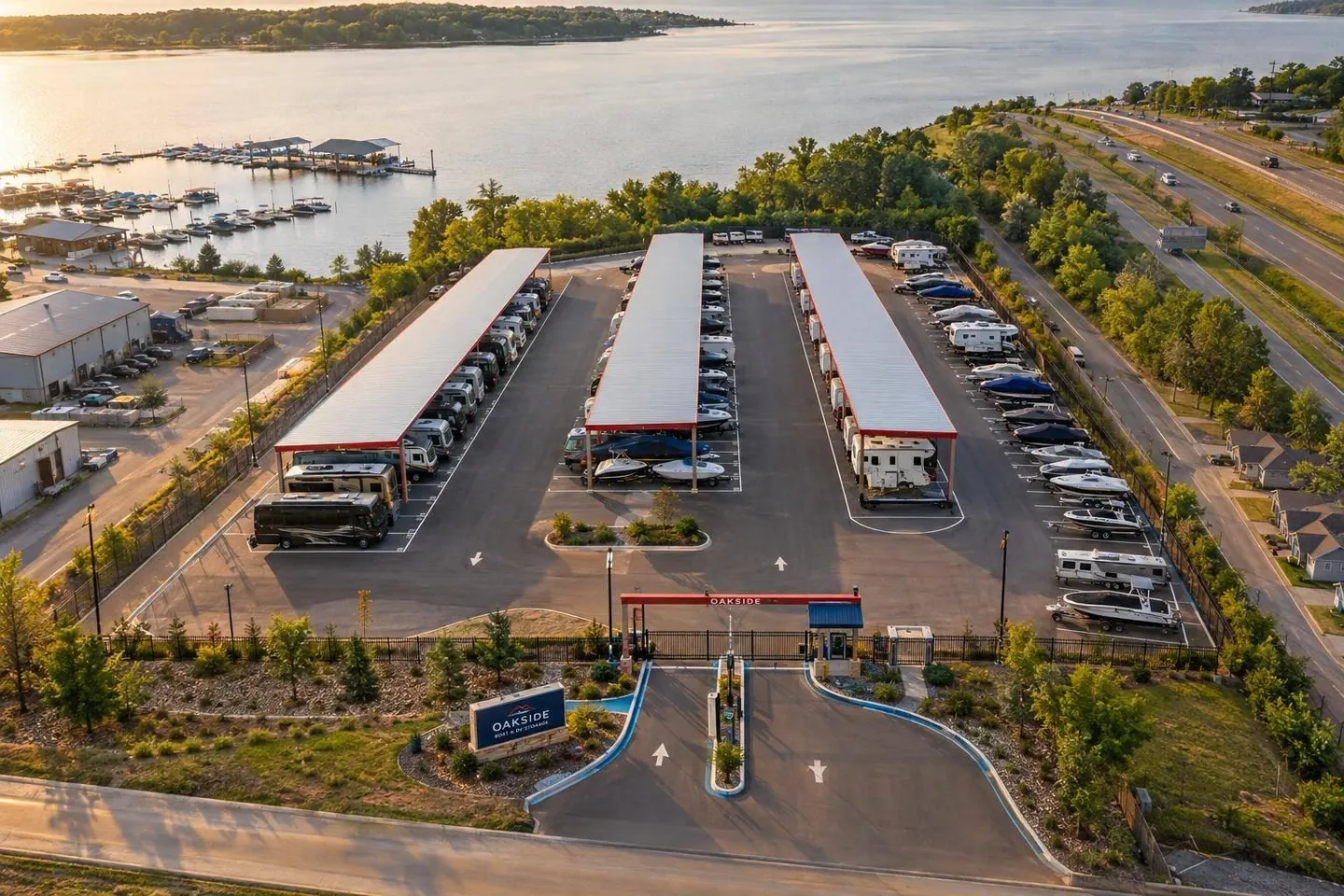
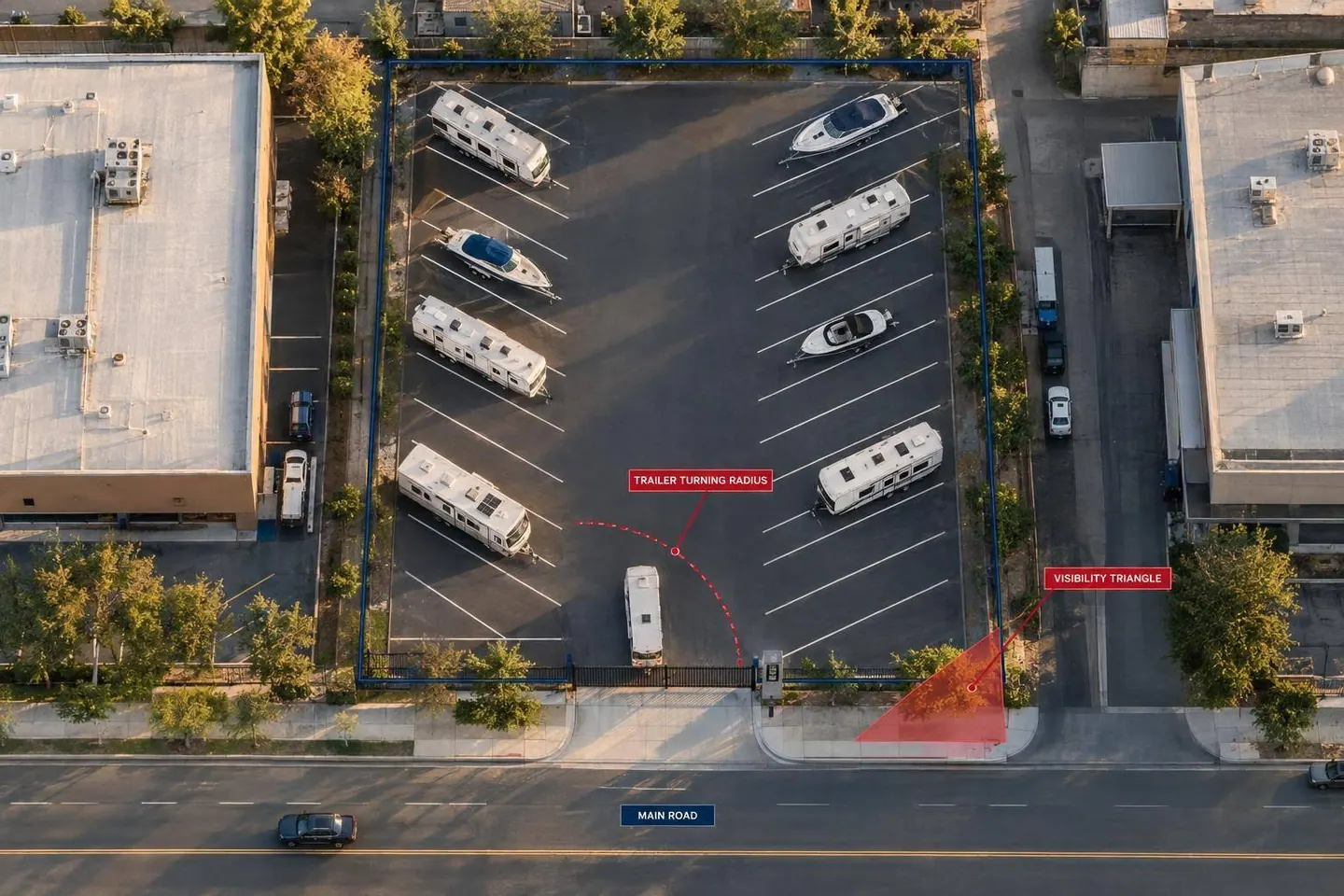
Usable capacity matters more than raw acreage. Inspect paved surfaces, drainage, security, utilities, fencing, lighting, cameras, access control, and turning radii for the largest rigs expected on-site. Confirm that zoning allows storage and ancillary services.
Review flood and storm exposure, prior claims, corrosion risk, and stormwater obligations. Give expansion land credit only after clearing setbacks, utility needs, permits, and entitlement risk.
Market Depth and Buyer Demand
Boat and RV storage has a smaller buyer pool than self-storage. That makes local occupancy, wait-list length, turnover, and planned supply more important than national ownership counts.
The RV Industry Association’s 2025 ownership profile reported approximately 8.1 million U.S. RV-owning households. But local demand and supply - not national ownership - drive contribution terms. A smaller buyer pool usually means broader pricing spreads and slower negotiations. Buyer depth directly affects how aggressively a REIT partnership can price the contribution.
Lease Terms and Income Stability
Group leases by both term - monthly, annual, seasonal, and short-term - and space type: open, covered, enclosed, and dry-stack. Track each segment separately. Headline occupancy can hide weak demand in a specific segment.
Review renewals, rent escalations, termination rights, access rules, and insurance requirements. Reconcile collections with bank deposits and tax returns, and separate launch, wash, maintenance, and other service fees from base rent.
Valuation and Contribution Terms
Higher rent does not equal higher contribution value. Underwrite normalized occupancy, seasonal revenue, concessions, bad debt, taxes, insurance, repairs, management fees, utilities, security, stormwater costs, and reserves. Asset quality affects OP-unit pricing and negotiated debt treatment.
Value dry-stack buildings and racks separately from forklifts, launch equipment, and marine-service operations. Provide at least three years of operating statements and a space-level rent roll. Document who pays for deferred maintenance and whether expansion land receives credit at closing or only after development risks are resolved. These same underwriting inputs frame the comparison with self-storage facilities.
Compared with boat and RV storage, self-storage is more standardized, which usually makes underwriting more straightforward.
Asset Quality and Property Features
Review the unit mix, rentable square footage, drive-up versus interior access, elevators, and leasing-system integration. Climate-controlled units can command higher rents, but they also increase utility and capital costs. A 2026 industry report found that these units earned about a 19% rent premium over non-climate-controlled units.
Assess redevelopment separately, including zoning, construction costs, permitting risk, and disruption to property operations.
Market Depth and Buyer Demand
Self-storage usually has a deeper buyer pool and more standardized operating data than boat and RV storage. Review recent sales, cap rates, price per rentable square foot, debt availability, and the number of interested bidders. Boat and RV storage depends more on local demand and a smaller pool of buyers.
More buyers and cleaner data help support disciplined contribution pricing. Weak local demand, however, can put pressure on terms. Match the facility’s size and operating model to the partnership’s requirements.
Study household growth, renter concentration, income, apartment deliveries, and planned storage supply in the local trade area. National advertised self-storage rates declined in 26 of Yardi Matrix’s top 30 metropolitan areas in February 2026, reflecting slower demand and uneven market conditions. Local rent data still matters. The sector’s standardization also shapes contribution pricing and OP-unit terms.
Lease Terms and Income Stability
Month-to-month leases allow frequent rent changes, but increases can lead to more move-outs. Partnership cash flow adjusts faster as a result, yet property-level totals can be misleading without unit-type detail.
Review 24 to 36 months of monthly data, separating asking rents, street rates, in-place rents, and collected revenue by unit type. Check move-ins, move-outs, concessions, delinquency, bad debt, ancillary income, and tenant retention after rent increases. Seasonal demand or reliance on niche tenant groups can still increase volatility.
Valuation and Contribution Terms
Base contribution value on net operating income the property can maintain, not peak occupancy or a seller’s pro forma. Normalize revenue for concessions, below-market rents, unusual move-outs, and ancillary income. Adjust expenses for nonrecurring items, and model recurring capital spending separately.
Apply market cap rates and comparable sales. Test occupancy, achieved rents, expense growth, capital expenditures, and new competition to assess contribution value and OP-unit economics. A higher stated value does not make up for weak liquidity, unfavorable debt terms, or capital calls. These valuation differences drive the underwriting and contribution-term gaps discussed next.
Keep documented facts, underwriting judgment, and negotiated terms separate. Focus on how differences between boat/RV storage and self-storage affect price, risk, and OP-unit terms. Record land in acres, improvements in square feet, and costs in U.S. dollars. Neither asset type automatically qualifies for contribution.
| Comparison Point | Boat and RV Storage | Self-Storage | Effect on Contribution Terms | Required Evidence |
|---|---|---|---|---|
| Condition and capital needs | Specialized improvements with asset-specific repair costs | Standardized building systems with established replacement benchmarks | Repair escrows, reserves, indemnities, and closing conditions | Surveys, inspections, repair bids, environmental reports, insurance terms |
| Market depth | Comparable sales may need adjustments for location and operating model | Comparable sales may need adjustments for unit mix and submarket | Relevance of comparable sales and fit with partnership acquisition criteria affect pricing leverage | Verified sales, competing supply, achieved rents, written acquisition criteria |
| Cash-flow quality | Storage rents and service revenue may have different retention patterns | Unit rents and ancillary revenue may respond differently to rent changes | Income the property can maintain supports contribution value and distribution expectations | Rental agreements, collections, tenant concentration, revenue by product |
| Debt, value, and OP-unit terms | Specialized improvements need explicit valuation support | Comparable property data alone does not establish OP-unit pricing | Debt treatment, unit price, redemption rights, and tax covenants | Appraisal, debt documents, tax-basis schedules, partnership agreement |
Property Condition and Capital Needs
Check legal use, access, insurability, and contamination before treating repairs as just a pricing issue. Unresolved zoning issues, flood exposure, or remediation needs may call for reserves, indemnities, or rejection.
Buyer Demand and Partnership Fit
Compare outside buyer interest with the partnership’s geography, scale, operating model, and concentration limits. A good fit improves the chance of acceptance. Documented buyer interest can support pricing leverage, but it doesn't guarantee favorable contribution terms.
Lease Terms and Income Stability
Review documented collections, termination rights, and tenant retention after rent changes to assess cash-flow confidence and contribution value. If a fleet, dealer, boat club, or large commercial tenant supplies a material share of revenue, uncertain renewal can weaken support for the property's value. These income patterns directly affect the valuation and debt terms below.
Valuation, Debt, and OP-Unit Terms
Start with supported property value, then account for debt, costs, reserves, and required capital to arrive at net equity. Apply the negotiated OP-unit price to determine the exchange ratio. Document whether debt will be assumed, refinanced, repaid, or retained, along with the tax effect of any shift in liabilities.
Single-property terms need asset-specific protections. Portfolios also need asset-level values, sequencing, and a review of cross-collateralization. Address distributions, lockups, redemption and conversion rules, transfer limits, voting rights, reporting rights, and reduced control over the property.
A negative capital account alone does not determine gain; basis, liabilities, cash, and disguised-sale rules do. Have tax and real-estate counsel review the agreement before signing.
Boat/RV scarcity can support pricing, while self-storage standardization can help with underwriting. Neither guarantees better terms. These differences affect pricing, OP-unit terms, and whether an asset fits the partnership.
| Asset type and factor | Key risk | Effect on Contribution Terms |
|---|---|---|
| Boat/RV: demand and income | Seasonal renewals and discounts can reduce annual income. | Monthly occupancy and annual renewals support valuation; off-season discounts of 5%–15% can lower the supported contribution value. |
| Boat/RV: improvements and expansion | Specialized construction and service operations add complexity. | That complexity can limit partnership fit or increase reserve requirements. Credit for expansion depends on feasibility. Tenant insurance does not remove owner liability. |
| Boat/RV: marketability | Few comparable sales make valuation less certain. | Scarcity may give owners pricing leverage, but proven storage income must be valued separately from unbuilt expansion and projected service income. |
| Self-storage: tenants and records | Monthly leases expose revenue to turnover and pricing pressure. | Verified tenant diversity and effective rents support underwriting. Occupied units do not always earn full-rate rent. |
| Self-storage: supply and property fit | Oversupply, concessions, maintenance, and a unit mix that does not match demand can weaken returns. | Demand by unit type and the shift from discounted to market rent affect pricing. Maintenance needs can increase reserves. |
For boat/RV assets, annualize results so peak occupancy does not inflate value. Separate storage income from detailing, winterization, and other services. Their labor requirements and liability may not fit the partnership’s operating model. For self-storage, check how long concessions last and whether tenants move from discounted to market rent.
These asset-level tradeoffs lead to the next question: whether the OP-unit economics justify giving up liquidity.
OP units may provide participation in a broader portfolio. But reduced control, restricted liquidity, and exposure to partnership-level debt and performance can offset the tax-deferral benefit. Counsel should review K-1 reporting, taxable income without matching cash, and taxes triggered by future property sales or OP-unit redemption or conversion. The deferred tax liability is not money available to spend.
For this boat/RV or self-storage asset, use these final checks to weigh tax deferral against access to cash. Compare after-tax, risk-adjusted value - not just the contribution price.
- Eligibility and taxes: Check title, zoning, environmental issues, ownership structure, basis, depreciation, built-in gain, and debt shifts.
- Operating results: Normalize income and capital needs by asset segment and unit type.
- Value and downside: Get an independent valuation, compare it with the OP-unit exchange ratio, and stress-test rents, occupancy, costs, exit cap rates, and liquidity.
| Decision factor | UPREIT contribution | Outright sale |
|---|---|---|
| After-tax value | OP-unit value after debt, costs, restrictions, and tax effects | Cash proceeds after debt payoff, costs, and taxes |
| Immediate taxes | Generally deferred; exceptions can trigger gain | Gain generally recognized |
| Liquidity | Subject to lockups and redemption terms | Cash available at closing |
| Control | Partnership rights replace direct ownership | Owner controls reinvestment of proceeds |
| Continued exposure | Continues through the partnership portfolio | Ends unless proceeds are reinvested |
| Required diligence | Tax, legal, valuation, debt, and partnership review | Tax, legal, valuation, debt, and sale contract review |
The choice depends on whether the owner prefers continued partnership exposure or immediate cash. When comparing value and liquidity, weigh boat/RV seasonality and a smaller pool of buyers against self-storage’s more standardized underwriting.
Have tax and legal advisers review distributions, exchange ratios, redemption rights, transfer restrictions, and resale rights. A contribution supports long-term participation; a sale provides cash and control over the proceeds.
Oakside Co supports valuation, transaction management, investor access, and disposition analysis for boat/RV and self-storage assets. Use its services alongside an independent appraisal and tax counsel.
Can I contribute storage property but retain its service business?
Contributing a storage property while keeping its service business - such as concierge services, on-site repairs, or managed retail - can get complicated. Institutional buyers and lenders want properties that can run without the original owner.
Separating the service business from the real estate can make due diligence harder. Buyers need income streams they can verify and take over, without relying on the owner’s personal involvement, informal relationships, or manual processes.
How can I protect my tax deferral if the partnership sells?
Review tax-deferral options, such as 1031 exchanges, well before signing a sale contract - typically 12 to 24 months before listing. Starting early gives you time to tackle outstanding maintenance issues and put your financial records in order, with documentation to back them up. That preparation can support your chosen tax-deferral approach and help you get the most from your exit.
Can I negotiate liquidity protections for my OP units?
Yes. In an UPREIT transaction, you can typically negotiate liquidity protections for your Operating Partnership (OP) units with the acquiring REIT. Unlike REIT shares, OP units aren’t immediately tradable on a public exchange.
Terms you may negotiate include when you can redeem your units, the ratio used to convert them into common stock, and cash-out options. The Partnership Agreement should clearly spell out these terms, which should align with your long-term investment and tax goals.