If you price every same-size unit the same, you may be leaving rent on the table. I’d sum up the article this way: self-storage pricing works best when rent reflects what tenants will pay for access, comfort, protection, and ease – not just square footage or cost.
Here’s the core idea in plain English:
- I price units by tenant demand, not by size alone
- I separate units into tiers like Economy, Standard, and Premium
- I use features such as climate control, drive-up access, first-floor location, covered parking, pull-through layout, and security
- I watch occupancy, re-lease speed, website conversion, length of stay, and delinquency
- I test pricing by tier instead of changing rates across the whole property
- I use the same model for self-storage, boat storage, and RV storage, with different feature drivers
A few numbers from the article make the point fast:
- Climate control can add about $10 to $40 per month
- Climate-controlled units may rent for 15% to 35% more than non-climate units
- Covered RV or boat parking can run 20% to 50% above open parking
- Deep interior or less convenient units may need a $5 to $10 monthly discount
- Smaller units often earn more per square foot, with 5×5 units at about $2.24 per square foot versus 10×30 units at about $0.88
What does that mean for me as an owner or investor? Simple: I can use pricing to improve revenue from the unit mix I already have, test upside in underwriting, and see where rent gaps are holding back NOI. This is one of several ways to increase self-storage property value before a sale.
Quick Comparison
| Model | What sets the rate | Main upside | Main limit |
|---|---|---|---|
| Value-based pricing | What tenants will pay for features and convenience | More precise rent by unit tier | Needs unit-level data and testing |
| pricing strategies like cost-plus | Property costs plus margin | Easy to explain | Can miss demand shifts and underprice better units |
| Flat-rate pricing | One price for each size or category | Simple to run | Treats unlike units as if they are the same |
Bottom line: I’d use value-based pricing when unit differences are easy for tenants to see and demand is strong enough to support tiered rents. If the property is very uniform or demand is weak, the pricing gaps may not hold.
sbb-itb-09b4138
Value-Based Pricing vs. Cost-Plus and Flat-Rate Pricing
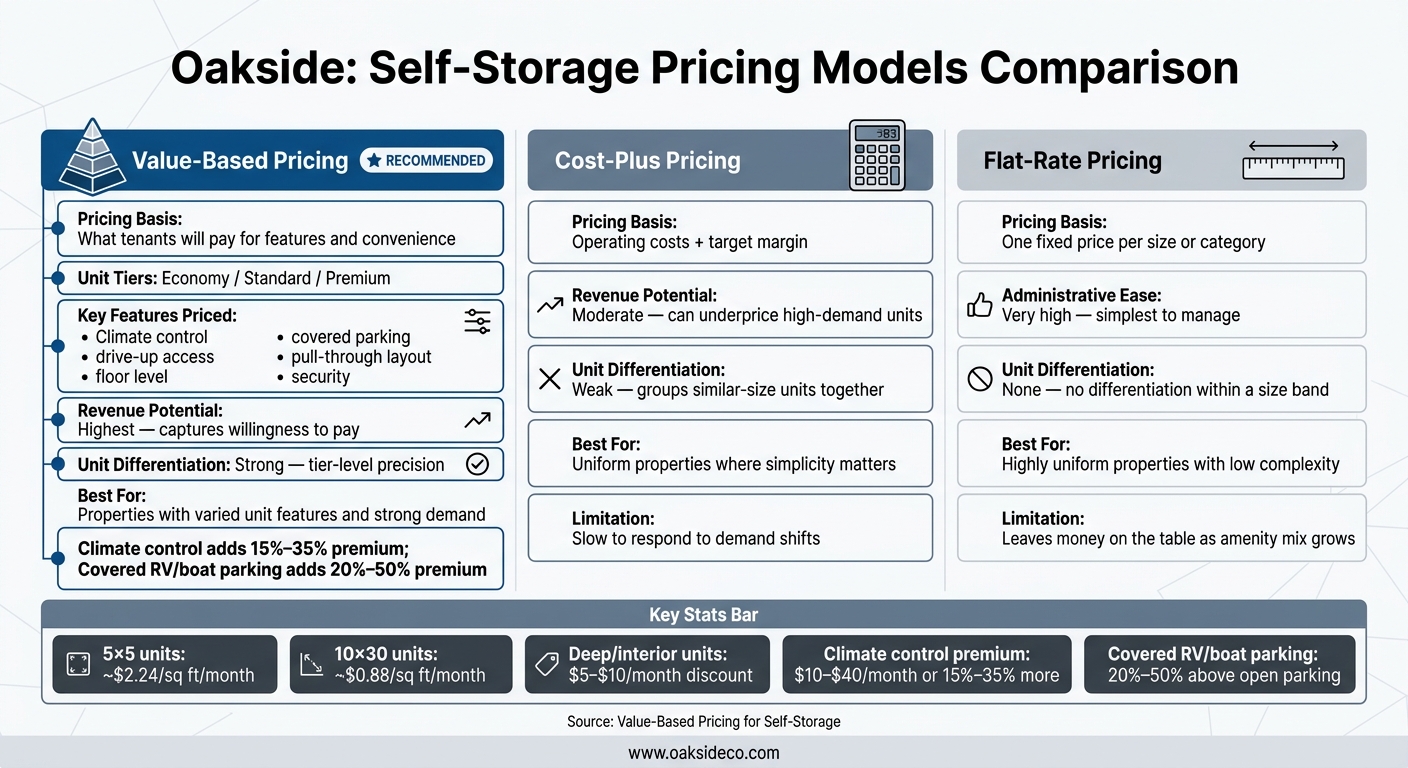
Value-Based vs. Cost-Plus vs. Flat-Rate Pricing for Self-Storage
Cost-plus pricing starts with expense. Flat-rate pricing starts with size bands. Value-based pricing starts with tenant demand.
That difference matters a lot when a property has mixed access, amenities, or location quality across climate control, drive-up access, floor level, covered parking, and pull-through access. Two units may look similar on paper, but to a tenant, they can feel like two very different products.
Cost-plus pricing: predictable but slow to respond to tenant demand
Cost-plus pricing begins with all-in operating costs. From there, those costs are spread across rentable square footage, and a target margin is added to set a monthly rate for each unit size.
It’s easy to see why operators use it. Rates are simple to explain, budgets stay steadier, and lenders can follow the math.
The problem is that cost-plus pricing tends to group together units that share a size or feature band, even when tenants place very different value on them. A drive-up 10×20 near the gate and a third-floor interior 10×20 at the far end of a corridor may end up with almost the same rent. But tenants don’t see those units as equal. One is easier to reach, easier to load, and usually more desirable.
And when demand changes, cost-plus pricing often trails behind. If summer demand for boat and RV storage jumps, rates usually don’t move fast enough because pricing changes are tied more to cost logic than to current demand.
| Dimension | Cost-Plus Pricing |
|---|---|
| Pricing basis | Operating costs + target margin |
| Revenue potential | Moderate; can underprice high-demand units |
Flat-rate pricing simplifies things even more. The catch is that it gives up even more precision.
Flat-rate pricing: easy to manage but weak at unit segmentation
Flat-rate pricing charges one fixed price for every unit in a given size or category. So, for example, every 10×10 non-climate unit might be priced the same, no matter the floor, access, or distance from the loading area. There is very little system complexity involved.
That simplicity comes at a cost. You lose unit-level pricing.
If a facility charges the same rate for covered RV spaces with pull-through access as it does for basic back-in open parking, it’s leaving money on the table. The same goes for self-storage. A first-floor drive-up unit near the gate is plainly a different product from an upper-floor interior unit, yet flat-rate pricing treats them alike.
As facilities add climate control, advanced security, and smart locks, that mismatch gets harder to ignore. The product mix becomes more varied, but the pricing model stays blunt.
| Dimension | Flat-Rate Pricing |
|---|---|
| Administrative ease | Very high; simplest model to manage |
| Unit-level differentiation | Weak; no differentiation within a size band |
Why value-based pricing produces better rate precision
Value-based pricing closes that gap by pricing each unit from the tenant’s point of view. Instead of tying rates to expenses or size alone, it ties them to what tenants are willing to pay for specific features and convenience.
In practice, that means setting tiers within each size band, such as Standard, Premium, and Elite, based on factors like size, access, floor level, climate control, security, and proximity to the gate or loading area.
That approach gives operators more control where it counts:
- Higher-demand Premium units can support higher rates
- Entry-level units can stay within reach for budget-conscious tenants
- Strong occupancy in one tier can signal a rate test for that group only
So if one tier keeps filling up, that’s a clear sign to test a rent increase there without changing the rest of the inventory.
The payoff is better rate precision, cleaner forecasts, and better repositioning decisions.
The Inputs That Determine Unit Value
Value-based pricing starts with three inputs: unit demand, site convenience, and tenant behavior. Those three factors show you which units can carry a premium and which ones should stay at the entry level.
Unit mix and demand by size type
Smaller units usually earn more per square foot because more people want them. Larger units usually bring in less on a per-foot basis because the buyer pool is smaller. For example, 5×5 units generate about $2.24 per square foot in monthly rent, while 10×30 units average about $0.88 per square foot.
That gap gives you a starting point, but the monthly leasing data tells you where pricing room still exists. Track re-lease speed and occupancy by size each month, then test modest increases on the unit types that move fastest. If a unit type re-leases in three to five days, that’s a strong sign the current rate may be under market.
Seasonality matters too. Boat and RV spaces in Sun Belt and vacation markets often see demand jump before boating and camping season, then rise again during winter storage periods. In that case, value-based pricing means charging more for covered pull-through spaces at the start of peak season, then easing off during slower months to protect occupancy instead of pushing a flat rate increase across the whole property.
Size demand sets the floor. Site access and convenience push prices higher from there.
Location and on-site convenience
Location and layout have a direct effect on how high rent can go. Dense trade areas and strong street visibility support higher base rents. Inside the gate, ground-floor, easy-access, and pull-through units often earn a premium.
Not all units feel the same to a renter, even if the dimensions match. Units that require long elevator rides and hallway walks tend to need a discount compared with easier-access spaces – sometimes $5 to $10 less per month for deeper units. The same idea applies to vehicle storage. Spaces that let drivers pull straight through with 30- to 40-foot vehicles can command a higher rate than tighter rows, even when the listed square footage is identical.
Once tenants consistently choose those spots at higher prices, the tier is more than a pricing idea. It’s showing up in behavior.
Amenities and tenant behavior data
Climate control, drive-up access, and covered parking can all support higher pricing when renters care about protection and ease. Climate control usually supports a 15% to 35% premium over non-climate units of the same size, depending on the region and local market norms. Covered vehicle parking with canopy protection can run 20% to 50% above open-air parking in markets where hail, intense sun, or snow damage is a real issue.
Still, a premium only works if tenant behavior backs it up. Watch website conversion by unit type, length of stay, and delinquency by tier to see which units can handle firmer renewal increases. Length of stay is often a strong clue. Small businesses and long-term vehicle storage tenants in larger drive-up units tend to stay longer and accept annual increases better than short-term movers in smaller units.
Delinquency by unit tier matters too. Premium units with lower delinquency rates often point to tenants with stronger payment habits, which can justify firmer renewal increases for that segment.
How Owners and Investors Apply Value-Based Pricing
When the strategy works and when it does not
After you’ve sorted out unit mix, location, amenities, and tenant behavior, the next step is pretty simple: can the property support tiered pricing at all?
Value-based pricing works best when renters can clearly see the difference between one option and another. If one unit is easier to access, better protected, or plainly more convenient, people are often willing to pay more for it. This approach tends to work best when unit features differ in a meaningful way and leasing volume is strong enough to test rate changes without putting occupancy at risk.
It starts to fall apart when the asset is highly uniform. If most units feel the same, tiered pricing can look arbitrary. The same issue shows up in weak-demand submarkets, where tenants may not pay enough extra to support clear pricing gaps between tiers.
A simple tier structure for self-storage, boat, and RV assets
A three-tier framework keeps pricing easy to explain to customers and easy to run day to day. Each tier should map to a feature that tenants will actually pay for.
| Tier | Common features | Pricing logic | Best fit |
|---|---|---|---|
| Economy | Upper-floor units, farther-from-entry spaces, uncovered parking, limited amenities | Lowest rent; fills less convenient inventory | Renters who will not pay more and prioritize savings over convenience |
| Standard | Typical drive-up units, average site access, common sizes, basic security | Mid-market rent; anchors core facility demand | General-purpose renters seeking a balance of price and access |
| Premium | Climate control, first-floor access, covered RV or boat storage, hookups, wide drive aisles | Highest rent; captures willingness to pay for protection and convenience | Renters who value easy access, specialized features, or asset protection |
For boat and RV assets, the drivers change a bit. Floor level matters less. Coverage, stall width, turning radius, hookups, security, and maneuverability matter more. The pricing logic stays the same.
Once that ladder is in place, investors can test whether the spread between tiers is wide enough to make repositioning worth it.
How investors use value-based pricing in underwriting and repositioning
When premium units sit only a little above standard units, even though demand is stronger, that spread can point to upside. Investors model what happens if those units are regrouped into clearer pricing tiers that better match market demand. Then they stress-test the higher rates to see whether occupancy holds.
That rate compression shows a direct revenue gap. And that gap flows through to NOI and exit value.
After acquisition, the repositioning play usually comes down to a few moves:
- Separate units more clearly
- Update the online rate display
- Adjust revenue management rules so premium inventory no longer subsidizes weaker units
A property that has long used flat or legacy pricing across a full size category is often a strong fit for this kind of work.
Oakside applies this framework to identify rate compression in acquisitions and dispositions. That ladder then becomes the rate sheet and monthly review framework.
Implementation and Key Takeaways
Steps to roll out and maintain value-based pricing
Once your tiers are set, the next job is rollout and control. Start with a unit audit. Review unit size, access, floor level, climate control, door size, and proximity to gates, entrances, or elevators. That inventory gives you the base for tiers built around what tenants are willing to pay for.
Then standardize labels across every system. Use the same tier name in the property management system, website, rate sheet, and internal reports. That consistency cuts down on staff confusion and helps customers see why two units with the same size can carry different rates.
Apply value-based rates right away for new leases. For current tenants, phase in increases and start with premium units. That approach helps protect occupancy while opening up rate spreads. It also makes sense to test the setup first on one building or one unit group before taking it across the whole property.
During each review cycle, adjust the spreads based on what the data shows. Widen spreads in tight tiers. Narrow them where vacancy or move-outs start to climb.
Key takeaways for pricing strategy decisions
At the investment level, this same tiering system also works as an underwriting tool.
Value-based pricing tends to work best when unit types differ in clear ways and demand can support tiered rates. In those cases, it gives owners more pricing control than flat-rate or cost-plus pricing.
For underwriting, break rent out by tier and stress-test occupancy before you build any rate lift into returns. That matters because any lift flows straight through to NOI and exit value.
FAQs
How do I know which units deserve a premium?
Look for units with rent lift potential: units that can support higher rents without hurting occupancy. Start with your unit mix and where demand is stronger, like climate-controlled and enclosed units versus standard drive-up units.
Then check the numbers. Compare achieved rents with asking rents. Review occupancy against economic occupancy. Look at churn and tenant stay length too. Those data points help show where pricing room exists and where it doesn’t.
It also helps to benchmark nearby properties by:
- Unit type
- Size
- Amenities
- Street rates
From there, segment rent increases based on tenant behavior. Not every tenant responds the same way, and that difference matters when you set pricing.
When does tiered pricing stop working?
Tiered pricing starts to fall apart when it can’t respond to what’s happening right now with supply and demand. Fixed tiers may leave money on the table during busy periods. And when things slow down, they can lead to empty units that didn’t need to sit vacant.
As Nolen Masserman, Managing Director at Oakside, points out, self-storage performance depends on data-led pricing instead of old benchmarks. When occupancy drops below 85 percent, sticking with fixed tiers alone can weaken tenant demand and cut into net operating income.
How should I test value-based pricing first?
Run a data-first pilot on a few specific unit types.
Start with a local market check. Look at achieved rent by unit size and amenity, then break down your unit mix to confirm demand. Two numbers matter here: RevPAF and the gap between physical occupancy and economic occupancy. That gap can tell you a lot. A property may look full on paper, but if discounts, concessions, or delinquency are dragging down income, the picture changes fast.
Next, factor in seasonality. Demand doesn’t move in a straight line, so pricing shouldn’t either. Make small, staged street-rate changes when occupancy is above ~90%. If occupancy drops below ~85%, lean on promotions instead. It’s a simple way to test price movement without overcorrecting.
Before you roll anything out across more units, track inquiry-to-lease conversion. That metric helps you see whether rate changes are holding up or if they’re starting to hurt demand.